
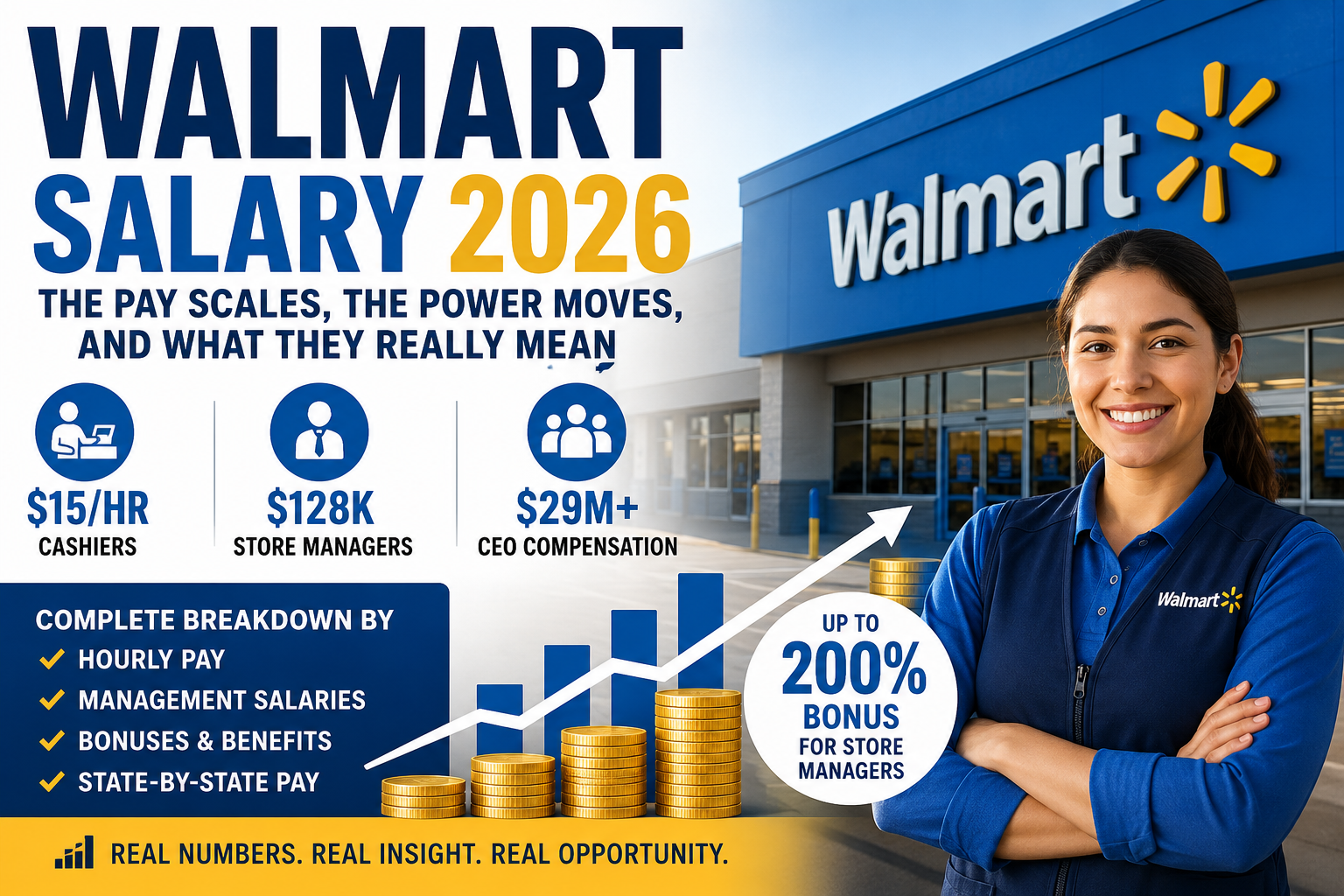
Walmart Salary
📅 Last Updated: July 2026
Compensation figures are based on the latest publicly available employer disclosures, regulatory filings, recruiting data, and verified salary reports available at the time of publication.
Quick Reference: Walmart Pay at a Glance
| Position | Base Pay | Typical Total Compensation |
|---|---|---|
| Cashier | $14–$19/hr | — |
| Stocker | $14–$19/hr | — |
| Team Lead | $19–$37/hr | — |
| Coach | $65K–$100K | Bonus eligible |
| Store Manager | $117K–$215K | Up to 200% bonus |
| Market Manager | $160K–$260K | $420K–$620K |
| CEO | — | $27M+ |
Let‘s cut through the noise.
Walmart is the largest private employer in the United States. It’s also one of the most written-about companies when it comes to pay. But most of what you‘ll find online is surface-level — repackaged job listings and generic averages that tell you nothing about how the system actually works.
This isn’t that.
I‘ve watched retail wage dynamics shift over three economic cycles. I’ve seen what happens when a company this size moves its pay floor — it ripples through every competitor, every supplier, and every local labor market in America.
Here‘s what Walmart’s 2026 salary structure actually looks like, what it signals, and where the real money is.
The Big Picture: Walmart‘s Wage Strategy in 2026
Let’s start with the answer to the question everyone‘s asking:
Walmart’s average hourly pay in 2026 ranges from approximately $14 to $37 per hour, depending on role, location, and experience. The **average U.S. hourly field associate now earns $18.25/hour** — a more than 90% increase since 2015. Annual salaries span from roughly $24,000 for entry-level positions to over $180,000 for senior corporate roles.
But that range is misleadingly wide. The real story is in the tiers.
Walmart operates a three-tier wage architecture:
| Tier | Roles | Pay Range |
|---|---|---|
| Hourly Frontline | Cashiers, Stockers, Cart Attendants | $14–$37/hr |
| Hourly Specialists | Team Leads, AP Team, Pharmacy Techs | $19–$37/hr |
| Salaried Management | Coaches, Store Managers, Market Managers, Corporate | $65K–$620K+ |
The floor has moved. The ceiling has exploded. And the gap between them tells you everything about where Walmart is placing its bets.
Hourly Pay: What Frontline Workers Actually Earn
Cashier / Front End Associate
Average hourly pay: $14–$19 per hour (national average ~$15.50)
Cashiers are the most visible Walmart employees and the most common entry point. The national average sits around $14.68 per hour. In higher-cost markets like California, the range pushes higher.
The institutional take: This is a living wage floor in some states and below it in others. Walmart‘s strategy here isn’t to lead on pay — it‘s to stay competitive with Target, Costco, and regional grocers while keeping labor costs manageable. The variance by state is the tell: Walmart pays what it has to pay, not what it could pay.
Stocker / Sales Associate
Average hourly pay: approximately $14–$19 per hour
Stockers earn a similar range to cashiers, reflecting the physical demands of the role. Overnight stockers often receive shift differentials of approximately $1/hour, pushing pay into the $15–$20 range.
The institutional take: The premium over cashiers is modest — about $1–$2 per hour for overnight work. That tells you Walmart values operational throughput (shelves stocked = sales) but doesn‘t see stocking as a retention priority. High turnover is baked into the model.
Team Lead
Hourly pay range: $19–$37 per hour
This is where hourly pay starts to get interesting. Team leads are first-line supervisors — they run shifts, manage small teams, and handle exceptions. The $19–$37 range represents a significant step up from frontline roles.
The institutional take: Walmart is investing in its frontline supervisors. The pay bump isn‘t charity — it’s recognition that bad shift management destroys productivity and drives turnover. Paying team leads well is cheaper than constantly retraining new hires.
The Real Money: Management Salaries
This is where the numbers get serious.
Coach
Total pay range: $65,000–$100,000 base, rising to $69,875–$130,000 with bonuses
Coaches oversee particular store departments, such as grocery or household items. Walmart‘s larger locations typically have five to seven coaches. This role was created in part through the elimination of the “Store Lead” position in 2026, with impacted employees converted to either emerging store manager or coach roles.
The institutional take: This restructuring is Walmart’s way of expanding its bench of second-tier store leaders without increasing headcount. It‘s a promotion pipeline play — and a signal that Walmart wants more people ready to step into store manager roles.
Emerging Store Manager
Base salary: $85,000–$120,000; with bonuses: $119,000–$276,000
At smaller neighborhood stores, the base pay range is $65,000–$110,000. Emerging store managers directly manage associates and are considered first in line for a store manager role when an opportunity opens.
The institutional take: Walmart is building a pipeline. The emerging manager program is designed to identify high-potential talent early and lock them in before competitors can poach them. The bonus structure mirrors the full manager tier — performance-first, loyalty-second.
Store Manager
Average base salary: $117,000–$215,000 per year
Store managers run multi-million-dollar operations. In 2026, Walmart raised the average store manager salary from $117,000 to **$128,000**. Supercenter store managers have a total pay range of $218,000–$530,000 including bonuses and stock.
But base salary is only part of the story. Performance bonuses can reach 200% of base salary. That means a Supercenter manager on $170,000 base could pocket an additional $340,000 in bonus — pushing total compensation past $500,000.
The institutional take: Walmart is tying store manager pay directly to store performance. This is classic principal-agent alignment: give managers skin in the game, and they‘ll squeeze every dollar of profit out of their stores. The 200% bonus cap is aggressive — it turns store managers into quasi-entrepreneurs.
Market Manager
Base salary: $160,000–$260,000; total compensation: $420,000–$620,000+
Market managers oversee clusters of stores — typically 8–12 locations. Walmart has roughly 440 market managers across the U.S. The revamped 2026 package includes a base salary jump from $130,000 to $160,000, plus performance bonuses and stock grants.
The institutional take: This is where Walmart‘s pay strategy gets aggressive. Market managers are the field generals — they translate corporate strategy into store-level execution. The $30,000 base pay increase tells you Walmart sees market managers as mission-critical. The stock grants are designed to make them think like owners — because they literally are, at least in terms of equity exposure.
Corporate & Executive Compensation
Senior Manager (Corporate)
Annual salary range: $90,000–$234,000
Corporate senior managers in functions like technology, strategy, and talent management earn six-figure salaries with performance bonuses.
Principal Product Manager
Annual salary range: $143,000–$286,000
This is Walmart‘s tech arm in action. Product managers at this level are building the systems that power Walmart’s e-commerce, supply chain, and in-store technology. The range varies by location — Sunnyvale, CA pays at the high end, while Bentonville, AR ranges from $110,000–$220,000.
The institutional take: Walmart is paying tech talent like a tech company because it is a tech company now. The distinction between “retailer with a website” and “technology company that sells stuff” has blurred. Walmart‘s product manager salaries reflect that reality.
Staff Software Engineer
Annual salary range: $108,000–$216,000 (Bellevue, WA); $90,000–$180,000 (Bentonville, AR)
The institutional take: Location matters — a lot. The same role pays 20% more in Bellevue than in Bentonville. That’s the cost-of-living adjustment in action, but it also reflects competition for tech talent in Seattle‘s backyard.
CEO Compensation
John Furner (current CEO): $27.34 million total compensation
Doug McMillon (former CEO): $29.2 million total compensation
Here’s the breakdown that matters: only 4.8% of Furner‘s compensation is base salary. The rest is bonuses, stock, and options. For McMillon, the package included a $1.5 million base salary, $4 million in incentive compensation, and stock awards worth about $21.1 million.
The CEO pay ratio: 958:1 — meaning the CEO earns 958 times the median employee’s $30,520.
The institutional take: The CEO pay ratio is a political talking point, not an economic one. The real question isn‘t whether the CEO earns too much — it’s whether the median employee earns enough to live on. At $30,520 per year, a full-time Walmart worker is above the federal poverty line but below a living wage in most major cities. That‘s the tension Walmart navigates every day.
The 9-Minute Rule: What It Actually Is
The Walmart 9-minute rule is an attendance policy grace period. Employees can clock in up to 9 minutes early or 9 minutes late without incurring attendance points.
Here’s how the point system works:
- Unexcused absence: 1 point
- Tardiness exceeding 9 minutes: 0.5 points
Accumulate too many points, and you‘re terminated. The 9-minute window exists to account for minor delays — crowded time clocks, finishing a task, or just running slightly late.
The institutional take: The 9-minute rule is both generous and strict. It’s generous because it gives employees a buffer. It‘s strict because the point system is unforgiving — and the policy is enforced algorithmically, not managerially. This is Walmart’s labor model in microcosm: clear rules, automated enforcement, minimal discretion. It‘s efficient. It’s also cold.
Walmart Salary by State
Walmart pays at or above the applicable minimum wage in every state. In states with higher minimum wage laws, Walmart adjusts its pay floors significantly.
| State | Entry-Level Pay Range | Notes |
|---|---|---|
| California | $17–$20/hr | State minimum wage $16.50/hr; higher in some cities |
| New York | $16–$19/hr | State minimum wage $16/hr |
| Washington | $16–$19/hr | State minimum wage $16.28/hr |
| Illinois | $14–$17/hr | State minimum wage $14/hr |
| Florida | $14–$16/hr | State minimum wage $13/hr |
| Texas | $14–$17/hr | No elevated state minimum; Walmart pays above federal floor |
The institutional take: Walmart adjusts pay to local conditions, which means Texas workers earn less than California workers for the same role. Whether that‘s “fair” depends on your perspective. From a business standpoint, it‘s rational.
How Walmart Determines Pay
Walmart’s pay rate is based on several factors:
- Job title — Different roles have different pay bands
- Experience — Entry-level positions start at a base rate, with increases based on performance reviews and tenure
- Location — Cost of living, local minimum wage regulations, and labor market dynamics all contribute
- Shift timing — Overnight shifts typically include a differential of approximately $1/hour
- Performance — Performance-based raises of up to 5% rolled out to over 500,000 hourly store associates in early 2026
- Tenure — Experience-based scales provide incremental increases with accumulated experience
How to Increase Your Walmart Salary
If you‘re looking to maximize your earnings at Walmart, here’s the playbook:
1. Get promoted fast. Walmart U.S. associates receive their first promotion within nine months, on average. Approximately 75% of U.S. salaried store, club, and supply-chain management started their careers in hourly positions.
2. Cross-train. Learning to handle more positions can lead to higher pay — some positions pay more than others.
3. Consider overnight shifts. The $1/hour differential adds up — about $2,000 per year for full-time workers.
4. Pursue certifications. Pharmacy technicians require state certification and earn $15–$23/hour. Auto Care Center technicians with certification can earn up to $25/hour.
5. Enter the leadership pipeline. The path from hourly associate to coach to store manager is well-trodden. Walmart‘s “Emerging Store Manager” program is designed to fast-track high-potential employees.
6. Join the Associate to Driver program. Walmart’s private fleet truck drivers can earn up to $135,000/year.
7. Move to a higher-cost state. The same role pays significantly more in California or New York than in Texas or Florida.
Walmart vs. Competitors: How Pay Stacks Up
| Company | Entry-Level Pay | Notes |
|---|---|---|
| Walmart | $14–$19/hr | $14/hr company minimum |
| Sam‘s Club | $15–$37/hr | $15/hr minimum |
| Target | ~$21/hr starting | |
| Costco | $21/hr minimum | |
| Amazon | ~$20/hr average | |
| Trader Joe‘s | $19.95/hr average | Can go up to $30.10/hr |
The institutional take: Walmart’s $14/hour floor is below Target and Costco‘s starting wages. But Walmart’s advantage isn‘t starting pay — it’s the sheer number of advancement opportunities. With 1.6 million U.S. employees and 75% of management coming from hourly ranks, Walmart offers a career ladder that few competitors can match.
Pros and Cons of Working at Walmart
Pros
- Performance bonuses — Store managers can earn up to 200% of base salary
- Promotion opportunities — First promotion within nine months, on average
- Benefits — 401(k) with up to 6% match, stock purchase plan with 15% match on first $1,800, medical coverage starting at $36.10 per pay period
- Tuition assistance — 100% of tuition and books covered through Live Better U
- No college degree required — 90% of U.S. roles do not require college degrees, including salaried management roles paying over $117,000 annually
Cons
- Shift work — Unpredictable schedules, weekend and holiday work
- Physical demands — Standing for long periods, heavy lifting
- High turnover — Frontline roles have high churn
- Attendance policy — The 9-minute rule and point system can be unforgiving
- Pay gap — CEO earns 958 times the median employee
Contrarian Perspective: Walmart‘s Pay Is a Market Signal
Here’s the take you won‘t read in most articles.
Walmart’s salary structure isn‘t just about paying employees — it’s about signaling to the entire retail labor market.
When Walmart raises its minimum wage, every retailer in the region has to respond. When Walmart boosts store manager bonuses, competitors lose their best managers. When Walmart invests in market manager stock grants, it‘s locking in talent that would otherwise go to Amazon or Costco.
Walmart doesn’t set wages in a vacuum. It sets the floor for American retail.
The 2026 pay structure tells you where Walmart sees its biggest risks:
- Store managers: High risk of poaching → big bonuses
- Market managers: Critical to execution → massive pay bump
- Cashiers: High turnover accepted → modest pay
- Tech talent: Competition with Silicon Valley → competitive corporate salaries
This isn‘t generosity. It’s strategy.
Risk Discussion: Where the Model Breaks
No analysis is complete without acknowledging the risks.
Risk 1: Automation. Walmart is investing heavily in automation — self-checkout, robotic stockers, AI-driven inventory management. As these technologies scale, the demand for hourly workers will decline. Today‘s $15/hour cashier job may not exist in five years.
Risk 2: Wage inflation. If Walmart keeps raising wages to compete for labor, margins compress. The company’s operating margin is already thin (~4%). There‘s only so much room before shareholders push back.
Risk 3: Labor organizing. Unionization efforts are gaining traction in some markets. If Walmart’s workforce organizes, the pay structure could become less flexible and more costly.
Risk 4: Economic downturn. Walmart performs well in recessions — people still need groceries — but a severe downturn would pressure the company to cut costs. Labor is the biggest cost center.
Featured Snippets: Quick Answers
Q: Are Walmart salaries good in 2026?
For hourly workers, Walmart pays above the federal minimum wage but below a living wage in high-cost cities. For managers, the pay is competitive with or above retail industry averages. The real value is in the bonus structure — top performers can earn multiples of their base salary.
Q: Which Walmart positions have the highest growth?
Market managers and technology roles have the fastest salary growth. Market manager base pay increased from $130,000 to $160,000 in 2026, with total compensation reaching $620,000. Tech roles like Principal Product Manager pay $143,000–$286,000.
Q: What is Walmart‘s 9-minute rule?
A grace period allowing employees to clock in up to 9 minutes early or late without incurring attendance points. Arriving more than 9 minutes late results in a 0.5-point penalty.
FAQs
Q: How much does Walmart pay per hour in 2026?
Walmart‘s hourly pay ranges from approximately $14 per hour for entry-level cashiers to $37 per hour for team leads. The average hourly rate across all U.S. field associates is $18.25.
Q: What is the minimum salary at Walmart?
The minimum hourly wage at Walmart is $14 per hour for Walmart stores and $15 per hour for Sam’s Club. In states with higher minimum wages, the applicable state or city minimum applies.
Q: What position at Walmart pays the most?
The highest-paying positions at Walmart are executive roles, with the CEO earning over $27 million in total compensation. Among non-executive roles, market managers can earn $420,000–$620,000 with bonuses.
Q: How much does a Walmart store manager make?
Walmart store managers earn a base salary of $117,000–$215,000. The average store manager salary is approximately $128,000. With performance bonuses that can reach 200% of base salary, total compensation can exceed $500,000.
Q: What is Walmart‘s CEO salary?
Walmart‘s CEO, John Furner, earned $27.34 million in total compensation in fiscal 2026, of which only 4.8% was base salary. Former CEO Doug McMillon earned $29.2 million.
Q: How much does Walmart pay in Texas?
Walmart pay in Texas ranges from approximately $14–$17 per hour for entry-level roles. Store managers can earn $117,000–$215,000 per year. Pay is generally lower than in coastal states due to lower cost of living and no state income tax.
Q: Does Walmart pay weekly or biweekly?
Walmart pays employees biweekly. The company also offers a “Pay on Demand” feature that allows employees to access a portion of their earned wages before the regular payday.
Q: Does Walmart negotiate salaries?
Walmart generally does not negotiate entry-level hourly wages, as pay is set by a standardized structure. However, salaried and corporate roles may have some room for negotiation, particularly for experienced candidates.
Q: Does Walmart offer overtime?
Yes. Eligible hourly employees receive overtime pay equal to 1.5 times their regular rate for any hours worked over 40 in a workweek. Salaried or exempt positions typically do not qualify.
Q: How often does Walmart raise wages?
Walmart provides annual performance-based raises. In early 2026, Walmart rolled out performance-based raises of up to 5% to over 500,000 hourly store associates. Associates also receive a 90-day raise and raises for learning additional positions.
Salary Progression: The Career Ladder
📊 The Institutional Take
Walmart’s career ladder is one of the most well-defined in retail. The path from entry-level to six-figure management is clear, and the company promotes from within—75% of salaried management started in hourly positions.
⏱️ The average time to first promotion is just nine months.
Conclusion: Key Takeaways
Walmart’s compensation strategy reveals exactly where the company is placing its bets.
For frontline hourly workers, pay is competitive but not generous — enough to attract labor, not enough to eliminate turnover. The real opportunity is in the management track, where performance-based bonuses can multiply base salaries several times over.
For job seekers, Walmart offers one of the clearest promotion paths in retail, with meaningful earnings growth for employees who move into leadership. The path from cashier to six-figure store manager is well-documented and achievable without a college degree.
For investors and industry observers, Walmart‘s compensation strategy continues to shape wage expectations across the broader U.S. retail sector. When Walmart moves its pay floor, the entire industry adjusts. When Walmart redesigns its bonus structure, competitors take notes.
The numbers tell one story. The strategy behind them tells another.
Walmart pays what it must — no more, no less. The big money goes to managers who drive performance, not to frontline workers who keep the stores running. That’s not generosity. It‘s not cruelty. It’s strategy.
And that‘s exactly how they want it.
For more salary insights, explore our Knowledge Center and In-Hand Salary guides. Check out our Salary Tools including the CTC Calculator, Income Tax Calculator, and HRA Calculator. Visit our homepage for more resources.