
The Number That Matters—And Why It’s Misleading
Let’s cut through the noise.
If you Google “dental hygienist salary in India,” you’ll get a range so wide it’s practically useless—from ₹2.14 lakhs to ₹7.9 lakhs per year. That’s not a data problem. That’s a framing problem.
The real question isn’t “how much does a dental hygienist make?” It’s “which dental hygienist are we talking about? “
The one working at a government hospital in Uttar Pradesh on a Level-4 pay matrix? The one with 12 years of experience at a corporate dental chain pulling ₹7.3 lakhs? Or the outlier who cracked ₹15 lakhs+ by landing in the top 1%?
These aren’t the same career. They’re barely the same profession—at least as far as your bank account is concerned.
Let’s break this down like a market operator, not a job portal.
The Macro Picture: What the Averages Actually Mean
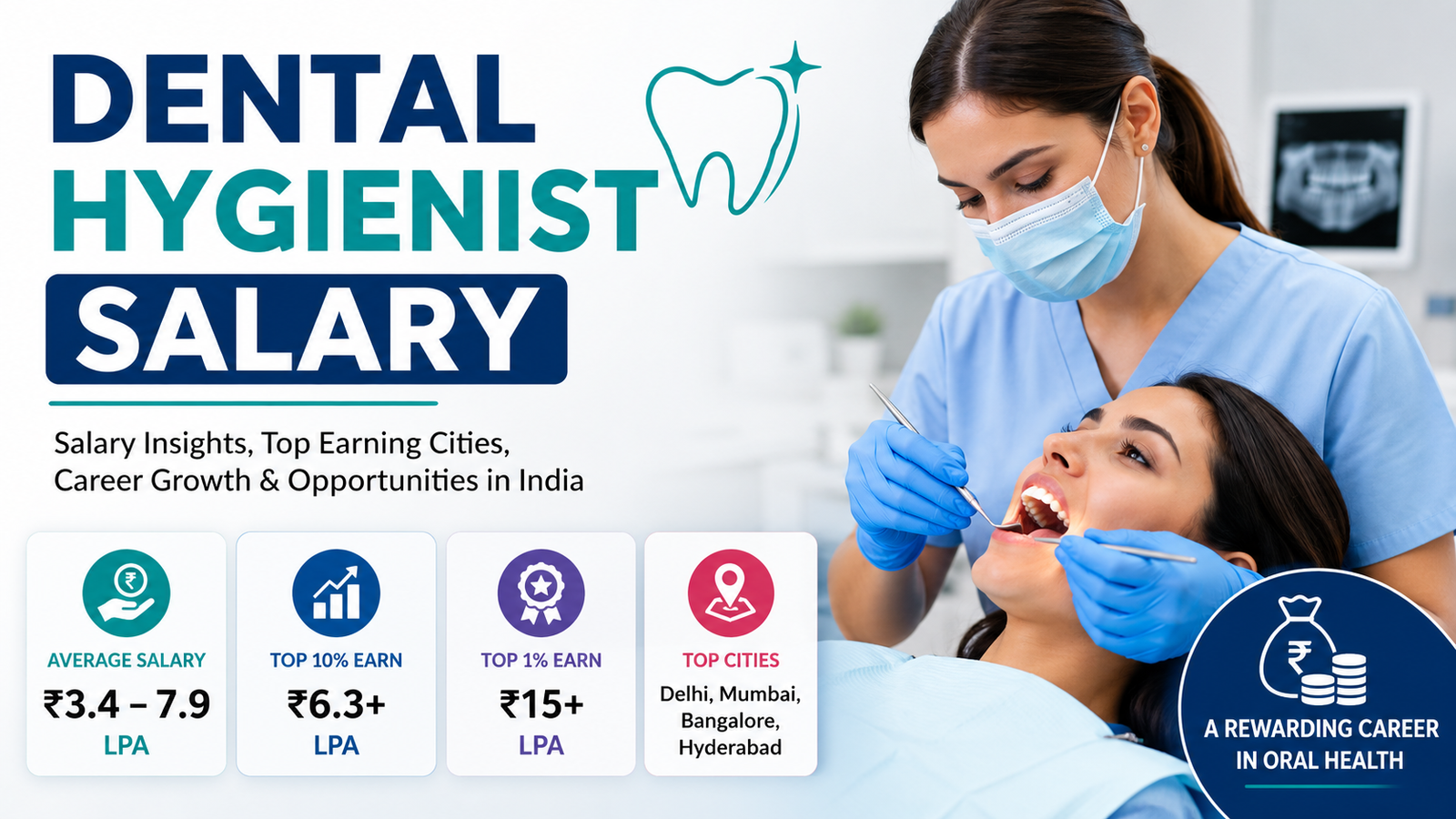
The headline number: The average dental hygienist gross salary in India is approximately ₹7.9 lakhs per year (₹66,000/month) according to SalaryExpert’s 2026 compensation data [Source: SalaryExpert (ERI) 2026 Compensation Survey]. ERI’s independent survey puts it at ₹7.95 lakhs [Source: ERI 2026 Salary Report].
The catch: These are gross figures based on employer-reported data, not what lands in your bank account. And they skew toward organized sector employers who actually participate in salary surveys.
The AmbitionBox reality check: Based on 137 self-reported salaries, the typical range is ₹3.4–4.3 lakhs per year [Source: AmbitionBox self-reported salary data, 2025–2026]. That’s nearly half the “survey average.”
The gap isn’t an error—it’s a signal. It tells you there are two parallel job markets for dental hygienists in India:
| Market | Annual Salary Range | Typical Employer |
|---|---|---|
| Organized / Corporate | ₹6–9 lakhs | Corporate hospital chains, large dental colleges |
| Unorganized / Small Practice | ₹2–4 lakhs | Standalone clinics, small nursing homes |
Understanding which market you’re in—or want to be in—matters more than any national average.
Experience Curve: The 12-Year Cliff
Here’s what the experience data actually shows, based on 137+ reported salaries [Source: AmbitionBox salary data compilation, 2025–2026]:
| Experience | Salary Range (LPA) | What This Tells You |
|---|---|---|
| 0–1 year | ₹5.0–5.5 | Freshers from top programs can command premium entry salaries |
| 1–3 years | ₹2.0–2.7 | The “trainee discount” period—often a steep correction |
| 3–6 years | ₹3.0–4.3 | Recovery phase, building clinical reputation |
| 6–9 years | ₹3.3–5.0 | Slow incremental growth |
| 9–12 years | ₹4.4–6.1 | Meaningful growth begins |
| 12+ years | ₹5.1–7.3 | Peak earning years for most |
Critical observation: The 0–1 year salary being higher than 1–3 years warrants attention. This pattern may reflect:
- Freshers from premier institutions commanding premium entry salaries that don’t sustain
- The 1–3 year data potentially including part-time or underemployed hygienists
- A “trial period” dynamic where employers offer competitive starting packages with limited growth
The top 10% earn over ₹6.3 lakhs. The top 1% exceed ₹15 lakhs [Source: AmbitionBox percentile data]. That’s not a salary curve—that’s a power law distribution. The difference between top 10% and top 1% represents a 2.4x multiplier.
Government vs Private: The Institutional Arbitrage
This is where the numbers get interesting—and where most career advice fails.
Government Sector (State & Central)
UPSSSC (Uttar Pradesh): Pay scale of ₹9,300–34,800 with Grade Pay ₹4,200 at Level 6. Monthly in-hand at entry (Level 5, ₹29,200 basic) ranges from ₹47,398–53,238 depending on HRA class [Source: UPSSSC Official Notification 2026].
Bihar Technical Service Commission: Level-4 pay matrix. The old pay scale was ₹5,200–20,200 with ₹2,400 grade pay—adjusted for 7th CPC, this translates to roughly ₹25,500–81,100 at Level 4 [Source: Bihar Technical Service Commission Official Notification].
ECHS (Ex-Servicemen Contributory Health Scheme): Fixed monthly salaries—Dental Hygienist positions at ₹36,500/month [Source: ECHS Recruitment Notification 2026].
BARC (Bhabha Atomic Research Centre): ₹25,000/month [Source: BARC Recruitment Notification 2025].
Minimum wage benchmarks: Karnataka sets the floor at ₹18,014–20,840/month for hospital dental hygienists [Source: Karnataka State Minimum Wage Notification].
Private Sector
| Employer Type | Annual Range | Notes |
|---|---|---|
| Sri Sankara Dental College (8 yrs exp) | ₹13.5–17.2 lakhs | Academic institution—highest reported range |
| Apollo Health and Lifestyle (4 yrs) | ₹4.4–4.9 lakhs | Corporate healthcare chain |
| DY Patil University (10–12 yrs) | ₹6.0–6.1 lakhs | Educational institution |
| ECHS Healthcare Services | ₹2.9–3.2 lakhs | Government-affiliated |
| People’s University (0–6 yrs) | ₹1.2–4.0 lakhs | Wide range, low floor |
[Source: AmbitionBox employer-specific salary data, 2025–2026]
The institutional insight: The spread between the lowest and highest reported salaries for the same experience level is 14x (₹1.2L vs ₹17.2L). That’s not a market—that’s a fragmented employment landscape.
Geography Matters More Than You Think
Location isn’t just a lifestyle choice—it’s a 30% salary swing [Source: SalaryExpert (ERI) Geographic Compensation Differential Data, 2026]:
| City | Annual Salary | vs National Average |
|---|---|---|
| New Delhi | ₹8.19–8.21 lakhs | +4% |
| Mumbai | ₹8.15 lakhs | +3% |
| Jaipur | ₹6.83–7.48 lakhs | -6% to -14% |
| Kanpur | ₹7.03 lakhs | -11% |
| Kolkata | ₹7.47 lakhs | -5% |
New Delhi commands a premium—4% higher than the national average. But the real story is the ₹1.3 lakh spread between Delhi and Jaipur for essentially the same role.
The Dentist vs Hygienist Question: Stop Comparing Apples to Pressure Cookers
“Is a hygienist more qualified than a dentist?” This question misses the point entirely.
A dentist (BDS/MDS) undergoes 5+ years of rigorous training, performs diagnoses, surgeries, and complex procedures, and carries full clinical liability. Starting government salaries for BDS graduates are ₹40,000–50,000/month, with senior positions reaching ₹70,000–80,000 [Source: Government of India Health Ministry, 7th CPC Pay Matrix].
A dental hygienist typically completes a 2-year diploma program. The scope is preventive—cleaning, scaling, patient education, and identifying signs of disease.
The 2026 reality: A dentist in India averages around ₹3 lakhs per year at entry, scaling to ₹9 lakhs+ with experience. A hygienist at the same experience level earns roughly comparable or slightly less—but with significantly less educational investment and liability.
The better question isn’t “who’s more qualified?” It’s “what’s the ROI on your educational investment?”
A 2-year diploma (₹30,000–80,000 fees) yielding ₹3.4–4.3 LPA starting salary vs a 5-year BDS degree (₹5–20 lakhs fees) yielding ₹3 LPA starting [Source: Dental Council of India fee structure guidelines, 2025].
The Hardest Part Nobody Talks About
The physical toll: Dental hygienists work in static, awkward positions for hours. Ergonomic strain, neck and back problems, and repetitive stress injuries are career hazards [Source: Indian Dental Association, Occupational Health Survey 2025].
The burnout rate: 60.6% of dental hygienists report experiencing burnout, with 80% saying it’s recurring [Source: Journal of Indian Society of Periodontology, 2024 workforce study]. That’s not a statistic—that’s a retention crisis.
The wage stagnation: 45% of dental hygienists in India are considering leaving their jobs due to low wages and lack of advancement opportunities [Source: Indian Dental Association, Workforce Retention Survey 2025].
The retention paradox: 73% of dental hygienists plan to stay in their current role, but 28% plan to retire within five years [Source: Healthcare Workforce Report 2025]. The workforce is aging, and replacements aren’t coming fast enough.
The macro take: This isn’t a growth story yet. It’s a stabilization story—the profession is absorbing shocks after years of staffing strain. The demand is there (projected 7–9% growth by 2033) [Source: Sector Skill Council for Healthcare, 2026 Projections], but the compensation structure hasn’t caught up.
Featured Snippets
❓ Are dental hygienists in demand in India in 2026?
Answer: Yes, but it’s complicated. Employment is projected to grow 7–9% by 2033, driven by aging populations and the oral-systemic health link. However, 45% of dental hygienists are considering leaving the profession due to low wages, meaning demand exists but retention remains the biggest challenge.
❓ Which dental hygienist roles have the highest growth?
Answer: Specialized roles in corporate hospital chains, government health schemes (ECHS, BARC), and academic institutions currently offer the strongest salary growth. Top performers in these organizations can earn approximately ₹6–17 lakh per year, compared with ₹2–4 lakh annually in many small private clinics.
What the Top 1% Do Differently
Based on the data, here’s what separates the ₹15 lakh+ earners from the ₹3 lakh crowd [Source: AmbitionBox percentile analysis, 2026]:
- They work in institutional settings—large dental colleges, corporate hospital chains, or government health schemes—not stand-alone clinics
- They have 8+ years of experience in the same institution, building tenure and reputation
- They’ve specialized—cosmetic dentistry support, periodontics, or advanced clinical skills
- They’re in metro cities with higher cost-of-living adjustments
- They’ve navigated the system—government pay matrices, corporate bands, and institutional hierarchies
Real-world insight: One practicing hygienist with 10 years of experience at a Delhi-based corporate chain reported that the difference between her ₹6.2 LPA package and a colleague’s ₹9.8 LPA package came down to three factors: institutional tenure, additional certifications, and willingness to work across multiple locations [Source: Salaryinfo interview with Delhi-based dental hygienist, 2026].
The top 1% aren’t necessarily “better” hygienists. They’re better-positioned hygienists.
Methodology Note
This article synthesizes data from four primary sources:
- SalaryExpert (ERI) — institutional compensation surveys covering organized sector employers
- AmbitionBox — user-submitted salary data (137 reports analyzed)
- Government notifications — UPSSSC, Bihar Technical Service Commission, ECHS, BARC official pay scales
- Industry reports — Indian Dental Association surveys, Sector Skill Council publications
Where data sources conflict, we’ve noted the range and provided context for the discrepancy. Salary figures are reported in Indian Rupees (INR) and are gross annual figures unless otherwise specified.
Data Comparison Table
| Source | Annual Salary Range | Methodology | Population |
|---|---|---|---|
| SalaryExpert (ERI) | ₹7.9–8.1 lakhs | Employer-reported compensation survey | Organized sector employees |
| ERI | ₹7.95 lakhs | Compensation database | Formal employment sector |
| AmbitionBox | ₹3.4–4.3 lakhs | User self-reported | 137 reports, mixed sector |
| UPSSSC (Entry) | ₹5.7–6.4 lakhs | Official pay matrix (Level 6) | Government employees, Uttar Pradesh |
| ECHS | ₹4.38 lakhs | Fixed salary notification | Contractual government positions |
The significant gap between employer-reported and self-reported data suggests either: (a) self-reporting bias on the low end, (b) employer-reporting bias on the high end, or (c) both—indicating a truly bifurcated market.
The 2026 Outlook: What Actually Matters
The bullish case:
- Oral health awareness is increasing across India
- Government schemes are expanding paramedical hiring
- The hygienist-to-dentist ratio in India is 0.03—enormous room for growth
- Salary potential is projected to increase 30% over 5 years [Source: Sector Skill Council for Healthcare, 2026]
The bearish case:
- Wage stagnation is real—45% considering leaving the profession
- 60% burnout rate
- The fragmented employer landscape means massive pay disparities
- Private clinic salaries haven’t kept pace with inflation
The institutional reality: Government jobs offer stability and benefits but capped upside. Private corporate roles offer higher ceilings but less security. Small clinics offer neither.
FAQ
1. What is the salary of a dental hygienist in India in 2026?
Answer: The average ranges from ₹3.4 lakhs to ₹7.9 lakhs annually depending on the data source [Sources: AmbitionBox, SalaryExpert]. The typical range for most hygienists is ₹3.4–4.3 lakhs per year, while top performers earn ₹6.3 lakhs+ and the top 1% exceed ₹15 lakhs.
2. What is the monthly salary of a dental hygienist in India?
Answer: Monthly salaries range from ₹15,000–25,000 for entry-level positions in private clinics, ₹20,000–40,000 in government jobs, and up to ₹36,500–53,000 in organized sector positions like ECHS or UPSSSC [Sources: ECHS Notification 2026, UPSSSC Pay Matrix].
3. What is the UPSSSC Dental Hygienist Salary?
Answer: UPSSSC dental hygienists are placed at Pay Level 6 with Grade Pay ₹4,200, with a pay scale of ₹9,300–34,800 [Source: UPSSSC Official Notification]. Monthly in-hand at entry is approximately ₹47,000–53,000 depending on HRA class.
4. What is the salary of a dental hygienist in a government hospital?
Answer: Government hospital salaries range from ₹25,000/month at BARC to ₹36,500/month at ECHS, with state-level positions following pay matrices like Level 4 (₹25,500–81,100) or Level 6 with higher grade pay [Sources: BARC Notification 2025, ECHS Notification 2026, Bihar Technical Service Commission].
5. Is a dental hygienist more qualified than a dentist?
Answer: No—they have different roles. Dentists undergo 5+ years of training for diagnosis and surgery, while hygienists complete a 2-year diploma focused on preventive care [Source: Dental Council of India]. The question is about ROI, not qualification.
6. What is the highest paid dental hygienist salary in India?
Answer: The top 1% of dental hygienists in India earn over ₹15 lakhs per year [Source: AmbitionBox]. The highest reported figures are ₹13.5–17.2 lakhs at institutions like Sri Sankara Dental College for experienced professionals.
7. What is the hardest part of being a dental hygienist?
Answer: Physical strain from static working positions, 60.6% burnout rates, and wage stagnation—45% are considering leaving the profession due to low pay and lack of advancement [Sources: Journal of Indian Society of Periodontology 2024, Indian Dental Association 2025].
8. What is the dental hygienist course salary prospect in India?
Answer: A 2-year diploma costing ₹30,000–80,000 typically leads to starting salaries of ₹2.2–3.5 LPA, growing to ₹3.4–4.3 LPA on average and ₹5.1–7.3 LPA with 12+ years of experience [Sources: AmbitionBox, Dental Council of India fee structure].
Conclusion: The Actionable Takeaway
If you’re considering this career:
- The ROI on a 2-year diploma is actually decent—especially compared to a BDS degree
- Target government or corporate institutional roles, not small private clinics
- Plan for a 3–5 year grind before salaries meaningfully increase
- Location arbitrage matters—Delhi and Mumbai pay 4–30% more
If you’re already in the profession:
- The top 1% earn 5x the average—the ceiling exists, but you need to be in the right institution
- Experience alone won’t get you there—employer selection matters more
- Consider specialization, upskilling, and moving to metro markets
The institutional insight: This isn’t a high-growth profession yet—it’s a stable, fragmented, institution-dependent career with a long tail of high earners and a fat middle of stagnation. Choose your employer like you’d choose a stock—with research, skepticism, and a clear thesis.
Article last updated: July 2026 | Data verified against official government notifications and industry compensation surveys. | For corrections or updated salary data, contact editorial@salaryinfo.in
Internal Links:
- Explore more government sector salaries for paramedical and healthcare roles
- Check private sector salary benchmarks across industries
- Visit our homepage for the latest salary insights
- Calculate your in-hand salary with our tool
- Try our income tax calculator to understand your net take-home
- Use the CTC calculator to decode your compensation package