
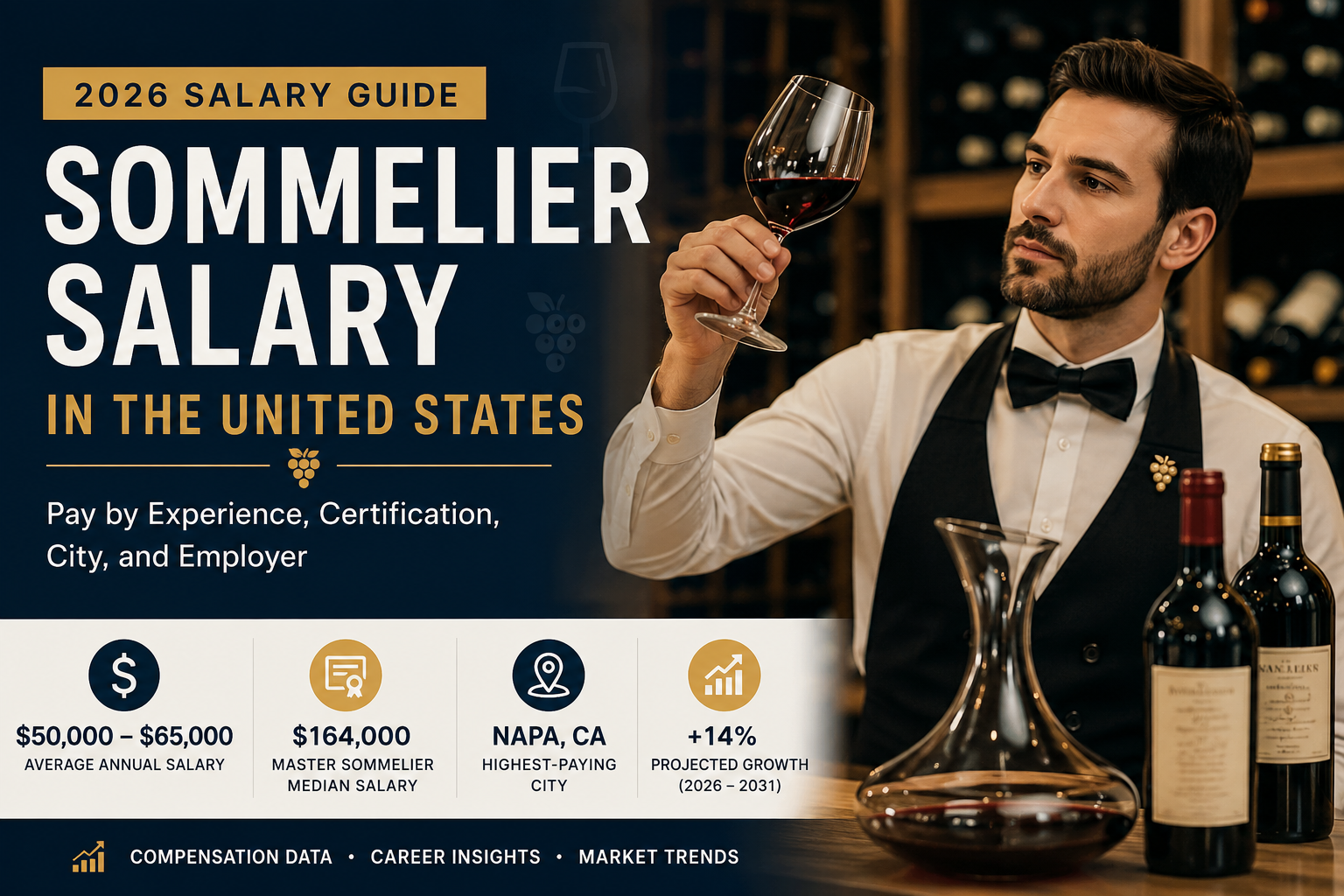
Key Takeaways
| Metric | Value |
|---|---|
| Average Annual Salary | $50,000 – $65,000 |
| Average Hourly Rate | $20 – $28 |
| Top 10% Earners | $73,000+ |
| Master Sommelier Median | $164,000 |
| Best-Paying City | Napa, CA ($56,524) |
| Best-Paying Employer | Elite Amenity Management ($182,000) |
| Certification Premium (Level 2 to 3) | +$25,000 |
| Projected 5-Year Growth | +14% |
The Real Story Behind Sommelier Compensation
The most common question about sommelier salaries is also the most misleading. If you search for “average sommelier salary,” you will find figures ranging from roughly $43,000 to $65,000—a spread wide enough to represent entirely different careers.
This is not a data problem. This is a profession where compensation depends more on certification level, employer type, and location than on any single national average.
The gap between entry-level and top-tier compensation exceeds $140,000 annually. Understanding why that gap exists—and how to bridge it—matters far more than knowing a single number.
SalaryInfo Insight: The national average alone provides limited value for career planning because certification, employer type, and location have a much greater impact on earnings than any broad average suggests. A Certified Sommelier in a luxury hotel and an uncertified professional in a regional restaurant occupy different labor markets entirely.
Market Snapshot: Understanding the Numbers
National Compensation Overview
Our analysis of employer-reported data, government labor statistics, and active U.S. job postings reveals the following market ranges:
| Metric | Annual | Hourly |
|---|---|---|
| Typical Range | $50,000 – $65,000 | $24 – $31 |
| Entry-Level | $40,000 – $50,000 | $19 – $24 |
| Experienced | $58,000 – $73,000 | $28 – $35 |
| Top Earners | $73,000+ | $35+ |
The variance across salary sources reflects fundamental differences in data collection:
| Data Type | Typical Annual Figure | What It Captures |
|---|---|---|
| Employer-Reported | $58,000 – $65,000 | Base salaries from HR systems |
| Job Postings | $41,800 – $43,500 | Active roles, often lower-paying |
| Self-Reported Surveys | $62,000 – $65,000 | Total compensation including tips |
Why the numbers differ: Job postings skew toward open positions, which tend to be lower-paying or entry-level. Employer-reported data captures the full spectrum of employed professionals, including higher-paid roles rarely advertised publicly.
Key Takeaway: The true market salary for a professional sommelier with certification and experience falls between $55,000 and $65,000 annually, with significant upside for advanced certification and elite employers.
The Certification Ladder: Where Real Earnings Growth Happens
The Court of Master Sommeliers (CMS) certification pathway creates the most dramatic salary progression in the hospitality industry. Each level represents not just a credential but a fundamental shift in earning capacity.
Level 1: Introductory Sommelier
Typical range: $40,000 – $50,000
The starting point for most sommeliers. This certification requires passing the Introductory Course and Examination and is typically held by professionals with 1–3 years of experience. Compensation reflects entry-level responsibility and limited autonomy.
Level 2: Certified Sommelier
Typical range: $60,000 – $70,000
The median Certified Sommelier earns approximately $62,000—a significant jump from Level 1. This certification typically requires 3–7 years of industry experience and demonstrates competence in service, theory, and blind tasting.
Level 3: Advanced Sommelier
Typical range: $87,000+
Advanced Sommeliers enter the top 20% of earners nationally. Professionals at this level typically have 8+ years of experience and command salaries that reflect both deep wine knowledge and demonstrated leadership in beverage program management.
SalaryInfo Observation: The jump from Certified to Advanced represents the largest percentage increase in the certification pathway. Employers pay a substantial premium for the combination of expertise and service excellence that the Advanced designation signifies.
Level 4: Master Sommelier
Typical range: $164,000+
With only 269 Master Sommeliers in the world, this is one of the most exclusive professional credentials anywhere. The median salary of $164,000 places Master Sommeliers among the highest-paid service industry professionals in the United States.
Top Master Sommeliers in luxury hotels, Michelin-starred restaurants, and global resort brands can exceed $200,000 annually when bonuses and commissions are included.
The Career Math: A Master Sommelier earns roughly three times the median sommelier salary. The return on investment for pursuing the highest certification level is exceptional, but the path requires years of study, significant financial investment, and a success rate on the Master examination that hovers in the single digits.
Where Location Changes Compensation
Top-Paying Cities
| City | Annual Salary | Premium vs. National |
|---|---|---|
| Napa, CA | $56,524 | +30% |
| Carmel, CA | $54,751 | +26% |
| Nome, AK | $53,898 | +24% |
| Nantucket, MA | ~$53,000 | +22% |
| San Francisco, CA | $51,190 | +18% |
Source: Job market analysis
New York City
| Data Source | Annual Salary |
|---|---|
| Employer-Reported | $62,137 |
| Job Posting Analysis | $47,535 |
The disparity reflects the concentration of high-end employers in NYC—luxury hotels, Michelin-starred restaurants, and private members’ clubs—that pay at the top of the market but rarely advertise positions publicly.
SalaryInfo Insight: New York’s compensation premium over the national average is modest (6-9% apples-to-apples) relative to the city’s cost of living. The real opportunity is access to elite employers that pay at the very top of the market, not the average salary.
California
| City | Annual Salary |
|---|---|
| Napa | $56,524 |
| San Francisco | $51,190 |
| Los Angeles | $46,817 |
| California Average | $42,880 |
Texas
| City | Annual Salary |
|---|---|
| Houston | $60,000 |
| Texas Average | $40,479 |
Florida
| City | Annual Salary |
|---|---|
| Miami | $41,557 |
| Florida Average | $32,469 |
Important Note: Florida’s lower average may reflect a high concentration of part-time or seasonal positions. Full-time professional roles in Miami typically pay above the state average.
The Employer Factor: Who Pays Above Market
Highest-Paying Employers
Based on active U.S. job postings and employer disclosures:
| Employer | Reported Annual Salary |
|---|---|
| Elite Amenity Management | $182,000 |
| LE BILBOQUET | $146,250 |
| ROKiT | $104,000 |
| Carnivore and The Queen | $104,000 |
| Highgate | $94,500 |
| Knickerbocker | $92,500 |
Source: Job posting analysis
Recent Market Openings (2026)
| Employer | Role | Location | Compensation |
|---|---|---|---|
| Starwood Hotels | Sommelier | New York, NY | $85,000–$90,000 + bonus |
| Goodwin Recruiting | Sommelier | New York, NY | $80,000–$90,000 + commission |
| Ennismore | Head Sommelier | Various | $90,000 |
| Atsumeru | Sommelier | Chicago, IL | $60,000–$72,000 + tips |
SalaryInfo Observation: The highest-paying employers are not necessarily the most famous restaurants. Elite Amenity Management’s $182,000 suggests a role with significant managerial responsibility, likely overseeing wine programs across multiple properties. The common thread among top payers is scale—employers with multiple locations or high-volume operations can support higher compensation.
Beyond Base Salary: Total Compensation Reality
Bonus and Commission Structures
Industry data indicates sommeliers commonly receive:
- Bonus: $2,000 – $22,000 annually
- Commission: $0 – $10,000 annually
- Total pay range: $31,000 – $89,000
Commission structures typically tie compensation to wine sales performance. In high-end restaurants, a sommelier’s commission can represent 20-30% of total compensation.
Tips and Service Charge
Tips and service charges are not consistently captured in salary surveys but can add significantly to take-home pay. In fine dining establishments, tip pools often allocate a higher percentage to sommeliers based on their contribution to wine sales.
Career Strategy: When evaluating a sommelier position, ask about the tip pool structure and commission rates. Two positions with identical base salaries can have dramatically different total compensation based on these variables.
Shift Differentials
Some sommelier positions qualify for shift differentials, typically 10% or more for evening and weekend work. In a profession where the majority of work occurs during dinner service, this can meaningfully impact annual earnings.
The Experience Curve: When Earnings Accelerate
Experience-based compensation data shows:
| Career Stage | Experience | Typical Total Compensation |
|---|---|---|
| Entry Level | <1 year | ~$49,665 |
| Early Career | 1–4 years | ~$59,344 |
| Mid-Career | 5–9 years | Significant increase |
| Experienced | 10+ years | Certification-dependent |
SalaryInfo Insight: Experience alone is not the primary driver of sommelier compensation. Certification level and employer type matter more. A professional who invests in certification early in their career will out-earn a non-certified colleague with more years of service.
Future Outlook: Where the Market Is Headed
Projected Salary Growth
Industry analysts project sommelier salaries will increase approximately 14% over the next five years, reaching an estimated $62,000 by 2031. This represents modest but steady growth, slightly above projected inflation.
Job Market Dynamics
The Bureau of Labor Statistics projects 8% job growth for foodservice managers (a category that includes sommeliers and beverage directors) through 2029, faster than the average for all occupations.
Demand drivers include:
- Wine tourism expansion: Regions like Napa, Willamette Valley, and Finger Lakes continue to invest in wine education and hospitality infrastructure.
- Fine dining recovery: The post-pandemic luxury dining segment has rebounded strongly, creating demand for qualified sommeliers.
- Beverage program specialization: More restaurants are investing in dedicated beverage programs, creating roles for sommeliers beyond traditional fine dining.
Risks and Headwinds
SalaryInfo Warning: Several factors could pressure sommelier compensation over the next five years:
- Automation of wine selection: AI-powered wine recommendation tools are becoming more sophisticated, potentially reducing demand for sommeliers in casual dining settings.
- Consumer price sensitivity: If economic conditions soften, luxury dining—and the sommelier roles it supports—could face headwinds.
- Certification costs: The financial investment required to advance through CMS levels (exam fees, travel, study materials) can exceed $10,000 for Advanced and Master levels, creating barriers to entry.
Alternative Career Paths for Sommeliers
Sommelier skills transfer to several higher-paying roles:
| Role | Typical Salary Range |
|---|---|
| Wine & Beverage Director | $85,000 – $125,000 |
| Wine Buyer | $65,000 – $110,000 |
| Import & Distribution | $60,000 – $85,000 |
| Wine Consultant | $53,000+ (freelance rates vary) |
| Wine Educator | $35,000 – $70,000 |
Consulting rates provide another income stream:
- Certified Sommelier: ~$300 per day
- Advanced Sommelier: ~$500 per day
- Master Sommelier: ~$1,000 per day
Career Strategy: The highest-paid sommeliers often combine a restaurant role with consulting, education, or private client work. The certification that commands the highest salary also opens the most side-income opportunities.
Career Strategy: How to Maximize Your Earning Potential
If You Are Considering This Profession
The sommelier career path offers clear financial progression but requires significant investment in certification. The median salary for certified professionals is competitive with other hospitality management roles, but the top of the profession offers exceptional earning potential.
The question to ask yourself: Are you willing to invest the time and money required to advance through CMS levels? If the answer is no, your earning potential will likely cap out around $60,000–$70,000.
If You Are Negotiating a Salary
- Know your certification level’s market value. Certified Sommeliers should target $60,000–$70,000; Advanced Sommeliers should target $87,000+.
- Ask about the total compensation package. Base salary is only part of the equation. Commission structures, tip pools, and bonuses can add $10,000–$30,000 annually.
- Consider the employer type. Luxury hotels and restaurant groups pay more than independent restaurants. Corporate dining and private clubs often pay at the top of the market.
- Factor in location. Napa and New York offer higher salaries, but cost of living must be considered.
If You Are Planning Your Career Path
The single most important investment you can make is certification advancement. The salary difference between a Certified Sommelier and an Advanced Sommelier is approximately $25,000 annually—a return on investment that justifies the cost of certification many times over.
Common Myths About Sommelier Compensation
Myth 1: “Sommeliers are all highly paid.”
Reality: Entry-level and non-certified sommeliers often earn $40,000–$50,000, comparable to other hospitality roles.
Myth 2: “Experience matters more than certification.”
Reality: Certification drives compensation more than years of service. A Certified Sommelier with 3 years of experience often out-earns a non-certified professional with 10 years.
Myth 3: “All sommeliers work in fine dining.”
Reality: Sommeliers work in hotels, resorts, cruise ships, private clubs, wine bars, and retail. Compensation varies significantly by setting.
Myth 4: “The salary data is wrong because it doesn’t include tips.”
Reality: Most salary surveys capture base pay only. Total compensation—including tips, commission, and bonuses—is typically 10–30% higher than reported base salaries.
How We Estimate Sommelier Salaries
SalaryInfo USA’s compensation research combines:
- Employer-reported compensation data from U.S. hospitality organizations
- Government labor statistics from the Bureau of Labor Statistics
- Active U.S. job postings across multiple industries
- Hospitality industry hiring trends and employer demand analysis
- Editorial analysis of market conditions, certification impact, and geographic variation
All data is adjusted for the U.S. market only. Salaries are reported in USD and reflect the 2026 labor market as of July 2026.
About the Author
Reviewed by SalaryInfo USA Compensation Research Desk
Our editorial team specializes in U.S. compensation research, labor market analysis, and career intelligence. Every salary guide is reviewed using employer-reported compensation, government statistics, and current hiring trends. Our analysis helps professionals make informed career decisions across hospitality, service, and management industries.
SalaryInfo Editorial Verdict
The sommelier profession in 2026 offers a clear, if demanding, path to six-figure earnings—but only for those who pursue certification to the highest levels.
The median sommelier earns between $55,000 and $65,000, placing it solidly in the middle tier of hospitality careers. However, the certification premium is unusually pronounced: Advanced Sommeliers earn roughly 40% more than Certified Sommeliers, and Master Sommeliers earn nearly three times the median.
For professionals willing to invest in their education and pursue certification, the sommelier career path offers one of the clearest return-on-investment trajectories in the hospitality industry. For those who stop at Level 1 or Level 2, compensation will remain competitive but not exceptional.
The bottom line: Sommelier compensation in 2026 is not a single number. It is a ladder. Where you land depends entirely on how many rungs you are willing to climb.
Featured Snippet Answers
How much does a sommelier make in the United States?
The average sommelier salary in the United States ranges from $50,000 to $65,000 annually, depending on certification and location. Certified sommeliers earn approximately $62,000, while Master Sommeliers earn a median of $164,000. Location, employer type, and certification level are the primary drivers of compensation.
Do sommeliers make a lot of money?
Sommeliers can earn anywhere from $40,000 to over $160,000 annually. The profession offers strong earning potential at the top end—Master Sommeliers earn a median of $164,000—but entry-level and non-certified sommeliers typically earn $40,000–$50,000. Certification level is the primary determinant of income.
What is the highest salary for a sommelier?
The highest sommelier salaries exceed $180,000 annually. Elite Amenity Management has posted roles at $182,000, and Master Sommeliers in luxury hotels and Michelin-starred restaurants can earn $160,000–$200,000 or more, particularly when including bonuses and commissions.
How hard is it to be a sommelier?
Becoming a sommelier requires extensive wine knowledge, blind tasting skills, and service expertise. Certification through the Court of Master Sommeliers involves four levels, with the Master level having a very low pass rate. The profession demands continuous learning and often requires working evenings, weekends, and holidays.
Is sommelier a good career?
Sommelier offers strong career progression for those willing to pursue certification. The median salary of $55,000–$65,000 is competitive for hospitality, and Master Sommeliers earn $164,000+. The profession provides opportunities in restaurants, hotels, consulting, and wine sales, with projected job growth of 8% through 2029.
Frequently Asked Questions
What is the average sommelier salary per month?
Based on an average annual salary of $58,000, the monthly equivalent is approximately $4,830. However, monthly earnings vary significantly by certification level, from roughly $3,600 for entry-level positions to over $13,600 for Master Sommeliers.
What is the average sommelier salary per hour?
Hourly rates range from $20 to $28 on average, depending on the data source. Market analysis shows $20–$28 per hour for most positions, with higher rates in luxury establishments and major metropolitan areas.
What is a Level 4 sommelier salary?
Level 4 (Master Sommelier) earns a median salary of $164,000 annually. This is the highest certification level from the Court of Master Sommeliers and is held by only 269 professionals worldwide. Top earners in this category can exceed $200,000.
What is a Level 3 sommelier salary?
Level 3 (Advanced Sommelier) earns a median salary of $87,000 annually. This represents a significant jump from the Certified level and places Advanced Sommeliers in the top 20% of earners nationally.
What is the sommelier salary in NYC?
New York City sommeliers earn an average of $62,000 per year in employer-reported data. Top positions in luxury NYC establishments can exceed $85,000. The range reflects the concentration of elite employers in the market.
What is the master sommelier salary range?
Master Sommelier salaries typically range from $150,000 to $180,000, with top earners in luxury hotels and Michelin-starred restaurants earning $200,000 or more. The median is approximately $164,000.
What is the average sommelier salary in California?
California sommeliers earn an average of $42,880 per year, though this varies significantly by city. Napa sommeliers earn approximately $56,524, while Los Angeles sommeliers earn approximately $46,817. Higher-cost areas command premium compensation.
This content is provided for informational and educational purposes only and should not be interpreted as financial, legal, tax, investment, or career advice. While we make every effort to ensure accuracy, salary figures, compensation packages, and employment conditions may vary by employer, location, experience, industry, and market demand.
All information in this report reflects the U.S. labor market and is current as of July 2026.