
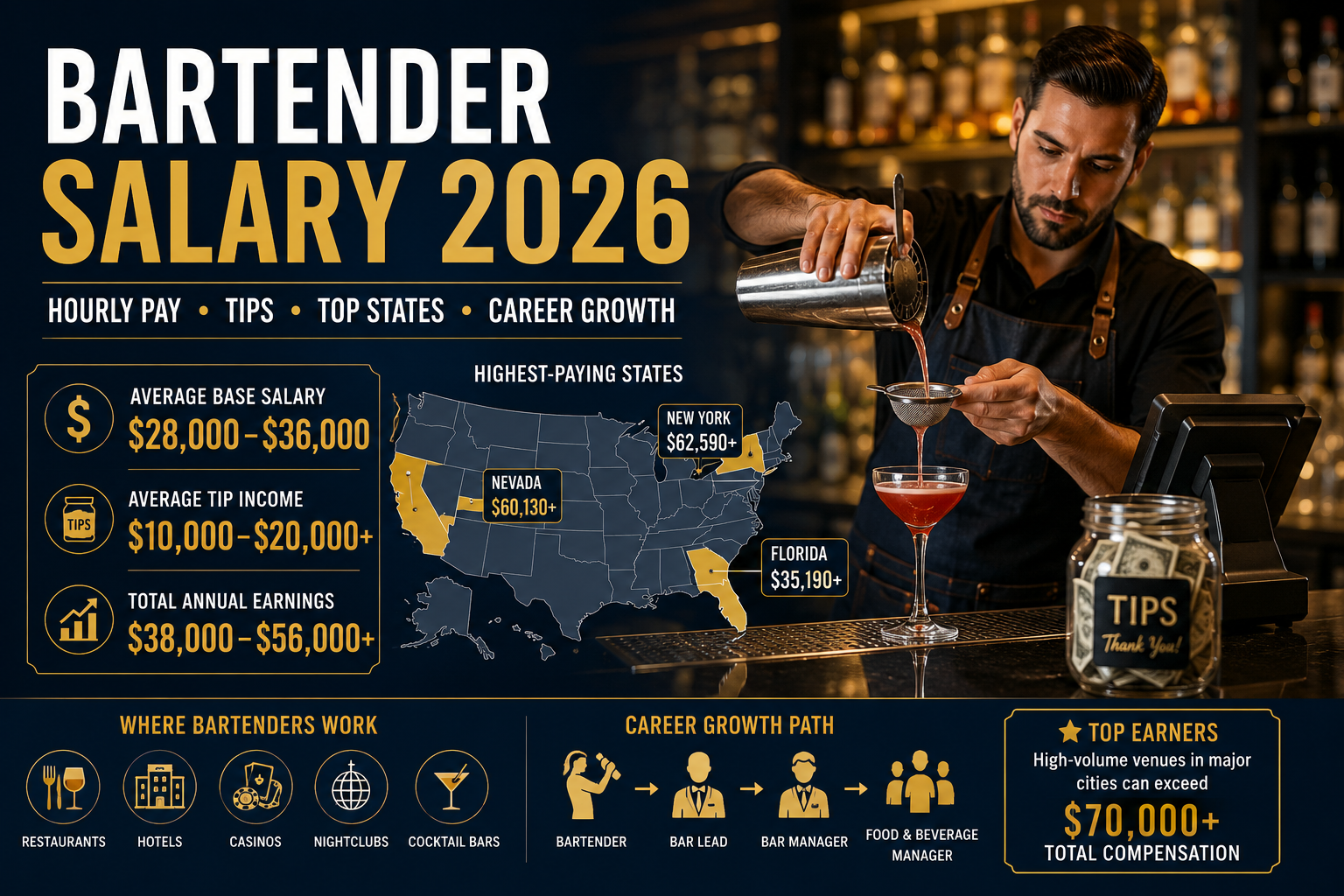
Bartender Salary
A bartender in Chicago can pocket over $33 an hour. Another in rural Texas earns minimum wage plus whatever customers leave on the bar. Same job title. Radically different economics.
The national numbers tell one story. The lived reality tells another.
According to the Bureau of Labor Statistics, the median annual wage for bartenders was $33,530 in May 2024. Employer-reported compensation datasets place the average closer to $28,000–$29,000 annually. Compensation survey estimates suggest approximately $36,000.
Three different numbers from three reputable data sources.
Here’s what they all agree on: base pay is only half the conversation. Tips can add another $10,000 to $20,000 annually depending on where you work, when you work and who you serve. For some bartenders, tips represent more than half their total income.
Key Takeaway: No single salary number defines this profession. Your earnings depend more on location and venue than on experience or education.
Why Bartender Pay Defies Easy Answers
Bartending sits at the intersection of multiple compensation systems. The federal tipped minimum wage remains $2.13 per hour—a number that hasn’t changed since 1991. But that’s mostly theoretical. Only a handful of states still use it. Most have their own minimums, some far higher.
The result is a profession where two people with identical skills can earn wildly different amounts simply because of geography.
Quick Answer: Most bartenders earn between $28,000 and $42,000 in base pay annually, with tips adding $10,000–$20,000. Top earners in high-volume urban venues can exceed $70,000 total compensation.
The National Numbers: What Surveys Actually Show
Let’s cut through the conflicting data.
| Data Source Type | Average Base Salary | Key Characteristics |
|---|---|---|
| Federal labor statistics | $33,530 (median) | Employer-reported wages, most comprehensive sample |
| Employer payroll data | ~$28,000–$29,000 | Real-time wage data from U.S. employers |
| National job posting analysis | ~$33,000 | Aggregated from current job listings |
| Compensation survey estimates | ~$36,000 | Economic modeling and survey combinations |
Why the spread?
Methodology matters. Government labor statistics and employer payroll data report actual wages from employers. Job posting analysis aggregates advertised salaries. Compensation surveys combine economic modeling with self-reported data. Each captures a different slice of the market.
SalaryInfo Insight: The $28,000–$36,000 range represents base wages only. Total compensation—including tips—typically lands between $38,000 and $56,000 for full-time bartenders. The 10th percentile earns around $21,300 annually; the 90th percentile exceeds $46,570 in base wages alone.
What Tips Actually Add to Your Paycheck
Here’s where the numbers get interesting.
Bartenders receive an average of $20,738 annually from tips, representing approximately 52% of their total income. That’s more than some professions earn in total.
But tip income is anything but guaranteed.
A Friday night at a packed Las Vegas nightclub might generate $400 in tips. A Tuesday lunch shift at a suburban chain restaurant might yield $40. The variance is extreme.
Industry breakdown of tip potential:
- High-volume nightclubs: $300–$600 per shift
- Upscale cocktail bars: $200–$400 per shift
- Busy neighborhood pubs: $150–$250 per shift
- Casual dining restaurants: $100–$200 per shift
- Hotel bars: $100–$300 per shift (variable by hotel class)
- Day shifts anywhere: $50–$150 per shift
Reality Check: Tip income isn’t passive. It reflects speed, personality, product knowledge and the ability to manage a bar during peak stress. Bartenders who master these skills consistently outperform those who don’t.
Why California Bartenders Earn More Than Florida Bartenders
Location isn’t just a factor. It’s the factor.
California dominates. The state’s top 10% of bartenders earn $73,770 or more annually. The average base wage sits around $19.39 per hour, with tips averaging $200 per day.
What drives this? California’s tipped minimum wage is effectively the state minimum—no tip credit allowed. Combined with high cost of living, dense population and a hospitality culture that values craft cocktails, the state creates conditions for higher earnings across the board.
New York City follows closely. Base wages average $18.78 per hour, about 5% above the national average. The city’s tipped minimum cash wage is $13.75 per hour with a $2.75 tip credit, as of 2025. High-volume venues and premium pricing push total compensation higher.
Florida tells a different story. The average base wage is $16.90 per hour, with tips averaging $175 per day. But Florida’s tipped minimum wage was $10.98 in 2025—significantly lower than California’s. The state’s lower cost of living partially offsets the gap, but not entirely.
Texas averages around $16.55 per hour with $150 in daily tips. The state benefits from no income tax but pays below national averages.
Washington, D.C. stands out. Bartenders there earn a median of $26.41 per hour—substantially higher than most cities—driven by the district’s $17.95 minimum wage and high-end hospitality scene.
Chicago bartenders average $18.72 per hour, ranging from $16.20 to $33.17 depending on experience and venue. The city’s tipped workers have experienced some of the fastest wage growth in the nation.
Las Vegas averages $15.19 per hour, but the volume and tourism-driven tipping can push total compensation significantly higher. Casino bartenders often earn more than their counterparts in other settings.
SalaryInfo Observation: The data reveals a clear pattern—states with higher minimum wages, no tip credit or strong hospitality industries produce the highest bartender earnings. California, New York, Illinois and D.C. consistently outperform the South and Midwest.
Which Employers Actually Pay Above Market
Not all bartending jobs are created equal. The employer determines the ceiling.
High-end restaurants pay premium base wages because they attract experienced talent and generate higher check averages—which means higher tips. Fine dining bartenders in major cities often earn $25–$35 per hour including tips.
Casinos in Las Vegas, Atlantic City and other gaming destinations offer competitive base pay plus the volume that drives tip income. Banquet bartenders in casino settings can earn $46,000+ annually.
Hotel bars at luxury properties combine steady foot traffic with affluent clientele. The base pay tends to be higher than standalone bars, and benefits packages often include health insurance and retirement plans—uncommon in the industry.
Craft cocktail bars reward specialized knowledge. Bartenders who can discuss spirits, create original drinks and deliver a polished experience command higher wages. Some craft bartenders in major cities earn $40,000–$60,000 total compensation.
Sports venues and concert halls offer high volume but seasonal inconsistency. Pay per hour tends to be average, but event-based tips can be substantial.
Chain restaurants typically pay the lowest base wages. The volume is steady, but check averages are lower and tipping culture is less generous.
SalaryInfo Career Strategy: The smartest career move isn’t always the highest-paying venue. Consider the entire package—base pay, tip potential, benefits, schedule stability and advancement opportunities. A $2 per hour difference in base pay is negligible compared to $200 per shift difference in tips.
How Experience Changes Your Earnings
Unlike corporate careers where salaries rise predictably with tenure, bartending pay doesn’t follow a neat trajectory.
Entry-level (0–2 years): $14–$17 per hour base. Total compensation typically $30,000–$38,000. The first years are about learning speed, building drink knowledge and developing customer service instincts.
Mid-career (3–7 years): $16–$20 per hour base. Total compensation $38,000–$50,000. This is where earnings accelerate. Bartenders who master the craft, build regular clientele and secure better shifts see meaningful income growth.
Experienced (8+ years): $18–$25 per hour base. Total compensation $45,000–$70,000+. Top earners in this bracket have usually moved to premium venues, developed specialized skills or taken on management responsibilities.
The ceiling: Most bartenders max out around $70,000–$80,000 total compensation unless they transition to management, ownership or high-end consulting. The profession has a natural income cap that experience alone won’t overcome.
Important Note: The lack of formal career ladders means bartenders must actively manage their progression. Staying in the same venue for five years without advancing roles or skills usually results in stagnant pay.
The Salary Ceiling Most Bartenders Never Reach
Here’s the uncomfortable truth.
Base wages for bartenders have not kept pace with inflation. The federal tipped minimum wage hasn’t changed since 1991. Even in states with higher minimums, base pay increases are modest.
The ceiling exists because bartending is classified as a low-skill occupation despite the actual skill required. Employers use this classification to justify lower wages.
How bartenders break the ceiling:
- Move to premium venues. A craft cocktail bar pays more than a sports bar. Fine dining pays more than casual dining.
- Secure premium shifts. Friday and Saturday nights generate 2–3 times the tips of weekday day shifts. Bartenders who earn these shifts through seniority or performance see immediate income gains.
- Develop specialized knowledge. Wine, spirits, cocktail history, flair bartending—specialization commands higher pay and better opportunities.
- Build a following. Bartenders who cultivate regular customers create predictable tip income. Regulars tip better and more consistently.
- Take on management. Bar manager, beverage director or head bartender roles come with higher base salaries and sometimes profit-sharing.
SalaryInfo Verdict: The bartenders who earn $70,000+ aren’t lucky. They’re strategic. They chose the right venue, mastered the right skills and positioned themselves for premium opportunities.
What Employers Reward More Than Experience
Employers care about three things in this order:
1. Speed and efficiency. A bartender who serves 40 customers per hour is more valuable than one who serves 20, regardless of drink quality. Speed drives revenue.
2. Personality and customer engagement. Bartenders who build relationships generate higher tips and repeat business. Employers notice.
3. Product knowledge. Understanding spirits, wine, beer and cocktail recipes reduces waste, improves customer experience and enables upselling.
What employers don’t reward: Certifications, degrees or formal education. Unlike most professions, bartending doesn’t have a credentialing system that correlates with higher pay. A bartending school certificate rarely increases earning potential.
Reality Check: The single most valuable asset for a bartender is a reputation for reliability. Employers pay more for bartenders who show up on time, don’t call out sick and handle pressure without breaking.
The States Where Bartending Pays Best
Based on federal labor statistics and state wage reports:
| State | Key Metric | Notes |
|---|---|---|
| California | Top 10% earn $73,770+ | No tip credit, high minimum wage |
| Illinois | Top 10% earn $73,770+ | Strong hospitality sector, Chicago drives wages |
| Texas | Top 10% earn $73,770+ | No state income tax, urban centers pay well |
| Washington | Top 10% earn $73,770+ | High minimum wage, Seattle premium |
| New York | Top 10% earn $73,770+ | NYC drives averages, high cost of living |
| Florida | Average $16.90/hour | Lower wages but no state income tax |
Note: The $73,770 figure for top earners appears consistently across multiple states in federal data, suggesting this represents the 90th percentile nationally.
SalaryInfo Insight: State-level data masks enormous intra-state variation. A bartender in San Francisco earns significantly more than one in Fresno. A Manhattan bartender out-earns one in Buffalo. City matters more than state.
The Cities Where Your Earnings Multiply
| City | Base Hourly | Total Annual Estimate |
|---|---|---|
| New York City | $18.78 | $50,000–$70,000 |
| Chicago | $18.72 | $48,000–$65,000 |
| Los Angeles | $17.23–$19.39 | $45,000–$60,000 |
| Washington D.C. | $26.41 (median) | $55,000–$75,000 |
| Las Vegas | $15.19 | $40,000–$60,000 |
| Miami | $11–$21+ range | $35,000–$55,000 |
| Austin | Varies widely | $35,000–$50,000 |
Total annual estimates include base pay plus tips and assume full-time hours.
Career Strategy: The highest-paying cities also have the highest costs of living. A $70,000 income in New York City has less purchasing power than $50,000 in Austin. When evaluating job offers, calculate real income after housing, taxes and living expenses.
How Bartending Compares to Other Hospitality Roles
Understanding where bartending sits in the compensation hierarchy helps with career planning:
| Profession | Average Annual Salary (2024–2026) |
|---|---|
| Bar Manager | $48,000–$65,000 |
| Bartender | $28,000–$36,000 base + tips |
| Server/Waiter | $29,000–$38,000 including tips |
| Chef | $45,000–$65,000 |
| Restaurant Manager | $50,000–$75,000 |
| Hotel Manager | $60,000–$100,000+ |
| Sommelier | $50,000–$90,000 |
Why this matters: Bartending offers faster income acceleration than serving but has a lower ceiling than management roles. The natural progression is server → bartender → bar manager → beverage director or restaurant manager.
Related Hospitality Careers
If you’re considering a career in hospitality, these related roles may offer different earning potential and career trajectories:
- Restaurant Manager Salary — Leadership roles with higher base pay and benefits
- Bar Manager Salary — The natural next step for experienced bartenders
- Sommelier Salary — Specialized wine expertise with premium earning potential
- Chef Salary — Culinary career path with similar income range
- Hotel Manager Salary — Hospitality management with broader career growth
- Server/Waiter Salary — The most common entry point into hospitality
Each role offers different trade-offs between base pay, tip income, benefits and career advancement.
The Next Five Years: What’s Changing
The Bureau of Labor Statistics projects bartender employment to grow 6% from 2024 to 2034, faster than the average for all occupations. About 129,600 openings are projected each year.
What’s driving growth:
- Recovery from pandemic-era hospitality losses
- Rising consumer spending on dining and entertainment
- Expansion of craft cocktail culture
- Growth in tourism and event industries
What threatens growth:
- Automation and self-pour technology
- Changing alcohol consumption patterns (Gen Z drinks less)
- Tip fatigue and shifting tipping norms
- Economic downturns affecting discretionary spending
SalaryInfo Future Outlook: The next five years will favor bartenders who adapt. Technology won’t replace the human element of bartending, but it will change how bars operate. Bartenders who embrace POS systems, inventory management and social media marketing will have an edge.
The Biggest Salary Myth About This Profession
“Bartenders make great money working part-time.”
This is partially true but dangerously misleading.
Some bartenders do earn excellent part-time incomes. A Friday night bartender at a high-volume club might earn $400 in a six-hour shift. That’s $67 per hour.
But these shifts are:
- Competitive. Everyone wants them. Seniority and relationships determine who gets them.
- Exhausting. Physical and emotional demands are high.
- Unpredictable. Tips vary by season, weather, events and random chance.
- Unstable. One slow night can cut income in half.
Reality Check: Most bartenders work full-time hours to generate full-time income. The “easy money” narrative obscures the reality of a physically demanding, schedule-unpredictable profession where income fluctuates weekly.
Career Risks Most People Don’t Consider
Income volatility. Tips fluctuate. A bad month can mean a 30% income drop with no warning.
No benefits. Most bartending positions offer no health insurance, retirement plans or paid time off. Independent contractors have even less protection.
Physical toll. Bartending is standing, lifting, repetitive motion and late nights. Long-term effects include back problems, foot issues and sleep disruption.
Schedule instability. Evenings, weekends and holidays are mandatory. Social life suffers.
Limited advancement. The career ladder is short. Most bartenders eventually transition out.
Economic sensitivity. Hospitality is the first sector cut during recessions. The 2020 pandemic wiped out the industry almost overnight.
SalaryInfo Warning: Enter bartending with open eyes. The income potential is real. So are the risks. Have an exit strategy and a savings cushion.
What Salary Surveys Don’t Tell You
Surveys report numbers. They don’t report:
How to get the best shifts. Seniority, performance and relationships determine schedule quality. New bartenders get slow shifts.
How to increase tips. Speed, personality, memory (for regulars’ drinks) and product knowledge all matter. Surveys don’t measure these.
How to negotiate. Most bartenders never negotiate their base pay. Those who do earn more.
How to manage tip income. Tips create tax complexity. Many bartenders underreport, creating future problems with Social Security and loan applications.
How to build a career. Surveys show what people earn, not how they got there. The path matters more than the number.
Professional Recommendation
If you’re considering bartending:
- Start in a high-volume venue. You’ll learn speed and efficiency faster.
- Master the classics. Old Fashioned, Martini, Manhattan, Margarita—these are your foundation.
- Work the slow shifts first. Learn the systems before you handle the rush.
- Build relationships with regulars. They’re your income stability.
- Save aggressively. Income volatility requires a financial buffer.
If you’re already bartending:
- Audit your venue. Are you in the right place for your skill level?
- Negotiate your base pay. Most employers expect it.
- Request better shifts. Seniority matters—use it.
- Develop a specialization. Wine, spirits or cocktail creation.
- Plan your exit. What’s next? Management? Ownership? A different industry? Consider exploring restaurant manager salary or bar manager salary for natural career progression options.
SalaryInfo Editorial Verdict: Bartending offers genuine income potential for the right person in the right place. But it’s not a career for everyone. The earnings are real, the work is demanding and the future is uncertain. Make the decision with your eyes open.
Editorial Methodology
How we researched this article: This guide combines U.S. Bureau of Labor Statistics wage data (May 2024), employer-reported compensation datasets, national job posting trends, hospitality industry compensation research, state labor department wage records, and SalaryInfo USA’s independent editorial analysis. Multiple independent datasets are compared to explain why reported salary figures vary across sources. All figures are in U.S. dollars and reflect the American labor market exclusively.
Featured Snippets
How much does a bartender make in the United States?
Bartenders in the United States earn an average base salary between $28,390 and $36,323 annually, with hourly rates ranging from $14 to $17. Total compensation including tips typically reaches $38,000 to $56,000, with top earners exceeding $70,000 in high-volume urban venues.
Can you make $1,000 a week bartending?
Yes. Bartenders in high-volume venues or premium establishments can earn $1,000 per week or more when combining base pay and tips. This typically requires working premium shifts (weekend nights) in busy cities like New York, Chicago or Las Vegas.
Is bartender a good career?
Bartending offers strong income potential but comes with significant trade-offs: no benefits, physical demands, unpredictable schedules and limited advancement. It works well as a short-term career or stepping stone but rarely provides long-term financial security without transitioning to management or ownership.
What state pays bartenders the most?
California, New York, Illinois and Washington consistently rank among the highest-paying states for bartenders. California’s top 10% earn $73,770+ annually, driven by high minimum wages, no tip credit and a strong hospitality culture.
What is the average bartender salary with tips?
The average bartender earns $28,000–$36,000 in base pay plus $10,000–$20,000 in tips annually, bringing total compensation to approximately $38,000–$56,000. Tip income represents about 52% of total earnings for most bartenders.
FAQ
What is the hourly rate for bartenders in the US?
Hourly rates range from $14 to $17 on average, according to 2026 data. However, rates vary significantly by state, city and venue type, from minimum wage in some areas to over $25 per hour in premium establishments.
Do bartenders make more than servers?
Bartenders typically earn slightly more than servers. Federal labor data shows bartenders earned an average of $37,090 in 2023, compared to $36,530 for waitstaff. The gap widens in high-volume or craft cocktail venues where bartenders command premium tips. For a detailed comparison, see our server salary guide.
How much do bartenders make in tips?
The average bartender receives approximately $20,738 annually in tips, representing about 52% of total income. Tip income ranges from $10,000 to $20,000+ depending on venue, shift and location.
What is the tipped minimum wage?
The federal tipped minimum wage is $2.13 per hour, unchanged since 1991. However, most states mandate higher minimums, and many have eliminated the tip credit entirely, requiring employers to pay full state minimum wage plus tips.
Which city pays bartenders the most?
New York City, Chicago, Washington D.C. and San Francisco consistently rank among the highest-paying cities. Washington D.C. bartenders earn a median of $26.41 per hour, while Chicago averages $18.72 and New York City $18.78.
Is bartending school worth it?
Generally, no. Employers prioritize speed, personality and experience over certifications. Bartending school provides basic knowledge but doesn’t correlate with higher pay. On-the-job training is more valuable and free.
How do bartenders increase their income?
Move to premium venues, secure weekend night shifts, develop specialized knowledge (wine, spirits, craft cocktails), build a following of regular customers and consider management roles. Negotiating base pay also helps.
What is the job outlook for bartenders?
Employment is projected to grow 6% from 2024 to 2034, faster than average, with about 129,600 annual openings. Growth is driven by consumer spending on dining and entertainment.
Do bartenders get benefits?
Most bartending positions offer no health insurance, retirement plans or paid time off. Unionized positions in hotels or casinos may provide benefits, but these are exceptions.
Can bartending be a career?
Yes, but with limitations. Most bartenders earn $38,000–$56,000 total compensation. Breaking $70,000 requires premium venues, management roles or ownership. The career ladder is short, and most bartenders transition to other industries within 5–10 years.
How much does a bar manager earn compared to a bartender?
Bar managers typically earn $48,000–$65,000 annually, significantly more than bartenders’ base pay. However, bartenders’ total compensation including tips can sometimes exceed bar manager salaries in high-volume venues.
What’s the difference between a bartender and a mixologist?
The terms are often used interchangeably, but mixologists typically focus on craft cocktail creation, recipe development and beverage program management. Mixologists in premium venues can earn higher base pay but may not receive as many tips as high-volume bartenders.
Understanding Your Paycheck and Benefits
Many bartenders work with base pay plus tips, which creates unique tax and financial planning considerations. Tools like the income tax calculator can help estimate take-home pay, while the CTC calculator provides insight into total compensation packages for those considering salaried hospitality roles.
For bartenders receiving gratuities as part of their compensation, understanding what is a salary slip or payslip becomes important when documenting income for loans or rental applications.