
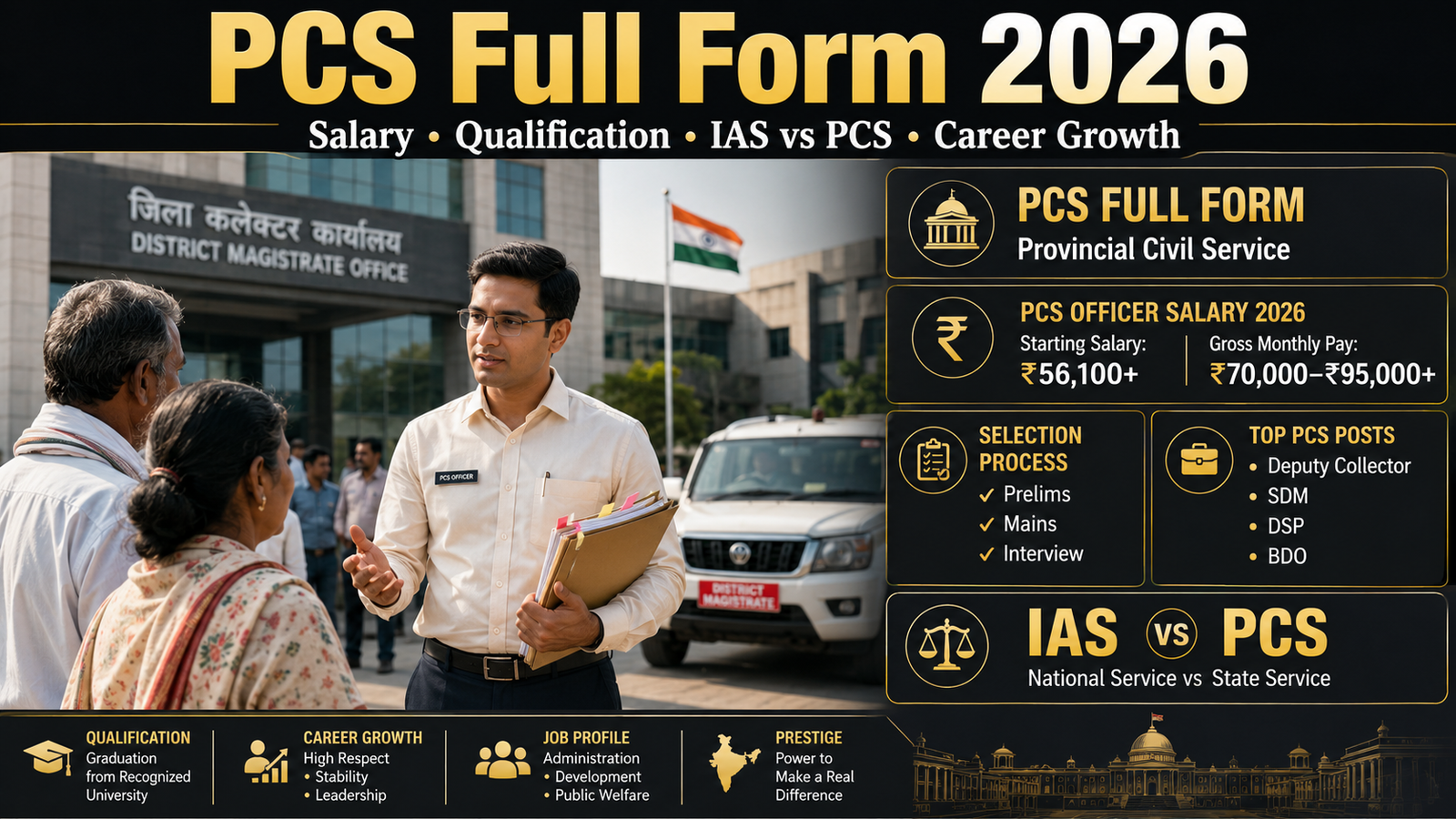
The PCS full form is Provincial Civil Service.
At first glance, that sounds like a standard government designation. In reality, PCS remains one of the most influential state-level administrative services in India.
Every year, lakhs of candidates chase UPSC dreams. Yet many experienced bureaucrats quietly acknowledge a reality rarely discussed online:
A successful PCS officer can wield enormous administrative influence within a state long before many central service officers gain comparable field-level authority.
That distinction matters.
While social media often glorifies IAS officers, the machinery of state administration frequently runs through PCS officers managing revenue administration, law and order, development programs, welfare implementation, and district governance.
If your goal is public administration, policymaking, or a stable government career with long-term promotion potential, understanding PCS is essential.
PCS Full Form in English
PCS Full Form in English: Provincial Civil Service
It is a state-level civil service conducted by State Public Service Commissions such as:
- UPPSC
- BPSC
- MPPSC
- RPSC
- UKPSC
- JPSC
Selected candidates are appointed to administrative and executive posts under state governments.
PCS Full Form in Hindi
PCS Full Form in Hindi: प्रांतीय सिविल सेवा
PCS एक राज्य स्तरीय प्रशासनिक सेवा है जिसके माध्यम से राज्य सरकार विभिन्न प्रशासनिक पदों पर अधिकारियों की नियुक्ति करती है।
What Is the PCS Exam For?
The PCS Exam is a competitive state civil services examination conducted by State Public Service Commissions. It recruits officers for administrative, revenue, police, development, taxation, and executive positions within state governments.
What Is PCS?
PCS is the backbone of state administration.
Most articles stop at definitions.
The more important reality is this:
A PCS officer sits where government policy meets ground-level execution.
Whether it is implementing welfare schemes, maintaining law and order, handling land disputes, supervising elections, or coordinating disaster response, PCS officers are often the first administrative authority citizens interact with.
Think of PCS officers as operational managers of governance.
Politicians may create policies.
Senior bureaucrats may design frameworks.
PCS officers ensure those decisions actually reach the public.
What Is a PCS Officer?
A PCS officer is a gazetted administrative officer recruited through state civil service examinations.
Common PCS positions include:
- Deputy Collector
- Sub Divisional Magistrate (SDM)
- Block Development Officer (BDO)
- District Supply Officer
- Commercial Tax Officer
- Assistant Commissioner
- Deputy Superintendent of Police (DSP)
- Assistant Labour Commissioner
- Municipal Executive Officer
Many PCS officers later get promoted to the Indian Administrative Service (IAS).
PCS Qualification
Educational Qualification
Candidates must possess:
- Bachelor’s Degree from a recognized university
- Final-year students may apply subject to commission rules
Accepted degrees include:
- BA
- BCom
- BSc
- BBA
- BTech
- Professional qualifications recognized by government authorities
Age Limit
Most states follow:
- Minimum Age: 21 Years
- Maximum Age: 40 Years
Reserved categories generally receive age relaxation.
PCS Exam Pattern 2026
The PCS selection process consists of three stages.
Stage 1: Preliminary Examination
Objective-type papers:
- General Studies
- CSAT/Aptitude
Purpose:
- Screening test
- Marks usually not counted in final merit
Stage 2: Mains Examination
Descriptive papers covering:
- Essay
- General Studies
- Language papers
- Optional subjects (varies by state)
Stage 3: Interview
The personality test evaluates:
- Administrative aptitude
- Decision-making ability
- Leadership
- Communication skills
- Public service orientation
PCS Full Form Syllabus Overview
The PCS syllabus generally includes:
Prelims
- History
- Geography
- Polity
- Economy
- Environment
- Current Affairs
- Reasoning
- Mathematics
Mains
- Essay Writing
- Governance
- Ethics
- Administration
- State-Specific Topics
- General Studies
PCS Salary 2026: What Is a PCS Officer Salary?
This is where many candidates focus first.
But salary alone rarely tells the full story.
Entry-Level PCS Salary
| Component | Amount |
|---|---|
| Basic Pay | ₹56,100 |
| DA + HRA + TA | Variable |
| Gross Salary | ₹70,000–₹95,000+ |
Mid-Career Salary
₹80,000 to ₹1.5 lakh+ monthly
Senior Administrative Levels
₹1.5 lakh to ₹2 lakh+ monthly depending on cadre and position.
What Is PCS Officer Salary?
A PCS officer typically starts with a basic salary of ₹56,100 under the 7th Pay Commission. Including allowances, monthly earnings generally range between ₹70,000 and ₹95,000, with significant growth through promotions.
PCS Officer Benefits
Beyond salary, officers receive:
- Government accommodation
- Official vehicle
- Staff support
- Medical facilities
- Pension benefits
- Travel allowances
- Security arrangements (certain posts)
For candidates comparing government careers, PCS compensation often exceeds many roles discussed in our guides on 4 LPA in Hand Salary, IBPS PO Salary, SSC MTS Salary, and Merchant Navy Salary.
Which Is Better IAS or PCS?
There is no universal answer.
The better question is:
Better for what?
If You Want National-Level Impact
IAS is generally superior.
Advantages:
- Central deputation
- National policy exposure
- Faster administrative reach
- Wider authority
If You Want State-Level Influence
PCS can be equally rewarding.
Advantages:
- Deep local governance involvement
- State-specific expertise
- Faster field responsibility
- Strong district-level authority
Many aspirants underestimate how influential senior PCS officers become after decades of service.
IAS vs PCS: Complete Comparison
| Feature | IAS | PCS |
| Recruitment | UPSC | State PSC |
| Authority | National | State |
| Cadre | All India Service | State Service |
| Transfer | Across India | Within State |
| Appointing Authority | President of India | Governor |
| Promotion Scope | Highest Bureaucratic Levels | Promotion to IAS Possible |
| Competition Level | Extremely High | Relatively Lower |
Is PCS Equal to IAS?
No. PCS and IAS are different services. IAS officers belong to an All India Service and have broader jurisdiction, while PCS officers primarily serve within their respective states. However, PCS officers can be promoted to IAS through departmental promotions.
Can PCS Officers Become IAS?
Yes.
This is one of the biggest advantages of PCS.
Through promotion quotas and seniority-based advancement, experienced PCS officers may enter the IAS cadre.
However:
- Promotions are limited
- Waiting periods can be lengthy
- Performance and vacancies matter
Still, thousands of IAS officers have historically entered through state civil services.
State PCS Exams in India
Popular state PCS examinations include:
- UP PCS
- BPSC
- MPPSC
- RPSC
- UKPSC
- HPSC
- JPSC
- CGPSC
Each commission follows its own syllabus and recruitment process.
PCS Full Form in Government
In government administration, PCS refers to Provincial Civil Service officers responsible for:
- Revenue administration
- District governance
- Policy implementation
- Public welfare delivery
- Executive administration
They form one of the most critical layers between citizens and government systems.
Other Meanings of PCS Full Form
Many users search PCS in different contexts.
PCS Full Form Medical
In medical terminology, PCS may refer to:
- Post-Concussion Syndrome
- Pelvic Congestion Syndrome
Meaning depends on context.
PCS Full Form in Kidney
In nephrology, PCS often refers to:
Pelvicalyceal System
This is the urine-collecting system of the kidney.
PCS Full Form Police
In police administration, PCS generally still refers to Provincial Civil Service, though police officers recruited through PCS examinations may serve as DSPs.
1 PCS Full Form
In commerce and inventory management:
PCS = Pieces
Example:
- Quantity: 1 PCS
- Meaning: One Piece
Career Growth of PCS Officers
A typical progression may look like:
- Deputy Collector
- SDM
- Additional District Magistrate
- District-Level Administrative Head
- Divisional-Level Administration
- Promotion to IAS (Eligible Cases)
The long-term growth trajectory is stronger than many private-sector salary benchmarks discussed in articles like 30 LPA In Hand Salary and 50 LPA Salary In Hand because government careers offer stability, pension-linked benefits, and institutional authority.
Common Career Comparisons
Candidates frequently compare PCS with:
The comparison often depends on personal goals rather than salary alone.
Understanding concepts like Full Form of CTC, LPA Full Form, and What Is a Salary Slip can help candidates better evaluate compensation structures across careers.
Are PCS Officers a Good Career Choice in 2026?
Yes, but not for everyone.
Choose PCS if:
- You value public service
- You want administrative authority
- You seek long-term career stability
- You are comfortable with competitive examinations
Avoid pursuing PCS solely for status.
The role involves significant public accountability, political pressure, and operational responsibility.
Those realities rarely appear in motivational videos.
FAQs
What is the PCS Full Form?
PCS stands for Provincial Civil Service.
What is the PCS exam for?
The PCS exam recruits officers for administrative and executive posts under state governments.
What is PCS officer salary?
Starting salary usually begins at ₹56,100 basic pay plus allowances.
Is PCS equal to IAS?
No. IAS is an All India Service, while PCS is a state civil service.
Can a PCS officer become IAS?
Yes. Eligible PCS officers may be promoted to IAS through established promotion channels.
What qualification is required for PCS?
A bachelor’s degree from a recognized university is generally required.
Which is better IAS or PCS?
IAS offers wider national exposure, while PCS provides strong state-level administrative authority.
Conclusion
The PCS full form may simply stand for Provincial Civil Service, but the career itself represents much more than an acronym.
PCS officers occupy one of the most influential positions in state governance. They manage administration where policies meet citizens, making them essential to public service delivery.
For aspirants, the decision should not revolve around prestige alone.
Focus on:
- Administrative interest
- Long-term career goals
- Public service motivation
- State-level governance opportunities
Those who understand these realities often make better career choices than those chasing titles alone.