
Most articles discussing IBPS PO salary make the same mistake.
They stop at the pay scale.
Candidates don’t.
What aspirants really want to know is simple:
How much money reaches your bank account every month, how quickly does income grow, and whether becoming an IBPS PO is still a smart career decision in 2026.
That’s where the real analysis begins.
Because salary alone rarely determines wealth.
Career trajectory does.
A newly recruited IBPS Probationary Officer enters India’s banking system at a compensation level that already exceeds many government jobs.
But the bigger story is what happens over the next 5–10 years through promotions, increments, allowances, and career mobility.
Let’s break down the numbers that actually matter.
IBPS PO Salary 2026: Quick Answer
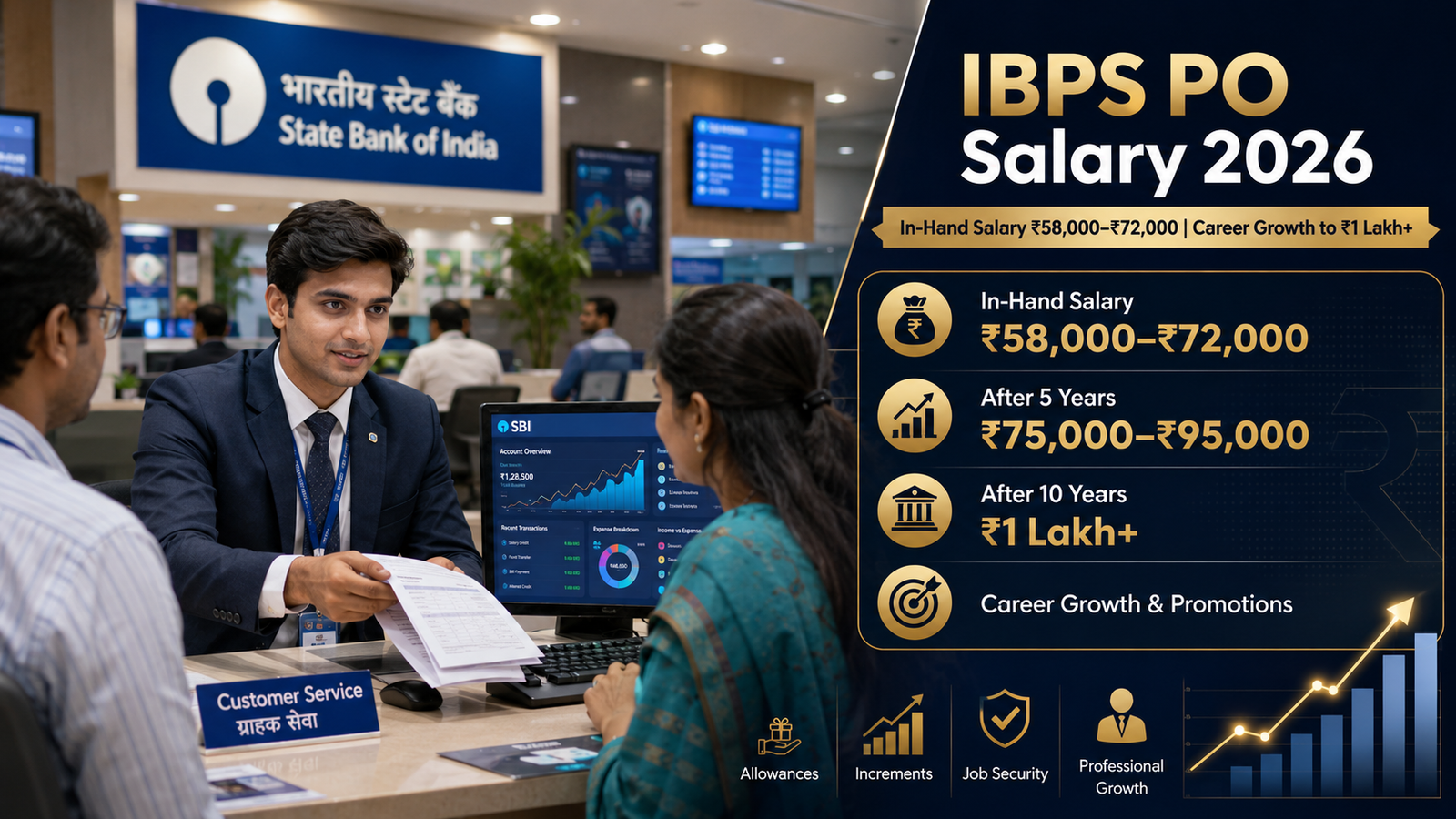
The IBPS PO Salary In-Hand in 2026 is typically between ₹58,000 and ₹72,000 per month, depending on posting location, HRA category, deductions, and allowances.
| Component | Amount |
|---|---|
| Basic Pay | ₹48,480 |
| Dearness Allowance (DA) | Variable |
| HRA | 7%–9% of Basic |
| Special Allowance | Applicable |
| Learning Allowance | Applicable |
| Gross Salary | ₹70,000–₹82,000 |
| In-Hand Salary | ₹58,000–₹72,000 |
The final amount varies from bank to bank under the IBPS recruitment system.
Can IBPS PO Earn ₹1 Lakh Per Month?
Yes.
A newly appointed PO generally does not receive ₹1 lakh in hand immediately.
However, after promotions to Senior Manager or Scale-II Officer and with annual increments, many officers cross ₹1 lakh monthly earnings within 7–10 years, especially in metro postings with higher allowances.
Why Most Salary Articles Miss the Bigger Picture
A common misconception is that government-linked banking jobs provide slow growth.
That was true twenty years ago.
Today, banking compensation grows faster than many traditional government departments because of:
- Annual increments
- Bipartite wage revisions
- Promotion exams
- Performance-linked opportunities
- Transfers to larger branches
The question isn’t whether the starting salary is attractive.
The question is whether the career compounds.
For many officers, it does.
IBPS PO Salary Structure 2026
The current pay scale for IBPS PO follows:
₹48,480 – 2000(7) – 62,480 – 2340(2) – 67,160 – 2680(7) – 85,920
What does this complicated formula mean?
It simply shows how salary grows through periodic increments during service.
A PO starts at ₹48,480 basic pay and gradually moves upward with experience.
This structured progression creates long-term earning visibility, something many private-sector jobs cannot guarantee.
IBPS PO Salary In-Hand 2026
After deductions such as:
- NPS Contribution
- Income Tax
- Professional Tax
- Staff Welfare Charges
Most officers receive:
₹58,000–₹72,000 monthly in-hand salary.
The exact figure depends on:
Posting Location
Metro cities receive higher HRA.
DA Revisions
Dearness Allowance changes periodically.
Bank Policies
Different participating banks may have slight variations in benefits.
If you’re comparing income packages, understanding terms like CTC can help. You can learn more through Salaryinfo’s guide on the full form of CTC and how compensation packages are structured.
IBPS PO Salary Slip: What Does It Look Like?
A typical IBPS PO salary slip includes:
Earnings
- Basic Pay
- Dearness Allowance
- House Rent Allowance
- Special Allowance
- Learning Allowance
- Travel Benefits
Deductions
- NPS
- Income Tax
- Professional Tax
- Welfare Contributions
Understanding a salary slip is crucial because gross salary often looks significantly higher than actual take-home pay. Salaryinfo has also explained what a salary slip or payslip contains and how employees should interpret deductions.
IBPS PO Salary After 2 Years
A newly recruited officer usually receives:
- Annual increments
- DA revisions
- Better branch responsibilities
As a result, monthly in-hand salary often moves toward:
₹65,000–₹78,000 per month
This is where banking starts becoming financially attractive.
The first two years are less about salary and more about building operational banking expertise.
IBPS PO Salary After 5 Years
Direct Answer
After five years, many officers earn between:
₹75,000 and ₹95,000 per month in-hand
depending on:
- Promotion status
- City category
- Bank allocation
- DA revisions
The biggest income jump usually comes from promotions rather than annual increments.
That’s why ambitious officers focus heavily on internal exams.
IBPS PO Salary After 5 Years
Most officers can expect monthly earnings between ₹75,000 and ₹95,000 after five years. Officers who secure promotions early often cross this range faster. Career progression, not starting salary, drives long-term income growth in public sector banking.
IBPS PO Salary After 10 Years
This is where the numbers become interesting.
Many officers by this stage become:
- Scale-II Managers
- Scale-III Managers
- Senior Branch Officials
Monthly earnings can reach:
₹1 lakh to ₹1.5 lakh+
depending on promotion speed and posting.
This is why judging banking careers solely on starting salary creates a misleading picture.
Which Bank PO Gets the Highest Salary?
Among public sector banking jobs, the comparison generally comes down to:
- SBI PO
- IBPS PO
- Regional Rural Bank Officers
SBI PO Advantages
- Higher allowances
- Better overall compensation
- Additional benefits
IBPS PO Advantages
- Larger number of vacancies
- Wider bank participation
- Strong promotion opportunities
As a result, SBI PO salary remains slightly higher, but the gap is often smaller than aspirants assume.
IBPS PO Salary vs SBI PO Salary
| Factor | IBPS PO | SBI PO |
|---|---|---|
| Basic Pay | Similar | Similar |
| Gross Salary | High | Slightly Higher |
| Perks | Good | Better |
| Career Mobility | Strong | Strong |
| Transfers | Moderate | Higher |
| Competition | High | Extremely High |
The salary difference exists.
The career difference is often exaggerated online.
Is IBPS PO a Good Career?
Short Answer
Yes, but not for everyone.
Here’s the honest assessment.
IBPS PO is ideal for candidates seeking:
- Stable income
- Structured promotions
- Pension-linked benefits
- Work-life balance better than many private banking roles
However, it may not suit individuals seeking:
- Rapid wealth creation
- Startup-style growth
- High-performance incentives
The role rewards consistency more than aggression.
That distinction matters.
Is IBPS PO a Good Career in 2026?
IBPS PO remains one of India’s strongest middle-class career options in 2026. It offers stable income, promotion opportunities, banking expertise, and long-term earning growth. For candidates prioritizing security and career progression, it remains highly attractive.
Is IBPS PO Very Difficult?
The answer depends on perspective.
Competition is intense because:
- Lakhs of candidates apply
- Vacancies remain limited
- Multi-stage exams filter candidates
Yet the exam is not impossible.
Most failures come from:
- Inconsistent preparation
- Weak quantitative aptitude
- Poor mock test analysis
Candidates who prepare strategically for 6–9 months often perform significantly better than those relying solely on coaching materials.
IBPS PO Eligibility
Basic eligibility includes:
Educational Qualification
Bachelor’s degree from a recognized university.
Age Limit
Generally:
- 20 to 30 years
Age relaxations apply to reserved categories.
Nationality
Must satisfy IBPS nationality requirements.
IBPS PO Syllabus Overview
The IBPS PO Salary Syllabus is often searched incorrectly.
Salary and syllabus are separate topics.
The IBPS PO examination covers:
Preliminary Exam
- Quantitative Aptitude
- English Language
- Reasoning Ability
Main Examination
- Data Analysis
- General Awareness
- Banking Awareness
- English
- Reasoning
- Computer Aptitude
Interview
Final personality assessment.
The Hidden Advantage Nobody Talks About
Many candidates compare PO salaries with private-sector offers.
That’s reasonable.
But they often ignore career volatility.
A ₹10 LPA private package sounds attractive.
Yet layoffs can erase years of income growth.
A public sector banking career offers:
- Predictable increments
- Promotion channels
- Pension-linked benefits
- Institutional stability
This doesn’t make banking superior.
It makes risk-adjusted comparisons more meaningful.
For context, you can compare income benchmarks through Salaryinfo analyses such as 4 LPA in-hand salary, 30 LPA in-hand salary, and 50 LPA salary in hand to understand how compensation translates into actual monthly earnings.
IBPS PO vs Other Popular Government Careers
Candidates often compare IBPS PO with:
- IPS Officer
- SSC MTS
- SPG Commando
Each offers a different risk-reward profile.
For example, IPS salary in India comes with administrative authority, while SPG Commando salary reflects elite security responsibilities. Meanwhile, SSC MTS salary offers stability but significantly lower growth potential than banking careers.
Which Career Has Better Growth?
Among mainstream government recruitments, banking officer positions generally offer faster income growth than lower-grade administrative roles. Promotions, wage settlements, and banking-sector revisions often accelerate earnings over a 10-year period.
Frequently Asked Questions (FAQ)
What is the IBPS PO salary in hand in 2026?
Most officers receive between ₹58,000 and ₹72,000 monthly after deductions.
Can IBPS PO earn ₹1 lakh per month?
Yes. Many officers cross ₹1 lakh monthly earnings after promotions and experience.
Which bank PO gets the highest salary?
SBI PO generally offers slightly better compensation than IBPS PO.
Is IBPS PO a good career?
Yes. It remains one of India’s strongest public-sector careers for income stability and growth.
What is IBPS PO salary after 5 years?
Many officers earn between ₹75,000 and ₹95,000 per month after five years.
What is IBPS PO salary after 10 years?
Promoted officers can earn ₹1 lakh to ₹1.5 lakh+ monthly depending on grade and posting.
Is IBPS PO difficult to crack?
Competition is high, but disciplined preparation significantly improves success chances.
Conclusion: Should You Choose IBPS PO in 2026?
The biggest mistake candidates make is focusing only on the starting salary.
The smarter question is:
What does the career look like after 5–10 years?
IBPS PO continues to offer:
✔ Strong starting income
✔ Structured salary growth
✔ Promotion opportunities
✔ Pension-linked benefits
✔ Long-term financial stability
No career is perfect.
Banking involves transfers, performance pressure, and customer-facing responsibilities.
But for candidates seeking a balance between income growth and job security, IBPS PO remains one of the strongest career options available in India in 2026.
The salary is attractive.
The real value, however, lies in how that salary compounds over time.
About the Author
Salaryinfo Research Team
Salaryinfo Research Team is a group of career analysts, financial researchers, and compensation experts dedicated to simplifying salary structures, government pay scales, employee benefits, and career growth opportunities across India.
Our team closely tracks salary revisions, government notifications, banking sector updates, pay commission developments, and workforce trends to provide accurate, data-driven insights. Rather than simply reporting salary figures, we analyze what those numbers mean for real-world earning potential, long-term career growth, and financial planning.
At Salaryinfo, we believe that a salary is more than a monthly paycheck—it reflects career progression, industry demand, and future wealth-building opportunities. Every article is researched using official sources, industry reports, and expert analysis to help readers make informed career decisions.
Whether you’re preparing for competitive exams, comparing government jobs, evaluating private-sector opportunities, or planning your financial future, our goal is to provide clear, trustworthy, and actionable salary insights.