
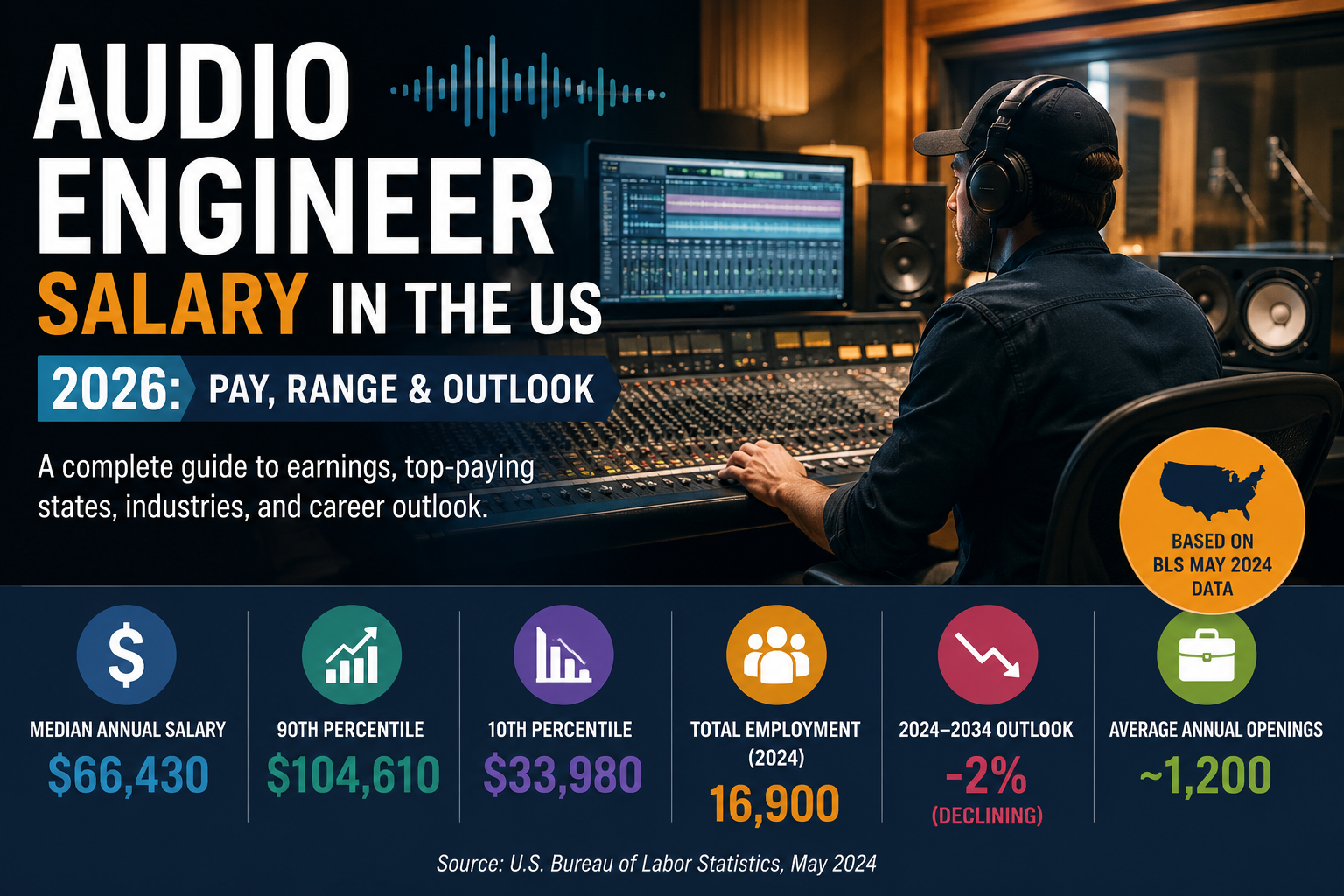
Audio Engineer Salary at a Glance
| Metric | Value |
|---|---|
| Median annual salary | $66,430 |
| Approximate hourly equivalent | $31.94/hour |
| 90th Percentile | $104,610 |
| 10th Percentile | $33,980 |
| Total US employment (2024) | 16,900 |
| 2024–2034 employment outlook | -2% (declining) |
| Average annual openings | ~1,200 |
Source: BLS May 2024
Walk into any recording studio in Nashville, Los Angeles, or New York, and you will find people with the same job title earning vastly different amounts. One engineer might earn well into six figures mixing major-label records, while another might struggle to reach $40,000 running sessions at a local studio. Same title. Same profession. Completely different financial outcomes.
This is the reality of audio engineering in America. Unlike many traditional engineering careers, audio engineering sits at the intersection of art, technology, and freelance work, so earnings can vary considerably. That variation is reflected in the wide spread of reported earnings.
If you are considering this career, the salary data alone won’t tell you what you need to know. You need to understand why the numbers vary so wildly, who earns the high end, and how professionals actually build sustainable incomes.
Salary Distribution: What Audio Engineers Actually Earn
The Bureau of Labor Statistics classifies audio engineers under Sound Engineering Technicians (SOC 27-4014). As of May 2024, the median annual wage for this occupation stood at $66,430.
But medians conceal as much as they reveal.
The full distribution tells a more complete story:
| Percentile | Annual Salary |
|---|---|
| 10th Percentile | $33,980 |
| Median (50th) | $66,430 |
| 90th Percentile | $104,610 |
The bottom 10 percent of sound engineering technicians earn less than $33,980 annually. The top 10 percent earn more than $104,610. That is a spread of over $70,000 between the lowest and highest earners—and that is only counting salaried employees, not freelancers.
SalaryInfo Insight: BLS wage data does not represent self‑employed workers, so it does not capture every income source or every person working under the broader audio‑engineering job title. The true income distribution is likely even more extreme at both ends.
Data note: The latest BLS median wage available for Sound Engineering Technicians is from May 2024. Some state, metropolitan‑area, and industry wage tables referenced below use May 2023 BLS data because those detailed geographic and industry tables are from that release. Salary figures are not directly interchangeable across different data years or methodologies.
Why the Numbers Don’t Match: Understanding the Data Discrepancy
If you search “audio engineer salary” online, you will find figures ranging from $48,000 to over $130,000. Why such dramatic variation?
Different data sources measure different populations:
- BLS OEWS covers employees working for employers. The May 2023 estimate counted about 14,600 Sound Engineering Technicians nationwide, and the wage estimates exclude self‑employed workers.
- Commercial salary databases aggregate self‑reported data from a mix of employees and freelancers, but these samples are self‑selected and not statistically representative.
- Employer job postings often show a range that reflects specific skill requirements, location, and employer size.
- Freelance platforms show rates ranging widely, but freelancers rarely work 40 hours per week at consistent rates.
Which number should you trust?
For salaried, full‑time positions in traditional employment, the BLS median of $66,430 is the most reliable benchmark. For freelance or project‑based work, earnings are inherently variable and depend entirely on client flow, rates, and specialization.
Where This Career Pays the Most
Location is one of the major factors influencing an audio engineer’s salary. The concentration of media, music, and entertainment industries drives both employment and compensation.
Top‑Paying States for Sound Engineering Technicians (May 2023)
| State | Hourly Mean Wage | Annual Mean Wage |
|---|---|---|
| Washington | $53.01 | $110,270 |
| District of Columbia | $43.36 | $90,190 |
| New York | $43.00 | $89,450 |
| New Jersey | $41.42 | $86,150 |
| California | $40.07 | $83,340 |
Source: BLS May 2023
Major Metropolitan Areas (May 2023 BLS Data)
| Metro Area | Hourly Mean Wage | Annual Mean Wage |
|---|---|---|
| Seattle‑Tacoma‑Bellevue, WA | $55.05 | $114,510 |
| San Francisco‑Oakland‑Hayward, CA | $53.65 | $111,600 |
| San Jose‑Sunnyvale‑Santa Clara, CA | $48.58 | $101,050 |
| Trenton, NJ | $48.50 | $100,870 |
| New York‑Newark‑Jersey City, NY‑NJ‑PA | $43.51 | $90,500 |
| Los Angeles‑Long Beach‑Anaheim, CA | $39.51 | $82,180 |
Source: BLS May 2023
Los Angeles is a good example of why salary estimates can vary. Different salary databases may report different figures because they use different job‑title definitions, geographic samples, employer data, and compensation methodologies. For that reason, salary estimates should be treated as benchmarks rather than exact market rates.
Reality Check: High salaries in cities like Seattle, San Francisco, and New York come with significantly higher costs of living. A $110,000 salary in Seattle does not go as far as $85,000 in Nashville or Atlanta. When evaluating offers, always adjust for local housing, taxes, and living expenses.
Industry Matters More Than You Think
The industry you work in can influence your salary, career trajectory, work stability, and long‑term earning potential.
| Industry | Employment | Hourly Mean Wage | Annual Mean Wage |
|---|---|---|---|
| Motion Picture and Video Industries | 3,980 | $48.07 | $99,990 |
| Software Publishers | 310 | $61.76 | $128,470 |
| Sound Recording Industries | 2,400 | $28.38 | $59,040 |
| Radio and Television Broadcasting | 650 | $28.65 | $59,590 |
| Promoters of Performing Arts, Sports, and Similar Events | 770 | $27.55 | $57,300 |
Source: BLS May 2023
Motion picture and video is the largest employer of sound engineering technicians, employing nearly 4,000 professionals at an average wage of $99,990. **Software publishers** pay the highest average wages—$128,470—reflecting demand for audio roles in software, gaming, interactive media, and digital products.
Sound recording industries—the traditional “studio” jobs—pay significantly less at $59,040 on average, despite employing the second‑largest number of audio engineers. This is the reality of the music industry: prestige does not always pay.
Video games and interactive media represent a rapidly growing opportunity. Industry surveys commonly show higher compensation ranges for experienced game‑audio professionals, with specialized sound designers and audio directors commanding premium rates.
How Experience Changes Your Earnings
Audio engineering is a profession where experience compounds—but not in the linear way most careers experience salary growth.
The early years can be financially challenging.
The bottom 10 percent of sound engineering technicians earn less than $33,980 annually, illustrating how low compensation can be at the lower end of the profession. Early‑career engineers may earn substantially less than the median while building experience, a portfolio, and industry connections. They may also spend time in internships, assistant roles, or other lower‑paid positions before moving into higher‑responsibility work.
Mid‑career can be a period of faster income growth.
Engineers with strong portfolios and established client relationships see their earnings jump significantly.
The ceiling is real—and not everyone breaks through.
The top 10 percent earn over $104,610. But reaching that level requires a combination of deep experience, strong specialization, a proven portfolio, established industry relationships, and often—work in a high‑cost media market.
Here is what the career ladder actually looks like:
| Career Stage | Typical Annual Income | What Changes |
|---|---|---|
| Assistant / Intern | $25,000–$35,000 | Learning workflows, building connections |
| Junior Engineer | $35,000–$50,000 | Running sessions independently |
| Staff Engineer | $50,000–$75,000 | Consistent work, employer benefits |
| Senior Engineer | $75,000–$110,000 | Specialization, client relationships |
| Lead / Supervising Engineer | $100,000–$150,000+ | Project leadership, higher‑value work |
Illustrative salary ranges based on career stage; actual compensation varies by market, specialty, employment type, and experience.
SalaryInfo Career Strategy: The biggest salary jump for audio engineers often comes not from staying with one employer but from moving between employers or transitioning from staff to freelance work—or vice versa. Each transition resets your market rate.
Freelance vs. Staff: The Fundamental Choice
Freelance and independent‑contract work are important parts of the audio engineering profession, particularly in music, live events, post‑production, and project‑based work. This has profound implications for income.
Freelance audio engineers set their own rates. Rates vary widely—newer engineers may charge modest project or hourly rates, while established specialists with strong credits can command substantially higher fees. Freelancers may have the potential to earn higher rates per hour than staff engineers, particularly when they have specialized skills and an established client base. But they also face:
- No guaranteed hours or income
- No employer‑provided health insurance
- No paid time off or sick leave
- No retirement contributions
- Unpredictable client flow
- Self‑employment taxes
Staff engineers trade some income potential for stability. The BLS data shows that employed sound engineering technicians have a median wage of $66,430. Staff roles may also provide benefits such as health insurance, paid time off, and retirement contributions, depending on the employer. But staff engineers are generally subject to employer salary bands and annual compensation cycles.
Freelance and project‑based opportunities remain an important part of the profession, and they can provide additional income streams as traditional salaried positions change.
Which path should you choose?
There is no universal answer. Early‑career professionals often benefit from staff positions that provide training, mentorship, and stability. Mid‑career professionals with strong networks often transition to freelance to capture higher rates. A hybrid model—staff work supplemented by freelance projects—can provide a useful balance of stability and additional income.
AI and Audio Engineering: Threat or Tool?
AI is reshaping audio engineering—but not in the way most people fear.
AI is increasingly automating portions of audio workflows, particularly repetitive tasks such as noise reduction, restoration, transcription, editing assistance, and automated mastering.
What this means in practice:
AI tools are accelerating workflows, not replacing engineers. Automated mastering services and AI‑powered noise reduction are becoming standard tools—but they still require human oversight for creative decisions.
The BLS projects employment for sound engineering technicians to decline by about 2% from 2024 to 2034. The BLS itself notes that technological advances, including AI, may reduce demand for these technicians.
SalaryInfo Market View: AI is unlikely to eliminate the profession outright, but it will change which skills are most valuable. Engineers who use AI effectively may be better positioned to handle routine work efficiently while focusing more time on creative and complex tasks. Those who resist AI adoption may find themselves competing with tools that work faster and cheaper.
Career Outlook: Where the Jobs Are
The job market for audio engineers is shifting.
Declining areas:
- Traditional recording studios (consolidation continues)
- Local radio stations (automation and syndication)
- Small independent labels (budget constraints)
Growing areas:
- Podcasting and digital content: Podcasting and digital content continue to create demand for audio editing, mixing, and post‑production services.
- Video games and interactive media: Spatial audio and interactive sound design are driving demand.
- Streaming and digital content: YouTube creators, Twitch streamers, and independent content producers increasingly hire audio professionals.
- Corporate AV and live events: Conferences, corporate streaming, and virtual events require skilled sound engineers.
- Film and television post‑production: Film and television post‑production remain important areas for audio professionals, while changes in streaming and digital distribution continue to reshape demand.
The total number of salaried sound engineering technician jobs declined from its 2017 peak. Freelance and contract work can provide additional opportunities as traditional salaried positions change.
Continued growth in streaming, podcasting, gaming, and digital content could support demand for audio services, although automation may change how much work is handled by individual engineers.
What Employers Actually Value (Beyond the Degree)
Ask any studio owner or post‑production supervisor what they look for in an audio engineer, and the answer rarely starts with “a degree.”
Skills that drive higher compensation:
- DAW proficiency: Pro Tools remains the industry standard. Logic Pro, Ableton Live, and Cubase are valuable in specific niches. Strong proficiency in at least one DAW is generally essential.
- Signal flow and troubleshooting: The ability to diagnose and fix audio problems quickly—especially in live settings—commands premium rates.
- Networking and client management: Technical skill alone does not build a career. Successful engineers often combine technical ability with strong communication and relationship‑building skills.
- Specialization: Specialists can command higher rates when their expertise is scarce and in demand. Engineers who focus on specific genres (hip‑hop, classical, EDM), specific industries (gaming, film, podcasting), or specific roles (mixing, mastering, dialogue editing) often see stronger earning potential.
- Portfolio and credits: Your past work is your resume. Credits on recognizable projects—even small ones—open doors.
Does a degree matter?
A four‑year college degree is not listed as the typical entry‑level education for sound engineering technicians. BLS lists a postsecondary nondegree award as the typical education needed for entry. Many successful engineers are self‑taught or learned through apprenticeships. However, formal audio engineering programs can accelerate career entry and provide valuable networking opportunities.
SalaryInfo Observation: The correlation between education and income for audio engineers is weaker than in many other professions. Experience, portfolio, and professional network matter more than credentials. A degree can help you get your first job; it will not determine your ceiling.
The Biggest Salary Myth About This Career
Myth: “Audio engineers make six figures right out of school.”
Reality: The top 10 percent earn over $104,610. But reaching that level typically requires a combination of deep experience, strong specialization, a proven portfolio, established industry relationships, and often—work in a high‑cost media market.
The median salary of $66,430 is a useful benchmark for salaried sound engineering technicians, but individual pay varies substantially by experience, industry, location, and specialization. Early‑career engineers often start much closer to the bottom of the pay scale.
The six‑figure salaries you see on job boards and salary sites are real—but they represent the top tier of the profession, not the average.
Myth: “Freelance audio engineers earn more than staff engineers.”
Reality: Freelancers can earn more—but they also face income volatility, no benefits, and higher self‑employment taxes. A freelancer charging a strong hourly or project rate might gross $150,000 per year—but after taxes, health insurance, retirement contributions, and unpaid downtime, net income may be significantly lower than a staff engineer earning $90,000 with full benefits.
Hidden Income: What Salary Surveys Don’t Tell You
Salary surveys capture base pay. They often miss:
- Bonuses and profit‑sharing: Some studios and post‑production houses offer performance bonuses.
- Overtime: Live sound and event engineers frequently earn overtime pay.
- Per diems and travel allowances: Touring engineers often receive daily per diems and travel expenses.
- Equipment stipends: Some employers provide allowances for personal gear.
- Royalties: A small number of engineers receive points on recordings—though this is increasingly rare.
- Teaching and consulting: Many engineers supplement their income with teaching, workshops, or consulting.
SalaryInfo Career Strategy: When evaluating a job offer, look beyond the base salary. Benefits—health insurance, retirement contributions, paid time off—can add 20–30% to total compensation. For freelancers, factor in self‑employment taxes (15.3% vs. 7.65% for employees) and the cost of purchasing your own benefits.
What Higher‑Earning Audio Engineers Have in Common
Audio engineers earning well above the typical salary range often share several characteristics:
- They work in high‑value industries: Film and television are among the higher‑paying industries in the BLS data, while specialized game‑audio roles may offer strong earning potential.
- They are specialized: Mastering engineers, dialogue editors, and sound designers for AAA games command premium rates.
- They are in major markets: Los Angeles, New York, San Francisco, Seattle, and Nashville concentrate the highest‑paying jobs.
- They have established reputations: Credits on recognizable projects create a “brand” that attracts higher‑paying clients.
- They have diversified income streams: Many top earners combine staff salaries, freelance projects, royalties, teaching, and consulting.
The ceiling is not fixed. Engineers who continually upgrade their skills, expand their networks, and pursue higher‑value work can push past the typical salary bands.
What the Next Five Years Could Change
Several trends will shape audio engineer salaries through 2030:
Freelance and contract work: Freelance and contract work are likely to remain important parts of the profession, particularly as employers and media companies adjust staffing models.
AI integration: AI tools will become more sophisticated, automating routine tasks and allowing engineers to work faster and take on more projects. This could increase per‑project profitability—or decrease rates if automation leads to oversupply.
Content explosion: The continued growth of streaming, podcasting, gaming, and digital content will create demand for audio engineering services.
Consolidation: Major media companies continue to consolidate, potentially reducing the number of staff positions while increasing demand for freelance and contract workers.
Spatial audio: The shift toward immersive audio formats (Dolby Atmos, Sony 360 Reality Audio) creates new opportunities—and new skill requirements—for audio engineers.
Professional Recommendations: How to Maximize Your Earnings
If you are considering entering the profession:
- Learn the business, not just the gear. Technical skills are table stakes. Understanding client management, project pricing, and contract negotiation differentiates successful engineers.
- Build a portfolio early. Start recording, mixing, and mastering—even if it is for free—to build a body of work.
- Build your professional network consistently. Relationships play an important role in the audio industry. Attend industry events, join professional organizations, and connect with working professionals.
- Consider a staff position first. Staff roles provide stability, training, and benefits while you build your skills and network. Transition to freelance once you have a client base.
- Specialize. Generalists often compete on price; specialists can compete on expertise.
If you are already working in the profession:
- Know your market rate. Research salaries for your role, experience level, and location. Use multiple sources—BLS, industry surveys, and employer job postings.
- Negotiate. Many engineers accept the first offer. Employers expect negotiation. Prepare a case based on your skills, experience, and market data.
- Diversify your income. Combine staff work with freelance projects. Teach. Consult. Create content. Multiple income streams provide stability and growth.
- Keep learning. AI tools, new DAWs, and emerging formats (spatial audio, VR/AR) are changing the profession. Engineers who adapt may be better positioned to remain competitive as the profession evolves.
- Consider relocation. If you are in a low‑paying market, moving to a major media hub can dramatically increase your earning potential—but factor in cost of living.
FAQs
Do audio engineers make good money?
It depends entirely on experience, location, industry, and employment type. The median annual salary for sound engineering technicians is $66,430. Top earners make over $104,610, while those at the lower end of the profession earn around $33,980. Freelance engineers have higher earning potential but face income volatility and no benefits.
Do audio engineers need a degree?
A four‑year college degree is not listed as the typical entry‑level education for sound engineering technicians. BLS lists a postsecondary nondegree award as the typical education needed for entry. Many engineers are self‑taught or learn through apprenticeships.
What do audio engineers do?
Audio engineers assemble and operate equipment to record, synchronize, mix, edit, or reproduce sound for theater, video, film, television, podcasts, sporting events, and other productions. They set up microphones and recording equipment, monitor sound quality, mix multiple audio tracks, apply effects, and collaborate with producers, artists, and directors.
Which audio engineer makes the most money?
There is no single audio‑engineering specialty that universally pays the most. Higher compensation is often found in specialized roles such as film and television post‑production, game audio, high‑end mixing and mastering, and technical audio positions supporting digital products. The BLS industry category for software publishers shows the highest average wage among the listed industries at $128,470, although this figure covers the broader industry and is not an audio‑engineer‑specific salary.
What is the highest‑paying state for audio engineers?
Washington pays the highest average wages at $110,270 per year, followed by the District of Columbia ($90,190) and New York ($89,450). However, high salaries in these states come with significantly higher costs of living.
Is audio engineering a declining career?
The BLS projects employment for sound engineering technicians to decline by about 2% from 2024 to 2034. Salaried positions have declined from their 2017 peak, while freelance and contract work remain important parts of the profession.
Can audio engineers make six figures?
Yes. The top 10 percent of sound engineering technicians earn over $104,610 annually. Reaching six figures typically requires significant experience, specialization, a strong portfolio, established industry relationships, and access to higher‑paying markets or industries.
What is the difference between an audio engineer and a sound engineering technician?
The terms are often used interchangeably. The BLS uses “Sound Engineering Technicians” as the official occupational title (SOC 27-4014), which encompasses the work commonly referred to as audio engineering.
Is audio engineering a good career for 2026?
It depends on your goals and expectations. Audio engineering offers creative work, flexibility, and the potential for strong earnings at the top end. However, it requires patience, networking, and often years of low pay before reaching higher income levels. It is not a path to guaranteed wealth or stability.
SalaryInfo Editorial Verdict
Audio engineering offers genuine earning potential—but it is not a path to guaranteed wealth. The profession rewards:
- Technical mastery (knowing your tools inside and out)
- Business acumen (understanding pricing, negotiation, and client management)
- Networking (relationships drive opportunities)
- Adaptability (the industry changes constantly)
The median salary of $66,430 is above the $49,500 median annual wage for all U.S. occupations in 2024, but audio engineering has a much wider range of earnings depending on specialization, location, industry, and employment type. The gap between top and bottom earners is enormous, and differences in specialization, industry, location, experience, and career choices can play a major role.
The engineers who earn six figures do not simply do the work. They actively manage their careers, cultivate relationships, specialize in high‑value niches, and adapt to industry changes. They treat audio engineering as a business, not just a craft.
If you are willing to do that, the ceiling is higher than most people think. If you are not, the floor is lower than you might expect.
Compare Audio Engineer Salary to Other Careers
📚 Data Sources: Bureau of Labor Statistics Occupational Employment and Wage Statistics (May 2023, May 2024).