
Minor League Baseball Salary
The narrative around minor league baseball pay has shifted dramatically—but not in the way most fans assume.
Between 2019 and 2025, the minimum annual salary for a Rookie-level player jumped from $3,480 to $20,430. A Triple-A player went from $11,044 to $36,590. Those are percentage increases of 487% and 231%, respectively.
Yet the question isn’t simply “how much do they make?” The real question is: what does this salary actually buy you in 2025, and can you build a career on it?
The Salary Reality Check
Here’s what most people get wrong about minor league baseball compensation: they compare it to major league salaries. That’s a meaningless comparison.
The major league minimum salary in 2025 was $760,000. The average MLB salary reached about $4.72 million in 2025, according to MLBPA data. Comparing a Triple-A player earning $36,590 to a big leaguer is like comparing a resident physician to a neurosurgeon—same profession, entirely different economic reality.
The more useful comparison is with other early-career professional paths. A Triple-A player earning $36,590 remains below many conventional full-time career salaries, even before considering the unusual seasonality and career uncertainty of professional baseball.
The 2025 pay scale represents a major improvement in minor league compensation, but whether it provides a comfortable living depends heavily on housing, location, and a player’s individual circumstances.
How Much Do Minor League Baseball Players Make in 2025?
For players on standard minor-league contracts, the CBA establishes minimum weekly rates by level. Players with different contract or roster status can earn more—we’ll cover that separately.
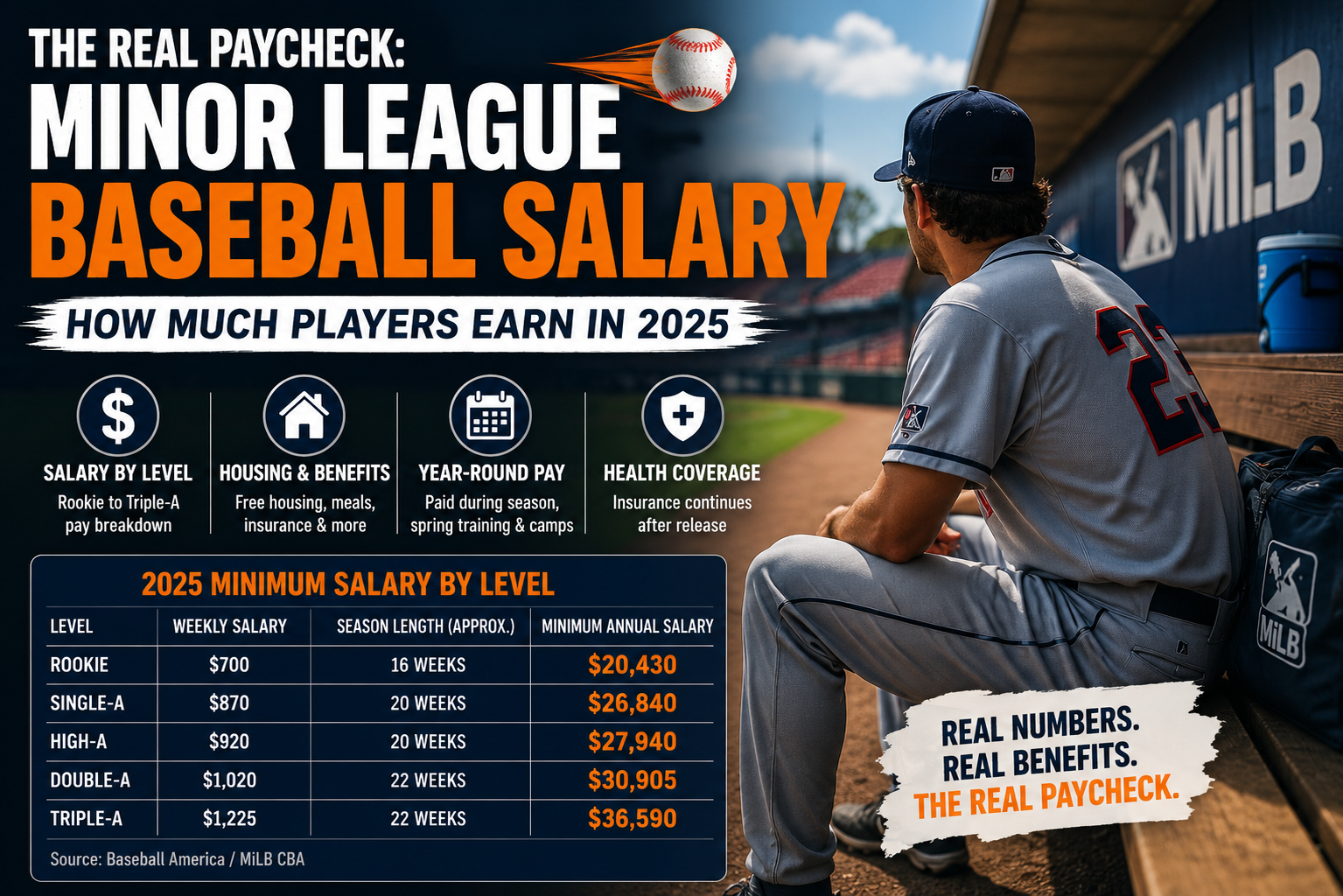
2025 Minor League Baseball Salary by Level
| Level | 2025 Weekly Salary | Season Length (Approx.) | 2025 Minimum Annual |
|---|---|---|---|
| Rookie | $700 | 16 weeks | $20,430 |
| Single-A | $870 | 20 weeks | $26,840 |
| High-A | $920 | 20 weeks | $27,940 |
| Double-A | $1,020 | 22 weeks | $30,905 |
| Triple-A | $1,225 | 22 weeks | $36,590 |
Source: Baseball America / MiLB CBA
What the Annual Numbers Actually Mean
These annual figures should not be interpreted as a simple weekly rate multiplied by the number of regular-season weeks. The compensation structure also includes paid training periods and excludes the December–January dead period. Promotions and demotions happen constantly—a player who starts in Double-A and moves to Triple-A will earn the Double-A rate for part of the season and the Triple-A rate for the remainder.
Key Takeaway: The annual figures are minimums, not guarantees. If you spend half the season on the injured list or get released, your actual earnings will be lower.
Year-Round Pay: The Game Changer
Before 2023, players were only paid during the regular season. Spring training? Unpaid. Offseason workouts? Unpaid.
In 2025, players receive:
- $650 per week for spring training
- $650 per week for offseason camps
- $255 per week for mandated offsite training
Players are now paid during the regular season, spring training, and qualifying offseason periods, with the December–January dead period remaining unpaid. That’s a fundamental shift from the pre-2023 model where players had no income for roughly eight months of the year.
The shift to year-round pay is arguably more significant than the per-week increases. A player who previously earned $11,000 for a season and nothing for the other eight months now has predictable income across most of the calendar year. That changes everything about financial planning, housing stability, and the ability to commit to the career long-term.
The Benefits That Change the Math
Salary numbers tell only part of the story. The benefits package in 2025 transforms the economic reality of playing minor league baseball.
Housing: From Host Families to Professional Accommodation
In 2025, the CBA mandates that teams provide furnished housing for their players.
The housing policy requires:
- Single beds, maximum two players per bedroom
- Furnished accommodations
- Utilities covered by the club
- Reasonable commuting distance to the ballpark
Why this matters: In 2019, players often lived with host families or scrambled to find affordable housing on $290-per-week salaries. A $1,200 monthly apartment in a mid-sized city would consume an entire week’s pay. Free housing can represent a substantial additional economic benefit, particularly in higher-cost markets where rent and utilities would otherwise consume a large share of a player’s income. The actual value varies considerably by location and housing arrangement.
Meals and Per Diem
Players receive:
- Two meals per day (one pre-game, one post-game)
- $31.50 daily per diem for expenses
The per diem applies to road trips and days when meals aren’t provided. In 2019, the per diem was $25.
Health Insurance
Perhaps the most overlooked benefit: health insurance now continues for two to three months after a player is released.
Previously, coverage ended the day a player was cut. Given the turnover rate in minor league baseball—where most players are released within a few years—this change provides a critical safety net.
Name, Image, and Likeness (NIL)
Players now control their own NIL rights. This is a relatively new development in minor league baseball, and while most players won’t earn significant NIL income, the option exists—particularly for top prospects with followings.
SalaryInfo Career Strategy: When evaluating a minor league offer, look beyond the weekly salary. The housing provision alone can be worth thousands annually. The health insurance extension provides protection worth thousands more. The total compensation package in 2025 is substantially larger than the base salary suggests.
What About Veteran and 40-Man Roster Players?
The $36,590 Triple-A figure is the 2025 minimum for players on standard minor-league contracts. But a separate tier exists for players with major league experience or those on the 40-man roster.
40-Man Roster Players in the Minors
Players on the 40-man roster who are assigned to the minors earn a minimum of:
| Year | Minimum Salary |
|---|---|
| 2025 | $62,000 |
| 2026 | $63,600 |
Source: MLB CBA
Players on a Second Major League Contract
Veterans who have signed a second major league contract and are playing in the minors earn significantly more:
| Year | Minimum Salary |
|---|---|
| 2025 | $123,900 |
| 2026 | $127,100 |
Source: MLB CBA
Most players on standard minor-league contracts do not spend their careers in the higher-paid contractual tiers associated with 40-man-roster or major-league contracts.
The Pre-2023 Reality: Why This Matters
To understand why 2025 represents a revolution, look at what changed.
2019: The Baseline
| Level | Weekly Salary | Annual Salary |
|---|---|---|
| Rookie | $290 | $3,480 |
| Low-A | $290 | $6,380 |
| High-A | $290 | $6,380 |
| Double-A | $350 | $7,700 |
| Triple-A | $502 | $11,044 |
Source: Baseball America
In 2019:
- No pay for spring training or offseason work
- No guaranteed housing
- No meals provided
- Health insurance ended on release day
- Teams controlled NIL rights
A Rookie-level player in 2019 earned $3,480 for a season and nothing for the rest of the year. That’s below the federal poverty line for a single person ($12,490 in 2019).
2021: The First Step
The 2021 season brought the first meaningful increases:
| Level | Weekly Salary | Annual Salary |
|---|---|---|
| Rookie | $400 | $4,800 |
| Low-A | $500 | $11,000 |
| High-A | $500 | $11,000 |
| Double-A | $600 | $13,800 |
| Triple-A | $700 | $17,500 |
Source: Baseball America
2023: The CBA That Changed Everything
In March 2023, minor league players ratified their first-ever collective bargaining agreement. The first minor league CBA covers the 2023–2027 seasons and established:
- Doubled salaries across all levels
- Year-round pay
- Mandated housing and meals
- Extended health insurance
- Annual salary increases
The 2023 CBA didn’t just change salaries—it changed the status of minor league players from seasonal apprentices to year-round professional employees. That shift in classification has ripple effects beyond pay, affecting everything from housing stability to long-term financial planning.
2026 Update
The current CBA runs through the 2027 season, with scheduled annual increases baked in. For 2026, Baseball America reports spring training and offseason camp rates at $660 per week, with standard-contract Triple-A players earning roughly $30,000 in-season and maximum standard-contract earnings reaching about $44,000–$45,000 after additional paid periods.
However, the bigger story beyond 2025 is not the incremental pay bumps—it’s the continued professionalization of the minor leagues. The housing standards, health insurance continuity, and year-round pay are now baked into the system. Future negotiations could address compensation, living conditions, and other player benefits, but the terms of any new agreement are not yet known.
SalaryInfo Outlook: The most significant change for players entering the system in 2025 is not the exact weekly rate—it’s the certainty that they can plan a year-round budget, secure housing, and access healthcare without the existential anxiety that plagued previous generations.
What This Means for Your Career Decision
Whether you’re a player, a parent, or a scout, here’s what the 2025 salary structure tells you about the economics of minor league baseball.
For Players Considering the Draft
The 2025 pay scale makes minor league baseball a viable but not comfortable career choice.
- Single players can live on the salary with housing provided
- Players with families will struggle—$36,590 with dependents is near the poverty line in most states
- Players in high-cost areas (California, New York) will find the money doesn’t go far
- The real value is in the benefits package, not the base salary
For Parents of Prospects
The 2025 structure means your child can pursue professional baseball without starving. But the career still carries substantial risk:
- Most players never reach the majors
- The physical toll of baseball can shorten careers
- Post-baseball career planning is essential
For Scouts and Organizations
Higher salaries and better benefits mean:
- Players can focus more on development and less on survival
- Turnover may decrease as players can afford to stay in the system
- The talent pool may deepen as baseball becomes a more viable career option
SalaryInfo Verdict
The 2025 minor league baseball salary structure represents a genuine breakthrough.
A Rookie-level player earning $20,430 with housing, meals, health insurance, and year-round pay is in a fundamentally different economic position than the 2019 player earning $3,480 with nothing else.
But let’s not romanticize it.
A Triple-A player earning $36,590 remains below the median U.S. income, highlighting how modest minor-league earnings can be even at the highest level below MLB. To put that in perspective, see our guide to the average salary in the U.S. for broader career comparisons.
The difference is the upside. A Triple-A player has a chance to reach the majors, where the 2025 minimum salary was $760,000. That potential jump in earnings is a major part of the incentive structure.
The minor league salary structure in 2025 is best understood as a subsistence wage with a lottery ticket attached. It’s enough to survive and pursue the dream. It’s not enough to build a life on unless you win the lottery.
For players who understand this trade-off and plan accordingly, minor league baseball is a more viable career path than ever before. For those who don’t, the economics remain challenging.
Frequently Asked Questions
What is the lowest minor league baseball salary in 2025?
The lowest standard salary in 2025 was $700 per week for Rookie-level players, with a listed minimum annual salary of $20,430. Players on different contractual arrangements can earn more. For comparison, the 2025 MLB minimum salary was $760,000 for players on the major league roster under the applicable MLB contract.
Do minor league baseball players have day jobs?
In 2025, fewer players need day jobs than in previous years. The combination of year-round pay, housing, and meals means most players can focus exclusively on baseball during the season and offseason training periods. However, many players still work during the December–January “dead period” when they are not paid and cannot be contacted by their organizations. During the offseason, some players also teach lessons, work at baseball academies, or take on seasonal work to supplement their income.
Do minor league players get housing?
Yes. Under the current minor-league CBA, teams are required to provide furnished housing for their players. The housing must include single beds (maximum two players per bedroom), be furnished, and have utilities covered by the club. This replaced the previous system where players often lived with host families or found their own housing.
Who was the first MLB player to earn $1,000,000 a year?
Nolan Ryan became the first MLB player to earn $1 million per season when he signed a contract with the Houston Astros in 1979. The contract was worth $1 million per year for four years. Adjusted for inflation, that’s approximately $4.3 million in 2025 dollars. For context, the 2025 MLB minimum salary of $760,000 is approaching Ryan’s historic $1 million figure in nominal terms.
How much do Double-A baseball players make?
Double-A players in 2025 earn $1,020 per week during the season. With a season of approximately 22 weeks, the minimum annual salary is $30,905. They also receive $650 per week for spring training, $650 per week for offseason camps, and $255 per week for offsite training. Housing, meals, and health insurance are provided.
What is the highest minor league baseball salary?
There is no single maximum salary for all minor league players because compensation depends on the player’s contract and roster status. Players on standard minor-league contracts have much lower salary ranges, while veterans and players on major league contracts can earn substantially more. Under the 2025 CBA, players signing a second or subsequent major league contract had a $123,900 minimum for minor-league service.
How much do Triple-A baseball players make?
Triple-A players in 2025 earn $1,225 per week during the season. With a season of approximately 22 weeks, the minimum annual salary is $36,590. They also receive $650 per week for spring training, $650 per week for offseason camps, and $255 per week for offsite training. Housing, meals, and health insurance are provided. Triple-A is the highest level of minor league baseball and the final step before the major leagues.
Are minor league players paid year-round?
Not entirely. Players are paid during the regular season, spring training, and offseason camps. However, there is a “dead period” between December and January when players cannot be contacted by their organizations and are not paid. For the rest of the year, players receive weekly paychecks: $650 per week for spring training and offseason camps, and $255 per week for mandated offsite training. This represents a significant improvement from 2019, when players were only paid during the regular season.