
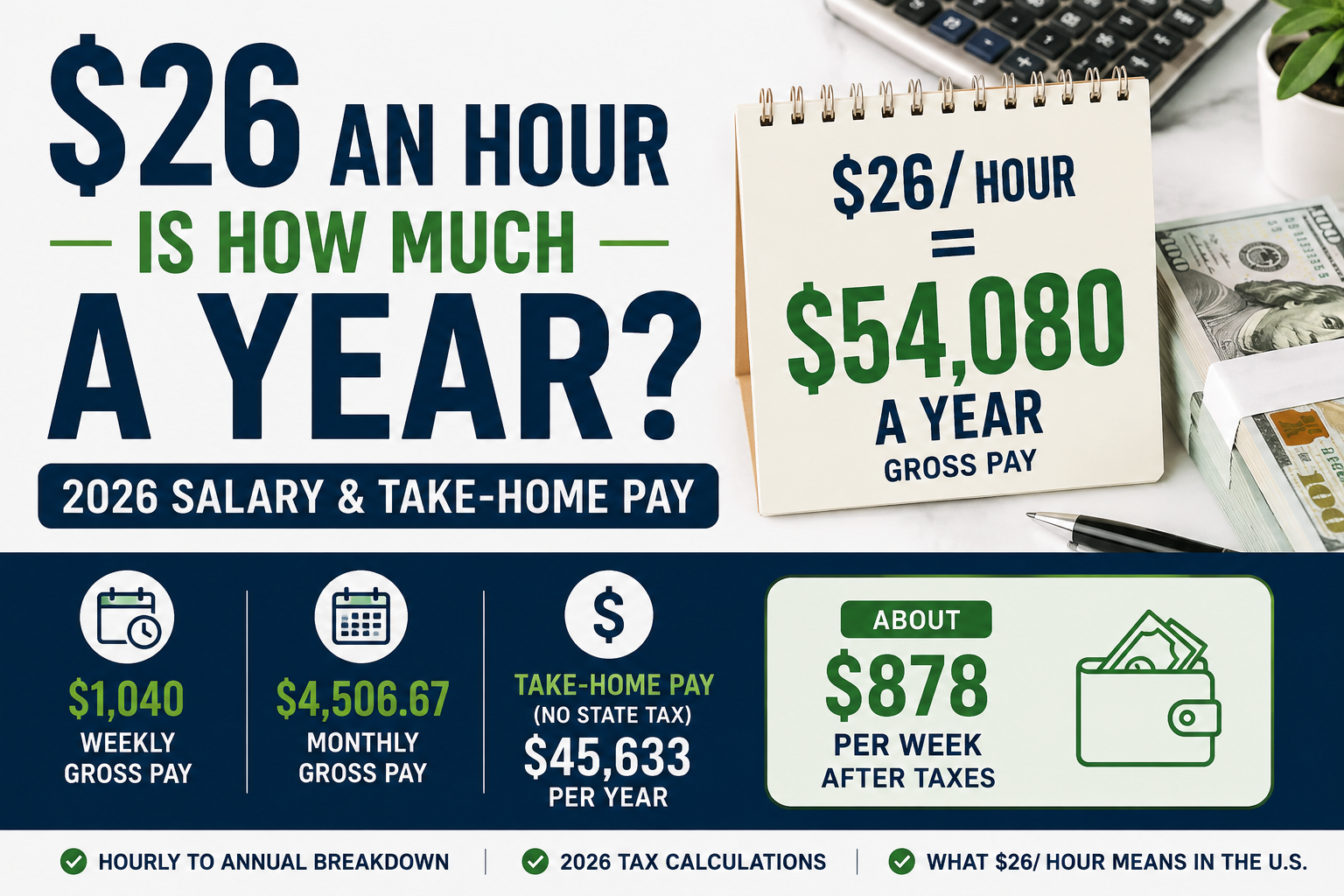
26 Hourly to Salary is $54,080 a year before taxes, assuming 40 hours a week and 52 weeks a year. After federal income tax and FICA (Social Security and Medicare), a single filer takes home approximately $45,633 per year — about $878 per week — in states with no income tax. In states with income taxes, take-home is lower. Use a state-specific tax calculator for an accurate estimate.
That $54,080 number is the starting point. What you actually keep depends on where you live, how you’re paid, and your career trajectory. For many workers, $26 an hour sits in a middle ground — above the national median wage but below what feels comfortable in high-cost coastal cities.
The $26/Hour Salary Snapshot
At 40 hours per week, 52 weeks per year:
| Pay Period | Gross Pay |
|---|---|
| Hourly | $26.00 |
| Daily (8 hours) | $208.00 |
| Weekly | $1,040.00 |
| Bi-weekly | $2,080.00 |
| Semi-monthly | $2,253.33 |
| Monthly | $4,506.67 |
| Annual | $54,080.00 |
If you work fewer hours, the numbers shift accordingly. At 30 hours per week, annual gross drops to $40,560; at 35 hours, it’s $47,320. Overtime changes the math dramatically — at $26/hour, overtime pays $39 per hour (time-and-a-half) after 40 hours.
Reality Check: The $54,080 figure assumes you work 40 hours every week, 52 weeks per year, with no unpaid time off. If you take unpaid leave, your actual gross will be lower. If you work overtime regularly, it will be higher. For a detailed breakdown of your specific situation, try our Income Tax Calculator to estimate your unique take-home pay.
What You Actually Take Home: The 2026 Tax Reality
$54,080 sounds solid. But federal taxes take a meaningful bite.
For 2026, a single filer using the standard deduction of $16,100 falls into the 12% federal tax bracket on a significant portion of their income. Add FICA (Social Security at 6.2% and Medicare at 1.45%, totaling 7.65%), and here’s the math:
- Gross: $54,080
- Standard deduction: $16,100
- Taxable income: $37,980
- Approximate federal income tax: $4,310
- FICA (Social Security + Medicare): $4,137
- Estimated net (no state tax): $45,633
SalaryInfo InsightThe gap between gross and net — roughly $8,400 per year — is one of the most misunderstood aspects of hourly-to-salary conversions. Many workers budget based on the $54,080 figure. The result? A $700-per-month shortfall. Always budget on net, not gross.
Methodology note: These estimates assume a single filer taking the standard deduction, with no pre-tax deductions (like 401(k) contributions), no tax credits, and no state income tax. Actual take-home pay varies based on individual circumstances.
How State Taxes Change Your Take-Home Pay
State income tax is where the numbers diverge significantly. However, effective state tax rates are often much lower than the top marginal bracket. For example, a state with a 9.3% top marginal rate does not apply that rate to your entire income; the effective rate is considerably lower due to progressive brackets and deductions.
In general:
- No-income-tax states (Texas, Florida, Washington, Nevada, New Hampshire, South Dakota, Wyoming, Alaska): Take-home remains approximately $45,633.
- States with income taxes: Take-home is lower, but the exact amount depends on state deductions, brackets, credits, filing status, and locality taxes. For example, California has a graduated system (1% to 13.3%), but effective rates at this income level are modest. New York’s take-home varies depending on whether you live in New York City (which adds its own tax).
Important NoteThese are general observations only. Actual state income tax liability depends on each state’s unique tax code. Always use a state-specific tax calculator or consult a tax professional for an accurate estimate.
Career StrategyWhen comparing job offers across states, never compare gross salaries. A higher gross wage in one state does not necessarily produce higher take-home pay than a lower gross wage in another state. Always calculate take-home pay first.
Is $26 an Hour a Good Wage in 2026?
The honest answer: it depends on where you live and your career stage.
At $26 an hour, you earn more than the May 2025 BLS median hourly wage of $24.51 across all occupations — about 6% above the national median. For a comprehensive view of how this stacks up across the country, see our Average Salary in the U.S. guide. However, wage comparisons vary substantially by occupation, location, and industry. The national median for all workers doesn’t tell you much about your specific field.
Where $26/hour works well:
In lower-cost markets, $26/hour may provide more room for rent, transportation, and savings than it would in high-cost coastal cities.
Where $26/hour feels tight:
In Chicago or Washington D.C., housing costs push many renters toward shared apartments or outer suburbs. In high-cost coastal cities, $26/hour is a struggle.
Key Takeaway$26/hour is a solid wage — above the national median — but it’s not a wealth-building wage in high-cost areas. It’s a launching pad, not a final destination.
What Kind of Jobs Pay $26 an Hour in 2026?
$26/hour sits in a sweet spot across multiple industries. Here are roles paying around this rate, based on BLS Occupational Employment and Wage Statistics (May 2025) :
| Role | BLS Occupation Code | Median Hourly Pay (May 2025) |
|---|---|---|
| Surgical Technologists | 29-2055 | ~$28.50 |
| Maintenance and Repair Workers | 49-9071 | ~$25.80 |
| Wind Turbine Technicians | 49-9081 | ~$29.70 |
| Industrial Machinery Mechanics | 49-9041 | ~$30.20 |
Source: U.S. Bureau of Labor Statistics, Occupational Employment and Wage Statistics, May 2025. For detailed career paths, see our related guides like Registered Nurse Salary or Walmart Salary .
These roles typically require specialized skills or experience but don’t demand advanced degrees. Many offer overtime, benefits, and advancement pathways.
SalaryInfo ObservationThe $26/hour wage tier is where “skilled” begins to separate from “entry-level.” Employers paying this rate expect reliability, competence, and often some form of certification or proven experience.
How Experience Changes Your Earnings
The $26/hour rate isn’t static. Here’s how compensation typically progresses:
| Career Stage | Typical Hourly Range | What Changes |
|---|---|---|
| Entry-level (0-2 years) | $22–$26 | Learning the role, building basic competence |
| Mid-career (3-7 years) | $26–$32 | Independent work, training others, problem-solving |
| Senior (8-15 years) | $32–$40 | Leading teams, complex work, strategic input |
| Master/Lead (15+ years) | $40–$55+ | Subject matter expertise, mentoring, high-stakes work |
The $26/hour mark often represents the transition point from junior to intermediate roles. For many workers, reaching $30+ per hour requires gaining experience, developing specialized skills, taking on additional responsibilities, or changing employers — rather than waiting for automatic raises.
Career StrategyIf you’re offered $26/hour, ask about the promotion timeline. What do you need to demonstrate to reach $28, $30, or $32? Employers with clear progression paths are more valuable than those offering a higher starting wage with no room to grow.
$26/Hour vs. Related Wages
Understanding where $26/hour sits relative to other common rates helps with context:
| Hourly Rate | Annual Gross (40 hrs) | Key Insight |
|---|---|---|
| $20.00 | $41,600 | Below median wage |
| $22.00 | $45,760 | Entry-level professional floor |
| $26.00 | $54,080 | Above national median ($24.51) |
| $27.00 | $56,160 | ~$2,000 more annually |
| $28.00 | $58,240 | Starts to feel comfortable in mid-cost areas |
| $30.00 | $62,400 | Well above median |
The jump from $26 to $27 per hour adds about $2,080 per year before taxes — roughly $160 per month after taxes. The real leap comes when you cross $30/hour.
Did You Know?A $60,000 annual salary translates to approximately $28.85 per hour gross. So $26/hour is about $6,000 per year less than a $60K salary — a significant gap that often reflects differences in role, industry, or location.
Common Myths About $26/Hour Salaries
Myth: $26/hour is the same as $54,080/year.
Reality: Only if you work 40 hours every single week, 52 weeks a year, with no unpaid time off. If you have paid time off, the gross remains the same — you’re still earning your full annual salary. If you take unpaid time off, your actual earnings will be lower.
Myth: A $26/hour job in California pays the same as a $26/hour job in Texas.
Reality: The gross pay is identical. The take-home pay and purchasing power are dramatically different.
Myth: You need a degree to earn $26/hour.
Reality: Many $26/hour roles require skills and experience, not degrees. Skilled trades, healthcare support, and logistics roles often pay this wage without a four-year degree.
Myth: $26/hour is a “good” wage everywhere.
Reality: In some parts of the country, it’s comfortable. In others, it’s tight. Location matters more than the number itself.
Overtime: What $26/Hour Really Means for Extra Hours
At $26/hour, overtime (beyond 40 hours per week) is typically paid at 1.5 times your base rate — so $39/hour for overtime hours. Use our Overtime Calculator to project how extra shifts boost your annual income.
2026 Tax Update: The One, Big, Beautiful Bill Act created a temporary deduction for qualified overtime compensation for tax years 2025 through 2028. Eligible workers may deduct up to $12,500 of qualified overtime pay ($25,000 for joint filers), subject to income phase-outs starting at $150,000 MAGI for single filers. This means some overtime earnings may be partially tax-advantaged — but the deduction applies only to the premium “half” of overtime pay (the amount above your base rate), not the full overtime rate. For example, on a $39/hour overtime hour, only the $13 premium portion may be eligible. The deduction is available for qualifying overtime under the Fair Labor Standards Act (FLSA) and equivalent state laws. Consult a tax professional for your specific situation.
Frequently Asked Questions: 26 Hourly to Salary
$26 an hour is how much a year?
$26 an hour is $54,080 a year before taxes, assuming 40 hours a week and 52 weeks a year (2,080 total hours). This is your gross annual salary before taxes, deductions, or unpaid time off.
$26 an hour is how much a year after taxes?
After federal income tax and FICA, a single filer using the 2026 standard deduction takes home approximately $45,633 per year in states with no income tax. In states with income taxes, take-home is lower. Use a state-specific tax calculator for an accurate estimate.
$26 an hour is how much a month?
At 40 hours per week, $26/hour grosses $4,507 per month. After federal taxes and FICA (no state tax), monthly take-home is approximately $3,803.
$26 an hour is how much a week?
Gross weekly pay at $26/hour for 40 hours is $1,040. After federal taxes and FICA, take-home is approximately $878 per week in states with no income tax.
$26 an hour is how much bi-weekly?
Gross bi-weekly pay is $2,080. After federal taxes and FICA, take-home is approximately $1,755 per bi-weekly paycheck in no-income-tax states.
$26 an hour is how much after taxes in California?
Take-home pay in California will be lower than in a no-income-tax state, but the exact amount depends on California’s deductions, credits, filing status, and current tax rules. Use a California-specific tax calculator for an exact estimate.
$26 an hour is how much after taxes in Texas?
Texas has no state income tax. A single filer earning $54,080 gross takes home approximately $45,633 per year — about $3,803 per month.
Is $26 an hour a good salary?
It depends on your location. At $26/hour, you earn above the national median wage of $24.51 (May 2025 BLS data). In low-cost metros, it supports independent living. In high-cost cities, it’s tight.
What jobs pay $26 an hour?
Common roles paying around this rate include surgical technologists (~$28.50/hr), maintenance and repair workers (~$25.80/hr), wind turbine technicians (~$29.70/hr), and industrial machinery mechanics (~$30.20/hr) per BLS May 2025 data.
How much is $60,000 a year hourly?
A $60,000 annual salary equals approximately $28.85 per hour gross (based on 2,080 hours per year). That’s about $2.85 more per hour than $26 — or roughly $6,000 more per year.
How do I convert hourly to salary?
Multiply your hourly rate by 40 (hours per week) and then by 52 (weeks per year). So $26 × 40 × 52 = $54,080. For part-time, adjust the hours: $26 × (your weekly hours) × 52.
Does $26 an hour include overtime?
No. $26/hour is your base rate. Overtime (hours beyond 40 in a week) is typically paid at 1.5 times your base rate — so $39/hour for overtime hours.
How much is $26 an hour for 30 hours a week?
Gross annual: $26 × 30 × 52 = $40,560. Net take-home will be lower, proportionate to your total tax liability. (Use our Income Tax Calculator for an accurate estimate.)
How much is $26 an hour for 20 hours a week?
Gross annual: $26 × 20 × 52 = $27,040. Net take-home will be lower, proportionate to your total tax liability.
SalaryInfo Editorial Verdict
$26 an hour is a solid, above-median wage, producing $54,080 in gross annual pay at 40 hours per week. Your actual take-home pay depends on federal taxes, state and local taxes, benefits, retirement contributions, and other payroll deductions.
The $54,080 gross number looks good. But the real story is in the take-home pay, the purchasing power (strong in the Midwest, weaker on the coasts), and the career trajectory (growth potential exists but requires active management).
What matters most:
- Where you live determines your real standard of living more than your gross wage.
- Your career strategy determines whether $26/hour is a stepping stone or a ceiling.
- Your take-home pay — not your gross salary — should drive your budgeting decisions.
What to do next:
If you’re earning $26/hour, ask yourself: Am I building skills that will push me to $30+? Am I in a location where this wage works? Am I actively managing my career, or just collecting a paycheck? The answers to those questions matter more than the math. For a broader perspective, explore our Career & Salary Guides or use our Income Tax Calculator to pinpoint your exact take-home.