
Xray Tech Salary
Here’s a number that should make you pause: the gap between the 10th- and 90th-percentile X-ray tech wages is $62,680 — the same occupation can produce dramatically different paychecks.
According to the Bureau of Labor Statistics’ May 2025 data, the bottom 10% of radiologic technologists earn around $55,980, while the top 10% pull in $118,660. The median? $80,110. The mean (average) annual wage is $83,840.
What drives that spread isn’t luck. It’s a combination of four specific levers: where you work, what you scan, how long you’ve been doing it, and who signs your paycheck.
This isn’t another salary roundup that tells you one number and calls it a day. Here’s what’s actually happening in the X-ray tech labor market in 2026 — and what it means for your earnings.
The National Picture: One Number, Three Different Realities
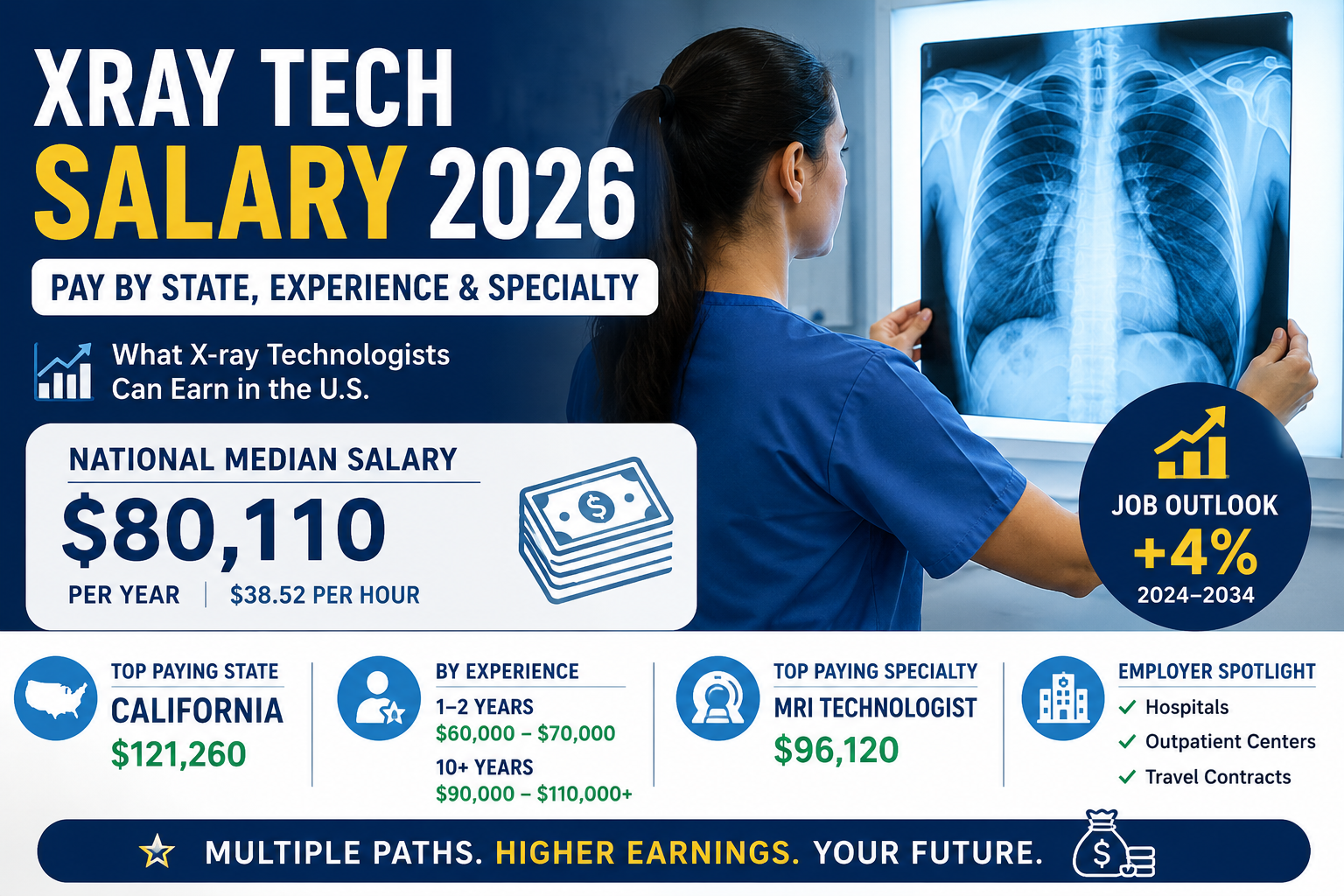
The BLS reports the median annual salary for radiologic technologists and technicians at $80,110 as of May 2025, with a median hourly wage of $38.52. The mean (average) annual wage is $83,840, with a mean hourly wage of $40.31.
That single median figure masks three distinct earning tiers:
| Percentile | Annual Salary | Hourly Rate |
|---|---|---|
| 10th | $55,980 | $26.91 |
| 25th | $64,810 | $31.16 |
| Median | $80,110 | $38.52 |
| 75th | $98,750 | $47.48 |
| 90th | $118,660 | $57.05 |
Source: BLS Occupational Employment and Wage Statistics, May 2025
SalaryInfo Insight: The 10th-to-90th percentile spread of nearly $63,000 isn’t random variation. It reflects a career where earnings are unusually sensitive to choices you make — specialty certification, geographic location, and employer type. A new grad in a rural clinic and a 15-year veteran running a CT scanner in a California trauma center have the same job title but entirely different financial trajectories.
Expert Tip: If you’re early in your career, your first job sets a baseline, not a ceiling. One of the clearest ways to improve earning potential is adding a post-primary credential within your first three to five years. ARRT certifications in CT, MRI, or interventional radiology consistently move techs from the median into the top quartile.
Why Location Matters More Than Most People Think
Geography isn’t just about cost of living. It’s about hospital density, union presence, state healthcare funding, and competition for talent.
The five highest-paying U.S. states and the District of Columbia for radiologic technologists (BLS median wages, May 2025):
| Rank | State | Median Annual Wage |
|---|---|---|
| 1 | California | $121,260 |
| 2 | Massachusetts | $103,620 |
| 3 | District of Columbia | $102,770 |
| 4 | Oregon | $102,290 |
| 5 | Washington | $102,090 |
Source: BLS OEWS state data, May 2025
The lowest? Mississippi ($59,300), Alabama ($60,700), and Arkansas ($63,640).
Reality Check: California pays the most in raw dollars — but raw dollars only tell half the story. A $121,260 salary in California doesn’t stretch the way $84,480 does in Arizona or $80,080 in Utah. Before chasing the highest-paying state, run the math on housing costs, state income tax, and commute times. Sometimes the second-highest paycheck in a lower-cost state leaves more money in your pocket at the end of the month.
Career Strategy: Texas, Tennessee, and several Midwestern states offer salaries in the $65,000–$80,000 range with housing costs 30 to 50 percent below California’s. The “real” pay — what you actually take home after rent and taxes — often comes out comparable.
Colorado and Utah: What X-Ray Techs Actually Earn in the Mountain West
Since you’re searching “Xray Tech Salary near Colorado” and “Xray Tech Salary near Utah,” here’s what the BLS data shows for these two states.
Colorado
According to May 2025 BLS wage data, Colorado radiologic technologists and technicians have a median annual wage of approximately $87,760.
Actual offers can vary based on certification, specialty, hospital system, experience, and metropolitan area. The Denver metro area generally commands higher wages than rural parts of the state, reflecting both higher demand and higher cost of living.
What this means for Colorado X-ray techs: Colorado offers solid earning potential, particularly for ARRT-certified technologists with specialty credentials. Major health systems compete for talent, which helps keep wages above the national median.
Utah
Utah’s median annual wage for radiologic technologists, according to BLS May 2025 data, is approximately $80,290.
This puts Utah slightly above the national median, with a cost of living that generally runs lower than Colorado’s. The Salt Lake City metro area offers the state’s highest wages, while rural areas and smaller cities like Provo and Ogden trend toward the lower end.
SalaryInfo Observation: Utah’s lower cost of living compared to Colorado means that an $80,000 salary in Salt Lake City may go further than an $87,000 salary in Denver. The trade-off is worth calculating. If you’re comparing offers across state lines, don’t just look at the number — look at what it buys.
X-Ray Tech vs. Radiology Tech: Same Profession, Different Pay
This confusion is everywhere. Here’s the distinction that actually matters for your paycheck.
X-ray tech and radiology tech are often used interchangeably, but there’s a meaningful difference in scope and, consequently, earning potential.
- Limited-scope X-ray technicians perform basic X-ray procedures under supervision. Earnings typically range from $45,000 to $60,000 per year.
- Radiologic technologists (fully ARRT-certified) perform a broader range of imaging procedures. Earnings range from $60,000 to $85,000 annually, with significant upside in specialized roles.
The bigger issue: When job postings say “X-ray tech,” they might mean either. When they say “radiologic technologist,” they almost always mean full ARRT certification. The pay difference can be $20,000 to $40,000 annually depending on the employer and state.
Expert Tip: If you’re entering the field, pursue ARRT certification from the start. Limited-scope roles can offer fewer advancement opportunities than full radiography credentials. Full ARRT credentials open the door to specialty certifications in CT, MRI, mammography, and interventional radiology — each of which can improve earning potential and expand access to higher-paying roles. Explore radiology tech salaries →
The Specialty Premium: How Adding One Credential Changes Everything
This is the lever most salary guides skip, and it’s the biggest one.
A general staff tech who only shoots X-rays caps out lower than someone who’s stacked a second or third modality certification.
| Specialty | Estimated Annual Salary Range | Approximate Pay Bump vs. General X-Ray |
|---|---|---|
| General X-ray (entry) | $58,000–$68,000 | Baseline |
| Mammography | $72,000–$85,000 | +10–15% |
| CT (Computed Tomography) | $78,000–$95,000 | +15–20% |
| MRI | $88,000–$104,000 | +20–25% |
| Interventional Radiology / Cath Lab | $88,000–$108,000 | +25–35% |
These ranges are illustrative market estimates, not official BLS occupation-wide medians. Actual compensation varies considerably by employer, location, experience, and shift structure.
Why the gap? Equipment cost and training time. A CT or MRI machine costs millions; the certification exam is harder, and fewer techs are qualified to operate one. Facilities pay more to keep someone certified on staff.
SalaryInfo Verdict: If you want to break out of the median and into the top quartile, specialty certification is one of the strongest ways to expand earning potential. MRI technologists have higher compensation than general radiologic technologists, with May 2025 BLS data showing mean annual pay of $96,120. Interventional and cath lab work pays the most because it blends imaging with a procedural, almost surgical-assist role.
Career Strategy: Start with CT or MRI. Both have strong demand, manageable training timelines (6 to 12 months for ARRT post-primary), and immediate pay bumps. Once you have one specialty, adding a second becomes easier and further increases your market value. Learn about MRI tech salaries →
CT Technologist Demand: A Market in High Gear
CT technologist demand has increased substantially in recent years, particularly as imaging volumes and the need for specialized technologists have grown.
What’s driving this? An aging population, increasing prevalence of chronic conditions, and a workforce that isn’t keeping pace. By 2030, all baby boomers will have reached age 65, with older adults accounting for 20% of the U.S. population. Over 130 million U.S. adults will be living with two or more chronic conditions.
SalaryInfo Market View: The CT shortage isn’t just a volume issue — it’s a distribution issue. Rural facilities face the greatest staffing challenges, with urban fill rates often significantly higher than rural rates. For techs willing to work in underserved areas, the leverage for negotiation is unusually strong.
Who Actually Pays the Most? Employer Breakdown
Not all employers pay the same. Here’s how the major settings compare:
| Setting | Estimated Pay Range |
|---|---|
| Hospitals (state, local, private) | $60,000–$95,000 |
| Physician offices | $58,000–$82,000 |
| Outpatient imaging centers | $62,000–$90,000 |
| Medical and diagnostic labs | $65,000–$88,000 |
| Federal government (VA, military) | $60,000–$95,000 (+ benefits) |
| Travel / contract | $70,000–$180,000 |
Estimated market ranges; actual compensation varies by employer, location, specialty, experience, and shift.
Why hospitals pay more: They handle the full case mix — emergency, inpatient, surgical, outpatient — which means more shifts, more overtime opportunities, and broader skill development. Outpatient imaging centers offer more predictable schedules but fewer specialty cases.
SalaryInfo Observation: The federal government offers competitive base pay, but the real value comes from benefits packages, pension plans, and job security that private employers often can’t match.
Travel Contracts: The Compensation Wild Card
Travel X-ray tech contracts can pay substantially more than some permanent staff positions, although compensation varies by location, specialty, contract length, overtime, and included benefits.
Illustrative travel-contract examples include:
- East Coast metropolitan areas: $2,700–$2,900/week
- Midwest urban centers: $3,300+/week
- West Coast locations: $2,500–$2,900/week
- Mid-size cities: $2,000–$2,200/week
Travel compensation changes quickly by assignment, location, specialty, and contract terms; weekly figures should be treated as illustrative rather than guaranteed.
The trade-offs are real: instability, time away from home, no guaranteed long-term employment, and often no benefits. But for techs who can handle the lifestyle, travel contracts offer an earnings trajectory that staff positions simply cannot match.
Career Strategy: Many techs alternate — travel for 3 to 5 years to build savings, then transition to a stable staff position with benefits and pension. The experience also builds a resume that commands higher pay when you eventually settle.
Experience and the Salary Curve: When Earnings Actually Accelerate
BLS doesn’t publish formal “experience level” buckets, but the wage percentiles offer a reasonable proxy:
- Entry level (roughly 10th to 25th percentile): $55,980 to $64,810 per year
- Mid-career (around the median): $80,110 per year
- Experienced (75th to 90th percentile): $98,750 to $118,660 per year
What this tells you: The salary curve is not linear. New ARRT-certified techs typically start near the lower end of this range. Long tenure plus advanced certifications push pay toward the upper end.
SalaryInfo Insight: The biggest earnings jump happens when you combine 5+ years of experience with a specialty certification. Experience alone plateaus. Specialty plus experience breaks the ceiling.
Education ROI: What Degree Actually Gets You
The entry standard for radiologic technologists is an associate degree from an ARRT-approved program. That’s it. You don’t need a bachelor’s to enter the field or earn a competitive salary.
ARRT certification requirements:
- Complete an ARRT-approved educational program (associate degree or higher)
- Meet ARRT ethics requirements
- Pass the ARRT Radiography national certification exam
Important eligibility note: For the primary ARRT pathway, candidates must complete an ARRT-approved educational program and earn an associate degree or higher. After completing the program, candidates generally have three years to establish eligibility for ARRT certification and registration.
The ROI calculation: A two-year associate degree costing $10,000–$30,000 leads to a starting salary of $55,000–$65,000. That’s a strong return on investment compared to four-year degrees that cost four times as much and often lead to lower starting salaries.
RN vs. Radiology Tech: Who Actually Makes More?
This is one of the most common career comparisons.
Registered Nurses (RNs) have a median annual wage of $101,420 (BLS May 2025 data). Radiologic technologists have a median of $80,110 (BLS May 2025 data).
Registered nurses have a higher national median wage than general radiologic technologists. Specialized imaging technologists can still reach six-figure compensation, particularly in high-paying markets, specialty roles, overtime, and travel assignments.
The nuance: RNs have a higher median, but radiology techs with specialty certifications (CT, MRI, interventional) can earn more than general RNs. A CT-certified technologist at $90,000+ outperforms many RNs. An interventional radiology tech at $100,000+ outperforms most RNs.
Who makes more?
- General X-ray tech: less than RN
- CT/MRI tech: comparable to RN or slightly below
- Interventional radiology tech: can match or exceed RN
SalaryInfo Verdict: If you’re deciding between the two careers, don’t base it solely on salary. The work is fundamentally different. RNs have broader career paths into management, advanced practice, and administration. Radiology techs have a narrower but deeply specialized track with strong earning potential through modality certifications. Compare RN salaries →
The AI Question: What Automation Actually Means for X-Ray Techs
This is the question every healthcare professional is asking. Here’s the reality.
Job growth: BLS projects employment of radiologic technologists and technicians to grow 4% from 2024 to 2034, about as fast as the average for all occupations. The BLS projects 228,000 radiologic technologist jobs in 2024 and 237,800 in 2034, a 4% increase, with about 9,800 growth-related openings.
What AI actually does in radiology: AI helps detect changes in the body — lesions, tumors, brain shrinkage — that a human might miss. It speeds up scanning processes. It flags urgent findings and prioritizes cases in a radiologist’s worklist.
What AI currently doesn’t replace: AI can assist with image analysis and workflow, but current X-ray technologist responsibilities still require hands-on patient positioning, equipment operation, image-quality assessment, communication, and radiation-safety procedures.
SalaryInfo Future View: The technologist who understands AI — who can work alongside it, troubleshoot it, and leverage it — will be more valuable than the technologist who ignores it. AI is a tool, not a replacement.
The Rural vs. Urban Pay Gap: An Untapped Opportunity
There’s a widening disparity in allied health fill rates between urban and rural settings. Rural facilities struggle to compete for imaging talent.
What this means for you: If you’re willing to work in a rural area, you have leverage. Sign-on bonuses, higher hourly rates, and faster promotion timelines are all on the table. Some rural facilities are offering:
- $10,000+ sign-on bonuses
- Housing stipends
- Student loan repayment assistance
- Faster track to lead tech or supervisory roles
The trade-off: Fewer entertainment options, longer commutes to major cities, and potentially less access to continuing education. But for early-career techs looking to build experience and savings quickly, rural positions can accelerate both.
How to Negotiate: What Employers Actually Value
Salary surveys give you a number. Negotiation gives you more.
What employers value (beyond the basics):
- ARRT certification in multiple modalities — each one reduces their training cost
- PACS proficiency — Picture Archival and Communication Systems skills are mentioned in job postings
- Shift flexibility — nights, weekends, and on-call availability command differentials
- Patient satisfaction scores — in an era of value-based care, patient experience matters
- Willingness to cross-train — techs who can cover multiple modalities reduce staffing costs
SalaryInfo Career Strategy: When negotiating, don’t just ask for more money. Ask for a specific path to higher earnings. Tuition reimbursement for a CT or MRI certification. A defined timeline for promotion to lead tech. Shift differentials for undesirable hours. These add up to more than a one-time base salary bump. Learn negotiation strategies →
The Salary Ceiling: Breaking Through
Some X-ray techs plateau after earning their initial credentials, especially when they remain in the same role without adding new skills or credentials. They get their ARRT certification, find a hospital job, and stay there for 10, 15, 20 years. Their salary grows with annual cost-of-living adjustments — 2%, maybe 3% — but never breaks into the top quartile.
How to avoid the plateau:
- Add a specialty certification within 3–5 years — CT, MRI, or interventional
- Consider travel contracts for 2–3 years — the experience and savings compound
- Move into a lead or supervisory role — PACS administration and team leadership add $5,000–$15,000
- Consider switching employers when it makes sense — changing employers can sometimes produce a larger compensation increase than a standard annual raise, but the value depends on benefits, seniority, retirement plans, and job stability
SalaryInfo Verdict: The ceiling isn’t $118,000. That’s just the 90th percentile of current earners. The ceiling is what you make it. Techs who stack credentials, embrace mobility, and seek leadership opportunities consistently out-earn their peers who stay in one role.
Common Myths About X-Ray Tech Salaries
Myth 1: “All radiology techs make the same.”
False. The spread between the 10th and 90th percentile is nearly $63,000.
Myth 2: “You need a bachelor’s degree to earn well.”
False. The entry standard is an associate degree. Advanced degrees rarely produce salary growth in this field.
Myth 3: “Hospitals always pay more than clinics.”
Generally true, but outpatient imaging centers sometimes offer better benefits and predictable schedules that offset a slightly lower base.
Myth 4: “California is always the best place to work.”
Raw pay is highest in California, but cost of living eats a significant portion of that premium. Run the numbers before moving.
Myth 5: “AI will replace radiologic techs.”
False. AI augments, doesn’t replace. Demand is projected to grow 4% through 2034.
Five-Year Outlook: What to Expect Through 2030
Job growth: 4% projected through 2034, about as fast as the average for all occupations.
Demand drivers:
- Aging population (all baby boomers reach 65 by 2030)
- Rising chronic disease prevalence
- Expansion of outpatient imaging
- Rural staffing shortages creating premium opportunities
Salary trajectory: Base salaries will likely keep pace with inflation. The real earnings growth will come from specialty certifications and travel contracts.
What could disrupt this: Healthcare policy changes, reimbursement cuts, and a sudden increase in radiology program graduates could all pressure wages. But the demographic tailwinds are strong.
SalaryInfo Prediction: The next five years will reward techs who specialize. General X-ray will remain stable but unexciting. CT, MRI, and interventional radiology will see above-average wage growth driven by persistent shortages.
Featured Snippets
Q: How much does an X-ray tech make in 2026?
The median annual salary for X-ray techs (radiologic technologists) is $80,110 as of May 2025, according to the Bureau of Labor Statistics. The mean (average) salary is $83,840. The bottom 10% earn around $55,980, while the top 10% earn $118,660. Pay varies significantly by state, specialty, and experience.
Q: Which state pays X-ray techs the most?
California pays the highest median wages for radiologic technologists at $121,260 per year, followed by Massachusetts ($103,620), District of Columbia ($102,770), Oregon ($102,290), and Washington ($102,090), according to BLS May 2025 data.
Q: What is the highest-paying X-ray tech specialty?
Interventional radiology and cath lab techs earn the most, with salaries ranging from $88,000 to $108,000 — 25–35% above general X-ray techs. MRI and CT certifications also add $15,000–$20,000 to base pay.
Q: Do travel X-ray techs make more money?
Yes. Travel X-ray tech contracts typically pay substantially more than staff positions, with weekly pay ranging from $2,000 to $3,500 depending on location and specialty. Compensation varies by contract length, benefits, and included overtime.
Q: Is X-ray tech a good career for salary growth?
Yes, but only if you specialize. General radiography pay varies widely by location and employer, while advanced certifications can expand access to higher-paying positions. Techs with CT, MRI, or interventional certifications can earn $90,000–$108,000.
Frequently Asked Questions
Is becoming a radiology tech hard?
The academic program is rigorous — two years of full-time study including clinical rotations. The ARRT certification exam has a pass rate around 85–90% for first-time test-takers from accredited programs. It’s challenging but achievable with consistent effort. The bigger challenge is the emotional and physical demands of the job: long hours on your feet, working with anxious or injured patients, and exposure to stressful clinical environments.
Who makes more, RN or radiology tech?
RNs have a higher national median salary ($101,420 vs. $80,110). However, radiology techs with specialty certifications in CT, MRI, or interventional radiology can reach six-figure compensation, particularly in high-paying markets, specialty roles, overtime, and travel assignments. The career paths are different — RNs have broader advancement opportunities into management and advanced practice, while radiology techs have a narrower but highly specialized track. Compare RN salaries →
How to become an X-ray tech in North Carolina?
Complete an ARRT-approved radiologic technology program (associate degree) at a North Carolina college, pass the ARRT certification exam, and apply for state licensure through the North Carolina Medical Board. Clinical rotation hours are typically built into the program. Most programs take 24 months to complete.
How to become an X-ray tech in California?
Complete an ARRT-approved program, pass the ARRT exam, and obtain certification from the California Department of Public Health’s Radiologic Health Branch (RHB). California requires state-specific licensing in addition to ARRT certification. The state also mandates continuing education for license renewal. California’s higher salaries reflect both higher demand and stricter credentialing requirements.
How much does an X-ray tech make in Florida?
According to BLS May 2025 data, Florida radiologic technologists have a median annual wage of approximately $74,840. Major metro areas like Miami, Tampa, and Jacksonville offer higher pay but also higher cost of living.
How much does an X-ray tech make in Texas?
BLS May 2025 data shows Texas radiologic technologists have a median annual wage of approximately $76,040. Houston offers higher pay, while smaller cities average closer to the state median. The wide range reflects Texas’s geographic and economic diversity.
How much does an X-ray tech make in NYC?
Radiologic technologist pay in the New York City area varies by employer, setting, certification, and experience, with metropolitan wage data generally placing compensation above many U.S. markets. NYC’s high cost of living offsets some of the premium — but the absolute pay is among the highest in the country.
Is X-ray tech vs radiology tech the same thing?
Not exactly. “X-ray tech” often refers to limited-scope technicians who perform basic X-rays ($45,000–$60,000). “Radiologic technologist” refers to fully ARRT-certified professionals who perform a broader range of imaging ($60,000–$85,000+). The terms are used interchangeably in casual conversation, but employers distinguish them for pay and scope of practice.
What is the difference between X-ray tech and MRI tech?
X-ray techs (radiologic technologists) perform general radiography using ionizing radiation. MRI techs specialize in magnetic resonance imaging, which uses magnetic fields and radio waves. MRI technologists have higher compensation, with May 2025 BLS data showing mean annual pay of $96,120 vs. $83,840 for radiologic technologists. MRI requires additional post-primary certification through ARRT or ARMRIT. Learn about MRI tech salaries →
What skills increase an X-ray tech’s salary?
Customer service skills, radiation safety expertise, and patient safety awareness are the most frequently cited skills that employers value. Beyond these, ARRT post-primary certifications in CT, MRI, mammography, and interventional radiology are the strongest salary drivers.
Can X-ray techs work remotely?
Not in the traditional sense — patients need to be physically present for imaging. However, some techs work in mobile imaging units, travel contracts, or teleradiology support roles that offer flexibility. Remote work in this field is limited to administrative or PACS management roles.
What is the job outlook for X-ray techs?
BLS projects employment of radiologic technologists and technicians to grow 4% from 2024 to 2034, about as fast as the average for all occupations. The BLS projects 228,000 radiologic technologist jobs in 2024 and 237,800 in 2034, with about 9,800 growth-related openings. MRI technologists specifically are projected to grow 7%, from 44,100 to 47,200 jobs.
What’s the difference between median and mean salary for X-ray techs?
The median salary ($80,110) is the midpoint — half of X-ray techs earn more, half earn less. The mean (average) salary ($83,840) is the total of all wages divided by the number of workers. The mean is higher because higher earners pull the average up. For career planning, the median is usually more representative of what a typical worker earns.