
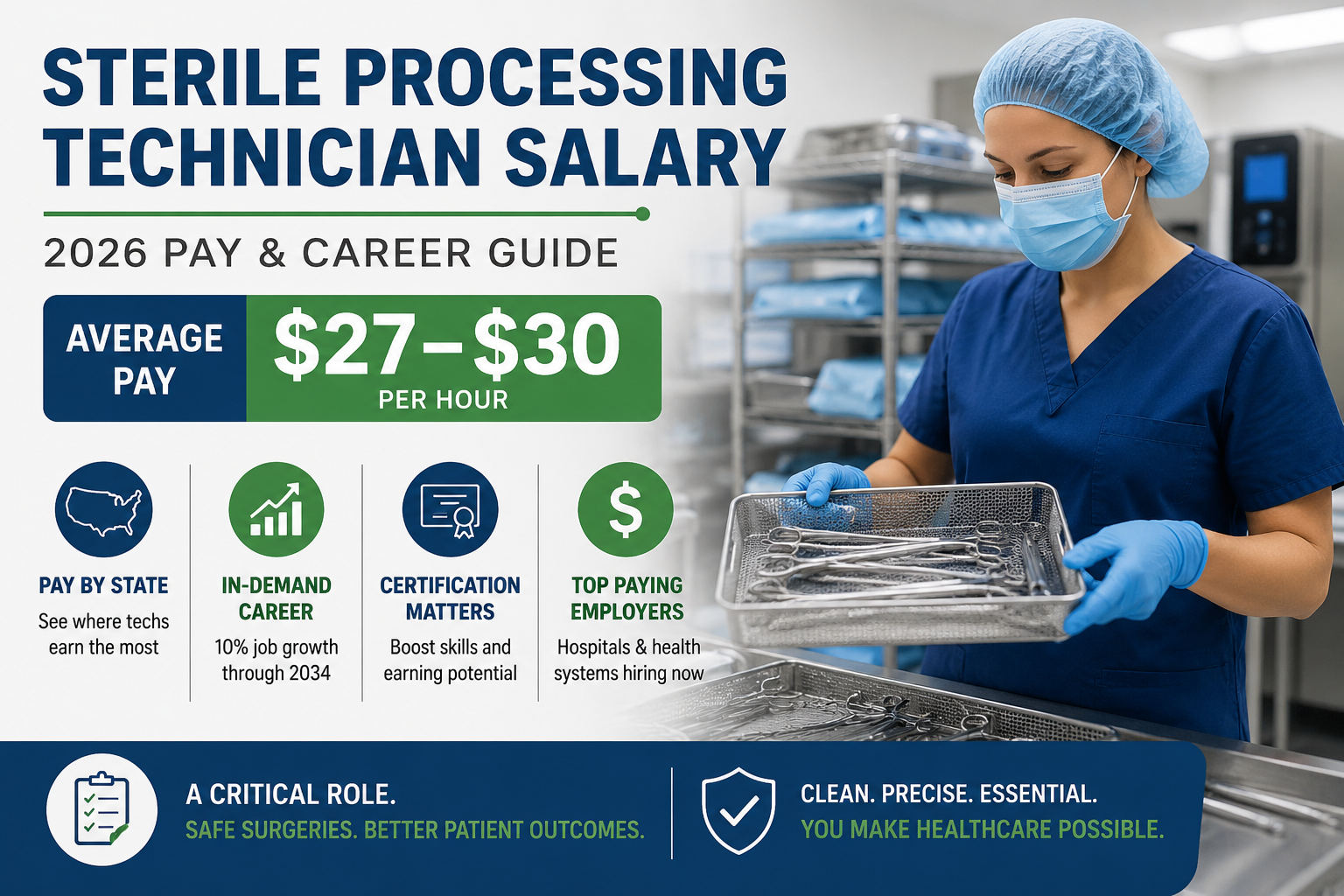
Sterile processing technician salary in the U.S. is roughly $27–$30 per hour in current market estimates, while the BLS’s broader Medical Equipment Preparers occupation averages $50,510 per year. Here’s what actually drives earnings — and how professionals can increase them.
There’s a room in every hospital that surgeons never see but absolutely depend on.
It’s where thousands of surgical instruments are decontaminated, inspected, assembled, and sterilised every single day. When this department functions well, nobody notices. When it doesn’t, surgeries get cancelled, patients wait, and hospitals lose millions.
Sterile processing technicians — the people who make sure scalpels, forceps, and endoscopes are safe to use — have become unexpectedly valuable. And their pay is reflecting that.
Current market estimates put typical sterile processing technician pay around $27–$30 per hour, although actual compensation varies widely by location, experience, certification and employer.
Learn more about average salary in the U.S. →
How We Calculate Sterile Processing Technician Salary
Salary figures in this guide combine U.S. government occupational data with current market salary estimates and employer job postings.
Because the Bureau of Labor Statistics does not publish a separate national wage series specifically for sterile processing technicians, BLS Medical Equipment Preparers data is used as a broader occupational benchmark. Employer and market estimates may vary by location, experience, certification, shift, and job title.
This distinction matters. When you see salary ranges in this article, they represent a combination of:
- BLS occupational data for the broader category
- Current job-market salary estimates
- Employer job postings
- Editorial estimates based on industry patterns
What Sterile Processing Technicians Actually Do
Sterile processing technicians — sometimes called central sterile processing technicians, SPD techs, or medical supply technicians — handle the decontamination, inspection, assembly, and sterilisation of surgical instruments and medical equipment.
They work in hospitals, surgical centres, and clinics. The job requires:
- Attention to detail and infection control knowledge
- Ability to work under pressure in fast-paced environments
- Understanding of sterilisation methods and instrument assembly
- Familiarity with tracking and inventory systems
A single missed step can compromise patient safety. That’s why hospitals are increasingly willing to pay for quality talent.
Key Takeaway: This isn’t a simple support role. It’s a critical patient safety function that requires specialised knowledge and consistent precision.
The Salary Reality: What the Numbers Actually Say
Salary data for sterile processing technicians varies significantly depending on the source. That’s not because the data is wrong — it’s because different surveys measure different things.
Current market estimates:
| Source | Average Annual Pay | Hourly Equivalent |
|---|---|---|
| Current market estimates | ~$56,000–$62,500 | ~$27–$30 |
| BLS Medical Equipment Preparers (May 2025) | $50,510 mean / ~$47,700 annualized median | $24.28 mean / $22.93 median |
Why the ranges differ. The BLS figure represents a broader occupational category called Medical Equipment Preparers (SOC 31-9093), which includes workers who prepare, sterilise, install, or clean healthcare equipment. It is not specific to sterile processing technicians alone.
Current job-market salary estimates typically capture hospital-based sterile processing positions and tend to be higher because they reflect specific roles in high-demand settings.
SalaryInfo Insight: The gap between the BLS median ($47,700) and current market estimates ($56,000–$62,500) represents the difference between a broad occupational category and more targeted hospital SPD roles. Certified technicians and those in major health systems typically earn at the higher end of this range.
The BLS projects 10% employment growth for Medical Equipment Preparers from 2024 to 2034, with approximately 10,900 annual openings. The projection reflects expected employment growth and replacement needs across the broader occupation.
Where Sterile Processing Technicians Can Earn More
Location is one of the biggest drivers of sterile processing technician pay.
Selected State and Metro Pay Ranges
Note: Figures represent a combination of BLS data for Medical Equipment Preparers and current job-market estimates for sterile processing technicians specifically. Actual pay may vary.
Selected states with higher reported pay ranges:
| State | Reported Pay Range |
|---|---|
| Alaska | $60,000–$65,000 |
| Massachusetts | $55,000–$62,000 |
| Washington | $52,000–$60,000 |
| California | $50,000–$65,000+ |
| New York | $50,000–$63,000 |
Major metro areas (typical hourly ranges):
| Metro | Typical Hourly Range |
|---|---|
| San Francisco, CA | $30–$38 |
| Los Angeles, CA | $28–$35 |
| New York City, NY | $28–$34 |
| Chicago, IL | $26–$32 |
| Atlanta, GA | $25–$30 |
| Houston, TX | $23–$28 |
| Miami, FL | $22–$27 |
How these ranges were estimated. State and metro figures reflect a combination of BLS May 2025 data for Medical Equipment Preparers, current job-market salary data, and employer job postings. Ranges account for variation within each market based on employer type, certification status, and experience level. Actual pay for individual positions may fall above or below these ranges.
What drives these differences. Pay differences between Texas, Florida, California, and New York reflect differences in local labour markets, employer mix, cost of living, and demand.
SalaryInfo Observation: Moving from a lower-paying market to California can increase gross pay, but higher housing and living costs can substantially reduce the financial benefit. Always calculate the cost-of-living adjustment before relocating for a job.
How Experience Changes Your Earnings
Experience doesn’t just increase your pay — it changes the nature of your work.
Illustrative Salary Ranges by Career Stage
These ranges combine current market data with editorial estimates. Actual pay varies by location, employer, and certification.
| Career Stage | Typical Responsibilities | Annual Salary Range |
|---|---|---|
| Entry-level (0–2 years) | Decontamination, basic assembly, routine sterilisation | $34,000–$44,000 |
| Experienced / Certified (2–5 years) | Complex instrument assembly, specialty trays, mentoring | $42,000–$56,000 |
| Senior / Lead (5–8 years) | Quality assurance, troubleshooting, training, shift supervision | $50,000–$67,000 |
| Supervisor (8+ years) | Department oversight, staffing, compliance, quality | $58,000–$78,000+ |
| Manager / Director | Full department management, budgeting, strategy | $70,000–$100,000+ |
Why earnings accelerate. More experienced technicians handle complex surgical sets — orthopaedic, cardiovascular, and robotic surgery instruments. These require greater skill and carry more responsibility. Errors are costlier. Employers pay more to retain people who can do this work reliably.
Where the salary ceiling exists. Many technicians plateau at the senior level because they don’t pursue management skills or additional education. Those who invest in leadership and operations knowledge can move into supervisory and management roles.
Explore how registered nurse salaries compare →
How Certification Can Affect Sterile Processing Pay
Certification is one of the most effective investments you can make in your sterile processing career.
The two main credentials are:
- CRCST (Certified Registered Central Service Technician) — offered by HSPA
- CSPDT (Certified Sterile Processing and Distribution Technician) — offered by CBSPD
What certification can do for your pay
Certification can improve earning potential, and some employers offer higher pay or require certification for advancement. Some employer and market reports suggest certified technicians may earn a higher hourly rate than non-certified colleagues in similar roles, although the difference varies by employer and location.
Certification demonstrates formal knowledge and hands-on experience, which can strengthen a technician’s qualifications for hiring and advancement.
The 400-hour requirement
HSPA describes the 400-hour requirement as a minimum of about 10 weeks of experience. The actual calendar time depends on the weekly schedule. This is an HSPA CRCST experience requirement, not a universal requirement for every sterile processing certification.
Key Takeaway: Certification is not mandatory everywhere, but it is increasingly expected. Many employers offer higher pay or require certification for advancement. Some will pay for your exam and study materials.
SalaryInfo Insight: Employers value certification because it demonstrates commitment to the profession and practical experience. Certification can strengthen a technician’s qualifications and may open access to higher-paying positions or advancement opportunities.
See how radiology tech salaries compare →
Which Employers Actually Pay Above Market
Not all hospitals pay the same. Here’s what the 2026 market shows:
| Employer | Position | Typical Pay Range |
|---|---|---|
| Sutter Health (CA) | SPD Technician II | $67,000–$95,000 |
| Kaiser Permanente (CA) | Certified SPD Tech II | $84,000–$88,000 |
| Northwell Health (NY) | Sterile Processing Tech | $28.76–$34.37/hour |
| RWJBarnabas Health (NJ) | Certified Tech | $24.18–$30.72/hour |
| Ann & Robert H. Lurie Children’s (Chicago) | Certified Tech | $22.25–$36.38/hour |
Important note on posted pay ranges: Posted pay ranges can change by location, shift, experience, and job requisition date. These figures reflect publicly available job postings at the time of research and may not represent current openings.
Why these employers pay more. Academic medical centres, large health systems, and specialty hospitals handle more complex surgeries and have higher instrument volumes. They need technicians who can handle specialty trays, robotic instruments, and rigid endoscopes. They’re also more likely to be unionised or to offer market-leading compensation.
What you should do. If you’re job hunting, prioritise academic medical centres and large health systems. They typically pay more, offer better benefits, and provide clearer career progression paths. Community hospitals may offer lower pay but can be good places to gain experience.
Explore medical assistant salary data →
The Career Path Most Technicians Don’t See
Many sterile processing technicians think the career ends at senior technician. It doesn’t.
Promotion timeline and career options
| Years in Field | Typical Role | Career Options |
|---|---|---|
| 0–2 | Technician I | Develop fundamental skills, pursue certification |
| 2–5 | Technician II / Certified | Specialise in complex instruments |
| 5–8 | Lead / Senior Technician | Train others, quality assurance |
| 8–12 | Supervisor | Manage teams, handle compliance |
| 12+ | Manager / Director | Full department management |
Beyond the SPD: Experienced technicians can move into:
- Operating room coordination
- Supply chain management
- Infection control
- Healthcare administration
- Medical device sales (with clinical expertise)
SalaryInfo Career Strategy: If you want to break the salary ceiling, invest in people management skills and hospital operations knowledge. The most successful sterile processing leaders understand not just instruments, but how the entire surgical workflow operates.
Overtime, Shift Differentials, and Hidden Income
Base pay is only part of the story. Sterile processing technicians often have access to additional compensation:
Shift differentials
- Evening shifts: 10–15% premium
- Night shifts: 15–20% premium
- Weekend shifts: $2–$5 per hour extra
Overtime
- Time-and-a-half for hours over 40 per week
- Many hospitals offer voluntary overtime due to staffing needs
Travel contracts
- Travel sterile processing contracts can pay materially more than permanent staff positions
- Premium rates typically include housing stipends or provided accommodation
- Best for experienced technicians who can adapt quickly to new environments
Important Note: Travel contracts pay more but come with less job security and fewer benefits. They’re best for experienced technicians who can adapt quickly to new environments.
Risks Most Career Guides Ignore
Every career has risks. Sterile processing is no exception.
Economic risks
- Hospital budgets can tighten during economic downturns
- Non-urgent surgeries may be postponed, reducing demand
- Some hospitals outsource sterile processing to third-party vendors
Technology risks
- Automated sterilisation and tracking systems reduce the need for manual work
- However, technology also creates demand for technicians who can operate and maintain it
Career stagnation risk
- Without certification or specialisation, earnings can plateau
- Many technicians stay in the same role for years without advancement
SalaryInfo Warning: The biggest risk isn’t automation — it’s complacency. Technicians who don’t pursue certification, specialisation, or leadership skills will find their earnings capped. Those who invest in their development will find ample opportunities.
The Next Five Years: What’s Changing
The sterile processing field is evolving rapidly.
Hiring trends
- 10% employment growth projected for Medical Equipment Preparers (2024–2034)
- 10,900 annual openings expected
- Demand for qualified sterile processing technicians remains an important factor in hiring, particularly in larger health systems and high-volume surgical settings
What employers will increasingly value
- Certification (becoming more common as a requirement)
- Experience with robotic and minimally invasive instruments
- Knowledge of tracking and inventory systems
- Ability to train and mentor new staff
Salary outlook
- Continued demand may support wage growth in some markets
- Actual pay will depend on location, employer budgets, staffing needs, and certification
- Certification may improve access to higher-paying positions and advancement opportunities
SalaryInfo Market View: Demand for skilled technicians is driving competition among employers, particularly in larger health systems. This is good news for anyone entering the field — and even better news for those who get certified.
Common Myths About Sterile Processing Pay
Myth 1: “It’s just a dead-end job.”
Reality: The career ladder extends to management and beyond. Some directors of sterile processing earn over $100,000.
Myth 2: “Certification doesn’t matter.”
Reality: Certified technicians may have better earning potential and more advancement opportunities. Many employers require it.
Myth 3: “All hospitals pay the same.”
Reality: Academic medical centres and large health systems typically pay significantly more than community hospitals.
Myth 4: “You need a degree to earn well.”
Reality: A high school diploma plus certification is sufficient for most roles. Experience and certification matter more than formal education.
What Salary Surveys Don’t Tell You
Salary surveys report numbers. They don’t tell you how to get them.
Here’s what the data won’t tell you:
1. Negotiation matters. Many hospitals have pay ranges that extend beyond the advertised rate. Technicians who negotiate often start $2–$3 per hour higher.
2. Benefits vary widely. A lower salary with excellent health insurance, tuition reimbursement, and a pension may be worth more than a higher salary with poor benefits.
3. Union facilities pay more. Unionised hospitals typically offer higher wages, better benefits, and clearer progression pathways.
4. Specialisation pays. Technicians who master orthopaedic, cardiovascular, or robotic surgery trays can earn premium rates.
Learn how to negotiate salary effectively →
SalaryInfo Verdict
Sterile processing technician pay in the U.S. varies by employer, location, experience, and certification.
Current market estimates put typical pay around $27–$30 per hour, while the BLS reports $50,510 in mean annual pay for the broader Medical Equipment Preparers occupation in May 2025.
The profession offers:
- Strong job growth (10% projected growth for the broader occupation)
- Clear career progression from entry-level to management
- Certification premiums that can increase earning potential
- Geographic flexibility with higher pay in states like California, New York, and Massachusetts
- Additional income through shift differentials, overtime, and travel contracts
The biggest drivers of earnings are certification, location, and experience — in that order.
SalaryInfo Recommendation: If you’re considering this career, pursue certification early. Target academic medical centres or large health systems. Specialise in complex surgical instruments. And don’t be afraid to negotiate your starting salary.
This isn’t a career that will make you wealthy overnight. But it offers stability, growth, and a clear path to increasing your earnings over time.
Explore nurse practitioner salaries for comparison →
Featured Snippets
Q: How much does a sterile processing technician make in the United States?
Sterile processing technician pay in the U.S. varies by employer, location, experience, and certification. Current market estimates put typical pay around $27–$30 per hour, while the BLS reports $50,510 in mean annual pay for the broader Medical Equipment Preparers occupation in May 2025.
Q: Where do sterile processing techs make the most money?
Sterile processing techs typically earn higher wages in states with larger hospital systems and higher costs of living. States like California, New York, Massachusetts, and Alaska tend to offer higher typical pay, with hourly rates often ranging from $28–$38 in major metro areas.
Q: Is sterile processing technician a good career?
Yes. Employment for the broader Medical Equipment Preparers occupation is projected to grow 10% with about 10,900 annual openings. Certification can improve earning potential, and the career ladder can extend into supervisory and management roles with higher earning potential.
Q: How long is 400 hours for a sterile processing technician?
The 400-hour requirement is an HSPA CRCST experience requirement for certification. HSPA describes it as a minimum of about 10 weeks of experience. The actual calendar time depends on the weekly schedule and facility requirements.
Q: How much do sterile processing techs make in Texas per hour?
Typical hourly pay for sterile processing technicians in Texas varies by location and employer. Houston and other major metro areas typically pay in the $23–$28 per hour range, with certified technicians and those in large health systems earning at the higher end.
FAQs
Q: What is the difference between a sterile processing technician and a central sterile processing technician?
They are essentially the same role. “Central sterile processing technician” (CSPT or SPD tech) is another term for the same profession. Some facilities use “medical supply technician” as the official job title. The responsibilities — decontamination, assembly, sterilisation, and distribution of surgical instruments — are identical.
Q: Do sterile processing technicians need a degree?
No. Most employers require a high school diploma or equivalent. Certification (CRCST or CSPDT) is often required or preferred within the first year of employment. Some community colleges offer certificate programs that include the clinical hours needed for certification.
Q: How much does CRCST certification increase pay?
Certification can improve earning potential. Some employer and market reports suggest certified technicians may earn a higher hourly rate than non-certified colleagues in similar roles, although the difference varies by employer and location.
Q: What are the highest-paying hospitals for sterile processing technicians?
Sutter Health pays SPD Technician II roles $67,000–$95,000. Kaiser Permanente offers certified SPD Technician II positions at $84,000–$88,000. Northwell Health in New York and RWJBarnabas Health in New Jersey also pay above-market rates.
Q: Can sterile processing technicians work remotely?
No. Sterile processing is a hands-on role that requires physical presence in hospitals, surgical centres, or clinics. However, some supervisory and management roles may include administrative work that can be done remotely part-time.
Q: What is the job outlook for sterile processing technicians?
The Bureau of Labor Statistics projects 10% employment growth for the broader Medical Equipment Preparers occupation over 2024–2034, with approximately 10,900 openings per year. The aging population and increasing number of surgeries are driving demand.
Q: How much do travel sterile processing technicians make?
Travel sterile processing contracts can pay materially more than permanent staff positions, particularly when housing stipends and overtime are included. Rates vary widely based on location, facility, and experience level.
Q: What skills do employers value most in sterile processing technicians?
Employers prioritise certification (CRCST or CSPDT), attention to detail, knowledge of infection control standards, experience with complex surgical instruments, and the ability to work under pressure. Familiarity with tracking and inventory systems is increasingly valuable.
Q: How long does it take to become a sterile processing technician?
Training programs typically take 4–12 months to complete, depending on whether you attend full-time or part-time. The clinical experience requirement (often 400 hours for CRCST) is usually included. Certification exams can be taken after completing the training and clinical hours.
Q: What is the salary ceiling for sterile processing technicians?
Illustrative market ranges vary substantially by employer and location.
Senior/lead technicians typically earn $50,000–$67,000. Supervisors earn $58,000–$78,000+. Managers and directors can earn $70,000–$100,000+. The ceiling is highest in academic medical centres and large health systems in high-paying states.