
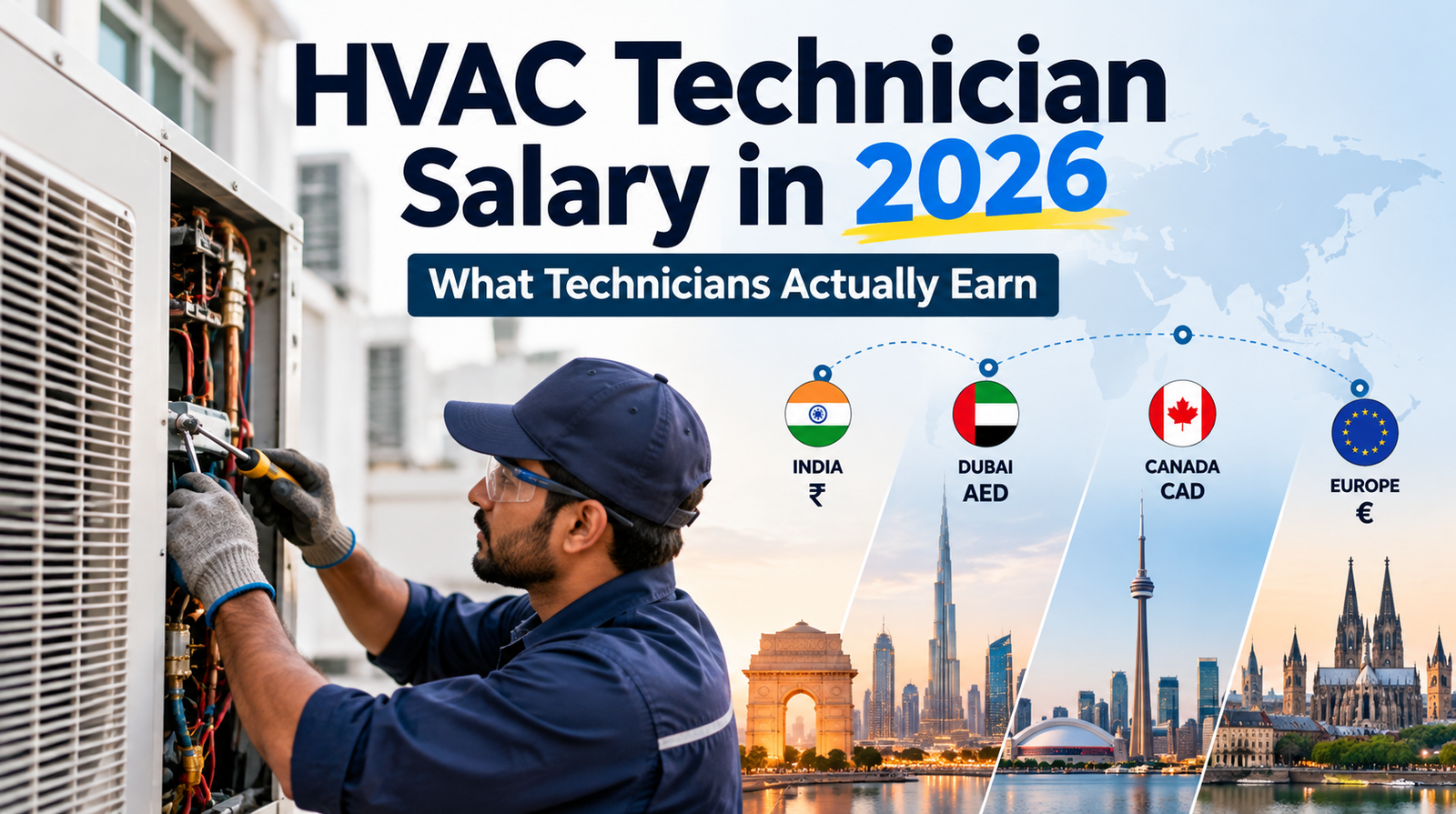
A Delhi HVAC contractor recently advertised a technician role at ₹25,000 per month, highlighting the strong competition for technician positions in India’s HVAC market. That single dynamic tells you something important about this profession: demand is real, but the salary market is far more stratified than most candidates realise.
HVAC (heating, ventilation and air conditioning) is one of the few skilled trades where a diploma holder can out-earn a general graduate within five years, and where a certified technician in Dubai can take home more than a junior engineer in Bangalore. But the same market that creates those opportunities also creates traps: low entry-level wages in India, qualification-recognition barriers in Europe, and a Gulf market where your salary depends almost entirely on which employer recruits you.
This is not a salary calculator. It is a career intelligence report on where HVAC pay actually comes from, who earns more and why, and what the next five years could look like.
The Real HVAC Salary Picture in India
The most quoted figure for HVAC technician pay in India is ₹7.90 lakh per year — roughly ₹65,800 per month. That number is accurate for a specific population: technicians with several years of experience, often in industrial or large-facility roles, whose salaries are reported through employer surveys.
It is not the number a fresh ITI graduate sees.
Indeed’s reported salary for HVAC technicians in Delhi — ₹31,873 per month — reflects a different reality: technicians with some experience, employed by facility-management companies and commercial contractors. In Hyderabad’s HITEC City, the reported average is ₹22,730 per month. Salary.com’s April 2025 data for India shows an annual average of ₹4.61 lakh — approximately ₹38,400 monthly — again reflecting a different population from the ₹7.90 lakh survey figure. A 2025 government tender for AC plant operation and maintenance in Delhi advertised ₹22,600–25,000 per month for VRV/VRF technicians.
Why the gap? India’s HVAC salary market is split into three tiers:
| Employer Type | Typical Monthly Pay (Technician) | What Drives the Difference |
|---|---|---|
| Local contractors / small service firms | ₹15,000–25,000 | Low overheads, informal hiring, limited benefits |
| Facility management companies (residential/commercial) | ₹25,000–40,000 | Contract-based staffing, client billing rates |
| Industrial / large-facility employers (hotels, hospitals, data centres) | ₹40,000–65,000+ | Specialised systems, compliance requirements, shift premiums |
The industrial tier is where Indian HVAC salaries begin to resemble the national survey figures. It is also where certifications — refrigerant-handling credentials, manufacturer-specific training, and specialised system certifications — start to carry direct salary weight.
SalaryInfo Insight: The ₹7.90 lakh “average” is not wrong. It is simply the average of a population that excludes most entry-level technicians. For service technicians, available job postings and salary reports often show substantially lower pay than experienced industrial and large-facility roles. Treat the survey average as a ceiling to aim for, not a starting point to expect.
Quick Answer: HVAC Salary in India ranges from ₹15,000–25,000 per month for entry-level local contractor roles to ₹40,000–65,000+ per month in industrial and large-facility positions. The commonly cited national average of ₹7.90 lakh per year reflects experienced technicians, not newcomers. (For a full explanation of Indian salary terminology, see our guide to LPA full form.)
Delhi NCR: A Market of Extremes
Delhi is simultaneously India’s largest HVAC employment cluster and one of its most wage-compressed.
The concentration of commercial real estate, hotels, hospitals and government facilities creates steady demand. But the supply of ITI-certified technicians from Uttar Pradesh, Haryana and Bihar keeps entry-level wages low. Indeed’s December 2025 data for Delhi shows an average base salary of ₹31,873 per month, based on seven reported salaries. Job postings in Dwarka, Nehru Place and Sector 19 consistently cluster between ₹25,000 and ₹42,000 per month for technicians with 2–6 years of experience.
The outliers matter. Recent Delhi job postings indicate that VRF/VRV specialists with chiller and AHU experience can find roles in the ₹35,000–65,000 monthly range. A government pay-scale role — such as the DSSSB air-conditioning mechanic position at Pay Level 2 (₹19,900–63,200) — offers lower starting pay but includes pension, job security and structured progression that private contractors rarely match.
The Delhi calculation is not simply “private pays more.” A government HVAC role at ₹25,000 per month with housing, pension and medical benefits may deliver a higher real standard of living than a ₹35,000 per month contractor role with no benefits and irregular hours. For broader context on public-sector compensation, see our government sector salaries category.
Did You Know? Delhi’s HVAC demand spikes every April–June, when commercial cooling systems fail under peak load. Some contractors offer additional compensation for emergency call-out work during peak summer demand. If you can tolerate the hours, summer overtime can meaningfully change your annual earnings.
What Experience Actually Changes (and What It Doesn’t)
The instinct to describe HVAC careers in neat tiers — “entry level earns X, senior earns Y” — obscures more than it reveals.
What changes with experience:
- Diagnostic responsibility. A junior technician follows a checklist. A senior technician diagnoses a failing chiller from compressor noise and refrigerant pressure readings. That diagnostic skill is what employers pay for.
- System complexity. Moving from split ACs to VRF systems, then to chillers and building-management systems, each layer adds salary.
- Client-facing authority. Senior technicians who can explain a ₹2 lakh repair to a facility manager without a supervisor are more valuable than those who cannot.
- Certification stacking. Refrigerant-handling credentials, manufacturer certifications and specialised system training create documented skill signals that hiring managers use to justify higher offers.
What changes less than people assume:
- Years alone. Ten years of split-AC servicing does not automatically pay more than five years of VRF and chiller experience. The system matters more than the calendar.
- Loyalty. Staying with one small contractor for a decade often means staying within that contractor’s billing-rate ceiling. Employer changes, not tenure, are the more common salary accelerators in Indian HVAC.
A realistic salary growth curve for an Indian HVAC technician:
| Experience Stage | Typical Monthly Range (Private Sector) | What Triggers the Jump |
|---|---|---|
| 0–2 years (entry) | ₹12,000–20,000 | ITI/diploma, basic split AC service |
| 2–5 years | ₹20,000–35,000 | VRF/VRV competence, independent diagnostics |
| 5–10 years | ₹30,000–50,000 | Chiller/AHU experience, team supervision |
| 10+ years (specialist) | ₹45,000–80,000+ | BMS integration, data-centre cooling, or business ownership |
Reality Check: The salary ceiling most Indian HVAC technicians never reach is not a skill ceiling. It is an employer-type ceiling. A technician who never moves from local contractors to industrial or large-facility employers will rarely see monthly pay cross ₹40,000, regardless of technical ability.
The Gulf Premium: Dubai, Saudi Arabia and Qatar
For Indian HVAC technicians, the Gulf is the single most consequential salary decision. The numbers are transformative — but only if you understand the structure.
Dubai presents the most misleading salary data in the entire HVAC market. Payscale reports an average total compensation of AED 36,620 per year for mid-career technicians — roughly AED 3,052 per month — based on a small sample of nine salaries. Indeed reports AED 2,693 per month in Dubai Silicon Oasis and AED 3,742 per month in Jumeirah, both based on very small samples. A recent employer posting for HVAC technicians in the UAE advertised AED 2,000–2,500 per month with accommodation and transportation provided.
What a realistic Dubai HVAC package looks like for an Indian technician:
| Component | Typical Range (AED/month) | Notes |
|---|---|---|
| Basic salary | 1,500–3,500 | Often the only figure quoted in recruitment ads |
| Housing allowance | 500–1,500 | Sometimes provided as accommodation instead |
| Transport allowance | 200–600 | May be a company bus rather than cash |
| Food allowance | 200–500 | Less common in smaller companies |
| Total package | 2,400–6,100 | This is what you should compare, not basic salary alone |
Saudi Arabia offers similar structures with slightly different scales. SalaryExpert reports an average HVAC technician gross salary of SAR 123,612 per year — roughly SAR 10,300 per month — but entry-level postings through Bayt show SAR 1,875–3,750 per month for 1–5 years of experience. The gap again reflects the difference between surveyed employees and advertised entry-level roles.
Qatar sits between the two. Indeed reports an average of QAR 2,765 per month for HVAC technicians, with a typical range of QAR 1,476–5,179.
Important Note: Gulf salary comparisons are meaningless without package structure. A “AED 2,500 salary” that includes accommodation, transport, food and annual flights may leave you with more disposable income than a “AED 4,000 salary” where you pay rent and transport yourself. Always calculate net disposable income after mandatory living costs, not gross salary.
The tax-free advantage is real but overstated. Indian technicians in the Gulf often quote their Gulf salary in INR terms without accounting for the loss of Provident Fund, gratuity, and the cost of returning home. A ₹60,000 per month tax-free Dubai salary sounds like ₹7.2 lakh per year free and clear. But add ₹15,000 per month for accommodation (if not provided), ₹5,000 for food, ₹3,000 for transport, and the effective Indian equivalent may be closer to ₹35,000–40,000 per month — competitive with Indian industrial roles, but not the windfall it appears. Use our income tax calculator to compare net take-home scenarios.
SalaryInfo Career Strategy: Before accepting a Gulf offer, ask for the total package breakdown in writing — basic, housing, transport, food, medical insurance, annual flight allowance, and end-of-service benefits. If the employer will not provide this, that is itself information about how they treat employees. Our guide on how to negotiate salary covers the questions to ask.
Canada: The Certification-Driven Market
Canada provides relatively detailed and accessible HVAC wage data through its Job Bank, and a structured career pathway for internationally trained technicians.
The Government of Canada Job Bank reports HVAC mechanic wages (NOC 72402) as follows, updated November 19, 2025:
| Region | Low ($/hour) | Median ($/hour) | High ($/hour) |
|---|---|---|---|
| Canada (national) | 22.00 | 37.50 | 56.00 |
| Quebec | 22.40 | 38.00 | 46.08 |
| Ontario | 21.00 | 37.00 | 58.00 |
At a median of $37.50 per hour and a standard 40-hour week, that’s approximately CAD 78,000 per year — roughly ₹47 lakh at current exchange rates. At the high end, $56 per hour translates to over CAD 116,000 annually. Red Seal–certified journeypersons in specialised roles can command CAD 55–77 per hour based on recent job postings.
But the pathway matters as much as the number. Canada’s HVAC trade is apprenticeship-based and provincially regulated. Trade certification for refrigeration and air conditioning mechanics is compulsory in Nova Scotia, New Brunswick, Quebec, Ontario, Manitoba, Saskatchewan and Alberta, and voluntary in other provinces and territories. Internationally trained technicians typically need:
- Credential assessment by a provincial authority
- Trade certification (Red Seal endorsement for interprovincial mobility)
- Gas fitter licence if working on gas-fired systems
- Provincial registration as an apprentice or journeyperson
The credential recognition process varies substantially by province and trade pathway. The Government of Canada advises that getting qualifications recognised “can take time, money, and effort,” and recommends contacting the relevant provincial regulatory authority for specific requirements. Some provinces have faster pathways for experienced technicians than others.
Where the real Canadian money is: Specialised roles in commercial refrigeration, building automation, and heat-pump installation command premiums. Job postings for TAB (testing, adjusting and balancing) technicians advertise CAD 75–81 per hour in some regions.
SalaryInfo Insight: Canada’s HVAC salary is high, but the barrier is certification, not skill. The process is province-specific and should be researched thoroughly before relocation.
Europe: A Fragmented but Certifiable Premium
Europe does not have a single HVAC salary market. Germany, France, the UK, the Netherlands and Luxembourg each operate different qualification frameworks, licensing requirements and pay structures.
Germany offers the most stable data. SalaryExpert reports an average HVAC service technician gross salary of €55,313 per year — approximately €4,600 per month — with entry-level technicians earning around €40,121 and senior technicians (8+ years) reaching €67,976. Job postings for heat-pump installers advertise €50,000–68,000 per year.
France shows similar levels: Dalkia, an EDF subsidiary, advertises HVAC maintenance technician roles at €30,000–38,000 per year — €2,500–3,200 per month.
The UK presents a more nuanced picture. Government job postings for HVAC technicians show £40,000–46,000 per year, while SalaryExpert reports an average of £46,972 for the London Greater Area. Outside London, average salaries drop to £40,000–41,000.
The European premium is real, but it is conditional. Germany requires recognition of foreign qualifications through the Anerkennung process. France requires fluency in French for most technician roles. The UK’s post-Brexit immigration system has made employer sponsorship more complex.
Where Europe differs from the Gulf and Canada: A German technician earning €4,000 per month may have a different real disposable income and benefits package from a Dubai technician earning AED 10,000, so headline salary comparisons can be misleading. Social safety nets — healthcare, pension, unemployment insurance — add substantial non-cash compensation that is not captured in basic salary figures.
Key Takeaway: Europe is not a quick-entry market for Indian HVAC technicians. The qualification-recognition process is longer and more demanding than Canada’s, and language barriers are real. But for technicians willing to invest in certification and language preparation, the long-term earnings and quality-of-life outcomes are among the strongest in the world.
What Employers Actually Reward (and What They Don’t)
HVAC hiring managers across markets consistently reward three things, in this order:
- Diagnostic independence. Can you identify the fault without a supervisor?
- System breadth. Can you work across split, VRF, chiller and AHU systems?
- Documentation and communication. Can you write a service report and explain it to a client?
What they reward less than candidates expect:
- Formal education level. A diploma helps at entry, but a 10-year experienced ITI holder with strong diagnostics will out-earn a fresh diploma holder every time.
- Years of experience alone. Employers increasingly screen for system-specific experience, not total years.
- General “hard work” claims. HVAC is physically demanding, but employers assume you can handle the physical work. They pay for what you can diagnose and document.
SalaryInfo Editorial Analysis: The HVAC salary conversation in India is distorted by an education-first bias. Families push for engineering degrees while the technician trade offers faster income acceleration for those who specialise. A B.Tech graduate in a non-specialist role may earn ₹25,000 per month for years. A VRF-certified technician with 5 years of experience in a data-centre environment can earn ₹50,000–70,000. The trade is not a consolation prize; it is a parallel career track with different timing and different ceilings. For a related trade comparison, see our electrician salary page.
Certification: What Matters Where
Certification value is highly market-specific. A credential that carries weight in one country may have limited recognition in another.
India: India has no single mandatory national refrigerant-handling certification equivalent to the U.S. EPA Section 608. However, EPA 608 certification is recognised by some employers — particularly multinational facility-management companies and industrial employers — and is referenced in Indian HVAC training programmes. Manufacturer-specific training (Daikin, Carrier, Voltas) and specialised system certifications carry direct salary weight in the Indian market.
Gulf: Employers in the UAE, Saudi Arabia and Qatar typically require trade certificates, relevant experience, and sometimes manufacturer certifications. Gulf employers value demonstrated experience with VRF, chiller and chilled-water systems more than formal certification from any single body.
Canada: Trade certification is compulsory in several provinces. Red Seal endorsement is the gold standard for interprovincial mobility. Gas fitter licensing is required for gas-fired systems. These credentials are non-negotiable for formal employment.
Europe: Germany’s Anerkennung process, France’s qualification recognition, and the UK’s Gas Safe Register are the relevant credentialing frameworks. Language proficiency is often as important as technical certification.
United States: EPA Section 608 certification is mandatory for technicians handling refrigerants. NATE certification is widely recognised as a skill-validation credential.
Quick Answer: There is no single “best” HVAC certification globally. The right credential depends entirely on your target market. Research the specific licensing and certification requirements of the country or region where you intend to work before investing in training.
The Risks Nobody Talks About
Skill obsolescence. HVAC technology is shifting toward inverter-driven systems, variable refrigerant flow, and integrated building-management platforms. A technician who only knows how to service conventional split ACs will face shrinking demand within a decade. The technicians who stay current — through manufacturer training and certification — will see their salaries grow.
Geographic concentration risk. India’s HVAC demand is heavily concentrated in Delhi NCR, Mumbai, Bangalore, Hyderabad and Chennai. A technician in a smaller city faces fewer employers, lower wages, and limited options for specialisation.
Gulf employment risk. Gulf HVAC jobs are visa-tied. Losing your job means losing your right to remain in the country, often within 30–60 days. The salary premium must be weighed against the absence of job security.
The “experience trap.” Technicians who remain with one employer for 8–10 years often find their skills are calibrated to that employer’s specific systems and processes. When they try to move — to a better employer, to a different country — their experience does not translate as cleanly as they expected. Periodic employer changes, even within India, keep skills broader and more portable.
SalaryInfo Market View: The single greatest career risk for Indian HVAC technicians is not low pay. It is delayed specialisation. Technicians who spend their first five years doing general split-AC service — because that is what local contractors need — enter their 30s without the system-specific expertise that commands higher wages. The window to move from generalist to specialist is widest in years 2–5. After that, employers increasingly expect you to already have the specialisation.
How the Next Five Years Could Change HVAC Pay
Current trajectory. Demand for HVAC technicians is rising across major markets. The U.S. Bureau of Labor Statistics projects 11% employment growth for HVAC mechanics and installers from 2025 to 2035 — much faster than the average for all occupations — with approximately 40,600 openings projected each year. The median annual wage was $61,010 in May 2025. Canada’s Job Bank forecasts good prospects in several provinces. The demand is driven partly by data-centre construction, heat-pump adoption, and industrial cooling requirements.
Upside scenario. If data-centre and industrial cooling demand continues to accelerate — driven by AI infrastructure, cloud computing and India’s expanding manufacturing base — specialised HVAC technicians in commercial and industrial segments could see meaningful salary growth over five years, outpacing general inflation.
Downside scenario. If India’s construction and real-estate sectors slow, or if Gulf infrastructure spending contracts with oil prices, demand for entry-level technicians could soften. Wages at the bottom of the market would stagnate first.
What the evidence supports. The clearest signal is not a specific number. It is a direction: specialisation pays. Technicians who invest in chiller systems, VRF technology, building automation or heat-pump expertise will separate themselves from the generalist pool. Those who do not will compete in a crowded, wage-suppressed market.
What to Do With This Information
If you are entering HVAC: get certified early, move toward commercial and industrial systems as fast as you can, and treat your first employer as a training ground, not a destination.
If you are already working: audit your system experience. If you have been doing the same type of work for more than three years, you are likely underpaid relative to your potential. Look for employers with industrial, healthcare or data-centre clients.
If you are considering the Gulf: calculate your net disposable income, not your gross salary. Compare it honestly against what you could earn in India in an industrial role. The Gulf premium is real, but it is smaller than the headline numbers suggest.
If you are considering Canada or Europe: start the credential-recognition process before you leave India. The salary is higher, but the barrier to entry is certification, not ambition. Research provincial requirements specific to your target region.
The most important takeaway: HVAC salaries are not determined by the profession. They are determined by system specialisation, employer type, and geography. A technician who understands that will navigate the market better than one who simply asks “what is the average salary.” For tools to evaluate your own offer, see our salary tools collection.
QUICK ANSWERS
1. What is the average HVAC salary in India?
The average HVAC salary in India is approximately ₹7.90 lakh per year for experienced technicians, according to SalaryExpert 2026 data. However, Indeed and government tender data show that many service technicians earn ₹15,000–25,000 per month, with industrial roles paying ₹40,000–65,000 monthly.
2. How much does an HVAC technician earn in Dubai?
Dubai HVAC technician salaries range from AED 2,400–6,100 per month when total package is included. Indeed reports an average base salary of AED 2,693 per month in Dubai Silicon Oasis, while a recent employer posting advertised AED 2,000–2,500 plus accommodation and transport. Package structure matters more than basic salary.
3. Is HVAC a good career in 2026?
HVAC is a strong career choice in 2026. The U.S. BLS projects 11% employment growth through 2035, with about 40,600 openings annually. Salaries range from ₹15,000 monthly entry-level in India to CAD 37.50/hour median in Canada, with clear specialisation pathways.
4. What is HVAC salary per month in India?
HVAC salary per month in India ranges from ₹15,000–20,000 for entry-level local contractor roles to ₹40,000–65,000+ for industrial and large-facility technicians. Delhi Indeed data shows an average of ₹31,873 monthly for reported technician salaries.
5. Which countries pay HVAC technicians well?
Canada and Australia are among the higher-paying major markets for HVAC technicians. Canada’s Job Bank reports a median of CAD 37.50/hour (CAD 78,000 annually), with high-end earners reaching CAD 56/hour. Gulf salaries are tax-free but package-dependent. Germany offers €55,000–68,000 annually.
FAQs
1. Is HVAC technician a stressful job?
HVAC work combines physical demands with diagnostic pressure and client expectations. Emergency call-outs, working in extreme temperatures, and the responsibility of restoring cooling for hospitals, data centres or commercial buildings create stress. However, the stress is predictable and skill-dependent — technicians with strong diagnostics and system knowledge experience less stress than those who struggle with unfamiliar equipment.
2. Is HVAC a lot of math?
HVAC requires basic arithmetic — refrigerant calculations, airflow measurements, electrical load estimates and temperature differentials — but not advanced mathematics. The critical skills are diagnostic reasoning and system knowledge, not calculus. Technicians who are comfortable with measurements and formulas will adapt quickly; those who are not can still succeed through hands-on learning and manufacturer-specific training.
3. What skills increase an HVAC technician’s salary?
Diagnostic independence, system breadth (VRF, chiller, AHU, BMS), and documentation skills are the strongest salary drivers. Manufacturer certifications and specialised training in commercial refrigeration or heat-pump systems also command premiums. Employers pay for the ability to diagnose faults without supervision and to work across complex systems.
4. How much does an HVAC technician earn in Delhi?
HVAC technician salary in Delhi NCR ranges from ₹25,000–42,000 per month for technicians with 2–6 years of experience, according to job postings and Indeed data. Indeed reports an average base salary of ₹31,873 per month in Delhi. VRF/VRV specialists with chiller experience can command ₹35,000–65,000 monthly.
5. Can Indian HVAC technicians work in Canada?
Yes, but certification is required. Trade certification for refrigeration and air conditioning mechanics is compulsory in several provinces, including Ontario, Quebec, Alberta and Saskatchewan. Internationally trained technicians must have their qualifications assessed through provincial regulatory authorities. The process varies by province and trade pathway.
6. What certifications increase HVAC salary?
Certification value is market-specific. In India, manufacturer-specific training and refrigerant-handling credentials carry weight with industrial employers. In Canada, Red Seal endorsement and provincial trade certification are essential. In the U.S., EPA Section 608 is mandatory for refrigerant handling. In Germany, the Anerkennung qualification recognition is required.
7. Is HVAC better than a government job?
It depends on what you value. Government HVAC roles (such as DSSSB Pay Level 2 in Delhi) offer lower starting pay but pension, job security and structured progression. Private HVAC roles offer higher earning potential, especially with specialisation, but less stability. The trade-offs are real, and the right choice depends on your priorities.
SALARY DATA SOURCES & METHODOLOGY
The salary figures and market analysis in this article were compiled from the following source types:
- Government labour statistics: U.S. Bureau of Labor Statistics Occupational Outlook Handbook (May 2025 wage data; 2025–2035 projections); Government of Canada Job Bank wage reports for NOC 72402 (updated November 19, 2025)
- Employer job postings: Indeed India, Naukri, Bayt, LinkedIn, and direct employer postings for HVAC technician roles in India, UAE, and Canada
- Compensation survey databases: SalaryExpert (ERI), Payscale, Salary.com Global Salary IQ
- Government tender documents: Delhi government AC plant operation and maintenance tenders (2025)
- Industry and training programme sources: Engineering Staff College of India HVAC programme documentation; manufacturer certification references
Salary figures represent different populations and methodologies. Government survey data (SalaryExpert, Salary.com) tends to reflect formally employed technicians captured through employer surveys. Job-posting data (Indeed, Naukri) reflects advertised salaries and may be skewed toward entry-level or high-turnover roles. Where sources disagree significantly — as in the Dubai market — the article explains the methodological differences rather than presenting one figure as definitive.
Currency conversions, where mentioned, are approximate and based on rates at the time of writing. Purchasing power differences are not adjusted.
Published: September 2026. Salary data period: 2025–2026.
Written by: SalaryInfo Editorial Team
Reviewed/Updated: September 2026
Research methodology: Salary data compared across government labour statistics, job postings, employer disclosures and established salary databases. All sources are identified in the methodology section.