
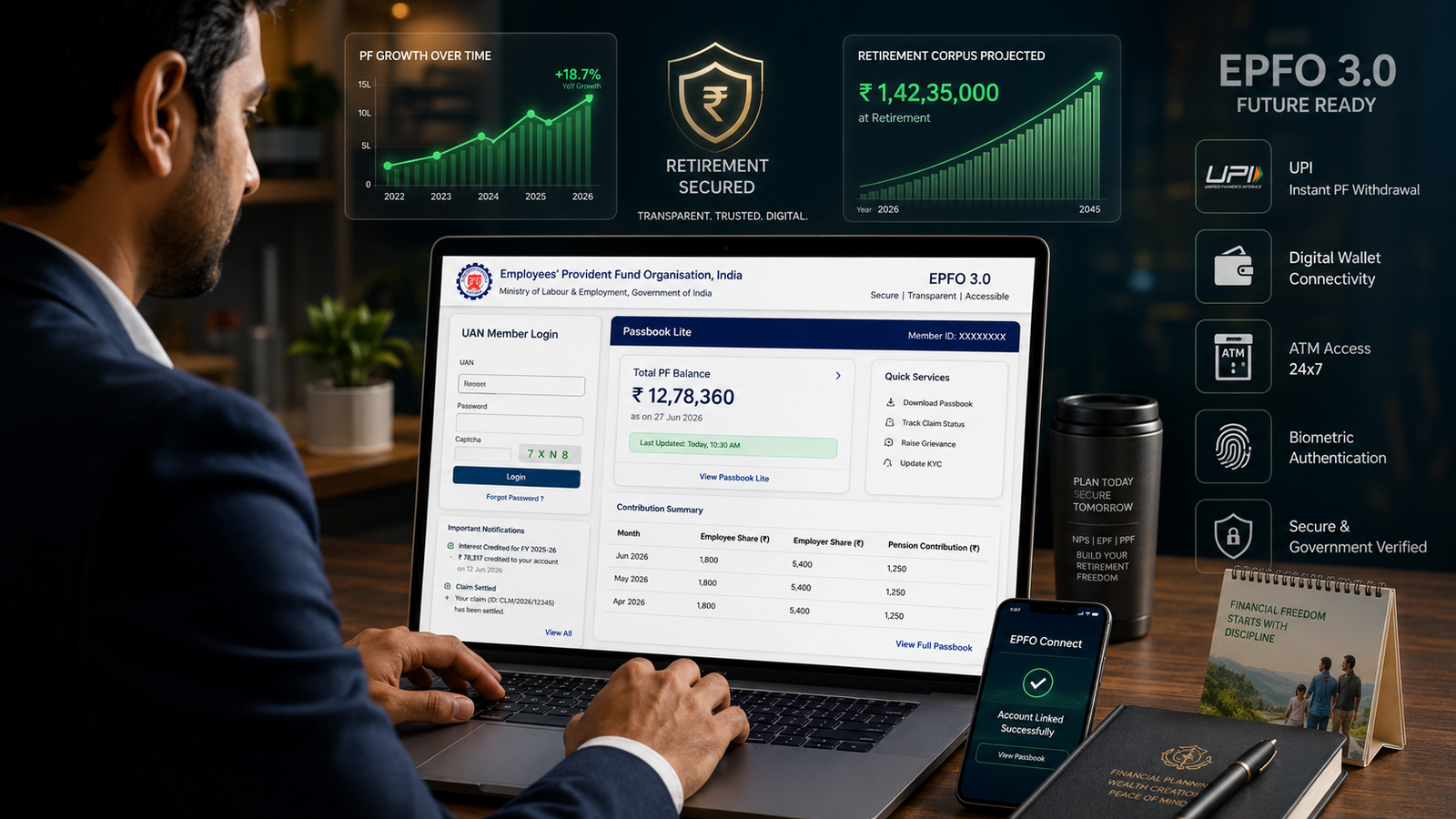
Let’s be direct: the PF passbook online is no longer just a digital replica of a physical ledger.
In 2026, it’s the control panel for your retirement savings—and most people are using it wrong.
The Employee Provident Fund Organisation (EPFO) has undergone a quiet but significant transformation. What was once a clunky portal requiring separate logins for different services is now a unified system.
The question isn’t whether you can check your EPF passbook balance online anymore. The question is: are you actually using it to manage your money, or just to look at it?
Here’s the reality: The EPF passbook is one of the most underutilized financial documents in India. Most salaried employees check it once a year, if at all.
That’s a mistake—and in 2026, it’s an expensive one.
Your PF passbook is the only document that provides an independent, verifiable record of your retirement savings. Without it, you’re relying entirely on your employer’s word.
What Is PF Passbook Online? (The Short Answer)
The PF passbook online is a digital statement from EPFO showing every transaction in your Provident Fund account—employee contributions, employer contributions, pension deposits, interest credits, withdrawals, and transfers. It’s accessible via the EPFO Member Passbook Portal or the UMANG app.
That’s the definition. Here’s what it actually means: transparency. For the first time, you can see exactly what your employer is depositing, when interest is credited, and whether anyone is shortchanging you.
The 2026 Updates That Actually Matter
1. Single Login System (Finally)
Until recently, EPFO had a dual login system that caused delays, password synchronization issues, and unnecessary friction. In 2026, that’s gone. Members can now access all key services—passbook, claims, KYC updates—through a single login on the member portal.
What this means for you: One password. One dashboard. No more hunting for the right URL.
2. Passbook Lite
This is the sleeper update. EPFO launched Passbook Lite within the Member Portal, allowing members to view a summarized passbook showing contributions, withdrawals, and current balance—all without leaving the main portal.
The catch? You cannot download the Lite version. For the full PDF, you still need the regular passbook portal. But for a quick check—say, verifying whether your employer deposited this month’s contribution—Passbook Lite is faster and doesn’t require a separate login.
3. EPFO 3.0: UPI and ATM Withdrawals
This is the big one. EPFO 3.0 is rolling out features that allow PF withdrawals via UPI and ATMs. The auto-settlement limit has been raised to ₹5 lakh. No employer involvement. No waiting.
Why this matters for your passbook: Your passbook will now reflect near-instant withdrawals. The old 20-day settlement cycle is being compressed. If you’re still treating your PF as “untouchable” money, you’re operating on outdated assumptions.
The shift to UPI withdrawals fundamentally changes the liquidity profile of EPF savings. Your passbook becomes a real-time ledger of deployable capital, not just a static retirement record.
How to Check PF Passbook Balance Online (2026)
Step 1: Go to the official EPFO passbook portal: passbook.epfindia.gov.in/MemberPassBook/login
Step 2: Enter your UAN (Universal Account Number) and password
Step 3: Complete the captcha and click Sign In
Step 4: Select your Member ID from the list (if you have multiple PF accounts linked to your UAN)
Step 5: Click “View Passbook” to see the full statement, or download it as a PDF
Alternative via UMANG App:
- Install UMANG from Play Store or App Store
- Log in with your registered mobile number
- Navigate to EPFO Services → Employee Centric Services → View Passbook
- Enter UAN and OTP
Missed Call & SMS (for quick balance checks):
- Missed call: 9966044425 from registered mobile number
- SMS: Type
EPFOHO UAN ENGand send to 7738299899
Comparison: Which PF Passbook Access Method Works Best?
| Method | Time Required | Download Available | Best For |
|---|---|---|---|
| EPFO Passbook Portal | 2-3 minutes | Yes (PDF) | Full statements, detailed verification, interest tracking |
| Passbook Lite (Member Portal) | 30 seconds | No | Quick balance checks, contribution verification |
| UMANG App | 1-2 minutes | Limited | Mobile access, on-the-go checks |
| Missed Call Service | Instant | No | Emergency balance checks without internet |
The Interest Rate Question Nobody’s Answering
EPFO retained the EPF interest rate at 8.25% for FY2025-26—the third consecutive year at this rate.
Here’s the contrarian take: 8.25% looks good on paper, but the delay in crediting interest is the real story.
Interest for FY2025-26 is expected to be credited between June and September 2026. That’s a 3-4 month lag after the financial year ended. The entry to look for in your passbook is: “Int. Updated up to 31/03/2026”.
If you don’t see that entry by September, something is wrong. And your passbook is the only way to know.
The institutional insight: The delay isn’t necessarily incompetence—it’s the scale. EPFO has to reconcile accounts for millions of subscribers. But that doesn’t mean you should accept it passively. Check your passbook. Track the entry. Hold them accountable.
The interest delay creates an invisible opportunity cost. While EPFO holds your interest credit for 3-4 months, that money could have been compounding elsewhere. It’s not a dealbreaker—but it’s worth understanding.
What Your PF Passbook Actually Tells You (Beyond the Balance)
Most people look at the bottom line and stop. That’s like reading only the last page of a book.
Here’s what to actually look for:
Monthly Contributions
- Employee share (12% of basic + DA)
- Employer share (12%—of which 8.33% goes to pension)
- Any discrepancies? Flag them immediately
Interest Credits
- Look for the “Int.” entries
- Verify the rate matches the declared 8.25%
- Interest is compounded annually, not monthly
Transfers
- When you change jobs, your old PF should transfer to the new one
- If it doesn’t show up, your UAN isn’t linked properly
Withdrawals
- Every claim, partial or full, shows here
- If you see a withdrawal you didn’t authorize, act fast
Common PF Passbook Issues (And How to Fix Them)
| Issue | Solution |
|---|---|
| UAN not activated | Activate using Aadhaar and OTP |
| KYC not updated | Update via Member Portal; employer approval may be required |
| New contributions not showing | Wait 48 hours; employer filings take time to reflect |
| Passbook shows old employer only | Link all Member IDs under your UAN |
| Claim rejected | Check KYC mismatch or incomplete documentation |
The Risk Scenario: What If You Never Check Your Passbook?
Let’s talk about what nobody wants to say: your employer might not be depositing your PF.
It happens. More often than you think. Companies facing cash flow issues sometimes “forget” to deposit the employer contribution. Sometimes they deduct your share but don’t remit it.
Your passbook is the only evidence.
If you never check, you’ll only find out years later—when you try to withdraw or retire. By then, recovery is difficult.
Actionable advice: Check your passbook every quarter. Not annually. Quarterly. Set a calendar reminder. It takes five minutes.
EPFO’s grievance system is more responsive in 2026 than ever before. Digital complaints are tracked with acknowledgment numbers. If you spot a discrepancy, file a grievance immediately—don’t wait for your employer to fix it
Featured Snippets (Quick Answers)
Q: Is the PF passbook online reliable in 2026?
Yes. EPFO’s digital infrastructure has matured significantly. Passbook Lite and single-login access have reduced friction. However, updates depend on employer filings—so delays of 48-72 hours are normal.
Q: Which PF service has the highest growth in 2026?
UPI and ATM-based withdrawals under EPFO 3.0. The auto-settlement limit has been raised to ₹5 lakh, and claims are being processed in under 20 days.
Q: Can I download my EPF passbook as PDF?
Yes. After logging into the passbook portal, select your Member ID and click “View Passbook”. The PDF option is available on the page.
Q: What’s the difference between Passbook and Passbook Lite?
Passbook Lite is a summarized view within the Member Portal—quick, no separate login, but not downloadable. The full passbook is detailed, downloadable, and requires the dedicated passbook portal.
Q: When will EPF interest for FY2025-26 reflect?
Between June and September 2026. Look for “Int. Updated up to 31/03/2026” in your passbook.
FAQ
1. What is PF passbook online?
PF passbook online is a digital statement from EPFO showing all transactions in your Provident Fund account—contributions, interest, withdrawals, and transfers. It’s accessible via the EPFO Member Passbook Portal using UAN and password.
2. How can I check my EPF passbook balance online?
Log in to passbook.epfindia.gov.in/MemberPassBook/login with your UAN and password. Select your Member ID and view the passbook. Alternatively, use the UMANG app or missed call service (9966044425).
3. What is UAN login for EPFO?
UAN (Universal Account Number) is a 12-digit unique number for every EPF member. UAN login is the gateway to all EPFO online services—passbook, claims, KYC updates, and transfers.
4. How do I download my UAN passbook?
Log in to the EPFO passbook portal, select your Member ID, and click “View Passbook”. The passbook can be downloaded as a PDF.
5. What is Passbook Lite in EPFO?
Passbook Lite is a simplified passbook view within the Member Portal showing contributions, withdrawals, and balance. It doesn’t require a separate login but cannot be downloaded.
6. Why is my PF passbook not showing latest contributions?
Employer filings take up to 48 hours to reflect. If it’s been longer, check with your employer or raise a grievance through the Member Portal.
7. How do I check if EPF interest is credited?
Look for the entry “Int. Updated up to 31/03/2026” in your passbook. Interest for FY2025-26 is expected between June and September 2026.
Action Strategy: Your PF Passbook Roadmap for 2026-27
Month 1 (Immediate):
- Log in to the EPFO passbook portal
- Verify last 3 months of contributions
- Check if your KYC (Aadhaar, PAN, bank) is fully updated
- Download your latest passbook PDF and save it
Month 2-3 (Quarterly):
- Set a calendar reminder to check your passbook every quarter
- Verify interest credits when they appear (June-September window)
- Flag any discrepancies immediately via EPFO grievance portal
Month 4-6 (Mid-Year):
- Check if your employer has filed returns for the first half of FY2026-27
- Verify that your contribution amount matches your salary slip
- Ensure all previous PF transfers are complete
Month 7-12 (Year-End):
- Download year-end passbook for tax records
- Verify full-year interest credit
- Check that all contributions for the financial year are reflected
References & Sources
- EPFO Official Circulars: Member Passbook Guidelines, 2025-26
- Ministry of Labour & Employment: EPF Interest Rate Notification, FY2025-26
- EPFO Annual Report 2024-25
- UMANG App Documentation: EPFO Services Integration
- EPFO Grievance Redressal Portal: Standard Operating Procedures
About the Author
Pawan Kumar
Senior Financial Journalist & Macro Analyst, Salaryinfo
Pawan covers government salaries, EPFO policy changes, retirement planning, and labour-market reforms in India.
With over a decade of experience analyzing India’s employment and benefits landscape, he has tracked the evolution of EPFO’s digital infrastructure from its early days to the current EPFO 3.0 framework. His work focuses on translating complex policy changes into actionable insights for Indian professionals.
Conclusion: Your Passbook Is a Tool, Not a Trophy
Key Takeaways:
- PF passbook online is now unified. Single login. Passbook Lite. No more portal-hopping.
- Interest is 8.25% for FY2025-26—but the delay in crediting (June-September) is the real metric to watch.
- EPFO 3.0 changes the game. UPI and ATM withdrawals mean your PF is becoming liquid. Your passbook will reflect these changes in real-time.
- Check quarterly, not annually. Employers make mistakes. Your passbook is your proof.
- The full passbook vs. Lite version: Use Lite for quick checks, full version for downloads and detailed verification.
Final Action Strategy:
- Today: Log in to the passbook portal. Verify your last three months of contributions.
- This week: Check if your KYC (Aadhaar, PAN, bank) is fully updated.
- This quarter: Set a calendar reminder to check your passbook every three months.
- September 2026: Look for the interest credit entry. If it’s missing, raise a grievance.
Your PF isn’t just a number on a screen. It’s your money. Treat it like it matters—because by the time you retire, it will.
Explore More on Salaryinfo: