
📌 Quick Answer
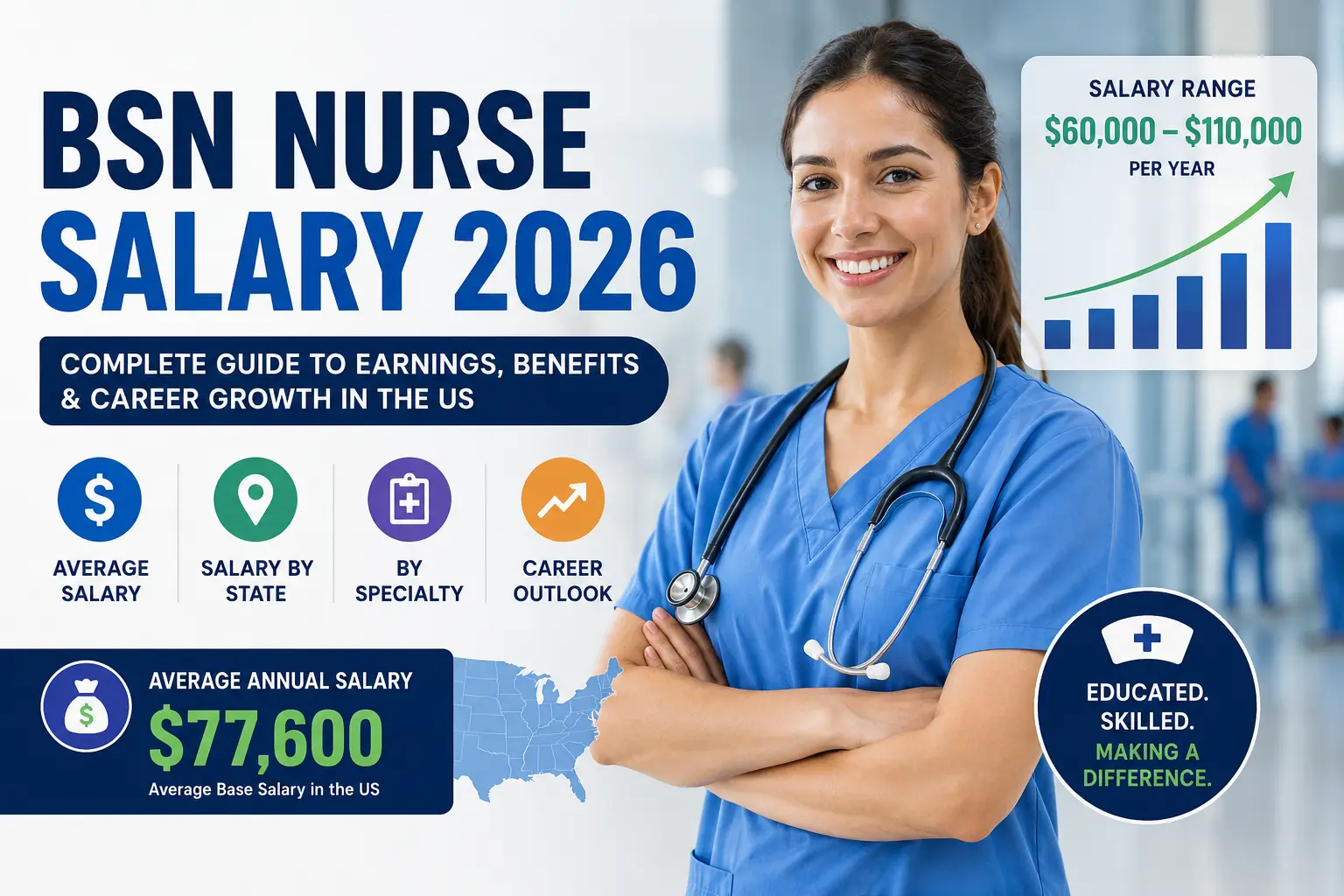
A BSN nurse in the United States earns a median salary of approximately $97,550 per year, while the average annual salary is around $101,420.
Actual compensation varies significantly based on experience, specialty, employer type, and geographic location.
📍 Geographic Insight: Nurses in California, Oregon, and Washington typically earn the highest nominal wages. However, after adjusting for the cost of living, Minnesota and Oregon often provide stronger overall purchasing power.
BSN Nurse Salary Snapshot (2026)
| Metric | Amount |
|---|---|
| Median Annual Salary | $97,550 |
| Mean Annual Salary | $101,420 |
| Median Hourly Rate | $46.90 |
| Entry-Level (10th Percentile) | ~$68,940 |
| Experienced (90th Percentile) | ~$137,470+ |
| Highest Paying State (Nominal) | California ($140,270) |
| Highest Paying State (Cost-Adjusted) | Oregon |
| Highest Paying Specialty | Informatics / Nurse Manager |
| Projected Job Growth (2024-2034) | 4.9% |
The Salary Myth Most Nurses Still Believe
There’s a persistent belief in nursing circles that a Bachelor of Science in Nursing (BSN) guarantees a specific paycheck—that the degree itself is the primary driver of earnings. The data tells a different story.
In 2026, the median annual wage for registered nurses with a BSN stands at $97,550 nationally. But that number obscures more than it reveals. A new graduate in Alabama earning $37 an hour and a seasoned ICU nurse in California making $67 an hour are both counted in that median. The gap—nearly $30 an hour—represents more than $60,000 annually before taxes.
The real question isn’t “what does a BSN nurse make?” It’s “what determines what you will make?” The answer involves geography, specialty, employer type, and a factor most salary guides ignore: cost of living.
Expert Insight: The BSN is a credential that unlocks opportunity, not a fixed salary tier. The degree’s value lies in the doors it opens—leadership roles, specialized units, and career mobility—rather than a guaranteed pay grade.
Market Snapshot: Where BSN Nursing Pay Stands in 2026
The National Picture
According to the Bureau of Labor Statistics’ May 2025 Occupational Employment and Wage Statistics (the most recent comprehensive data available), registered nurses nationally earned:
| Metric | Amount |
|---|---|
| Median annual wage | $97,550 |
| Mean annual wage | $101,420 |
| 10th percentile | ~$68,940 |
| 90th percentile | ~$137,470+ |
The median annual wage for all U.S. occupations in 2025 was approximately $62,088. Registered nurses with a BSN earn roughly 57% more than the typical American worker.
BSN vs. ADN: The Real Earnings Gap
The BSN premium is real but often misunderstood. Multiple independent nursing salary surveys place the difference between $3 and $17 per hour depending on the dataset and methodology:
- Industry compensation surveys indicate BSN nurses earn approximately $3.89 to $5.00 more per hour than ADN-prepared nurses
- National workforce data suggests the annual difference typically ranges from $7,000 to $20,000
- The gap widens significantly with experience—mid-career BSN nurses often out-earn ADN counterparts by $15,000+ annually
Why the range? Different surveys use different samples, geographic distributions, and methodologies. Some include only hospital nurses; others span all settings. The consistent finding across every dataset: BSN nurses earn more—typically between $7,000 and $20,000 annually.
For a deeper comparison of nursing career paths, explore our complete Registered Nurse Salary guide.
Industry Observation: The BSN premium compounds over a career. A $10,000 annual difference invested over 30 years at modest returns could exceed $500,000 in additional lifetime wealth.
National Comparison: BSN Earnings vs. Other Careers
| Occupation | Median Annual Salary | Education Required |
|---|---|---|
| All U.S. Occupations | $62,088 | Varies |
| Medical Assistant | $42,590 | Certificate/Diploma |
| Licensed Practical Nurse | $62,340 | Diploma/Certificate |
| Registered Nurse (ADN) | ~$89,000 | Associate Degree |
| BSN Nurse | ~$97,550 | Bachelor’s Degree |
| Nurse Practitioner | ~$132,050 | Master’s Degree |
| Physician (Primary Care) | ~$224,000+ | Doctoral Degree |
| CRNA | ~$212,650 | Master’s/Doctoral |
BSN-prepared nurses earn approximately 57% above the national average for all occupations. This places nursing in the upper-middle tier of American professions, with earnings comparable to accountants, engineers, and IT professionals.
Salary by State: Where Your Nursing Dollar Goes Furthest
Highest-Paying States for RNs (Nominal Wages)
Based on May 2025 BLS data:
| Rank | State | Median Hourly | Median Annual |
|---|---|---|---|
| 1 | California | $67.44 | $140,270 |
| 2 | Hawaii | $65.54 | $136,320 |
| 3 | Oregon | $62.02 | $129,010 |
| 4 | Washington | $59.71 | $124,200 |
| 5 | Alaska | $52.64 | $109,480 |
| 6 | New York | $52.62 | $109,440 |
| 7 | New Jersey | $51.20 | $106,500 |
| 8 | Massachusetts | $50.27 | $104,550 |
| 9 | Nevada | $49.84 | $103,670 |
| 10 | Connecticut | $49.39 | $102,740 |
Lowest-Paying States
| Rank | State | Median Hourly | Median Annual |
|---|---|---|---|
| 51 | Alabama | $37.06 | $77,080 |
| 50 | Mississippi | $37.06 | $77,090 |
| 49 | South Dakota | $37.53 | $78,060 |
| 48 | Iowa | $37.80 | $78,630 |
| 47 | Arkansas | $37.95 | $78,940 |
The Cost-of-Living Reality Check
Here’s where the narrative gets complicated. California’s $67.44/hour looks impressive until you account for the state’s cost of living. When adjusted for purchasing power, the rankings shift significantly:
| State | Nominal Hourly | Cost-of-Living Adjusted | Cost of Living Index |
|---|---|---|---|
| Oregon | $62.02 | $55.50 | 95.2 |
| Minnesota | $52.10 | $55.10 | 93.5 |
| Washington | $59.71 | $52.30 | 108.0 |
| Nevada | $49.84 | $49.70 | 100.5 |
| California | $67.44 | $47.40 | 143.8 |
| Michigan | $47.70 | $52.90 | 91.2 |
The starkest example: Hawaii ranks second in nominal pay at $65.54/hour but falls significantly on a cost-adjusted basis—a reduction of over $20 per hour in real purchasing power.
Career Strategy: When evaluating job offers, calculate your real purchasing power. A $90,000 salary in Texas may provide a higher standard of living than $120,000 in California or Hawaii.
Salary by Experience: How Earnings Evolve
BSN nursing salaries follow a predictable but meaningful progression. Based on industry compensation data:
| Experience Level | Annual Salary Range | Hourly Range |
|---|---|---|
| Entry (0-2 years) | $64,000 – $77,000 | $30.75 – $37.00 |
| 3-5 Years | $78,000 – $88,000 | $37.50 – $42.30 |
| 5-10 Years | $89,000 – $105,000 | $42.80 – $50.50 |
| 10-20 Years | $106,000 – $125,000 | $51.00 – $60.10 |
| 20+ Years | $120,000 – $136,000+ | $57.70 – $65.40+ |
The earnings acceleration between entry-level and senior roles—often $30,000 to $60,000—reflects both skill accumulation and career moves into higher-paying specialties or leadership.
What drives this growth:
- Skill specialization (ICU, OR, ER, oncology)
- Certification (CCRN, CEN, CNOR)
- Leadership progression (charge nurse, nurse manager, clinical supervisor)
- Employer movement (from community hospitals to academic medical centers)
Practical Advice: The most significant salary jumps typically occur between years 5 and 10, when nurses move from generalist roles into specialized units or first-line leadership positions.
Salary Growth Chart
Highest-Paying BSN Roles: Beyond Bedside Nursing
A BSN opens doors to roles that extend well beyond floor nursing. Here are the top-paying positions available to BSN-prepared nurses:
| Role | Estimated Average Salary | Key Responsibility |
|---|---|---|
| Informatics Nurse | ~$105,000 | Manage patient data systems and workflow optimization |
| Nurse Manager / Clinical Supervisor | ~$100,000 | Oversee staff, budgets, and patient safety |
| Oncology Nurse | ~$100,000 | Coordinate complex cancer care and treatment |
| Travel Nurse | ~$100,000+ | Temporary assignments filling staffing gaps nationwide |
| Critical Care (ICU) Nurse | ~$95,000 | High-acuity patient care in intensive care units |
| Operating Room (Perioperative) Nurse | ~$90,000 | Surgical assistance and pre/post-operative care |
| Quality & Patient Safety Coordinator | ~$90,000 | Analyze outcomes and compliance data |
| Emergency Room (ER) Nurse | ~$88,000 | Trauma and emergency care in fast-paced environments |
| Nurse Case Manager | ~$85,000 | Coordinate long-term care for chronic conditions |
| Public/Community Health Nurse | ~$82,000 | Disease prevention and population health initiatives |
Hiring Insight: The highest-paying BSN roles share a common thread: they move nurses away from task-based care toward systems thinking, leadership, or technical specialization. The BSN curriculum—with its emphasis on research, policy, and leadership—directly enables this transition.
Career Ladder: The BSN Progression Path
For nurses considering advanced practice roles, our Nurse Practitioner Salary and CRNA Salary guides provide comprehensive earning data.
Salary Comparison: Nursing Careers Side-by-Side
| Career | Median Annual Salary | Education Required | Job Growth |
|---|---|---|---|
| Medical Assistant | $42,590 | Certificate/Diploma | 15% |
| Licensed Practical Nurse (LPN) | $62,340 | Diploma/Certificate | 5% |
| Registered Nurse (ADN) | ~$89,000 | Associate Degree | 6% |
| BSN Nurse | ~$97,550 | Bachelor’s Degree | 6% |
| Nurse Practitioner (MSN) | ~$132,050 | Master’s Degree | 35% |
| CRNA | ~$212,650 | Doctoral/Master’s | 9% |
The compensation ladder clearly shows how advanced education translates to higher earnings. The gap between BSN and MSN-prepared nurses—approximately $35,000 annually—represents one of the clearest return-on-investment cases in healthcare education.
For healthcare career comparisons, see our Medical Assistant Salary and Radiology Tech Salary guides.
Career Strategy: If you’re early in your BSN career, prioritize skill development and certification over immediate salary maximization. The earning power you build in your first five years determines your trajectory for the next two decades.
Employer Type: Where You Work Matters
The type of employer significantly influences compensation:
| Employer Type | Annual Mean Wage | % of RNs Employed |
|---|---|---|
| Government (excluding hospitals) | ~$106,000+ | 5% |
| Hospital (state, local, private) | $104,420 | 59% |
| Ambulatory healthcare services | ~$83,780 | 19% |
| Nursing/residential care facilities | ~$81,820 | 6% |
| Educational services | ~$74,360 | <5% |
Key trend: Hospital wages for RNs rose 3.3% year-over-year in 2025, from $101,100 to $104,420. This outpaces inflation and reflects continued labor market pressure.
Government employers—including VA hospitals, state psychiatric facilities, and public health departments—often offer competitive base pay with superior benefits packages, including pension plans that private sector hospitals rarely provide.
Industry Observation: The 19% of RNs working in ambulatory care settings earn nearly $20,000 less than hospital nurses. This pay gap reflects both the lower acuity of outpatient care and the absence of shift differentials and overtime opportunities common in hospital settings.
The Career Ceiling: MSN vs. BSN Earnings
A BSN provides a strong foundation, but the earnings ceiling rises significantly with graduate education.
- BSN-prepared RNs: Median $93,600 – $97,550
- MSN-prepared APRNs: Median $132,050 (Nurse Practitioner Salary)
- CRNAs: Median ~$212,650 (CRNA Salary)
Some nurse practitioners earn up to $217,270 annually. The gap between BSN and MSN earnings—often $35,000 to $50,000 annually—represents one of the clearest return-on-investment cases in healthcare education.
But here’s the nuance: Not every BSN nurse should pursue an MSN. The decision depends on career goals, specialty interest, and tolerance for additional education debt. Many BSN nurses achieve six-figure incomes through experience, certification, and leadership progression without graduate degrees.
What Employers Actually Value (Beyond the Degree)
Healthcare employers consistently prioritize three factors when setting BSN nurse compensation:
1. Specialty Certification
Certifications like CCRN (critical care), CEN (emergency), or CNOR (perioperative) signal advanced competency. Many employers offer $1–$5/hour premiums for certified nurses, though rates vary by facility and region.
2. Shift Differentials
Evening, night, weekend, and holiday shifts typically add 10–25% to base pay. For nurses willing to work non-traditional schedules, this can represent $10,000–$20,000 annually in additional compensation.
3. Experience in High-Acuity Settings
ICU, ER, and OR experience commands premium pay. Nurses who develop skills in these units become more valuable—and more mobile—across the job market.
Career Strategy: If you’re early in your BSN career, prioritize skill development and certification over immediate salary maximization. The earning power you build in your first five years determines your trajectory for the next two decades.
Overtime: The Hidden Income Stream
Nursing offers overtime opportunities that are rare in many professions. Industry data indicates that approximately 40% of RNs work overtime weekly.
Of those working overtime:
- 56% work 1–5 overtime hours
- 31% work 6–10 overtime hours
- 13% work more than 10 overtime hours
The majority (57%) report overtime as voluntary, with only 15% describing it as mandated.
The financial impact: At a $45/hour base rate, 10 overtime hours weekly at time-and-a-half ($67.50/hour) adds approximately $35,000 annually. For nurses who can sustain the schedule, overtime represents a meaningful income lever.
SalaryInfo Tool: Use our Overtime Calculator to estimate your potential earnings from overtime shifts. For a complete understanding of your total compensation, our CTC Calculator and Salary Slip Generator can help you decode your pay structure.
Magnet Hospitals and BSN Requirements
The American Nurses Credentialing Center’s Magnet Recognition Program requires hospitals to demonstrate BSN-prepared nursing staff. Specifically:
- Magnet hospitals must have a higher percentage of BSN-prepared nurses than non-Magnet facilities
- Many Magnet hospitals set internal targets of 80%+ BSN-prepared staff
The salary impact: Magnet hospitals often offer pay premiums for BSN-prepared nurses, though the exact amount varies by employer and region. Some facilities provide differentials of 3-8% above non-Magnet hospital base pay, reflecting their commitment to higher education standards and quality outcomes. For a $100,000 base salary, this could represent $3,000–$8,000 annually.
Future Outlook: Where BSN Nursing Pay Is Headed
Demand Drivers
The Bureau of Labor Statistics projects 4.9% job growth for registered nurses through 2034. More significantly:
- Employment of nurse practitioners is projected to grow 35% through 2034
- 32,700 job openings for advanced practice nurses are expected annually
Compensation Trends
Several forces are shaping future BSN nursing compensation:
- Healthcare staff pay rose 4.3% in 2025, up from 2.7% in 2024
- Labor market strain continues to push wages upward
- Medium-sized health systems ($250M–$750M revenue) saw the greatest median base pay growth at 3.2% in early 2025
- Hiring bonuses declined from 22% in 2024 to 16% in 2025, suggesting the acute staffing crisis may be moderating
Risks to Monitor
- Healthcare consolidation may reduce wage competition in some markets
- Telehealth expansion could shift care delivery and alter traditional staffing models
- Scope of practice changes for advanced practice nurses may affect RN role definitions
- Economic uncertainty could pressure hospital margins and wage growth
Common Salary Myths
Myth: “All BSN nurses earn the same.”
Reality: The gap between the 10th and 90th percentile exceeds $68,000 annually.
Myth: “California is always the best place to earn.”
Reality: Cost-of-living adjustments significantly reduce California’s advantage. Oregon and Minnesota often provide better purchasing power.
Myth: “The degree alone determines your salary.”
Reality: Specialty, certification, experience, and employer type collectively outweigh the degree in determining actual compensation.
Myth: “You need an MSN to earn six figures.”
Reality: Many BSN nurses in leadership, specialty, or travel roles earn $100,000+ annually without graduate degrees.
Myth: “Magnet hospitals always pay more.”
Reality: While Magnet hospitals frequently offer pay premiums, the difference varies significantly by region and employer.
People Also Ask
Can you become an RN without a BSN?
Yes. You can become a registered nurse with an Associate Degree in Nursing (ADN) or a diploma from an approved nursing program. However, many employers prefer or require BSN-prepared nurses, particularly in hospital settings and Magnet-designated facilities.
Is BSN harder than ADN?
The BSN typically requires more coursework in leadership, research, public health, and community nursing. While the clinical nursing skills are similar, the BSN’s additional academic requirements make it more comprehensive and time-intensive.
Does every hospital pay BSN nurses more?
Not every hospital provides a formal BSN premium. However, BSN-prepared nurses often qualify for higher-paying roles, leadership positions, and specialized units that command premium pay. Many Magnet hospitals offer BSN differentials.
Which nursing specialty has the highest demand?
Critical care, emergency nursing, and operating room nursing consistently show high demand. Advanced practice roles like nurse practitioners and CRNAs have the strongest projected job growth at 35% and 9%, respectively.
What is the salary difference between BSN and MSN?
MSN-prepared nurses earn approximately $35,000 to $50,000 more annually than BSN-prepared nurses. The gap widens further for CRNAs, who earn approximately $115,000 more than BSN nurses.
Is BSN required for Magnet hospitals?
Magnet hospitals don’t require BSN for every nurse, but they must demonstrate a high percentage of BSN-prepared staff. Many Magnet facilities maintain internal targets of 80%+ BSN-prepared nurses.
FAQs
What is the average salary for a BSN nurse in the USA in 2026?
The median annual wage for registered nurses with a BSN is approximately $97,550, with a mean wage of $101,420, according to May 2025 BLS data. Entry-level salaries start around $64,000, while experienced nurses can earn $136,000 or more.
Do BSN nurses make more than ADN nurses?
Yes. Industry compensation surveys indicate BSN nurses earn approximately $3.89 to $5.00 more per hour than ADN-prepared nurses. The annual difference typically ranges from $7,000 to $20,000, depending on experience level and geographic location.
What type of BSN nurse gets paid the most?
Among BSN-level roles, nurse informaticists (~$105,000), nurse managers (~$100,000), oncology nurses (~$100,000), and travel nurses (~$100,000+) are among the highest-paying. ICU, OR, and ER nurses also command premium pay, especially with specialty certification.
What is the highest-paying state for BSN nurses?
California ranks highest in nominal wages at $140,270 annually, followed by Hawaii ($136,320) and Oregon ($129,010). On a cost-of-living adjusted basis, Oregon, Minnesota, and Washington rank highest for purchasing power.
How much does a BSN nurse make per hour?
The median hourly wage for registered nurses is approximately $46.90 nationally. Entry-level BSN nurses earn around $30.75–$37 per hour, while experienced nurses in high-cost states can earn $65+ per hour.
Is a BSN worth the additional cost and time?
For most nurses, yes. The BSN premium—typically $7,000–$20,000 annually—compounds significantly over a career. Additionally, many employers now prefer or require BSNs for hospital positions and leadership roles.
What is the job outlook for BSN nurses?
The BLS projects 4.9% job growth for registered nurses through 2034. Advanced practice roles (requiring MSN) are projected to grow 35%. Demand remains strong due to aging populations, chronic disease prevalence, and nurse retirements.
Can BSN nurses earn over $150k?
Yes. BSN nurses in California, Hawaii, and Oregon frequently earn $130,000–$140,000 in base salary. With overtime, shift differentials, and leadership roles, many BSN nurses exceed $150,000 annually.
Is BSN required for Magnet hospitals?
While not strictly required, Magnet hospitals must demonstrate a high percentage of BSN-prepared nurses. Many Magnet facilities set internal targets of 80%+ BSN-prepared staff and offer salary premiums for BSN graduates.
Which hospital systems pay BSN nurses the most?
Academic medical centers, Magnet-designated hospitals, and unionized facilities typically pay the highest wages. Systems like Kaiser Permanente, Stanford Health Care, and Mayo Clinic are known for competitive nursing compensation.
About This Guide
Editorial Note
Salary estimates in this guide are based on U.S. Bureau of Labor Statistics Occupational Employment and Wage Statistics (May 2025), independent industry compensation research, and editorial analysis of workforce trends. Actual earnings vary significantly depending on experience, employer, geographic location, certifications, overtime hours, and specialty. All figures represent national averages and should be used as reference points rather than guaranteed salary projections.