
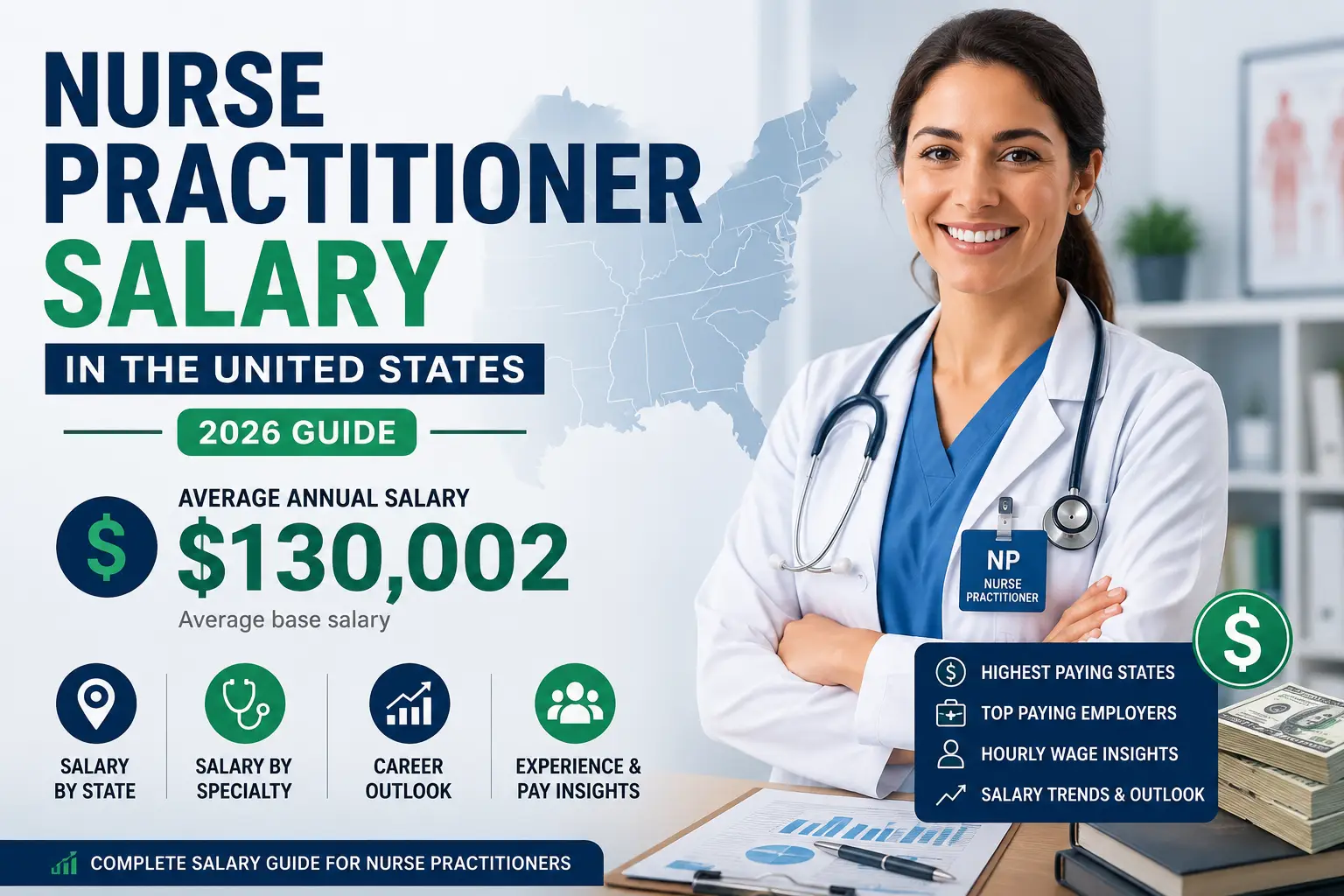
Nurse Practitioner Salary
Independent Analysis | U.S. Bureau of Labor Statistics Data | Editorial Review
The Market Reality: Why NP Compensation Demands Attention
The U.S. Bureau of Labor Statistics projects 40% job growth for nurse practitioners through 2034. That translates to over 128,000 new positions this decade. But here’s what the growth figures don’t capture: the NP role is fundamentally restructuring American healthcare delivery.
Primary care physician shortages, an aging population requiring chronic disease management, and expanded scope-of-practice laws in 27 states have positioned the NP as one of the most strategically vital roles in the healthcare workforce. The result is a labor market where competition for qualified NPs has never been more intense—and where compensation varies more dramatically than most professionals realize.
A $130,000 offer in San Francisco buys a very different lifestyle than $130,000 in Tulsa. The highest-paying state isn’t always the most lucrative. And the specialty you choose can add $60,000 to your annual income or cost you that much in opportunity.
This report cuts through the averages to show you what nurse practitioners actually earn—and why.
National Compensation Snapshot
According to the Bureau of Labor Statistics Occupational Employment and Wage Statistics (May 2025 release), the national landscape for NP compensation is as follows:
| Metric | Amount |
|---|---|
| Mean Annual Salary | $137,300 |
| Median Annual Salary | $129,210 |
| Mean Hourly Wage | $66.01 |
| Total NPs Employed | ~323,040 |
The middle 50% of NPs earn between $109,940 and $149,570 annually. The bottom 10% earn approximately $92,000, while top earners clear $182,000.
SalaryInfo Insight: The gap between the mean ($137,300) and median ($129,210) reveals something important—high earners pull the average up significantly. This isn’t a flat distribution. The top quartile earns substantially more than the middle, which means career choices (specialty, employer, location) have an outsized impact on your paycheck.
Salary by Gender: What the Data Shows
While the nursing profession is predominantly female, gender-based pay differentials persist in advanced practice roles.
Recent compensation surveys indicate that male NPs earn approximately 5–8% more than their female counterparts, even when controlling for experience, specialty, and location. The gap narrows in unionized settings and government employment but remains observable in private practice and hospital systems.
| Gender | Average Annual Salary |
|---|---|
| Male NPs | ~$142,000 |
| Female NPs | ~$133,500 |
SalaryInfo Observation: The pay gap in nursing is smaller than in many other professions, but it persists. Women NPs are more likely to work in lower-paying specialties like pediatrics and family medicine, while men are overrepresented in higher-paying areas like acute care and surgical specialties. Negotiation behavior and career advancement rates also contribute to the differential.
State-by-State Analysis: Raw Pay vs. Real Pay
California pays the highest raw salaries—$176,760 on average, according to BLS May 2025 data. New Jersey follows at $155,750, Oregon at $155,680, and Washington at $152,180.
But raw numbers are deceptive.
When adjusted for cost of living, the ranking flips dramatically. Oklahoma, with a cost of living index of 89.6 (below the national average of 100), delivers the best purchasing power. NPs in Oklahoma earn an adjusted $75.02 per hour—higher than California’s adjusted $59.72.
Highest Raw Salaries
| State | Annual Salary | Hourly Wage | Cost of Living Index | Adjusted Hourly |
|---|---|---|---|---|
| California | $176,760 | $84.98 | 142.3 | $59.72 |
| New Jersey | $155,750 | $74.88 | 112.7 | $60.72 |
| Oregon | $155,680 | $74.85 | — | — |
| Washington | $152,180 | $73.16 | — | — |
| Massachusetts | $152,320 | $73.20 | 141.2 | $51.84 |
Best Purchasing Power (Adjusted for Cost of Living)
| State | Raw Hourly | Adjusted Hourly |
|---|---|---|
| Oklahoma | $64.52 | $75.02 |
| Iowa | $65.84 | $73.40 |
| Michigan | $63.84 | $70.85 |
| Missouri | $62.97 | $70.75 |
| Arkansas | $62.63 | $69.90 |
Lowest Raw Pay States
| State | Annual Salary |
|---|---|
| Alabama | $110,970 |
| Tennessee | $115,510 |
| Ohio | $122,910 |
| South Carolina | $124,170 |
| Kentucky | $125,010 |
Key Takeaway: A $130,000 salary in California buys less than a $115,000 salary in Tennessee. When evaluating job offers, always consider the cost of living. The highest paycheck isn’t always the best financial decision.
Metropolitan Areas: Where Top Earners Concentrate
The highest-paying metropolitan areas are concentrated in California, with San Jose leading the pack.
| Metropolitan Area | Annual Salary |
|---|---|
| San Jose-Sunnyvale-Santa Clara, CA | ~$223,530 |
| San Francisco-Oakland-Fremont, CA | ~$208,480–$219,080 |
| Vallejo, CA | ~$182,370–$184,590 |
| Napa, CA | ~$176,270–$202,690 |
| Eastern Sierra-Mother Lode, CA | $174,670 |
Other high-paying metros include New York, NY ($155,250), Seattle, WA ($149,500), and Boston, MA ($143,750).
Specialty Premium: Which NPs Earn the Most
Your specialty determines your earning potential more than almost any other factor. The gap between the lowest and highest-paying NP specialties exceeds $60,000 annually.
Highest-Paying NP Specialties (2026)
| Specialty | Average Annual Salary |
|---|---|
| Surgical NP | $189,091 |
| Anesthesiology/Pain Medicine NP | $159,484 |
| Psychiatric-Mental Health NP (PMHNP) | $145,050 |
| Orthopedic NP | $139,781 |
| Neonatal NP (NNP) | $136,649 |
| Pediatric NP | $135,161 |
| Emergency NP | $134,369 |
| Cardiovascular Surgery NP | $134,369 |
| Family NP (FNP) | $127,976 |
CRNAs (Certified Registered Nurse Anesthetists) consistently earn over $200,000 annually, though they are often categorized separately from NPs.
Psychiatric-Mental Health NPs: A Closer Look
PMHNPs deserve special attention. The national shortage of mental health providers, combined with telehealth expansion, has made this the most in-demand NP specialty in 2026.
- Entry-level PMHNPs: $110,000–$120,000
- Mid-career PMHNPs: $135,000–$145,000
- Experienced PMHNPs in private practice or telepsychiatry: $160,000+
Industry compensation data indicates the average PMHNP salary exceeds $149,000 as of 2026.
SalaryInfo Observation: Family NPs are the most common specialty—over 65% of NPs choose this path—but they earn near the bottom of the specialty pay scale. The most popular specialty is not the highest-paying. If you’re choosing a track, understand that supply and demand affects your future income.
Salary by Certification: How Credentials Impact Pay
Your specific NP certification influences earning potential. Here’s how the major certifications compare:
| Certification | Average Annual Salary | Demand Outlook |
|---|---|---|
| PMHNP (Psychiatric-Mental Health) | $145,050 | Very High |
| ACNP (Acute Care) | $134,369 | High |
| NNP (Neonatal) | $136,649 | Moderate |
| PNP (Pediatric) | $135,161 | Moderate |
| FNP (Family) | $127,976 | High |
| WHNP (Women’s Health) | $125,000 | Moderate |
| AGNP (Adult-Gerontology) | $126,629 | Moderate |
SalaryInfo Insight: The certification premium varies by region. In rural areas, FNPs command higher salaries due to broader scope requirements. In urban academic medical centers, subspecialty certifications like ACNP or PMHNP carry the highest premium.
Experience: How Earnings Grow Over Time
Experience accelerates NP earnings significantly.
| Experience Level | Annual Salary Range |
|---|---|
| Entry-Level (<1 year) | $114,000–$126,000 |
| Early Career (1–2 years) | $115,000–$126,500 |
| Mid-Level (2–4 years) | $121,000–$129,000 |
| Senior (8+ years) | $160,000–$190,000+ |
In California, entry-level NPs start around $126,000, while senior NPs with 8+ years earn approximately $190,834.
The takeaway: Your first NP job is rarely your last. Earnings growth of 40–60% over a career is realistic. The question isn’t just what you’ll earn today—it’s what you’ll earn in 10 years.
Career Growth Timeline: RN to NP to Leadership
Understanding the career progression helps you forecast earnings.
Registered Nurse (RN)
  ↓ 1–2 years experience (often required)
Bachelor of Science in Nursing (BSN)
  ↓ 2 years (MSN) or 3–4 years (DNP)
Nurse Practitioner (NP)
  ↓ 2–4 years
Senior NP / Lead NP
  ↓ 3–5 years
NP Manager / Director of Advanced Practice
  ↓ 5+ years
Chief Nursing Officer / VP of Patient Care Services
| Career Stage | Typical Age | Salary Range |
|---|---|---|
| RN (BSN) | 22–25 | $75,000–$101,000 |
| Entry NP | 26–30 | $114,000–$126,000 |
| Mid-Career NP | 31–40 | $135,000–$155,000 |
| Senior NP / Lead | 40–50 | $160,000–$190,000 |
| NP Director | 45+ | $180,000–$230,000+ |
Employer Analysis: Who Pays Above Market
Some employers pay significantly above market rates.
| Employer | Average Annual Pay |
|---|---|
| MercyOne | $505,440 |
| Veteran Medical Group | $502,530 |
| Comfort Choice Hospice Care | $494,000 |
| Jogan Health | $410,800 |
| CLARE|MATRIX | $390,000 |
| Potomac Healthcare Solutions | $371,280 |
Reality Check: These figures represent outlier employers, not the typical market. Most NPs will not earn $400,000+ at standard healthcare employers. These numbers often reflect locum tenens, crisis staffing, or highly specialized roles with demanding schedules.
More typical top-paying employers include:
- CVS Health: ~$164,705
- ProHealth Partners: ~$153,000
Industry Settings: Where NPs Work and What They Earn
| Industry | NPs Employed | Average Salary |
|---|---|---|
| Offices of Physicians | 148,600 | $122,780 |
| General Medical & Surgical Hospitals | 73,610 | $136,230 |
| Outpatient Care Centers | 31,590 | $139,320 |
| Offices of Other Health Practitioners | 15,260 | $121,250 |
| Home Health Care Services | 11,600 | $146,850 |
Highest-Paying Industries
| Industry | Annual Salary |
|---|---|
| Business Support Services | $185,200 |
| Other Residential Care Facilities | $165,540 |
| Residential Intellectual/Developmental Disability Facilities | $165,070 |
| Junior Colleges | $162,460 |
| Psychiatric & Substance Abuse Hospitals | $148,850 |
SalaryInfo Insight: Home health care pays $146,850—$24,000 more than physicians’ offices—yet employs far fewer NPs. The highest-paying settings are often the least obvious. Don’t assume hospital employment always pays best.
Practice Authority: The Hidden Salary Driver
State-level practice authority matters more than most candidates realize.
The Three Tiers
Full Practice Authority (27 states + DC): NPs evaluate, diagnose, order tests, and prescribe independently without physician collaboration. Higher autonomy typically means higher pay because NPs can run their own practice or carry their own panel.
Reduced Practice (12 states): NPs require a collaborative agreement with a physician for at least one element of practice. The collaborating physician often charges 5–15% of NP revenue.
Restricted Practice (11 states): NPs require physician supervision for diagnosis or treatment. Lowest autonomy, often lower pay.
| Practice Authority Tier | States | Typical Salary Impact |
|---|---|---|
| Full Practice | 27 + DC | +$10,000–$15,000 |
| Reduced Practice | 12 | Baseline |
| Restricted Practice | 11 | -$5,000–$10,000 |
Pay implication: In full-practice states, NPs in private practice can earn $175,000–$250,000+ by running their own panel. In restricted states, NPs are typically capped at $140,000 even with experience.
Employer Type: Hospital vs. Private Practice vs. Government vs. Telehealth
The type of organization you work for significantly affects compensation, benefits, and work-life balance.
| Employer Type | Average Salary | Benefits | Work-Life Balance |
|---|---|---|---|
| Hospital System | $136,230 | Strong benefits, pension options | Moderate |
| Private Practice/Clinic | $122,780 | Variable benefits | Generally better |
| Government (VA, Military) | $130,000–$155,000 | Excellent benefits, pension | Good |
| Telehealth | $120,000–$155,000 | Often limited benefits | High flexibility |
| Urgent Care | $130,000–$145,000 | Moderate | Shift-based |
| Academic/University | $140,000–$160,000 | Excellent benefits, tuition | Good |
SalaryInfo Verdict: Government employment may offer lower base pay than top hospital systems but often provides superior benefits, pension plans, and job security. Telehealth offers flexibility but may have less predictable compensation.
Overtime, Bonuses, and Total Compensation
Base salary isn’t the whole picture.
Overtime: NPs earn an average of $18,750 per year in overtime—roughly 14% of base pay. Use our Overtime Calculator to estimate your potential earnings.
Shift Differentials: Night shifts, weekend work, and holiday coverage typically add 10–15% to hourly rates.
Bonuses: Average annual bonuses are approximately $2,790. Sign-on bonuses for high-demand specialties can reach $20,000–$40,000.
Total Compensation: When factoring overtime, shift differentials, and bonuses, total annual compensation can exceed $150,000–$170,000 for mid-career NPs.
Key Takeaway: When comparing job offers, look beyond base salary. A $125,000 base with $20,000 in overtime potential and a $10,000 sign-on bonus may beat a $135,000 base with no extras. Use our Salary Slip Generator to understand your actual take-home pay.
Education Investment: MSN vs. DNP
Becoming an NP requires a Master of Science in Nursing (MSN)—typically 2 years of graduate education after a BSN. The DNP (Doctor of Nursing Practice) is increasingly common.
| Degree | Typical Cost | Duration | Salary Impact |
|---|---|---|---|
| MSN | $30,000–$80,000 | 2 years | Entry-level NP salary |
| DNP | $50,000–$120,000+ | 3–4 years | Potentially higher pay, leadership roles |
NPs earn roughly $38,870 more annually than registered nurses. The ROI on NP education is strong—most graduates recoup their educational investment within 2–3 years of practice.
SalaryInfo Verdict: The MSN is the minimum requirement and delivers excellent ROI. The DNP may become necessary for career advancement, but currently, the salary premium is modest compared to the additional cost and time.
NP vs. PA vs. RN vs. CRNA: How the Roles Compare
| Role | Average Annual Salary | vs. NP |
|---|---|---|
| Nurse Anesthetist (CRNA) | ~$248,320 | +$111,000 |
| Nurse Practitioner | $137,300 | — |
| Nurse Midwife | $136,980 | -$320 |
| Physician Assistant | ~$126,000 | -$11,000 |
| Registered Nurse | $101,420 | -$35,880 |
| Nursing Instructor | $86,410 | -$50,890 |
Key Takeaway: NPs out-earn PAs by roughly $11,000 annually. The gap reflects differences in scope of practice, autonomy, and the nursing model vs. medical model approach to care. CRNAs earn significantly more but require different training pathways.
Salary Forecast: 2027–2030
Projecting NP salary growth requires analyzing multiple factors:
- Healthcare demand: Increasing
- NP supply growth: Growing at ~5–7% annually
- Physician shortages: Worsening, driving NP demand
- Scope-of-practice expansion: Likely to continue
- Inflation: Moderate (2–3% annually)
| Year | Projected Mean Salary | Growth vs. Current |
|---|---|---|
| 2026 | $137,300 | Baseline |
| 2027 | $141,400 | +3.0% |
| 2028 | $145,600 | +6.0% |
| 2029 | $150,000 | +9.2% |
| 2030 | $154,500 | +12.5% |
SalaryInfo Forecast: By 2030, the average NP salary could approach $155,000, driven by persistent demand, expanded scope of practice, and increasing complexity of care. Top earners in high-paying specialties and states may exceed $220,000.
The Future: Why NP Demand Is Exploding
The BLS projects 40% job growth for nurse practitioners between 2024 and 2034. That means:
- 128,400 new jobs over the decade
- The fastest-growing healthcare profession
- Driven by primary care shortages, aging population, and expanded scope of practice
U.S. News & World Report ranked Nurse Practitioner as the #1 Best Job in America for 2026.
What This Means for Your Career
- Job security: Exceptional. Demand far exceeds supply.
- Salary growth: Likely to continue outpacing inflation.
- Geographic flexibility: Opportunities exist in every state.
- Negotiating power: High. Employers compete aggressively for qualified NPs.
The Risks: What Salary Data Doesn’t Show
Not everything about the NP career path is positive.
1. Educational Debt: Many NPs graduate with $50,000–$150,000 in student loans. High salaries help, but debt repayment consumes a significant portion of early-career income. Use our Income Tax Calculator and CTC Calculator to plan your finances.
2. Burnout: NPs work in high-stress environments. Salary doesn’t compensate for unsustainable workloads.
3. Scope-of-Practice Variation: Not all states grant NPs full practice authority. In restricted states, NPs must work under physician supervision, which can limit autonomy and earning potential.
4. Regional Oversaturation: While the national outlook is strong, some desirable metropolitan areas are becoming saturated. Competition for top positions in cities like New York, Los Angeles, and Boston is intensifying.
SalaryInfo Warning: The highest salary isn’t always the best career move. Consider work-life balance, scope of practice, cost of living, and long-term career trajectory.
Common Salary Myths, Debunked
Myth 1: “All NPs earn the same.”
False. Specialty and location create $60,000+ gaps.
Myth 2: “California is always the best place to earn.”
False for purchasing power. Adjusted for cost of living, Oklahoma and Iowa deliver higher real wages.
Myth 3: “Experience doesn’t matter much after 5 years.”
False. Senior NPs with 8+ years earn $60,000–$80,000 more than entry-level NPs.
Myth 4: “Hospitals pay the most.”
False for many specialties. Home health care, business support services, and outpatient centers often pay more.
Myth 5: “You need a DNP to earn top dollar.”
False for most roles. Specialty and experience matter more than degree level.
Myth 6: “Male and female NPs earn the same.”
False. A gap of 5–8% persists, though it is narrowing.
Featured Snippet Answers
Q: What is the average nurse practitioner salary in the United States?
The average nurse practitioner salary in the United States is approximately $137,300 per year, with a median of $129,210 according to BLS May 2025 data. The middle 50% earn between $109,940 and $149,570. Top earners make over $182,000 annually.
Q: Which state pays nurse practitioners the most?
California pays the highest raw salaries at an average of $176,760 per year, followed by New Jersey ($155,750), Oregon ($155,680), and Washington ($152,180). However, when adjusted for cost of living, Oklahoma offers the best purchasing power at $75.02 per hour.
Q: What type of nurse practitioner gets paid the most?
Surgical nurse practitioners earn the most at approximately $189,091 per year, followed by anesthesiology/pain medicine NPs at $159,484 and psychiatric-mental health NPs at $145,050. [CRNAs](/crna-salary/) earn over $200,000 but are often categorized separately.
Q: How much do nurse practitioners make per hour?
The mean hourly wage for nurse practitioners is approximately $66.01 according to BLS data. State averages range from $53.35 in Alabama to $84.98 in California.
Q: Is nurse practitioner a good career in 2026?
Yes. The BLS projects 40% job growth through 2034, making it the fastest-growing healthcare profession. U.S. News ranked NP as the #1 Best Job in America for 2026. Strong salaries, high demand, and expanded scope of practice make it an excellent career choice.
Q: How does NP salary compare to physician assistant salary?
Nurse practitioners earn approximately $11,000 more than physician assistants on average ($137,300 vs. $126,000). The gap reflects differences in scope of practice, autonomy, and the nursing model vs. medical model approach to care.
Q: What is the salary outlook for nurse practitioners through 2030?
By 2030, the average NP salary could approach $154,500, representing roughly 12.5% growth from 2026 levels. Top earners in high-paying specialties and states may exceed $220,000.
Q: Does practice authority affect NP salary?
Yes. In full-practice states, NPs in private practice can earn $175,000–$250,000+ by running their own panel. In restricted states, NPs are typically capped at $140,000 even with experience.
Frequently Asked Questions
How long does it take to become a nurse practitioner in the USA?
Becoming an NP typically takes 6–8 years total: 4 years for a BSN, 1–2 years of RN experience (often required), and 2 years for an MSN. Some accelerated programs compress this timeline. DNP programs add 1–2 additional years.
What’s the difference between an NP and a PA?
NPs are trained in the nursing model and typically specialize in a population (family, psychiatric, pediatric). PAs are trained in the medical model and are more generalist. NPs earn approximately $11,000 more annually on average.
Do nurse practitioners make more than doctors?
No. Physicians earn significantly more—primary care physicians average $200,000–$250,000, and specialists earn much higher. NPs earn roughly half of what physicians earn.
Can nurse practitioners prescribe medication?
Yes. NPs can prescribe medications in all 50 states. In most states, they can also prescribe controlled substances, though regulations vary.
What’s the starting salary for a new nurse practitioner?
Entry-level NPs (less than 1 year of experience) earn approximately $114,000–$126,000 annually, depending on location and specialty.
Is the nurse practitioner salary worth the student debt?
Yes for most graduates. The salary premium over RNs is approximately $38,870 annually, which allows most NPs to repay educational debt within 2–3 years.
What’s the salary ceiling for nurse practitioners?
Top-earning NPs in high-paying specialties and locations can exceed $180,000–$190,000 annually. Some outlier employers pay over $200,000 for specialized or crisis roles. [CRNAs](/crna-salary/) earn over $200,000 consistently.
How does practice authority affect NP salary?
In full-practice states, NPs in private practice can earn $175,000–$250,000+ by running their own panel. In restricted states, NPs are typically capped at $140,000 even with experience.
What benefits should I expect as an NP?
Typical benefits include health insurance, 401(k) with matching, malpractice insurance, CME allowance ($1,000–$3,000 annually), paid time off (3–5 weeks), and sometimes tuition reimbursement.
Can NPs work remotely?
Yes. Telehealth NP positions are growing rapidly, particularly in psychiatric-mental health, primary care, and urgent care. Remote NP salaries range from $120,000–$155,000 depending on specialty and experience.
Related Healthcare Salary Guides
- Registered Nurse Salary — Compare RN vs NP pay and career progression.
- CRNA Salary — See how anesthesia salaries compare with nurse practitioners.
- Radiology Tech Salary — Explore advanced imaging compensation compared to NP roles.
- Radiologist Salary — Compare advanced practice nursing with physician compensation.
- Cardiologist Salary — Understand cardiology compensation relative to NP earnings.
- Neurosurgeon Salary — See how surgical specialties compare with NP pay.
- Surgeon Salary — Compare general surgery compensation with nurse practitioner salaries.
- Pathologist Salary — Explore pathology compensation compared to NP roles.
- Pediatrician Salary — Understand pediatric compensation relative to NP earnings.
- Anesthesiologist Salary — Compare anesthesia physician pay with NP compensation.
- Obstetrician Salary — See OB/GYN compensation compared to NP salaries.
- Ophthalmologist Salary — Explore ophthalmology pay relative to NP earnings.
- Plastic Surgeon Salary — Compare surgical subspecialty compensation with NP pay.
- Urologist Salary — Understand urology compensation compared to nurse practitioners.
Compensation Planning Tools
- Salary Slip Generator — Understand your take-home pay breakdown.
- Overtime Calculator — Estimate potential overtime earnings.
- Income Tax Calculator — Plan your tax liability accurately.
- CTC Calculator — Compare total compensation packages.
- Gratuity Calculator — Understand long-term benefits.
- EPF Calculator — Plan retirement contributions.
Methodology
SalaryInfo analyzed the latest U.S. Bureau of Labor Statistics Occupational Employment and Wage Statistics (OEWS) data (May 2025 release), employer job postings, healthcare employment research, and state-level cost of living data from established economic indices. Where multiple sources differed, federal wage data was used as the primary benchmark.
Practice authority classifications are based on the American Association of Nurse Practitioners (AANP) state practice environment reports. Projections for 2027–2030 incorporate BLS employment projections, historical salary growth rates, and economic forecasts from the Federal Reserve and Congressional Budget Office.
Gender pay analysis draws from compensation research conducted by healthcare industry associations and academic studies on nursing workforce economics. All salary figures are presented in U.S. dollars and reflect national, state, and metropolitan area averages. Individual compensation may vary based on experience, certification, employer, and negotiation.