
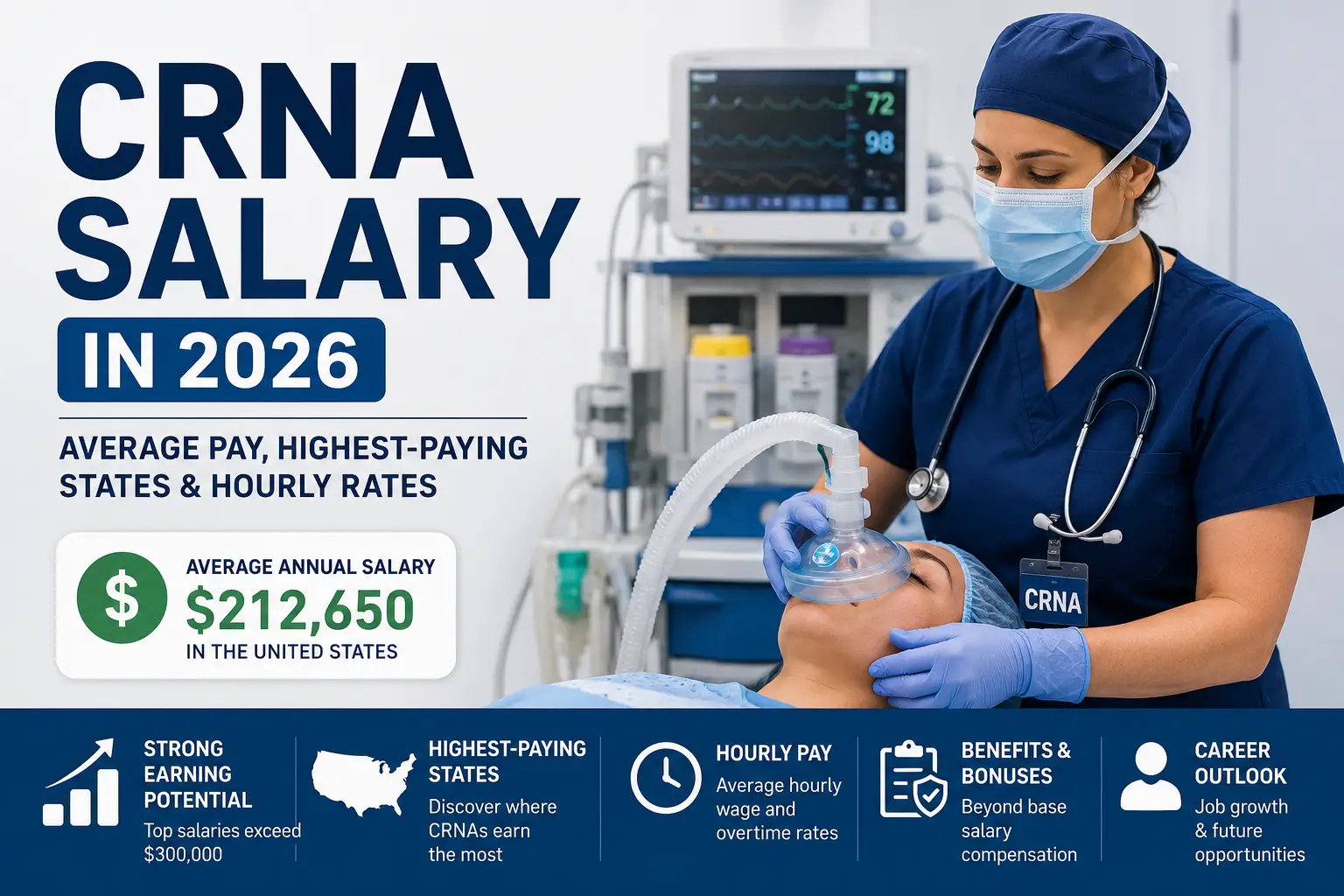
How much does a CRNA make in 2026? The average total compensation is $291,396 as of July 2026, according to Marit Health’s compilation of 559 peer-reported salaries. The median annual salary reported by the U.S. Bureau of Labor Statistics is $223,210. The highest-paying state is Alaska at $311,110, and the highest-paying employer type is outpatient care centers at approximately $264,000.
But these headline numbers tell only part of the story. For employers, the fully loaded cost of employing a CRNA now exceeds $342,812—a $51,000 gap that’s reshaping how hospitals and ambulatory surgery centers staff their anesthesia departments.
What follows is a data-driven breakdown of what CRNAs actually earn in 2026, why pay varies so dramatically, and what you need to know to negotiate effectively.
The 2026 Salary Snapshot: What CRNAs Actually Earn
CRNA compensation data comes from multiple sources, and they tell slightly different stories depending on methodology:
| Source | Average/Median Compensation | Data Type |
|---|---|---|
| Marit Health (July 2026) | $291,396 | Average total compensation, 559 peer-reported salaries |
| AANA Compensation Survey | ~$270,000 | Average compensation, up from $181,000 in 2019 |
| BLS (May 2024) | $223,210 | Median annual salary |
| Payscale (2026) | $196,505 | Self-reported average |
| Vivian.com (June 2026) | $130.82/hour (~$272,000 annualized) | Active job postings |
Why the range? Government data is typically published with a delay, while employer surveys and job-posting platforms reflect current market conditions. BLS data is the most conservative—it lags by roughly two years and includes all settings. Marit Health and AANA data reflect real-time compensation from active professionals. Payscale captures self-reported figures that tend to run lower.
Editorial Analysis: The $68,000 gap between the BLS median and Marit Health’s average represents the difference between government-reported data and what professionals actually earn. For career planning, trust industry-specific surveys over broad government statistics.
CRNA Salary Growth: 2019–2026
CRNA pay has increased dramatically over the past seven years, outpacing inflation and most other healthcare professions.
| Year | Average/Median Salary | Source | Growth |
|---|---|---|---|
| 2019 | $181,040 | BLS | Baseline |
| 2024 | $231,700 | BLS | +28% (2019–2024) |
| April 2026 | $276,434 | Marit Health | +53% (2019–2026) |
| July 2026 | $291,396 | Marit Health | +61% (2019–2026) |
Between 2019 and 2026, CRNA compensation increased approximately 59–61%. Over that same period, inflation was roughly 19%. In real (inflation-adjusted) terms, CRNAs have experienced meaningful wage growth—a distinction not shared by all healthcare specialties.
What drove this growth? Five key factors:
- Anesthesia demand expanded beyond the OR—endoscopy suites, cath labs, interventional radiology, and MRI units now require coverage. Non-operating room anesthesia is projected to account for more than 50% of all anesthetics delivered by 2030.
- CRNA graduates are offsetting retirements, not growing the workforce—approximately 2,400 CRNAs graduate annually from 155 accredited programs, but roughly 31% of the current workforce is 55 or older.
- The anesthesiologist workforce is contracting—about 30% of practicing anesthesiologists are projected to exit clinical practice by 2033.
- Surgical volumes climbed sharply as elective procedures resumed post-pandemic, driven by an aging population requiring more joint replacements, cardiac procedures, and cancer surgeries.
- The doctoral degree requirement (effective 2025) raises training standards but constrains how quickly new programs can scale.
Market Outlook: The AANA projects a shortage of about 12,500 anesthesia providers by 2033—nearly 22% of the current workforce. Based on current workforce trends, compensation is expected to remain under upward pressure.
CRNA Salary Compared to Other Nursing Roles
Users searching “CRNA salary” almost always compare it with other nursing careers. Here’s how the numbers stack up:
| Career | Median Annual Salary | Difference from CRNA |
|---|---|---|
| CRNA | $223,210 (BLS median) / $291,396 (average) | Baseline |
| Anesthesiologist | $337,000 (base) / $535,000 (total) | +51% to +84% |
| Nurse Practitioner | $129,210 | -42% |
| Nurse Midwife | $128,790 | -42% |
| Registered Nurse | $93,600 | -58% |
| Licensed Practical Nurse | $62,340 | -72% |
| All Occupations (US) | $49,500 | -78% |
Key takeaway: CRNAs earn approximately 73% more than nurse practitioners and 138% more than registered nurses. The earning gap has widened as CRNA compensation has grown 61% since 2019, while RN salaries have grown at a slower pace.
Learn more about Registered Nurse salaries for a detailed comparison of RN compensation across different settings and states.
Starting Salary for New CRNA Graduates
Entry-level CRNAs don’t start at the average. But they start well above most nursing careers.
| Career Stage | Typical Compensation | Key Characteristics |
|---|---|---|
| 0–2 years | $180,000–$205,000 | Learning curve, lower autonomy |
| 3–5 years | $220,000–$260,000 | Full productivity, some specialisation |
| 6–10 years | $250,000–$300,000 | Senior roles, call premiums |
| 10+ years | $280,000–$340,000+ | Leadership, specialisation, mentorship |
Entry-level details:
- Typical new graduate range: $180,000–$205,000 base salary
- Some employers now offer new grads $280,000+ in competitive markets
- Entry-level California range: $200,530–$335,550
- Senior CRNA earnings: $224,179+
The premium for new graduates has increased dramatically. Five years ago, starting offers in the $150,000 range were common. Today, even conservative employers start new CRNAs above $180,000, and aggressive recruiters in high-demand regions offer well over $200,000.
Career Strategy: If you’re a new graduate, don’t anchor on the lowest number you see. Many employers now offer $60,000–$100,000 signing bonuses specifically to attract new CRNAs. The starting salary is negotiable, but the bonus structure often has more room to move.
Highest-Paying States for CRNAs in 2026
Geography remains one of the strongest predictors of CRNA earnings. The data shows significant variation across states.
Top States by Average Advertised Salary
| State | Average Advertised Salary | Key Drivers |
|---|---|---|
| Alaska | $400,000 | Remote location premium, highest in nation |
| New Hampshire | $321,667 | Largest Q1 2026 jump (+$56,667) |
| Missouri | $300,833 | Strong rural demand |
| Louisiana | $293,125 | Q1 increase of $50,625 |
| Connecticut | $288,750 | Northeast market pressure |
| Texas | $287,692 | Large locum market, rural demand |
| Pennsylvania | $282,850 | Northeast competition |
BLS State Data (2024, Most Recent Federal)
| State | Average Salary |
|---|---|
| Alaska | $311,110 |
| California | $283,780 |
The ceiling is rising: The highest maximum advertised salary for CRNAs hit $475,000 in Pennsylvania and reached $450,000 in four other states. Average compensation reached at least $350,000 in eight different states.
Practical Tip: The highest-paying states aren’t always the best financial choice. California’s $283,780 average comes with a cost of living that can erase the premium. Alaska had the highest hourly mean wage, but West Virginia had the highest hourly mean wage after adjusting for cost of living.
States with the Biggest Q1 2026 Pay Jumps
Between Q4 2025 and Q1 2026, these states saw the largest increases in advertised base pay:
| State | Q4 2025 | Q1 2026 | Increase |
|---|---|---|---|
| New Hampshire | $265,000 | $321,667 | +$56,667 |
| Louisiana | $242,500 | $293,125 | +$50,625 |
| Connecticut | $242,500 | $288,750 | +$46,250 |
| Wisconsin | $226,923 | $267,500 | +$40,577 |
| Pennsylvania | $243,091 | $282,850 | +$39,759 |
CRNA Salary by Work Setting
Work setting significantly affects CRNA compensation. Here’s how different employers compare:
| Work Setting | Typical Compensation | Key Considerations |
|---|---|---|
| Outpatient care centers | $260,000–$280,000 | Highest average, predictable schedules |
| General medical/surgical hospitals | $230,000–$260,000 | Benefits, stability, call requirements |
| Specialty hospitals | $220,000–$250,000 | Focused caseload, often lower acuity |
| Physician offices | $210,000–$240,000 | Variable schedules, lower benefits |
What’s changed in 2026: Outpatient care centers have widened their lead. As more procedures move out of hospitals, ASCs and ambulatory surgical centers compete aggressively for CRNA talent.
The hospital trade-off: Hospitals often pay slightly less in base salary but offer superior benefits—better retirement matches, more PTO, and loan repayment programs. A $260,000 hospital package with a 10% retirement match and $20,000 in loan repayment may exceed a $280,000 ASC offer with minimal benefits.
Compare Anesthesiologist salaries to understand how physician compensation compares to CRNA earnings across different settings.
The $51,000 Gap: What Employers Actually Pay vs. What You See
The average CRNA total compensation of $291,396 doesn’t include the full cost an employer bears. Here’s the breakdown:
| Cost Component | Annual Amount |
|---|---|
| Base compensation | $291,396 |
| Employer FICA (7.65%) | $22,292 |
| Malpractice insurance | $5,968 |
| Health benefits | $8,500 |
| Retirement match (3–5%) | $11,656 |
| CME, licensing, dues | $3,000 |
| Total loaded cost | $342,812 |
That’s a $51,000 gap between what you’re paid and what you actually cost your employer.
This explains why ambulatory surgery centers are increasingly subsidizing anesthesia coverage. The share of ASCs paying anesthesia stipends jumped from 28% in 2024 to 44% in 2025. Sixty-seven percent of ASC leaders ranked anesthesia coverage among their top three financial challenges for 2026.
What This Means: When you understand the full cost of your employment, you understand your negotiating leverage. Employers have already budgeted $340,000+ for your position. Asking for an additional $10,000–$20,000 in base salary is a 3–6% increase on their total cost—well within negotiation range for most organizations.
CRNA Hourly and Monthly Salary Breakdown
CRNA pay structures vary significantly by employment type.
Hourly Rates
| Employment Type | Typical Rate | Key Trade-offs |
|---|---|---|
| W-2 (employed) | $95–$120/hour | Benefits, stability, PTO, retirement |
| Locum Tenens | $160–$230/hour | Higher gross pay, no benefits, self-employment tax |
| 1099 (independent contractor) | $150–$250+/hour | Maximum flexibility, no benefits, higher tax burden |
Monthly Salary Estimates
Based on the BLS median of $223,210 and Marit Health average of $291,396:
| Salary Level | Annual | Monthly (Gross) | Biweekly (Gross) | Weekly (Gross) |
|---|---|---|---|---|
| BLS Median | $223,210 | $18,601 | $8,585 | $4,293 |
| AANA Average | ~$270,000 | $22,500 | $10,385 | $5,192 |
| Marit Health Average | $291,396 | $24,283 | $11,208 | $5,604 |
| Top Earner | $400,000+ | $33,333+ | $15,385+ | $7,692+ |
Locum Tenens Examples (2026)
- North Carolina: $240/hour
- Virginia: $230/hour + $750/week travel reimbursement
- Hawaii: $160–$230/hour (all-inclusive)
- General range: $210–$220/hour with travel/lodging covered
1099 considerations: Self-employment tax (15.3% vs. 7.65% for W-2), health insurance costs ($7,000–$10,000 annually), and retirement contributions all reduce the net advantage. Nearly one in five CRNAs reportedly holds three or more contracts simultaneously.
Career Advice: Don’t compare 1099 and W-2 offers on base salary alone. Calculate the total value including benefits, taxes, and retirement contributions. A $240,000 1099 offer may be worth less than a $220,000 W-2 with a 10% retirement match and full health benefits.
Travel CRNA Salary: The Premium for Mobility
Travel CRNAs—also called locum tenens—earn substantially more than permanent staff.
| Component | Typical Amount |
|---|---|
| Hourly rate | $160–$230/hour |
| Travel reimbursement | $500–$750/week |
| Housing stipend | $1,500–$3,000/month (untaxed) |
| Per diem | $100–$200/day (untaxed) |
| Total annual potential | $250,000–$400,000+ |
The trade-offs:
- No benefits (health insurance, PTO, retirement match)
- Schedule instability
- Regular relocation
- Self-employment tax burden (if 1099)
- No guaranteed hours
Who should consider travel CRNA work:
- Professionals seeking maximum earning potential
- Those with minimal family obligations
- CRNAs who enjoy variety and new environments
- Those comfortable with self-employment administration
Practical Tip: Travel CRNAs should incorporate these into their compensation calculations:
- Housing stipends ($1,000–$1,500/month)
- Per diem ($100–$150/day)
- Travel reimbursement
- Licensing, housing, and rental car expenses
Signing Bonuses and Total Compensation Packages
Base salary is only one component of total compensation.
| Benefit | Typical Value | Prevalence |
|---|---|---|
| Signing bonus | $20,000–$100,000 | ~80% of CRNAs offered |
| Retention bonus | $25,000–$50,000 (biannual) | Increasing |
| Call pay | $200–$600 per shift | Common |
| Overtime | 1.3x–1.5x base rate | Standard |
| CME allowance | $4,000–$5,000 + 5 days | Standard |
| PTO | 4–8 weeks | Standard |
| Loan repayment | $20,000–$100,000 | Increasing |
| Relocation | $10,000–$20,000 | Common |
Real-world examples (2026):
- Omaha, NE: $400,000/year average, $60,000 signing bonus, $20,000 relocation
- Northern IL: $210/hour for 32+ hours, quarterly signing bonus
- Various: $300,000 base, $100,000 signing/student support, 368 hours PTO (8 weeks)
Important: Bonuses Are Not “Free Money” Most bonuses include repayment obligations tied to length of employment. Before signing, review repayment language carefully. Small details can create significant financial obligations.
Independent Practice vs. Supervision: The Salary Premium
State scope-of-practice laws directly affect earning potential.
- Independent practice states (California, Alaska, Oregon, etc.): CRNAs can practice without physician supervision. Compensation typically runs $210,000–$280,000+.
- Supervision-required states (Texas, Florida, etc.): CRNAs work under anesthesiologist direction. Compensation typically runs $195,000–$240,000.
The premium for independence: CRNAs in independent practice states earn roughly $20,000–$40,000 more than those in supervision-required states, all else equal.
Industry Perspective: The independent practice premium isn’t just about billing autonomy—it’s about supply and demand. States with independent practice attract more CRNAs, which increases competition among employers. But states with supervision requirements often have fewer CRNAs, which can also drive up wages in specific markets.
As of 2023, 75% of CRNAs reported practicing without physician oversight. “Most of the ASCs in my area are also becoming CRNA-only,” one CRNA told Becker’s. “This helps keep costs down for anesthesia services.”
Take-Home Pay: What You Actually Keep
A $225,000 salary doesn’t mean you take home $225,000. Here’s an estimate for a single filer in a state with no income tax:
| Item | Amount |
|---|---|
| Annual salary | $225,000 |
| Federal income tax (est.) | ~$45,000 |
| FICA (Social Security + Medicare) | ~$17,213 |
| State income tax | $0–$15,000+ |
| Approximate annual take-home | ~$163,000–$178,000 |
| Monthly take-home | ~$13,500–$14,800 |
Actual take-home varies significantly based on:
- State income tax (0% in Alaska, Texas, Florida; 13.3% in California)
- Filing status (single vs. married)
- Deductions (retirement contributions, health insurance)
- Local taxes
Estimate your take-home pay using the Income Tax Calculator to understand your net earnings.
Generate your Salary Slip to see a detailed breakdown of your earnings and deductions.
CRNA Salary Negotiation: What Employers Actually Value
When negotiating a CRNA compensation package, these factors matter most:
What drives higher offers:
- ICU experience—especially high-acuity settings
- Willingness to take call—adds $20,000–$50,000 annually
- Geographic flexibility—rural markets pay premiums
- Subspecialty focus—pediatric, cardiac, or neuroanesthesia
- Independent practice eligibility—state scope of practice
What to negotiate beyond base salary:
- Signing bonus ($20,000–$100,000+)
- Retention bonus (biannual payments becoming common)
- CME allowance ($4,000–$5,000 + days)
- PTO (4–8 weeks)
- Loan repayment ($20,000–$100,000)
- Relocation assistance
- Call pay rates
- Overtime premium
Career Strategy: Negotiation should begin before signing a letter of intent (LOI). Contracts should be revisited periodically, not just negotiated once. The market is tight—employers expect to negotiate.
Calculate Overtime Pay to understand how additional hours affect your total compensation.
Job Outlook: Why Demand Will Stay Strong
The CRNA job market is fundamentally tight and likely to remain so.
Key statistics:
- Projected growth: 35% from 2024 to 2034 (BLS)
- Current workforce: ~67,700 CRNAs in the United States
- Retirement wave: ~12% of CRNAs plan to retire by 2027
- Program acceptance rate: 24% (highly competitive)
- Rural coverage: CRNAs provide more than 80% of anesthesia care in rural counties
- Annual openings: ~32,700 per year across APRN roles
Where demand is strongest:
- Rural markets
- Independent practice environments
- CRNA-heavy or CRNA-only models
- Facilities facing staffing shortages
Hiring Trend: The combination of an aging workforce, limited training capacity, and expanding demand for anesthesia services creates a sustained seller’s market for CRNAs. This isn’t a temporary spike—it’s a structural shortage that will persist through 2030 and beyond.
Career Timeline: From RN to CRNA
The path to becoming a CRNA is rigorous but financially rewarding.
| Step | Duration | Key Requirements |
|---|---|---|
| BSN | 4 years | Bachelor’s degree in nursing |
| ICU Experience | 1–2 years | Critical care nursing |
| Doctoral Program | ~3 years | DNP or DNAP, 2,500+ clinical hours |
| Certification | Variable | National Certification Examination (NCE) |
| Total | 7–8.5 years |
As of 2025, all new CRNAs must hold a doctoral degree—either a Doctor of Nursing Practice (DNP) or a Doctor of Nurse Anesthesia Practice (DNAP)—to be eligible for certification.
Program competitiveness: The average program acceptance rate is 24%. Most programs require:
- Minimum 1–2 years of acute or critical care nursing experience
- ICU experience strongly preferred
- Strong academic record
- Competitive GRE scores (varies by program)
Common CRNA Salary Myths, Debunked
Myth 1: “The BLS number is what I’ll earn.”
The BLS median of $223,210 is a conservative baseline. Most experienced CRNAs earn significantly more, and compensation packages often exceed $300,000.
Myth 2: “Higher salary always means better career.”
The highest-paying positions often come with the most demanding schedules, the most call, and the least flexibility. Calculate your effective hourly rate and evaluate lifestyle factors.
Myth 3: “Moving to California always pays off.”
California’s $283,780 average comes with a cost of living that can erase the premium. A $250,000 salary in North Dakota may provide a higher standard of living than $300,000 in San Francisco.
Myth 4: “1099 always pays more.”
After accounting for self-employment tax, health insurance, and retirement, the 1099 advantage often disappears. Compare total packages, not just base rates.
Myth 5: “Signing bonuses are free money.”
Most bonuses include repayment obligations if you leave before the commitment period ends. Review the clawback language carefully before signing.
Editorial Verdict
CRNA compensation in 2026 is strong and getting stronger. The 59–61% growth since 2019 reflects fundamental supply-demand dynamics that show no signs of reversing.
What employers want: Experienced CRNAs willing to work in high-acuity settings, take call, and practice in underserved areas. Employers are paying premiums for flexibility and availability.
What professionals should do: Don’t anchor on a single salary number. Evaluate total compensation packages, including bonuses, benefits, and loan repayment. Consider geography carefully—the highest nominal salary isn’t always the best financial choice.
The bottom line: CRNA remains one of the highest-ROI careers in healthcare. The investment in education and training pays off quickly, and the career trajectory offers both financial and professional rewards. With a projected shortage of 12,500 anesthesia providers by 2033, the earning potential will likely continue to rise.
Featured Snippets
Frequently Asked Questions
How many years does it take to become a CRNA?
The total timeline is typically 7–8.5 years: 4 years for a BSN, 1–2 years of ICU experience, and approximately 3 years in a doctoral nurse anesthesia program. As of 2025, all new CRNAs must hold a doctoral degree (DNP or DNAP).
Can a CRNA make $500,000 a year?
Yes, though it’s rare. Top earners in high-demand areas with significant call obligations can exceed $400,000. The highest maximum advertised salary hit $475,000 in Pennsylvania in Q1 2026. Reaching $500,000 typically requires substantial overtime, call, or independent contracting in high-premium markets.
Is CRNA school harder than nursing school?
CRNA school is significantly more demanding than undergraduate nursing education. Doctoral-level programs require advanced coursework in pharmacology, physiology, and pathophysiology, plus a minimum of 2,500 supervised clinical hours. The academic rigor and clinical intensity are comparable to medical school in many respects.
What’s the difference between a CRNA and an anesthesiologist?
Anesthesiologists are physicians (MDs or DOs) who complete medical school and a 4-year residency. CRNAs are advanced practice nurses who complete a doctoral program in nurse anesthesia. Both administer anesthesia, but anesthesiologists have broader medical training and typically earn higher compensation ($337,000 base, $535,000 total).
Do CRNAs need a doctorate?
Yes. As of 2025, all new CRNAs must hold a doctoral degree—either a Doctor of Nursing Practice (DNP) or a Doctor of Nurse Anesthesia Practice (DNAP)—to be eligible for certification.
What’s the job outlook for CRNAs?
The BLS projects 35% employment growth for nurse anesthetists, nurse midwives, and nurse practitioners through 2034—much faster than the average for all occupations. The AANA projects a shortage of about 12,500 anesthesia providers by 2033.
How does CRNA pay compare to other APRNs?
CRNAs earn significantly more than other advanced practice nurses. The median CRNA salary ($223,210) is approximately 73% higher than nurse practitioners (~$129,000) and 74% higher than nurse midwives (~$128,790).
What’s the average CRNA signing bonus?
Approximately 80% of CRNAs are being offered signing bonuses, with average bonuses around $20,000 and significantly higher amounts in competitive markets. Some employers offer $60,000–$100,000+ signing bonuses.
How much do travel CRNAs make?
Travel CRNAs earn $160–$230/hour plus travel reimbursement ($500–$750/week), housing stipends ($1,500–$3,000/month), and per diem ($100–$200/day). Total annual potential ranges from $250,000–$400,000+.