
The numbers tell a compelling story. A medical dosimetrist in San Francisco can earn over $200,000. A certified professional in Houston averages around $153,000. An entry-level dosimetrist in a community hospital might start closer to $100,000. The same job title, dramatically different compensation.
So how much does a medical dosimetrist actually make in the United States in 2026?
The Bureau of Labor Statistics reports a median annual wage of $138,110 for all medical dosimetrists as of May 2024. For certified medical dosimetrists, current market data shows an average of approximately $161,013 per year. The difference reflects a critical distinction: certification, experience, location and employer type separate the lower end of the profession from the upper tier.
📊 Here is the full picture.
Medical Dosimetrist Salary in 2026
The median annual wage for medical dosimetrists in the United States is $138,110 as of May 2024, according to the Bureau of Labor Statistics. The median hourly wage is $66.40.
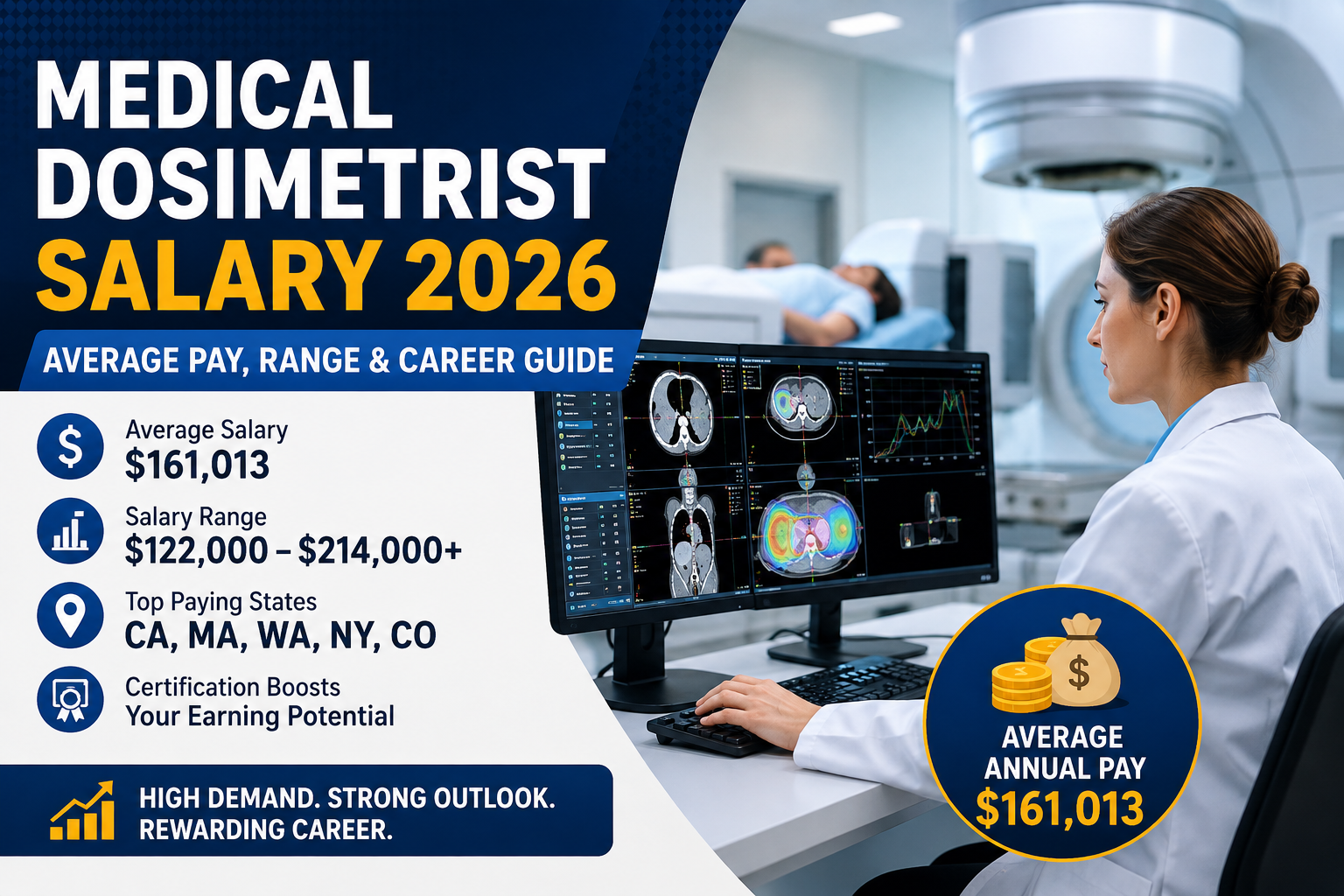
For certified medical dosimetrists, current market data shows an average of approximately $161,013 per year. Reported compensation for certified professionals typically falls within a range of roughly $122,000 to $214,000, with higher-end earners exceeding $200,000.
For context, the average salary across all U.S. occupations was $67,920 in May 2024. Medical dosimetrists earn roughly 2 times the national average at the median, and certified professionals earn roughly 2.4 times the national average.
The following table summarizes key compensation benchmarks:
| Compensation Measure | Annual Pay | Approx. Hourly Equivalent |
|---|---|---|
| BLS median, all medical dosimetrists | $138,110 | $66.40 |
| Entry-level (BLS lowest 10%) | Below $103,760 | Below $49.88 |
| Certified medical dosimetrist average | ~$161,013 | ~$77.41 |
| Certified compensation range | ~$122,000–$214,000 | ~$58.65–$102.88 |
| Higher-end certified compensation | Can exceed $200,000 | Can exceed $96.15 |
These figures should not be interpreted as one unified percentile distribution because they come from different compensation datasets and population definitions. The BLS figures represent all medical dosimetrists, while the certified figures reflect a subset of professionals who hold the Certified Medical Dosimetrist (CMD) credential. Certification, experience and employer type create significant variation within the profession.
Salary Reality Check
A six-figure salary does not mean every medical dosimetrist starts at $160,000.
The BLS reports that the lowest 10% of medical dosimetrists earned below $103,760 annually in May 2024. Entry-level professionals typically earn in the $103,000–$110,000 range.
The $161,013 figure represents certified professionals—those who have passed the Medical Dosimetrist Certification Board (MDCB) exam and hold the CMD credential. Non-certified dosimetrists, or those early in their careers, earn significantly less.
The spread from the lower end of the profession to the upper end is substantial. That spread reflects:
- Certification status – CMD credential holders earn substantially more
- Years of experience – salaries accelerate between years 3 and 7
- Employer type – academic medical centres pay more than community hospitals
- Geographic location – high-cost markets offer higher nominal pay
- Specialisation – proton therapy and advanced techniques can strengthen earning potential
Understanding these variables is the first step toward maximising earning potential.
Why Medical Dosimetrist Salaries Vary
Salary estimates for medical dosimetrists vary because compensation depends on multiple factors. Certification, experience, employer type, geographic market, treatment complexity and specialisation all play a role. Job postings can also reflect different levels of responsibility, which is why individual offers may fall above or below the national average.
For 2026, the most useful way to interpret the market is as a range rather than a single number. Certified and experienced professionals can command substantially more than entry-level workers, while location, employer type, specialisation and clinical responsibility can move compensation significantly.
The “right” salary number depends on your situation. If you are an employer benchmarking a new hire, you look at market rates for your region and facility type. If you are a professional evaluating an offer, you compare against your credentials and experience. If you are a student assessing a career path, you look at long-term earning potential. For certified medical dosimetrists, current market data places a large share of reported salaries between roughly $122,000 and $214,000—but actual compensation varies by experience, location, employer and specialisation.
Medical Dosimetrist Salary in Real Job Postings
Theory is useful. Actual job postings are better.
Sharp Grossmont Hospital in California posted a dosimetrist role in March 2026 with an hourly range of $67.07 to $96.93. That translates to roughly $139,500 to $201,600 annually for a full-time position.
UCLA Health’s Westwood campus listed dosimetrist positions at $77.39 to $92.51 per hour—or $161,000 to $192,000 annually—with senior roles reaching $106.76 per hour.
Palomar Health in Escondido, California, offered $69.84 to $104.92 per hour, a top end of roughly $218,000 annually.
MD Anderson Cancer Center in Houston posted a range of $53.36 to $80.28 per hour (approx. $111,000 to $167,000 annually).
Harris Health System in Houston offered $62.66 to $81.46 per hour.
What these postings reveal is not just numbers but structure. Academic medical centres and large cancer hospitals pay more. They also define their pay ranges broadly, which tells you that experience and certification move you through that band—sometimes quite quickly.
How CMD Certification Affects Salary
Certification is one of the strongest salary differentiators in medical dosimetry.
The Certified Medical Dosimetrist (CMD) credential, issued by the MDCB, is the industry standard. Employers increasingly require it. And they pay for it.
In Houston, the average salary for a certified medical dosimetrist was $153,763 in June 2026, compared to $111,939 for uncertified dosimetrists in the same market. That is a $41,824 premium—roughly 37% higher—for holding the credential.
In Los Angeles, certified professionals averaged $173,493 in 2026. In Hawaii, certified dosimetrists averaged $167,285.
If you are already working as a radiation therapist and considering the dosimetrist pathway, the investment in certification is one of the highest-return career moves you can make. For professionals who qualify for higher-paying certified roles, the salary difference can make the additional education and training financially worthwhile over time.
Highest-Paying States and Cities
Among locations represented in available 2026 compensation data, location matters significantly for medical dosimetrists.
Top-paying locations:
- California: Average $158,904, with Los Angeles certified roles reaching $173,493
- Hawaii: Certified dosimetrists average $167,285
- Alaska: Sitka pays approximately 20.5% above the national average
Major metro areas:
- San Francisco: Approximately $211,284—31.2% above the national average
- Los Angeles: $173,493 for certified roles
- Houston: $123,539 for non-certified, $153,763 for certified
The California premium is real, but it is not as simple as “California pays more.” The state’s income tax rate exceeds 9% at higher brackets, and median home prices in San Francisco exceed $1.2 million. A dosimetrist earning $120,000 in San Francisco may have less disposable income than one earning $95,000 in Nashville, where Vanderbilt-Ingram Cancer Center anchors a growing oncology market. The highest nominal salary is not always the highest real salary.
States with high concentrations of cancer treatment facilities—Texas, California, New York, Florida and Pennsylvania—typically have more job openings and more competitive compensation packages. Rural and underserved areas sometimes offer surprisingly attractive salaries and signing bonuses to attract candidates.
Medical Dosimetrist Salary by Experience
The salary growth curve for medical dosimetrists is steeper than many allied health roles, particularly in the first decade.
- Entry-level (BLS lowest 10%): Below $103,760 annually
- Early career: Typically $103,000–$122,000 annually
- Experienced (5+ years): $131,000–$161,000 annually
- Senior/lead roles: $180,000+ with certification and specialisation
The typical professional can expect to move through this range over the course of a career—but the pace depends on certification, employer choice and specialisation.
The biggest salary jumps happen between years 3 and 7, when professionals complete certification, gain proficiency in advanced treatment planning systems, and move from community hospitals to academic medical centres or specialised proton therapy centres.
Specialisations That Can Increase Pay
Not all dosimetrists earn the same, and the fastest-growing segment of the profession is also among the highest-paying.
Proton therapy centres—specialised facilities that treat cancer with proton beams rather than conventional photon radiation—require dosimetrists with advanced skills in pencil-beam scanning, range verification and adaptive planning. These are not skills that every dosimetrist possesses.
Similarly, dosimetrists working with stereotactic body radiotherapy (SBRT) and stereotactic radiosurgery (SRS) are in high demand. These techniques involve tight planning-target-volume margins, high fractional doses and multi-isocenter geometries—complexity that not every dosimetrist can manage.
Proton therapy, SBRT, SRS and MR-guided adaptive radiotherapy can strengthen a dosimetrist’s earning potential because these specialties require advanced planning skills and are concentrated in more complex treatment environments. The learning curve is steep, but the additional skills can be financially valuable.
Medical Dosimetrist Job Demand in 2026
The American Society of Radiologic Technologists (ASRT) conducts a biennial staffing survey that tracks vacancy rates across radiation therapy and medical dosimetry. The 2026 results are striking.
The medical dosimetrist vacancy rate fell to 6.8% in 2026, down from 9.6% in 2024. That means nearly 7% of budgeted dosimetrist positions across the country are unfilled and actively being recruited.
At the same time, the average number of full-time equivalent (FTE) dosimetrist positions per facility increased from 2.7 in 2024 to 2.8 in 2026. Over the 22-year period from 2004 to 2026, the number of FTE dosimetrists per facility grew from 1.6 to 2.8—an increase of 75%.
The 6.8% vacancy rate is a meaningful labor-market signal. Employers are actively recruiting for unfilled positions, while the number of budgeted dosimetry positions per facility continues to trend upward. That combination can strengthen recruiting pressure and support competitive compensation in some markets. The ASRT survey had a margin of error of ±4.1% at a 95% confidence level, but the directional trend is unambiguous: demand is growing and supply is not keeping pace.
Related Healthcare Careers
For comparison, other advanced healthcare roles show similar demand patterns. The CRNA salary averages over $200,000 annually, while the radiology tech salary typically ranges from $60,000 to $85,000. Nurse practitioner salaries and registered nurse salaries also vary significantly by specialisation and location.
How to Become a Medical Dosimetrist
The pathway to CMD certification depends on the candidate’s education and clinical background, but generally involves undergraduate preparation, an eligible medical dosimetry program, clinical training and certification requirements.
Step 1: Earn a bachelor’s degree
For current U.S. applicants, MDCB eligibility requires a minimum bachelor’s degree and graduation from a JRCERT-accredited medical dosimetry program of at least 12 months. Most successful candidates hold degrees in physical or health sciences, radiation therapy, or medical physics.
Step 2: Complete a JRCERT-accredited medical dosimetry program
Programs must be at least 12 months in duration and are typically offered as either:
- A Bachelor of Applied Science (BAS) with a medical dosimetry concentration (for those without a bachelor’s degree)
- A certificate of achievement (for those who already hold a bachelor’s degree and ARRT certification in radiation therapy)
Step 3: Gain supervised clinical experience
Clinical experience in medical dosimetry is required for initial certification.
Step 4: Pass the MDCB Certification Examination
Successful completion grants the Certified Medical Dosimetrist (CMD) credential.
The most efficient pathway is to first become a certified radiation therapist (ARRT), then pursue a medical dosimetry certificate or degree program while working. This allows you to earn income during training and reduces the financial burden of the transition. Many dosimetry programs are designed specifically for working radiation therapists, with evening lectures and part-time clinical requirements.
How Much Do Medical Dosimetrists Make Per Hour?
The BLS reports a median hourly wage of $66.40 for all medical dosimetrists as of May 2024. The lowest 10% earned below $49.88 per hour, and the highest 10% earned above $84.79 per hour.
For certified professionals, the average hourly equivalent is approximately $77.41. Actual hourly rates vary widely:
- Entry-level (BLS lowest 10%): below $49.88/hour
- Mid-career: $58–$87/hour
- Senior/lead roles: $97–$107/hour for certified professionals in high-paying markets
For context, a dosimetrist earning $80/hour and working 40 hours per week for 52 weeks grosses $166,400 annually. Many facilities offer shift differentials for evening or weekend work, which can add 10% or more to hourly rates.
When comparing hourly rates, always check whether the figure includes benefits, bonuses and overtime. Some advertised rates reflect total compensation packages rather than base pay, which can create misleading comparisons.
Career Risks: AI, Consolidation and Reimbursement
No career analysis is complete without a sober discussion of risks.
Automation and AI
Treatment planning systems are becoming more sophisticated, and artificial intelligence is increasingly capable of generating initial treatment plans. However, the role of the dosimetrist is not being eliminated—it is evolving. AI-generated plans require human review, adaptation and quality assurance. The clinical judgment, contouring expertise and understanding of patient-specific anatomy that dosimetrists bring cannot be fully automated in the current regulatory and clinical environment.
Consolidation
Large hospital systems and private equity-backed radiation oncology platforms are consolidating smaller practices. This can lead to standardisation of pay scales and, in some cases, downward pressure on compensation in non-academic settings.
Reimbursement changes
Medicare and commercial payer reimbursement for radiation therapy has faced periodic cuts. While these typically affect facility and professional fees broadly, they can influence hiring and salary growth in the longer term.
The risks are real but manageable. The profession’s specialised nature, credentialing requirements and growing demand create a strong moat against broad labour market disruptions. The greater risk for individual professionals is stagnation—remaining in a community hospital with limited complexity rather than pursuing opportunities in academic or specialised centres.
Medical Dosimetrist Salary Outlook Through 2030
Projecting salary growth requires looking at the underlying drivers.
The BLS projects employment of medical dosimetrists to grow 3 percent from 2024 to 2034, about as fast as the average for all occupations, with about 200 openings projected each year.
The ASRT data shows that dosimetrist positions per facility have grown steadily from 1.6 in 2004 to 2.8 in 2026. That growth trajectory, combined with a vacancy rate of 6.8%, suggests continued recruiting pressure.
The broader oncology landscape is also shifting. The number of cancer cases is expected to rise as the population ages, and radiation therapy remains a cornerstone of treatment for many malignancies. Proton therapy centres are expanding, and adaptive radiotherapy is becoming more widespread—both of which increase demand for highly skilled dosimetrists.
If vacancy rates remain elevated and demand for advanced radiation treatment planning continues to grow, a national average approaching $180,000–$190,000 by 2030 is possible. This is an editorial scenario, not an official salary forecast.
What Salary Surveys Don’t Tell You
Every salary survey captures a moment in time. None of them capture the full picture of what a medical dosimetrist actually earns.
Bonuses
Bonuses for dosimetrists typically range from $2,000 to $11,000, with experienced professionals seeing bonuses up to $14,000. Signing bonuses for hard-to-fill positions can be substantially higher, particularly in rural or underserved areas.
Profit sharing
Some employers offer profit-sharing arrangements, typically ranging from $1,000 to $4,000.
Overtime
While dosimetrists are typically salaried, many employers offer overtime pay for hours beyond 40 per week, particularly in high-volume centres.
Relocation assistance
Academic medical centres and large hospital systems frequently offer relocation packages that can add $5,000–$15,000 to total first-year compensation.
Continuing education
Many employers fund continuing education credits, conference attendance and advanced training—benefits that have real financial value but rarely appear in salary surveys.
Medical Dosimetrist Salary Myths
Myth 1: “All dosimetrists earn about the same.”
Reality: The spread from entry-level to top earners is substantial. Certification, location, employer type and specialisation create significant differences.
Myth 2: “You need a master’s degree to earn top dollar.”
Reality: The CMD credential, not an advanced degree, is the primary driver of higher pay. While some dosimetrists hold master’s degrees in medical physics, the certification itself is the key differentiator.
Myth 3: “Private practice pays more than hospitals.”
Reality: Academic medical centres and large cancer hospitals typically pay more than private practices, due to higher patient volumes, more complex cases and greater resources.
Myth 4: “Salaries are highest in New York and California.”
Reality: Nominal salaries are higher in these states, but cost of living adjustments often erase the advantage. A dosimetrist in Houston earning $153,000 may have greater purchasing power than one in San Francisco earning $211,000.
Is Medical Dosimetry a Good Career?
For radiation therapists considering the transition: the dosimetrist pathway offers a clear upgrade in compensation, responsibility and career trajectory. The education investment is significant—typically 12 to 22 months—but the additional training can provide a strong long-term return on investment for professionals who move into higher-paying certified roles. Pursue CMD certification as early as possible.
For students exploring healthcare careers: medical dosimetry offers one of the most favourable compensation-to-education ratios in allied health. The entry requirements are rigorous but achievable, and the job market is consistently strong. Focus on JRCERT-accredited programs and plan for certification immediately upon graduation.
For current dosimetrists seeking higher pay: evaluate your certification status first. If you are not CMD-certified, that is your highest-return investment. Next, assess your employer type—academic medical centres and specialised cancer hospitals pay more than community hospitals. Finally, consider specialisation in proton therapy, SBRT or adaptive radiotherapy.
Medical dosimetry offers a relatively high compensation ceiling within allied health, but actual earnings depend heavily on certification, experience, employer and location. The BLS median of $138,110 places the profession comfortably above the national average, and certified professionals earn even more. For professionals willing to build specialized skills, the 2026 market remains attractive.
The key insight from the 2026 data is not the average itself. It is the dispersion. The gap between entry-level and top earners represents not luck but choice—choice of certification, choice of employer, choice of location, choice of specialisation. The professionals who make deliberate decisions about each of these variables earn substantially more than those who do not.
For employers, the message is equally clear: the 6.8% vacancy rate is not going to resolve itself. Competitive compensation, clear career progression and investment in professional development are no longer optional—they are prerequisites for attracting and retaining talent in a constrained labour market.
FAQs
Q: What is the average medical dosimetrist salary in the United States?
The median annual wage for medical dosimetrists was $138,110 in May 2024, according to the Bureau of Labor Statistics. For certified medical dosimetrists, current market data shows an average of approximately $161,013 per year. Reported compensation varies significantly by certification, experience, location and employer.
Q: What is the starting salary for a medical dosimetrist?
The BLS reports that the lowest 10% of medical dosimetrists earned below $103,760 annually in May 2024. Entry-level professionals typically earn in the $103,000–$110,000 range. This figure increases substantially with certification, experience and employment at academic medical centres.
Q: How much does a medical dosimetrist make per hour?
The BLS reports a median hourly wage of $66.40 for all medical dosimetrists. Certified professionals average approximately $77.41 per hour. The lowest 10% earned below $49.88 per hour, while the highest 10% earned above $84.79 per hour.
Q: Is medical dosimetry a good career?
Yes. Medical dosimetry offers strong compensation, with a BLS median of $138,110, growing demand indicated by a 6.8% vacancy rate, and meaningful work in cancer care. Current compensation remains strong relative to many allied-health occupations.
Q: How hard is it to become a medical dosimetrist?
Becoming a medical dosimetrist requires a bachelor’s degree, graduation from a JRCERT-accredited program, clinical experience and passing the MDCB certification exam. The pathway is rigorous but achievable for dedicated candidates.
Q: Do medical dosimetrists need a medical degree?
No. Medical dosimetrists are not physicians. They hold bachelor’s degrees and CMD certification. They work under the supervision of radiation oncologists and medical physicists to design radiation treatment plans.
Q: What is the highest-paying state for medical dosimetrists?
Among locations represented in available 2026 compensation data, California leads with average salaries around $158,904, with Los Angeles certified dosimetrists averaging $173,493. Hawaii and Alaska also rank among the highest-paying locations.
Q: How much does a medical dosimetrist make in Houston, Texas?
In Houston, the average salary is $123,539, but certified medical dosimetrists average $153,763. MD Anderson Cancer Center’s posted range is $111,000–$167,000 annually.
Q: What is the difference between a medical dosimetrist and a radiation therapist?
Radiation therapists deliver daily treatments to patients. Medical dosimetrists design the treatment plans that therapists deliver. Dosimetrists earn significantly more due to the advanced technical and clinical expertise required.
Q: Is CMD certification required to work as a medical dosimetrist?
While not legally required in all states, CMD certification is increasingly mandatory for employment and is the primary driver of higher salaries. Employers strongly prefer or require it.
Q: Can medical dosimetrists work remotely?
Some treatment planning work can be done remotely, and teleradiotherapy planning services exist. However, most dosimetrists work on-site due to the need for collaboration with physicians, physicists and therapists.
Q: What skills increase a medical dosimetrist’s earning potential?
Proficiency in multiple treatment planning systems (Varian Eclipse, Elekta Monaco, RayStation), experience with proton therapy, SBRT, SRS and adaptive radiotherapy, and supervisory experience all increase earning potential.
Q: How long does it take to become a certified medical dosimetrist?
The pathway typically takes 12–22 months of accredited program study after completing a bachelor’s degree, plus clinical experience. Many candidates are already certified radiation therapists, which shortens the timeline.
Q: What is the average medical dosimetrist salary in the United States?
The median annual wage for medical dosimetrists was $138,110 in May 2024, according to the Bureau of Labor Statistics. Certified medical dosimetrists earn an average of approximately $161,013 per year based on current market data.
Q: How much does a medical dosimetrist make per hour?
The median hourly wage for medical dosimetrists is $66.40, according to BLS data. The lowest 10% earned below $49.88 per hour, while the highest 10% earned above $84.79 per hour. Certified professionals average approximately $77.41 per hour.
Q: Is medical dosimetry a good career?
Yes. Medical dosimetry offers strong compensation, with a BLS median of $138,110, growing demand indicated by a 6.8% vacancy rate, and meaningful work in cancer care. Current compensation remains strong relative to many allied-health occupations.
Q: How hard is it to become a medical dosimetrist?
Becoming a medical dosimetrist requires a bachelor’s degree, graduation from a JRCERT-accredited medical dosimetry program of at least 12 months, clinical experience and passing the MDCB certification exam. The pathway is rigorous but achievable.
Q: Do medical dosimetrists need a medical degree?
No. Medical dosimetrists are not physicians. They hold bachelor’s degrees and CMD certification and work under the supervision of radiation oncologists and medical physicists.