
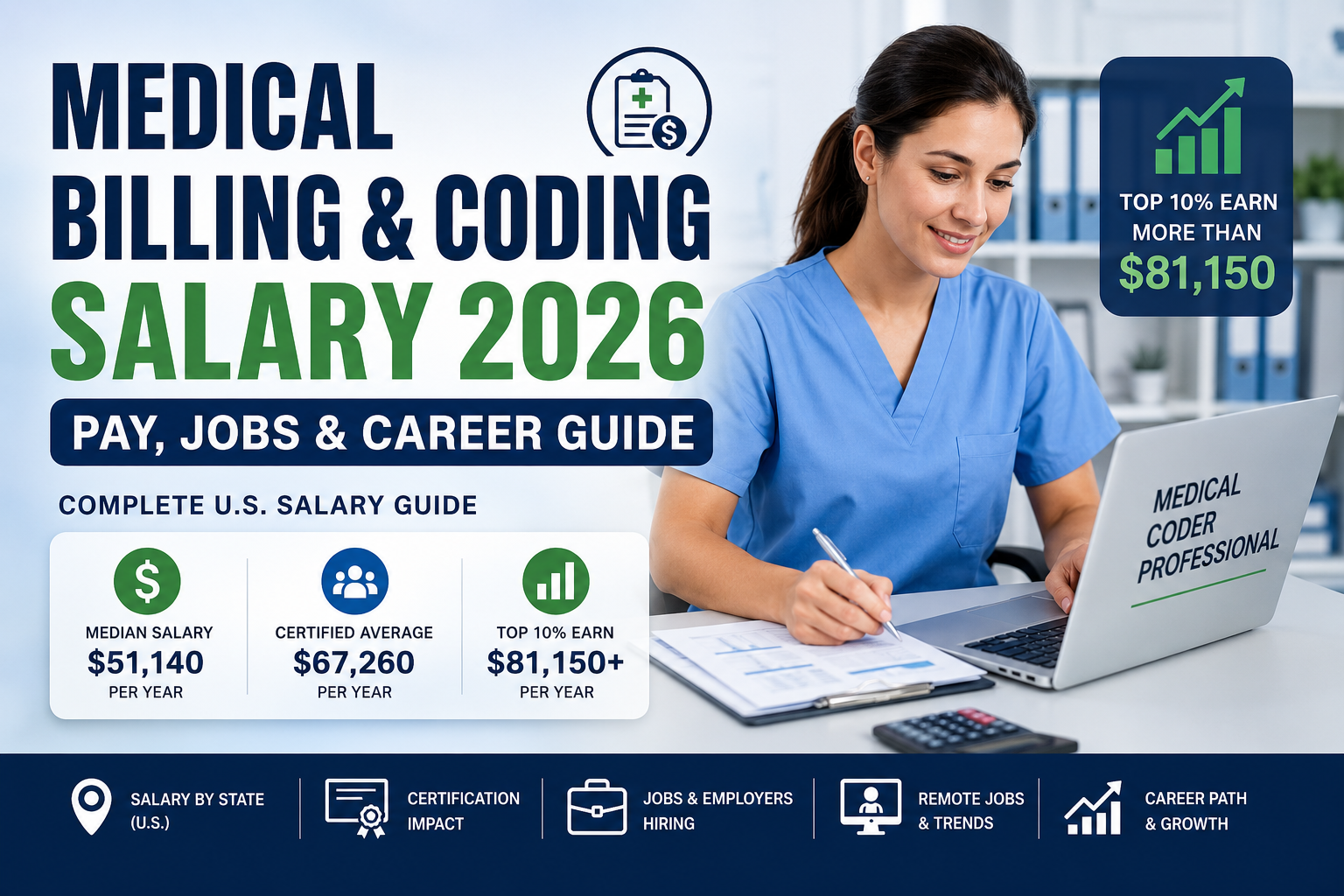
The median medical billing and coding salary in the United States is $51,140 per year ($24.59/hour) according to May 2025 BLS data. Certified professionals average $67,260 annually—20.7% more than non-certified colleagues. The top 10% earn more than $81,150.
| Salary Measure | 2025 Figure |
|---|---|
| Median salary | $51,140 |
| Average (mean) salary | $56,790 |
| 10th percentile | $37,000 |
| 25th percentile | $43,490 |
| 75th percentile | $64,820 |
| 90th percentile | $81,150 |
| Certified average (AAPC) | $67,260 |
| 3+ certifications | $81,227 |
Source: BLS May 2025 wage data; AAPC 2026 Salary Report
Here’s a question most salary guides won’t answer: Why do two equally qualified medical coders in the same state earn $20,000 apart?
The short answer is that certification is one major factor. The longer answer involves where you work, who you work for, and whether you’ve figured out that “medical billing and coding” isn’t one career—it’s at least a dozen different ones wearing the same name.
Let’s cut through the noise.
The Bureau of Labor Statistics (BLS) reports that medical records specialists—the federal category that includes medical billers and coders—earn a median annual salary of $51,140, or roughly $24.59 per hour. The mean sits at $56,790—which is higher than the median because higher-paid workers lift the overall average.
But here’s where the numbers get interesting.
The American Academy of Professional Coders (AAPC) reports that certified professionals average $67,260 per year—$16,000 above the BLS median. That’s not a data discrepancy. That’s certification strongly associated with higher reported income.
Neither number is wrong. They’re measuring different populations. The BLS captures everyone in the occupation—entry-level, uncertified, part-time, and everyone in between. AAPC captures professionals who’ve invested in credentials and career development.
SalaryInfo Insight: The gap between the BLS median ($51,140) and the AAPC certified average ($67,260) represents one of the clearest career levers a worker can influence. Certification is among the most effective ways to increase earning potential in this field.
Medical Billing and Coding Salary Distribution
Averages obscure more than they reveal.
The full salary distribution for medical records specialists tells a more useful story. According to BLS May 2025 data:
| Percentile | Annual Salary | Hourly Equivalent |
|---|---|---|
| 10th | $37,000 | $17.79 |
| 25th | $43,490 | $20.91 |
| 50th (Median) | $51,140 | $24.59 |
| 75th | $64,820 | $31.17 |
| 90th | $81,150 | $39.01 |
Source: BLS OEWS May 2025
The spread from the 10th to the 90th percentile exceeds $44,000. That’s not a narrow pay band—it’s a chasm. And it’s driven by factors you can actually influence.
Medical Billing and Coding Salary by State
Geography can swing your salary by nearly $30,000 annually.
The highest-paying states and the District of Columbia for medical billing and coding, based on BLS May 2025 state-level data, are:
| State/District | Mean Annual Wage |
|---|---|
| District of Columbia | $77,890 |
| California | $68,920 |
| Washington | $68,270 |
| Hawaii | $65,140 |
| New York | $65,010 |
| Massachusetts | $62,970 |
| New Jersey | $61,480 |
| Oregon | $60,570 |
| Alaska | $59,780 |
| Connecticut | $58,530 |
Source: BLS May 2025 state occupational wage data
Reality Check: A higher salary in an expensive state doesn’t always mean more buying power. A $44,000 salary in rural Arkansas may stretch further than $58,000 in the San Francisco Bay Area once housing, transportation, and taxes are factored in.
California leads the West Coast at roughly $68,920 average, with New York at $65,010 and Texas at $52,880. The Southeast consistently lags, with states like Alabama ($45,530), Mississippi ($44,930), and Arkansas ($44,320) among the lowest-paying.
The coastal and upper-Midwest corridor consistently outpaces the Southeast. But a lower-wage state isn’t always a bad deal—purchasing power matters more than the number on your paycheck.
Certification: The Single Biggest Salary Driver
If you take one thing from this guide, let it be this: certification pays.
AAPC’s 2026 salary report—based on 2025 survey data—makes the case with striking clarity:
| Credential Status | Average Annual Salary |
|---|---|
| Non-certified | $55,721 |
| Certified (any AAPC credential) | $67,260 |
| 2 AAPC certifications | $74,557 |
| 3+ AAPC certifications | $81,227 |
Source: AAPC 2026 Medical Coding and Billing Salary Report
That’s a 20.7% premium for holding a single credential. With three or more certifications, professionals earn roughly 46% more than non-certified peers.
SalaryInfo Insight: Certification is strongly associated with higher reported income—and AAPC identifies it as the No. 1 factor influencing medical records specialist incomes. The data suggests that investing in credentials is one of the most effective ways to increase your earning potential.
The math on certification ROI is straightforward. AAPC currently lists the CPC exam at $425 for one attempt or $499 for two attempts (prices can change), plus annual membership at approximately $222. For professionals who receive a meaningful salary increase after certification, the upfront cost can potentially be recovered relatively quickly.
Key Takeaway: The credential with the highest earning potential is the AAPC Approved Instructor, with reported earnings averaging $94,357 in 2025. The Certified Inpatient Coder (CIC) saw the biggest income increase over the past five years—41.9%.
Medical Billing and Coding Salary by Experience
Experience compounds with certification to drive higher earnings.
AAPC’s 2025 survey data shows a clear progression:
| Years of Experience | Average Annual Salary |
|---|---|
| 0–1 years | $45,377 |
| 2–4 years | $51,073 |
| 5–9 years | $59,144 |
| 10–15 years | $67,331 |
| 16–20 years | $72,558 |
| 21–25 years | $75,602 |
| 26–30 years | $78,747 |
| 31+ years | $80,479 |
Source: AAPC 2025 Salary Survey
The bigger story is how earnings accelerate with career progression. Certified professionals with three or more credentials average $81,227 annually—a number that typically requires 5-10 years of experience combined with strategic credential stacking.
The BLS data shows that top earners (90th percentile) exceed $81,150. That places the 90th-percentile wage around $81,150, but it is not a hard salary ceiling—it’s a signal that experienced, certified professionals in high-paying markets and specialties can earn well into six figures.
Highest-Paying Medical Coding Certifications and Specialties
Not all coding is created equal.
Some specialties command significantly higher pay due to complexity, reimbursement rates, and demand. AAPC data shows the earning power of specific credentials:
| Credential / Specialty | Average Salary |
|---|---|
| AAPC Approved Instructor | $94,357 |
| Certified Professional Compliance Officer (CPCO) | $94,017 |
| Certified Physician Practice Manager (CPPM) | $84,521 |
| Certified Documentation Expert Outpatient (CDEO) | $83,611 |
| Certified Professional Medical Auditor (CPMA) | $81,591 |
| Certified Professional Coder-Payer (CPC-P) | $81,957 |
| Certified Inpatient Coder (CIC) | $76,354 |
Source: AAPC 2025 Salary Survey
SalaryInfo Career Strategy: The fastest path to higher earnings isn’t more years in the same role—it’s moving into a specialized, high-complexity coding niche. AAPC’s data shows several specialized coding, auditing, compliance, and management credentials associated with substantially higher reported salaries than the overall non-certified average.
Which Employers Actually Pay Above Market
The employer you choose can swing your salary by tens of thousands of dollars.
According to AAPC data, work setting matters significantly:
| Employer Type | Average Salary (AAPC 2025) |
|---|---|
| Health systems | $67,657 |
| Individual hospitals | $65,396 |
| Large physician groups | $65,224 |
| Medium physician groups | $59,088 |
| Small/solo practices | $53,246 |
Source: AAPC 2025 Salary Survey
The gap between health systems and small practices exceeds $14,000—and that’s before factoring in benefits, overtime opportunities, and career progression.
Key Takeaway: Hospitals and health systems pay more than small practices. If you’re currently in a small practice, the single biggest salary move may be switching employer type—not just job title.
Medical Billing and Coding Remote Jobs in 2026
Remote medical billing and coding positions are increasingly the norm.
Among AAPC survey respondents, 80.2% of medical records specialists now work entirely or partly remotely, with 64.8% working from home full-time. Another 15.4% work hybrid schedules.
Current job postings show remote hourly rates ranging from $18 to $35 per hour, depending on experience and specialty.
Specific examples from 2026 job postings:
- Remote Medical Coder (Outpatient/Profee): $28–$35/hour
- Remote Medical Appeals & Coding Specialist: $25–$28/hour
- Remote Medical Biller & Coder (Entry-Level): $20.25–$27/hour
- Remote Coding & Reimbursement Specialist: $18–$32/hour
SalaryInfo Observation: Remote work is a double-edged sword. It offers flexibility and eliminates commuting, but it also exposes you to national competition. The professionals who thrive in remote roles are those with in-demand certifications and specialized skills that employers can’t easily find.
The Future Outlook: Growth, AI, and What Comes Next
The Bureau of Labor Statistics projects 7% job growth for medical records specialists between 2024 and 2034—much faster than the 3% average across all occupations. About 14,200 openings for medical records specialists are projected each year, on average, over the decade. An aging population and rising rates of chronic conditions are driving that demand.
But here’s the caution: the BLS also notes that wider adoption of AI-powered coding tools could affect demand.
O NET OnLine currently lists Medical Records Specialists as a Bright Outlook occupation, based on BLS 2024–2034 projections. The field remains one of the most stable career paths in healthcare administration.
SalaryInfo Market View: AI will change medical coding—but it’s unlikely to eliminate the occupation altogether. What AI does is automate routine coding, which shifts the value proposition toward complex coding, auditing, compliance, and revenue cycle management. The professionals who thrive will be those who move up the complexity ladder, not those who stay at the entry level.
The Career Path Most Professionals Ignore
Medical billing and coding isn’t a dead-end job—it’s a gateway.
The career progression typically looks like this (typical career-path estimates):
- Entry-Level Coder/Biller: $35,000–$45,000
- Certified Coder: $50,000–$65,000
- Specialty Coder (HCC, Inpatient, Surgical): $65,000–$85,000
- Coding Auditor / Compliance Specialist: $70,000–$95,000
- Revenue Cycle Manager / HIM Director: $80,000–$120,000+
Professionals who reach six-figure compensation often move beyond routine coding into auditing, compliance, revenue-cycle leadership, management, or other specialized roles.
Career Strategy: Think of certification as the foundation, not the destination. The real earnings growth comes from specialization and management progression. Additional credentials can help position professionals for higher-paying specialized roles.
Common Myths About Medical Billing and Coding Salaries
Myth 1: “You need a four-year degree to earn well.”
False. AAPC members with no college degree average $61,635 in 2025. Those with an associate degree average $62,643. A bachelor’s degree adds about $6,700 on average—but certification adds $11,000+ without the four-year commitment.
Myth 2: “All medical coders earn the same.”
False. The spread from the 10th to the 90th percentile exceeds $44,000. Certification, specialty, employer type, and geography create massive variation.
Myth 3: “AI will replace medical coders.”
Unlikely in the near term. AI will automate routine coding, but complex coding, auditing, compliance, and revenue cycle management require human judgment. The BLS still projects 7% growth through 2034.
Industry Risks Worth Knowing
Every career has risks. Medical billing and coding is no exception.
Automation risk is real but often misunderstood. AI tools like computer-assisted coding (CAC) are already in use, and they’ll continue to evolve. The professionals most at risk are those doing basic, repetitive coding without specialisation.
Payer rule changes can disrupt workflows and create compliance headaches. Medicare and private insurers regularly update coding requirements, and staying current is non-negotiable.
Outsourcing pressure exists, particularly for basic billing functions. However, clinical coding—especially inpatient and specialty coding—typically remains domestic due to complexity and compliance requirements.
Salary stagnation is a risk for professionals who don’t invest in continuing education and additional credentials. The data is clear: non-certified professionals earn significantly less and have fewer advancement opportunities.
What Salary Surveys Don’t Tell You
Salary surveys provide numbers. They don’t provide context.
Here’s what the numbers won’t tell you:
Benefits matter. Health insurance, retirement contributions, paid time off, and continuing education reimbursement can add 20-30% to total compensation. A $55,000 job with excellent benefits may out-earn a $60,000 job with minimal benefits.
Overtime and bonuses aren’t always reflected in base salary figures. Bonuses and profit sharing can add $1,000–$6,000 to total compensation.
Career trajectory matters more than starting salary. A $45,000 entry-level position with clear advancement path may be a better long-term bet than a $50,000 dead-end role.
SalaryInfo Editorial Verdict: Among survey respondents, certification is strongly associated with higher reported income. The evidence suggests certification is strongly associated with earning above the non-certified average, although experience, specialty, employer, and location also matter.
Professional Recommendations
For those considering this career:
- Expect entry-level pay around $35,000–$40,000
- Plan to get certified within your first 12-18 months
- Target hospitals and health systems over small practices
- Consider remote work for flexibility, but understand the trade-offs
For those currently in the field:
- If you’re uncertified, get certified. The ROI is clear.
- If you have one certification, consider a second. The premium compounds.
- If you’re in a small practice, explore hospital or health system roles.
- If you’re doing general coding, consider specializing in HCC, inpatient, or surgical coding.
For those negotiating salary:
- Know the BLS median: $51,140
- Know the certified average: $67,260
- Know your state’s average
- Know your employer type’s average
- Come prepared with data, not demands
The Salary Ceiling Most Professionals Never Reach
The top 10% of medical records specialists earn more than $81,150. The certified average sits at $67,260. Professionals with three or more certifications average $81,227.
That places the 90th-percentile wage around $81,150, but it is not a hard salary ceiling. The professionals who break through earn six figures—and they do it by moving beyond coding into auditing, compliance, revenue cycle management, or management. They’re not just coding. They’re ensuring revenue integrity, managing teams, and solving complex billing problems.
SalaryInfo Career Strategy: If you want to earn above the 90th percentile, plan your career beyond coding. The highest earners in this field are the ones who understand the entire revenue cycle—not just the codes.
Medical Billing and Coding Salary: The Bottom Line
The medical billing and coding salary landscape in 2026 offers real opportunities—but they’re not evenly distributed.
The median is $51,140. The mean is $56,790. The certified average is $67,260. The top 10% earn more than $81,150.
The difference between these numbers isn’t luck. It’s certification, specialization, employer choice, and geography.
The data is clear. The path is visible. The question isn’t whether the money exists—it’s whether you’ll position yourself to earn it.
Frequently Asked Questions
What field of medical coding pays the most?
Risk adjustment/HCC coding, inpatient/DRG coding, and surgical coding are among the highest-paying specialties. Coding auditors and compliance specialists also command premium salaries. AAPC data shows the Approved Instructor credential averaging $94,357 and CPCO averaging $94,017.
Is medical coding a good career?
Yes. The BLS projects 7% job growth through 2034—faster than average. Entry is accessible (no four-year degree required), remote work is common (64.8% work from home full-time), and clear advancement paths exist through certification and specialization.
Is medical billing and coding hard?
It depends on your aptitude for detail-oriented work. The learning curve involves mastering ICD-10, CPT, and HCPCS coding systems, plus understanding medical terminology and payer rules. The work is intellectually demanding but learnable.
How much do medical coders earn in the USA?
The BLS median is $51,140 per year ($24.59/hour). The mean is $56,790. Certified professionals average $67,260 according to AAPC data. The top 10% earn more than $81,150.
Do I need a degree to earn well in medical billing and coding?
No. AAPC members without a college degree average $61,635 in 2025. Certification—not a degree—is the primary salary driver. A bachelor’s degree adds about $6,700 on average, but certification adds $11,000+ without the four-year commitment.
What’s the best state for medical billing and coding salary?
The District of Columbia leads at $77,890 mean annual wage, followed by California ($68,920) and Washington ($68,270) (BLS May 2025 data). However, cost of living matters—a higher salary in an expensive state may not stretch as far.
How does remote work affect medical billing and coding pay?
Remote roles pay $18–$35/hour depending on experience and specialty. Remote work offers flexibility but also exposes you to national competition. Professionals with in-demand certifications and specialized skills command the highest remote rates. Currently, 64.8% of medical records specialists work from home full-time.
How long does it take to become a certified medical coder?
Training programs typically take 4-12 months. The CPC exam can be taken upon completion. Most professionals achieve certification within their first 12-18 months in the field. Entry-level uncertified roles pay around $35,000–$40,000, with significant increases post-certification.
Is medical billing and coding still worth it in 2026?
Yes. The field offers a relatively favorable employment outlook, with 7% projected growth from 2024 to 2034. Entry is accessible, remote work options are widespread, and clear advancement paths exist through certification and specialization. The key is treating certification and specialization as non-negotiable—not optional—for career progression.
Will AI replace medical coders?
AI will automate routine coding but is unlikely to eliminate the profession. The BLS still projects 7% growth through 2034. The role is shifting toward complex coding, auditing, compliance, and revenue cycle management—areas requiring human judgment.