
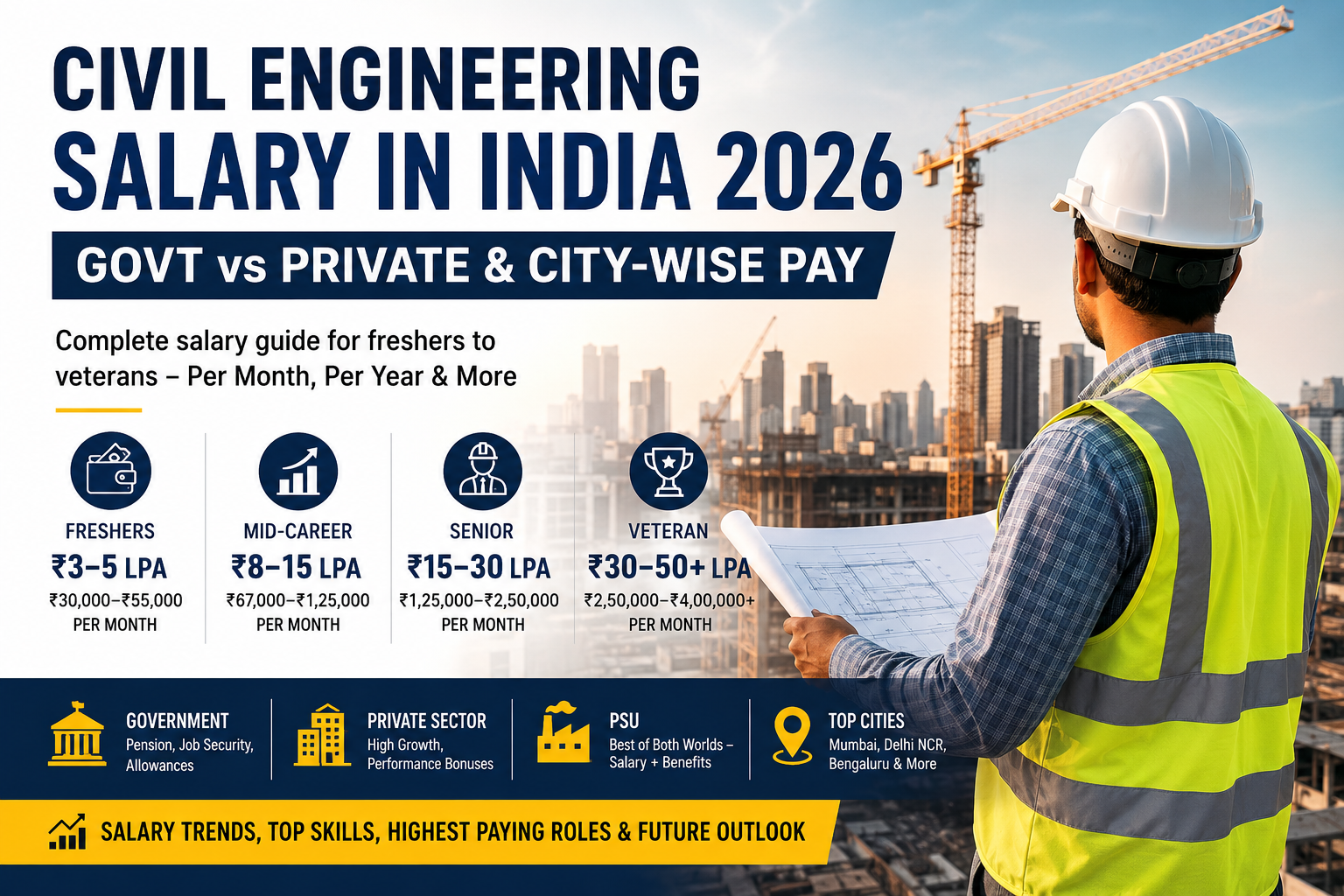
Civil Engineering Salary
Let’s cut the noise.
The average salary figure you see everywhere is a statistical mirage.
Yes, the average civil engineer in India earns approximately ₹8.18 lakh annually. But that number is almost meaningless for career planning.
The distribution tells the real story: some professionals take home ₹4.5 lakh a year, while others command packages exceeding ₹50 lakh.
The difference isn’t merely luck—it’s the result of deliberate decisions involving specialization, sector selection, and geographic location.
What follows is the 2026 salary landscape, interpreted through the lens of a market operator rather than a recruiter—focusing on incentives, career leverage, and the forces that truly shape long-term earning power.
The Short Answer: What Does a Civil Engineer Earn in India in 2026?
The average civil engineer in India earns approximately ₹8.18 lakhs annually. But that number is almost meaningless.
The distribution tells the real story: while some professionals take home ₹4.5 lakhs per year, others command packages exceeding ₹50 lakhs. At the extremes, entry-level professionals start at ₹3-5 LPA, while senior leadership commands packages that can cross the ₹1 crore mark for top executives and consultants.
Monthly breakdown: freshers average ₹30,000–₹55,000; mid-career professionals earn ₹58,000–₹1,17,000; senior leadership crosses ₹1.5 lakhs+ per month. Across all experience levels, the national average generally falls between ₹60,000 and ₹75,000 per month, although freshers and senior professionals sit far from that midpoint.
What Is the Monthly Income of a Civil Engineer?
The monthly income of a civil engineer in India ranges from ₹25,000–₹45,000 for freshers, ₹60,000–₹1.25 lakh for mid-career professionals, and ₹1.5 lakh or more for senior engineers and project managers. Government, PSU, and specialized BIM roles typically offer higher compensation than standard site positions.
The Experience Ladder: Where the Money Actually Scales
Compensation doesn’t climb linearly—it accelerates. Here’s the 2026 progression based on verified industry data:
| Experience Level | Annual Salary Range (₹ Lakhs) | Monthly Equivalent (₹) |
|---|---|---|
| Freshers (0-1 year) | 3.0 – 5.0 LPA | 25,000 – 42,000 |
| Early Career (2-4 years) | 4.5 – 8.0 LPA | 38,000 – 67,000 |
| Mid-Career (5-8 years) | 8.0 – 15.0 LPA | 67,000 – 1,25,000 |
| Senior (9-15 years) | 15.0 – 30.0 LPA | 1,25,000 – 2,50,000 |
| Veteran (15+ years) | 30.0 – 50.0+ LPA | 2,50,000 – 4,00,000+ |
The inflection point: years 5-8. This is when specialization, project delivery track record, and leadership signals start separating the ₹8 LPA engineer from the ₹15 LPA one.
Reality check: if your IT batchmate starts at ₹8-10 LPA while you’re at ₹4-5 LPA, don’t panic. Civil engineering has slower initial growth but catches up significantly with experience. The catch-up is real, but it requires deliberate career moves—not passive tenure. Fresh graduates earning ₹4–5 LPA can compare their take-home pay using our 4 LPA in-hand salary guide and 5 LPA in-hand salary breakdown.
Location Premium: Where Geography Dictates Your Paycheck
Metropolitan hubs offer the highest nominal salaries, but the effective savings rate often tells a different story.
| City | Annual Salary Range (₹ Lakhs) | Monthly Equivalent (₹) |
|---|---|---|
| Mumbai | 5.0 – 35.0 LPA | 42,000 – 2,90,000 |
| Delhi NCR | 4.0 – 32.0 LPA | 35,000 – 2,70,000 |
| Bengaluru | 5.0 – 22.0 LPA | 42,000 – 1,80,000 |
| Hyderabad | 4.5 – 20.0 LPA | 38,000 – 1,70,000 |
| Chennai | 4.0 – 18.0 LPA | 35,000 – 1,50,000 |
The contrarian take: tier-2 cities may offer better effective savings. A ₹12 LPA salary in Indore often beats ₹18 LPA in Mumbai when you factor in rent, commute, and quality of life. The premium isn’t always worth the premium.
Sector Showdown: Government, Private, and PSU
The sector you choose defines your risk-reward profile as much as your salary.
| Sector | Fresher Range (₹ Lakhs) | Mid-Career Range (₹ Lakhs) | Key Benefits |
|---|---|---|---|
| Government (PWD, CPWD, Railways) | 4.8 – 8.0 | 12.0 – 18.0 | Pension, Housing, Medical |
| Private (Construction/EPC) | 3.0 – 6.0 | 10.0 – 20.0 | Performance Bonuses |
| Private (Consultancy/PMC) | 6.0 – 10.0 | 15.0 – 40.0 | Fastest Growth Track |
| PSU (GATE Entry) | 7.0 – 14.0 | 18.0 – 35.0+ | Pension + Benefits + Growth |
The PSU arbitrage: PSU roles through GATE offer the highest-paying government entry points, with starting packages of ₹7-14 LPA plus pension, housing, and medical benefits. Engineers India Limited (EIL), NTPC, and ONGC offer some of the most competitive packages in this space.
Private sector trade-off: higher risk, higher reward. Consultancy and Project Management Consultancy (PMC) firms offer the highest-growth private track, with mid-career professionals earning ₹15-40 LPA. But the trade-off is higher volatility—project delays and economic cycles hit private firms harder. Professionals crossing management levels often explore the 30 LPA in-hand salary and 50 LPA salary in-hand breakdowns.
The Specialization Premium: What Skills Actually Pay
Generic civil engineering is commoditized. Specialization is where the multiples live.
| Specialization | 2026 Salary Range (₹ Lakhs) | Premium Over Generalist |
|---|---|---|
| BIM Engineer | 8.0 – 18.0 LPA | 35-45% higher |
| Structural Engineer | 12.0 – 22.0 LPA | 25-35% higher |
| Project Manager | 15.0 – 30.0 LPA | 40-60% higher |
| Geotechnical Engineer | 10.0 – 22.0 LPA | 20-30% higher |
| Construction Manager | 12.0 – 25.0 LPA | 30-50% higher |
The BIM arbitrage: Building Information Modeling is the single highest-ROI skill in 2026. Engineers with BIM capabilities command 35-45% salary premiums over general site engineers at equivalent experience levels. A mid-level BIM engineer in the Gulf can earn an equivalent of ₹18-35 LPA annually.
The structural play: structural engineers average ₹18.95 lakhs annually, with senior roles crossing ₹22 lakhs. The premium comes from liability—structural failures are catastrophic, and the market pays for that risk.
Top Employers: Who Pays What
Leading construction giants set the benchmark:
| Company | Salary Range (₹ Lakhs) |
|---|---|
| ACC Limited | ~13.5 LPA |
| Al-Futtaim | ~12.6 LPA |
| Black & Veatch | ~12.5 LPA |
| Robert Half | ~12.0 LPA |
| Mott MacDonald | ~11.25 LPA |
Campus placements: IITs, NITs, and BITS Pilani consistently report higher placements, with specialized M.Tech graduates commanding packages up to ₹39.5 LPA.
The Hidden Risks: What No One Tells You
1. The site premium is real—and brutal.
Site engineers often earn overtime and allowances that design office engineers don’t. But the trade-off is 6-day weeks, remote locations, and physical demands. The money is compensation, not charity.
2. Bonus structures are volatile.
Profit sharing and performance bonuses can add significantly to your total compensation. But they’re also the first thing cut in a downturn. Base salary matters more than variable pay for long-term stability.
3. The GATE/PSU path is a marathon.
PSU salaries look attractive—₹7-14 LPA starting with pensions. But the opportunity cost of 1-2 years of GATE preparation at ₹0 income is rarely calculated. The break-even point is typically 5-7 years.
4. International mobility is under-discussed.
Overseas opportunities in the UAE or Canada offer ₹25-60 LPA. But the visa, credential recognition, and family transition costs are non-trivial. The premium exists, but it’s not free money.
5. Understanding CTC is critical.
Fresh graduates often confuse CTC with take-home pay. Our guide on the full form of CTC and what a salary slip actually contains is essential reading for anyone evaluating job offers.
The Future Outlook: 2026 and Beyond
The bull case: India’s infrastructure investment is structural, not cyclical. The National Infrastructure Pipeline’s ₹111 lakh crore, a ₹12.2 lakh crore capital expenditure budget, and a construction market projected to hit ₹39.1 trillion ensure sustained demand. Employment for civil engineers is projected to grow faster than the average for all occupations over the coming decade.
The bear case: Automation and AI are already reshaping design and project management. Civil engineers who don’t upskill in BIM, AI-driven design, and sustainable construction will find their skills commoditized. The salary premium for digital skills is already widening—and will accelerate.
Salary growth projection: 10-18% annual growth for experienced professionals. But this is not automatic—it requires deliberate skill acquisition and strategic job moves.
Is Civil Engineering Still Worth It in India in 2026?
Civil engineering remains one of India’s strongest long-term professions, but the old formula—earn a degree, wait for promotions, and retire comfortably—is disappearing. The winners of the next decade will combine site expertise with BIM, sustainability, data analytics, and project leadership. Infrastructure spending creates opportunity. Specialization determines who captures it.
Engineers considering a career switch increasingly compare compensation with software engineer salary and data analyst salary trends. Non-IT roles like the Merchant Navy and underwater welding also offer interesting comparisons for adventurous professionals.
Featured Snippets: Quick Answers
Is civil engineering a good career in India in 2026?
Yes. With ₹111 lakh crore in infrastructure investment, civil engineering offers strong demand. Fresh graduates earn ₹3-5 LPA; senior professionals earn ₹15-45 LPA. Specializations in BIM and project management command 25-45% salary premiums.
Which civil engineering specialization has the highest growth?
BIM (Building Information Modeling) offers the highest growth, with 35-45% salary premiums over general site engineers. Project management and sustainable/green building design are also high-growth areas.
How much does a fresher civil engineer earn in India?
Fresh graduates earn ₹3.5-6.6 LPA annually, or ₹30,000-55,000 per month. Top consulting firms and large construction companies like L&T pay towards the higher end.
What is the highest salary for a civil engineer in India?
Senior leadership roles at major firms offer ₹40-50 lakhs or more annually, with profit-sharing and performance bonuses. Senior project managers, consultants, and entrepreneurs in civil engineering can cross ₹1 crore annually.
Government vs private: which pays more for civil engineers?
Private sector pays higher at mid-career levels (₹10-20+ LPA vs ₹4.8-12 LPA for government). But PSUs offer the best combination: ₹7-14 LPA starting with government-style benefits and private-sector growth.
FAQ
1. What is the monthly income of a civil engineer in India?
Freshers earn ₹30,000-55,000 per month; mid-career professionals earn ₹58,000-1,17,000; senior leadership earns ₹1,50,000-4,00,000+. The average across all levels is generally between ₹60,000 and ₹75,000 per month, though this varies significantly by city and specialization.
2. Which engineer has a 1 crore salary?
While rare, some civil engineers in senior leadership at top firms, international consultants, or with specialized skills can approach ₹1 crore. Senior project managers, consultants, and entrepreneurs in civil engineering can cross this mark. Packages of ₹40-50 Lakhs are more common for top-tier roles.
3. What are the 7 types of civil engineers?
The main specializations include: (1) Structural Engineer, (2) Geotechnical Engineer, (3) Transportation Engineer, (4) Environmental Engineer, (5) Water Resources Engineer, (6) Construction/Project Manager, and (7) Urban/Planning Engineer.
4. What is CSS job salary?
CSS (Central Superior Services) is a Pakistan government service, not relevant to Indian civil engineering salaries. In India, similar roles include IAS/IPS—see the IPS salary guide for comparison.
5. Does location significantly affect civil engineering salary?
Yes. Mumbai offers ₹5-35 LPA, Delhi-NCR ₹4-32 LPA. Tier-2 cities pay 20-30% less but offer significantly lower cost of living, often resulting in better savings.
6. How do PSU salaries compare to private sector?
PSUs offer ₹7-14 LPA for freshers with pension and benefits. Private sector starts lower (₹3-8 LPA) but offers faster growth (₹10-20+ LPA at mid-career). The PSU trade-off is lower risk, slower growth; private is higher risk, higher reward.
7. Is BIM specialization worth it for civil engineers?
Yes. BIM-skilled engineers earn 35-45% more than general site engineers at equivalent experience levels. A mid-level BIM engineer can earn ₹18-35 LPA, especially in international markets.
Conclusion: The Strategy
Key takeaways:
- The average is misleading. ₹8.18 LPA hides a distribution from ₹3 LPA to ₹50+ LPA. Your trajectory depends on choices, not just tenure.
- Specialize or stagnate. BIM, structural engineering, and project management offer the highest premiums. General site engineering is increasingly commoditized.
- Location is a leverage point. Tier-2 cities often offer better effective savings than metros. Calculate net, not gross.
- The PSU arbitrage is real but has opportunity costs. ₹7-14 LPA starting with benefits is attractive, but the GATE preparation years have a real economic cost.
- The macro tailwind is strong. ₹111 lakh crore in infrastructure investment and ₹12.2 lakh crore capital expenditure ensure sustained demand. But AI and automation will reshape the profession—adapt or be left behind.
Action strategy for 2026:
- If you’re a fresher: prioritize BIM and digital skills over generic site experience.
- If you’re mid-career: target a specialization with a 25%+ premium.
- If you’re senior: leverage your network for project management or consultant roles.
- If you’re considering government: calculate the full PSU package (pension, housing, medical) against private sector offers.
Compare your earning potential across industries:
- 4 LPA in-hand salary breakdown
- 5 LPA in-hand salary breakdown
- 30 LPA in-hand salary breakdown
- 50 LPA salary in-hand breakdown
- Software engineer salary comparison
- Data analyst salary comparison
- Merchant Navy salary comparison
- Underwater welder salary
- What is CTC? Full form and breakdown
- LPA full form and salary context
- What is a salary slip or payslip?