
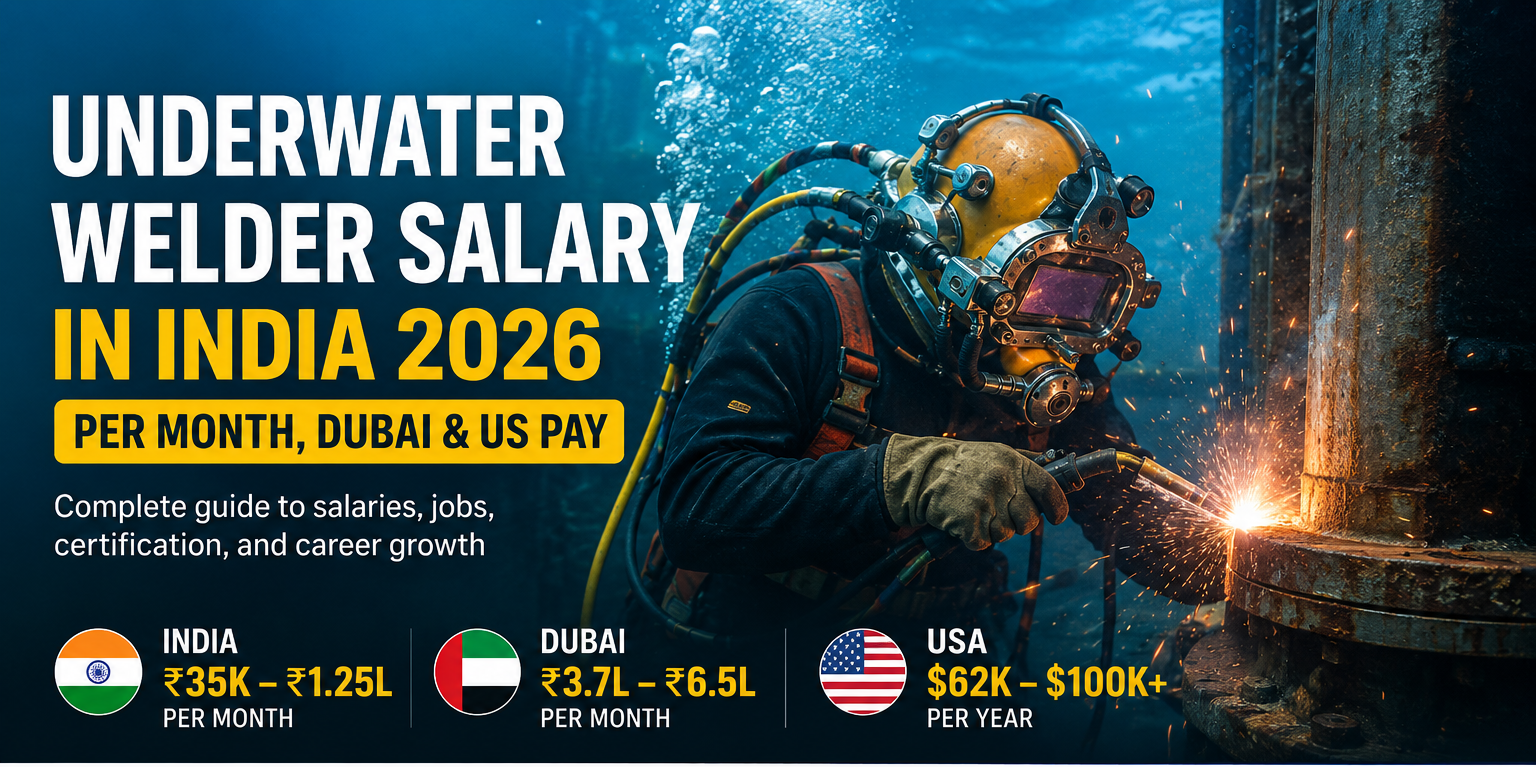
The average underwater welder salary in India ranges from ₹6.2 lakh to ₹11.2 lakh per year in 2026. Independent estimates place the national average near ₹6.2 lakh, while specialized commercial divers and offshore welders can earn substantially more. :contentReference[oaicite:0]{index=0}
Entry-level professionals typically begin around ₹4.2 lakh annually, whereas experienced offshore specialists, saturation divers, and international contractors can command ₹15 lakh to ₹30 lakh or more per year, depending on project risk, depth, and employer. :contentReference[oaicite:1]{index=1}
In underwater welding, compensation is driven less by age or tenure and more by certifications, offshore experience, diving specialization, and willingness to work in high-risk environments.
What Underwater Welders in India Actually Earn
Underwater welders in India earn between ₹6 lakh and ₹11 lakh annually on average, although offshore specialists and Gulf-based professionals can earn several times more. The widely shared $300,000 salary stories refer to saturation divers working in a very small segment of the global offshore industry.
The gap between different data sources tells you something important about this market. Jobted reports an average of ₹6,18,900 per year (₹33,520 per month). SalaryExpert, using employer survey data collected directly from employers, puts the figure at ₹11,17,214 annually. The difference suggests significant underreporting in advertised roles, or that the best-paying jobs are filled through networks rather than job boards.
For context, the national average salary in India is roughly ₹3.87 lakh annually. Underwater welding pays approximately 60% higher than the national average, according to Jobted’s data.
US Comparison: The Global Benchmark
The American Welding Society reports entry-level wages around $62,000, a national median of $68,000, and experienced welders earning $100,000+. The Bureau of Labor Statistics puts the mean annual wage for commercial divers at roughly **$75,000 .
The $300,000 figure is real but rare. It represents total compensation for saturation divers — day rates of $1,000–$1,500, depth pay, hazard bonuses, overtime, and per diems. These are the top 1% of an already small profession.
The gap between India and the US: In nominal terms, US underwater welders earn roughly 8-10x the Indian average. Adjust for purchasing power parity, and the gap narrows to 2-3x — but the absolute difference remains substantial. That’s why the Gulf market, with its 5-8x premium over Indian salaries, is so attractive for Indian welders.
The Fatality Question: What the Data Actually Says
The widely repeated 15% fatality figure is heavily disputed. It traces back to a small 1970s study and bears little resemblance to what modern data shows.
NIOSH and BLS data from 2011–2017 recorded 39 fatal injuries among roughly 3,380 commercial divers — a rate of about 150–180 per 100,000 workers. That is roughly 40 times the national average for all occupations. UK HSE studies suggest 2–4 fatalities per 10,000 divers per year.
Some sources estimate 1–2% lifetime fatality risk. Others still cite 15%. The honest answer: underwater welding remains one of the most dangerous industrial occupations, but exact fatality estimates vary significantly between studies and are often exaggerated online.
The risk is real. The specific percentage is debated.
India Salary Breakdown
Experience Progression
Monthly Breakdown
| Experience Level | Monthly Salary (₹) |
|---|---|
| Entry (<3 years) | ~₹35,000 |
| Mid-career (4-9 yrs) | ~₹50,000 |
| Senior (10-20 yrs) | ~₹82,000 |
| Late career (20+ yrs) | ~₹99,000 |
| Top earners | ₹1,25,000+ |
Employer Comparison
The takeaway: location matters as much as skill. An experienced welder working for an international offshore contractor can earn several times more than someone doing similar work for a small local firm.
Dubai/UAE: The Opportunity Indian Welders Are Missing
| Market | Average Annual (AED) | Average Annual (₹) |
|---|---|---|
| Dubai | 272,627 | ~₹62.7 lakh |
| UAE (national) | 222,901 | ~₹51.3 lakh |
| Dubai entry (1-3 yrs) | ~193,991 | ~₹44.6 lakh |
| Dubai senior (8+ yrs) | ~339,207 | ~₹78 lakh |
The Dubai premium is roughly 22% above the UAE national average. SalaryExpert projects 12% salary growth over 5 years for underwater welders in Dubai.
For Indian welders, the Gulf market pays 5-8x the Indian average. Dubai is roughly 9.7% more expensive than the UAE average, based on cost-of-living data across five cities — but the salary premium more than compensates.
Dubai Monthly Breakdown
| Level | Monthly (AED) | Monthly (₹) |
|---|---|---|
| Entry (1-3 yrs) | ~16,166 | ~₹3.7 lakh |
| Average | ~22,719 | ~₹5.2 lakh |
| Senior (8+ yrs) | ~28,267 | ~₹6.5 lakh |
Europe Comparison
| Location | Average Annual | Notes |
|---|---|---|
| London, UK | £74,817 | ~29% above UK average |
| Germany | €78,248 | ~$85,000 USD |
| UK offshore | £60,000–£150,000+ | North Sea projects |
European rates have not kept pace with US offshore growth. The North Sea is a mature basin with declining activity. The Gulf of Mexico, Southeast Asia, and West Africa are where the growth — and the highest day rates — are.
Underwater Welder Jobs in India
Most underwater welding jobs in India are concentrated around:
- Offshore oil and gas projects — ONGC contractors, rig maintenance, pipeline repair
- Shipyards — Cochin Shipyard, L&T Marine, Mumbai and Visakhapatnam yards
- Port maintenance contracts — structural inspections and repairs
- Defence and naval infrastructure — submarine and naval vessel maintenance
- Marine inspection and repair companies — specialised contractors
Unlike conventional welding, many opportunities come through contractors and industry networks rather than large public job boards. Job listings for underwater welders in India show wide dispersion — from ₹12,000 per month at smaller contractors to ₹58,000 per month at IIT Kanpur research projects. Offshore roles with international firms can push into ₹15–30 lakh+ territory.
The IIT Guwahati-IRS certification programme, launched in 2024, is gradually formalising the profession and creating new pathways to organised-sector employment.
How to Become an Underwater Welder in India
Step 1: Learn Industrial Welding
Start with surface welding. You need certification in basic welding techniques before you can weld underwater. Look for courses through:
- Industrial Training Institutes (ITIs)
- Welding training centres
- Technical colleges offering diploma or certificate programmes
Step 2: Complete Commercial Diving Training
Underwater welding requires commercial diving certification. In India, this has historically been a gap — but the landscape is changing.
November 2024 milestone: IIT Guwahati’s Technology Innovation Hub, in collaboration with the Indian Register of Shipping (IRS), conducted India’s first training and certification programme in underwater welding and deep diving.
The programme was held at the Neel Diving Academy in Kochi. Participants received theoretical and practical training, engaged in rigorous underwater welding exercises, and underwent technical evaluations against stringent quality and safety standards.
November 2025 update: Union Minister Sarbananda Sonowal inaugurated an expanded Underwater Welding, Offshore Repair and Additive Manufacturing programme at IIT Guwahati, distributing certificates to seven youths who completed the certification.
Step 3: Obtain Underwater Welding Certification
The IIT Guwahati-IRS certification is India’s first globally benchmarked programme. It aligns with the ‘Atmanirbhar Bharat’ vision by building local expertise in underwater wet welding — a skill crucial for maintaining offshore and maritime infrastructure.
Dr Asokendu Samanta, Divisional Head of R&D at IRS, noted: “This programme equips our workforce with vital underwater wet welding and deep diving skills, which are essential for maintaining India’s oil, gas, and shipping infrastructure.”
Step 4: Build Offshore Experience
Certification opens doors. Experience determines your earning potential. Entry-level welders in India start around ₹4–8 lakh annually. Mid-career professionals earn ₹6–11 lakh. Senior welders cross ₹10–15 lakh.
Talk to people in shipyards and you will hear the same thing: certification opens doors, but overseas exposure changes earnings.
Step 5: Consider Gulf Opportunities
The Gulf market pays 5-8x the Indian average. Dubai’s underwater welding market offers 272,627 AED (~₹63 lakh) on average with 12% projected growth. For Indian welders with certification and experience, the UAE represents the most accessible high-income market outside the US.
What Surprised Me While Researching This
One thing that surprised me while researching this piece was how small the industry actually is.
India has thousands of welders, but only a tiny fraction ever move into commercial diving or offshore work. The IIT Guwahati-IRS programme certified its first batch of seven underwater welders in 2024. Seven. For a country with 7,500 kilometres of coastline and major offshore oil and gas operations, that number tells you everything about the supply constraint.
Malaysia, with a booming offshore sector, has produced only 17 certified underwater welders. The global workforce for commercial divers in the US is roughly 3,380. This is not a mass-market career. It is a niche within a niche.
That supply constraint is exactly why wages remain high at the top end — and why certification programmes like the one at IIT Guwahati are so important.
Feature Snippet: Quick Answers
Are underwater welders in demand in 2026?
Yes — but demand is highly specialized. The global underwater welding services market continues to grow, driven by aging offshore infrastructure and renewable energy expansion. However, the profession employs only ~3,400 people in the US. The real constraint is supply, not demand: training takes 2-3 years, certification is expensive, and the occupational risks deter most candidates.
Which welding jobs have the highest growth potential?
Saturation diving and offshore underwater welding lead growth, driven by deep-water oil exploration and offshore wind farm installation. ROV-assisted welding is the fastest-growing subsector, reducing human exposure to extreme depths. In India, the IIT Guwahati-IRS certification programme launched in 2024 is creating a formal pipeline for skilled underwater welders.
FAQ
How much does an underwater welder make in India?
An underwater welder in India earns an average of ₹6,18,900 per year (₹33,520 per month) according to Jobted, or ₹11,17,214 according to SalaryExpert. The gap reflects differences in data sources — job postings vs. employer surveys. Entry-level positions start around ₹4,23,100, while senior welders can exceed ₹15,00,000. Some job postings in the unorganized sector list salaries as low as ₹12,000–₹18,000 per month.
Can underwater welders really make $300,000?
Yes, but it is the exception, not the rule. Saturation divers working on deep-sea offshore oil rigs can earn $200,000–$300,000 through day rates ($1,000–$1,500), depth pay, hazard bonuses, and overtime. The average underwater welder earns $62,000–$100,000. Reaching $300,000 requires years of experience, saturation certification, and willingness to work in extreme environments.
How much does an underwater welder make in Dubai?
An underwater welder in Dubai earns an average of 272,627 AED per year (~₹62.7 lakh). Entry-level (1-3 years) earns ~193,991 AED, while senior welders (8+ years) earn ~339,207 AED. SalaryExpert projects 12% salary growth over 5 years for underwater welders in Dubai.
What is the death rate for underwater welders?
There is no single agreed-upon figure. The widely cited 15% figure is disputed and likely originates from a small 1970s study. NIOSH and BLS data from 2011–2017 show 39 fatal injuries among ~3,380 commercial divers — a rate of roughly 150–180 per 100,000 workers, or about 40 times the national average. UK HSE studies suggest 2–4 fatalities per 10,000 divers per year. The honest answer: the risk is significantly higher than most occupations, but the exact percentage varies by study.
How long does it take to become an underwater welder?
Total time: 2–3 years. Commercial dive school takes 6–8 months. After that, you need on-the-job experience — typically 1-2 years of commercial diving before specializing in underwater welding. Advanced certifications (saturation diving, hyperbaric welding) add another 1-2 years. In India, IIT Guwahati and IRS launched the first certification programme in November 2024.
What is the IIT Guwahati underwater welding programme?
IIT Guwahati’s Technology Innovation Hub, in collaboration with the Indian Register of Shipping (IRS), conducted India’s first training and certification programme in underwater welding and deep diving in November 2024. The programme, held at the Neel Diving Academy in Kochi, provides theoretical and practical training in underwater wet welding. The first batch of seven candidates was certified in 2024, with an expanded programme launched in November 2025.
Which country pays underwater welders the most?
The United States — particularly the Gulf of Mexico — offers the highest absolute salaries, with saturation divers earning $200,000–$300,000. Dubai/UAE offers strong salaries (272,627 AED/~₹63 lakh) with 12% projected growth. Australia follows closely. Europe pays well but lags US offshore rates: London averages £74,817, Germany €78,248. India pays significantly less in nominal terms (₹6–11 lakh) but industry surveys suggest strong long-term growth potential as certification programmes and offshore infrastructure expand.
Conclusion: Underwater Welder Salary
Underwater welding can provide strong earnings, but only after significant training, certification, and practical offshore experience.
Key takeaways:
| Metric | Value |
|---|---|
| India average | ₹6.2L–₹11.2L |
| India top end | ₹15L+ |
| Dubai average | 272,627 AED (~₹63L) |
| US median | $68,000 |
| US experienced | $100,000+ |
| US top (saturation) | $200,000–$300,000+ |
| Fatality rate (vs. national avg) | ~40x higher |
| US workforce | ~3,380 |
The action strategy:
- If you are considering this career: Certification is everything. The IIT Guwahati-IRS programme launched in 2024 is India’s first formal pathway. Without certification, you are competing in the unorganized sector at ₹12,000–₹18,000 per month. With it, you become eligible for organized sector roles in India (₹6–12 lakh+) or Gulf roles (₹50–80 lakh+).
- If you are hiring in India: The supply constraint is real. Seven certified welders in the first batch. You will need to compete on safety equipment, protocols, and insurance as much as salary.
- If you are an Indian welder looking to maximize earnings: The Gulf market offers 5-8x the Indian average. Dubai pays 272,627 AED (~₹63 lakh) on average with 12% projected growth. The certification and language barriers are lower than the US or Europe.
Higher pay in this industry usually comes with longer rotations, tougher conditions, and years of specialized training. Anyone considering the field should weigh those trade-offs carefully.
Related Reading:
- Merchant Navy Salary — compare offshore career earnings
- Full Form of CTC — understand compensation packages
- LPA Full Form — salary terminology explained
- Surgeon Salary — medical specialist earnings comparison
- Cardiologist Salary — another high-skill profession benchmark
- Neurosurgeon Salary — top-tier medical income comparison