
📌 At a Glance
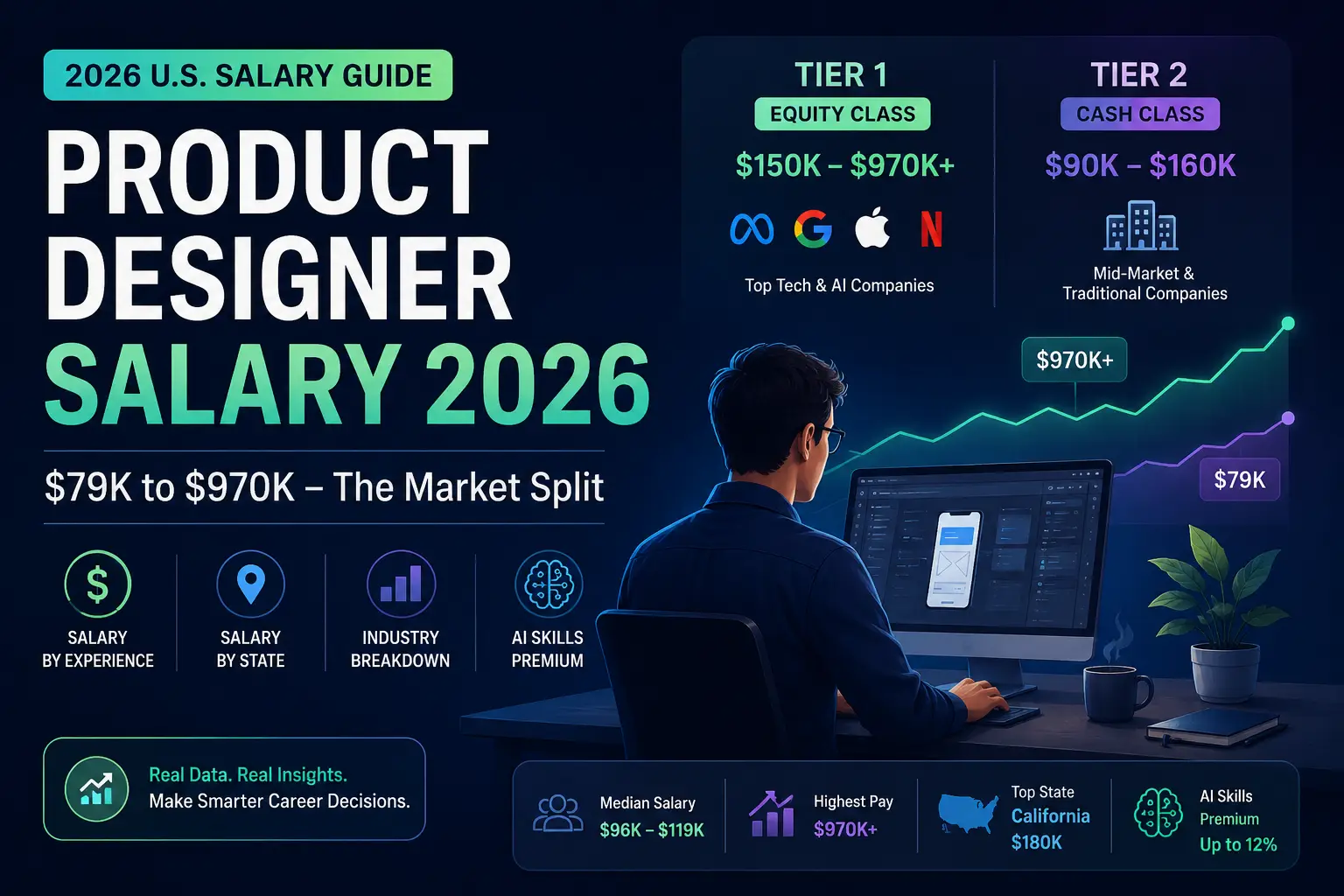
The median total compensation for a U.S. Product Designer is $96,000–$119,000 in 2026. Entry-level professionals typically start near $70,000.
Senior roles at top-tier technology companies routinely exceed $500,000 in total compensation, with exceptional outliers earning more than $970,000.
Market Reality: The compensation gap is driven primarily by employer tier, not simply by years of experience. Two designers with identical experience can earn dramatically different salaries depending on whether they work for a startup, enterprise, or leading Big Tech company.
Four different search results. Four different answers. All technically correct.
If you type “how much does a Product Designer make” into Google, you’ll see $96,770, $119,000, $144,360, and $163,000. The algorithms aren’t broken. They’re just looking at different slices of a market that fractured in 2024 and has only widened since.
The 2026 reality is binary. There is no single product designer salary. There is a Tier 1 market and a Tier 2 market. The gap between them is now wider than the gap between a junior and a director inside the same company.
Here is the data, the interpretation, and the contrarian playbook for 2026. For broader benchmarks across creative roles, check our UX Designer Salary and Graphic Designer Salary guides.
The 2026 Snapshot: What You Actually Need to Know
| Metric | Salary Range |
|---|---|
| Median Total Pay (All Tiers) | $96,000 – $119,000 |
| Entry-Level (0–2 Years) | $70,000 – $90,000 |
| Senior-Level (5–9 Years) | $140,000 – $180,000 |
| Staff/Principal (10+ Years) | $220,000 – $500,000+ |
| Top 1% (FAANG + AI Unicorns) | $500,000 – $970,000+ |
Hourly, Daily, Weekly, and Monthly Breakdown
If you prefer to think in cash flow intervals—which matters if you’re freelancing or comparing contract offers—here is the estimated translation:
| Pay Period | Estimated Range |
|---|---|
| Hourly | $35 – $58 |
| Daily (8 hours) | $280 – $900 |
| Weekly (40 hours) | $1,400 – $4,500 |
| Monthly (Gross) | $5,800 – $18,000 |
Data synthesized from verified compensation submissions, employer disclosures, and market-wide surveys updated through Q2 2026.
The Two-Tier Reality
Tier 1 – The Equity Class
Meta, Google, Netflix, Apple, and high-growth AI startups. Total compensation here starts at ~$150,000 for fresh graduates and scales past $900,000 for staff-level ICs. These firms compete on equity. Base salary is table stakes; the real wealth is in RSUs and stock appreciation.
Tier 2 – The Cash Class
Mid-market SaaS, traditional manufacturing, healthcare systems, retail, and design agencies. Total compensation clusters between $90,000 and $160,000. Equity is either non-existent or Monopoly money. The median Tier 1 designer out-earns the median Tier 2 designer by a factor of 2.5x, not because of skill, but because of market structure.
Salary by Experience Level (U.S. Market)
| Experience Level | Years | Total Compensation (Median) |
|---|---|---|
| Entry / Junior | 0–2 | $79,500 |
| Early Career | 3–4 | $95,900 |
| Mid-Career | 5–7 | $115,000 |
| Senior | 8–10 | $140,000+ |
| Staff / Principal | 11–15 | $220,000+ |
Contrarian insight: The Payscale dip showing seniors earning less than mid-career is a survey artifact—it captures the “plateau” in non-tech industries. If you hit year 8 and aren’t at a Tier 1 company, your comp stagnates. If you are, it compounds. Use our In-Hand Salary Calculator to see how your gross offer translates to net take-home at different experience tiers.
Salary Growth Trend (2022–2026)
Compensation hasn’t risen linearly. It spiked, cooled, and is now separating by tier. Here is the 5-year trajectory of the median total compensation:
| Year | Median Total Comp (All Tiers) | YoY Change |
|---|---|---|
| 2022 | $98,000 | – |
| 2023 | $104,000 | +6.1% |
| 2024 | $110,000 | +5.8% |
| 2025 | $116,000 | +5.5% |
| 2026 | $119,000 | +2.6% |
The growth rate is decelerating at the median. However, the top quartile (Tier 1) grew at 8-10% annually over the same period, while the bottom quartile grew at less than 2%. The middle is being squeezed.
Salary by State (2026 Median Total Pay)
Location still dictates floor. A remote employee at a California-based company often gets adjusted down by 10–15% if they move to Texas, but the absolute number remains higher than local Texas firms.
| State | Median Total Pay |
|---|---|
| California | $180,000 |
| New York | $175,000 |
| Washington | $170,000 |
| Massachusetts | $158,000 |
| Texas | $145,000 |
| Illinois | $140,000 |
| Florida | $135,000 |
| Colorado | $133,000 |
The geography tax is real, but remote arbitrage (earning SF comp while living in Austin) is still the single greatest leverage play for Tier 2 designers.
Education and Certifications: Does the Paper Matter?
The design industry is famously meritocratic, but data shows distinct entry points based on education path:
| Education Path | Median Starting Salary (0–2 yrs) |
|---|---|
| Bachelor’s Degree (HCI/Design) | $78,000 – $85,000 |
| Master’s Degree (HCI/MBA) | $90,000 – $105,000 |
| Bootcamp Graduate | $70,000 – $80,000 |
| Self-Taught | $65,000 – $75,000 |
Certifications don’t guarantee a raise, but they signal commitment to specialization. High-value certs in 2026 include:
- Google UX Design Certificate (good for foundational credibility)
- Nielsen Norman Group UX Certification (stronger for enterprise roles)
- AI/ML Product Design (offered by emergent academies—this moves the needle)
- Human-Centered Design (LUMA Institute)
The caveat: A Master’s in HCI pays for itself within 2-3 years if it lands you a FAANG interview. A bootcamp certificate without a stellar portfolio is now dangerously close to being ignored by hiring managers.
Salary by Industry (Beyond Big Tech)
| Industry | Median Total Pay | Why |
|---|---|---|
| SaaS / B2B Software | $155,000 | High margins, product-led growth focus |
| Fintech | $145,000 | Regulatory complexity + high monetization stakes |
| Real Estate (Proptech) | $152,000 | UI/UX directly impacts conversion rates |
| Healthcare / Healthtech | $130,000 | Complex data viz, high barrier to entry |
| Retail / E-Commerce | $125,000 | Massive A/B testing cadence |
| Design Agencies / Consultancies | $110,000 | Billable hours model caps pay |
Fintech and Proptech are underrated hunting grounds. They don’t have the Instagram-level glamour, but they have profitability and retention—which translates to stable bonuses. Compare these figures to the broader Software Engineer Salary trajectory to see how the design premium stacks against engineering.
Salary by Company Size & Remote Status
| Company Size | Median Base | Median Equity (Annualized) |
|---|---|---|
| Startups (1–50) | $110,000 | $10,000 – $30,000 (Options) |
| Mid-Market (51–1,000) | $125,000 | $15,000 – $40,000 (RSUs) |
| Enterprise (1,000+) | $140,000 | $50,000 – $150,000+ |
| Remote-First (Any) | $130,000 | Varies widely |
Remote vs. On-Site: On-site roles in SF/NYC command a 15–20% premium over remote, but when you factor in commute costs and state taxes, the effective hourly rate often favors remote.
Freelance and Contract Product Designer Rates
Freelance rates have held firm because companies are wary of full-time headcount in a volatile macro environment.
| Level | Hourly Rate |
|---|---|
| Junior / Mid Freelance | $65 – $95 |
| Senior Freelance | $100 – $150 |
| Principal / Specialist | $175 – $250+ |
If you are a W-2 employee, your hourly equivalent (based on a 2,000-hour year) is roughly $48–$75/hour. Freelancers aren’t necessarily “paid more,” but they capture the overhead that companies save on benefits and payroll taxes. Always calculate your net effective rate using our Overtime Calculator if you are billing hourly.
Equity Compensation: The Silent Wealth Driver
Most designers underestimate equity. Here’s the breakdown:
- RSUs (Restricted Stock Units): Grant value is fixed at offer, but payout depends on stock price. At Meta/Google, this is a major lever.
- Vesting: Typically 4 years with a 1-year cliff. If you leave before 12 months, you get $0 in equity.
- The Math: A $200,000 stock grant at a company growing 15% YoY could be worth $300,000 by the time it vests. Conversely, a $200,000 grant at a sinking startup could be worth $40,000.
The Strategy: When negotiating, fight for equity at public companies (it’s real money) and discount private options by 70% (they are lottery tickets). Evaluate your total offer structure using the CTC Calculator to compare apples-to-apples between companies.
The AI Premium: +12% and Growing (Now with Specific Skills)
Product designers who can ship AI-native interfaces command a verified 12% pay premium. This isn’t about knowing ChatGPT. It’s about specific, marketable skills that address the probabilistic nature of AI:
- AI Copilots: Designing collaborative interfaces where the AI assists the user (e.g., GitHub Copilot, Figma AI).
- LLM UX (Prompt Engineering): Designing interaction patterns for large language models—how users craft prompts and how the system responds.
- AI Agents: Building autonomous task-executing agents that require trust and transparency in the UI.
- Multimodal Interfaces: Integrating voice, text, and visual inputs seamlessly.
- AI Workflow Design: Redesigning existing user workflows to incorporate generative AI features without disrupting core user tasks.
The contrarian view: AI tools are compressing the low-end visual design market. Tasks that took juniors 10 hours (iconography, layout variations) now take 2 hours. The value premium is shifting entirely to strategic product thinking and AI orchestration—the stuff AI can’t abstract away yet.
Product Designer vs. UI/UX Designer: The Salary Gap
| Role | Median Total Pay |
|---|---|
| UI Designer | $95,000 |
| UX Designer | $108,000 |
| Product Designer | $120,000 |
| UX Researcher | $115,000 |
| Design Engineer | $135,000 |
The $12,000 premium for Product Designers comes down to P&L ownership. Product designers track onboarding rates, retention, and conversion funnels. UX designers focus on usability and research synthesis. If you want to earn more, shift your vocabulary from “user flows” to “business outcomes.” For a deeper dive into the adjacent field, read our UI-UX Designer Salary breakdown.
The Career Progression Ladder
Understanding the rungs helps you target the right salary jumps:
- Junior Product Designer (0–3 yrs) – Execution heavy. Portfolio is king.
- Product Designer (3–5 yrs) – Owning features. Mentoring juniors.
- Senior Product Designer (5–8 yrs) – Owning products, driving strategy.
- Lead Product Designer (8–10 yrs) – Owning multiple streams, managing stakeholders.
- Principal Product Designer (10–15 yrs) – Org-level strategy, setting design standards.
- Design Director – Management track, handling hiring and team health.
- VP of Design – Executive comp structure (mix of cash & performance bonuses).
The Hiring Outlook: Is Product Design Still a Good Career in 2026?
The Good:
- Demand for strategic designers has never been higher.
- AI-savvy designers are snapped up quickly.
- Remote work has opened 39% of roles to a national talent pool.
The Bad:
- Junior roles are shrinking. The “bootcamp to six-figure” pipeline is broken.
- Hiring volume is flat compared to 2021 peaks.
- Agency roles are under immense fee pressure, suppressing wages.
The Ugly:
- The market is punishing “visual-only” designers. If your portfolio only shows UI polish without metrics, you will struggle to get interviews.
Verdict: Yes, for senior and strategic profiles. Maybe not for fresh graduates unless they have a stellar internship and AI project portfolio. Check our Project Manager Salary to see how adjacent roles are faring in the same macro environment.
How to Negotiate in 2026
- Information is power: Always benchmark against the specific company tier, not the national average. Use our Income Tax Calculator to understand your effective state tax burden before signing.
- Negotiate equity earlier: If they won’t move on base, move on equity. A 20% increase in RSUs is often easier for recruiters to approve.
- The “Cliff” clause: If they require relocation to SF/NYC, ensure the signing bonus covers moving costs and the first 3 months of rent—cash flow matters.
- Performance bonuses: Ask if there is a discretionary bonus pool (typically 10–15%) and what the actual historical payout has been.
Methodology
The salary figures presented in this guide are synthesized from verified compensation submissions, employer salary disclosures (in compliance with state pay-transparency laws), public job postings, and market-wide compensation surveys updated through June 2026. Data is weighted and normalized to reflect overall U.S. market trends rather than any single dataset. Tier definitions are derived from market capitalization, funding stage, and revenue scale.
Frequently Asked Questions
How much does a Product Designer make per month?
Monthly base pay ranges from ~$5,800 (entry-level, mid-market) to ~$18,000 (senior, FAANG). Including equity, monthly total value can spike to $40,000+ at top-tier firms.
What is the starting salary of a Product Designer?
$70,000 – $90,000 in mid-market, rising to ~$150,000+ total comp at FAANG. Location (CA/NY vs. Midwest) shifts the floor by up to $20,000.
Do product designers get paid well?
Relative to the U.S. median wage ($59,000), yes. Relative to software engineers at the same tier, no—engineers typically out-earn designers by 20–30% at senior levels.
Which is better, UI/UX or product design?
Product design pays ~11% more because it ties closer to product strategy and revenue. If you want to stay purely research or visual, UX/UI is viable, but the ceiling is lower.
How to become a product designer in 2026?
Build a portfolio demonstrating business impact. Learn Figma, user research, and AI product design basics. Start in UX/UI and transition internally. Expect a tougher job market—use networking, not just cold applications.
Does a Master’s degree increase Product Designer salary?
Yes, by roughly $10,000–$15,000 at the entry level, primarily because it opens doors to HCI-specific roles at large enterprises. However, 5 years of solid experience outweighs a Master’s degree in almost every scenario.
Conclusion: The Operator’s Take
Compensation is no longer determined by tenure. It is determined by tier, product ownership, AI fluency, location, and equity literacy.
Designers who treat the role as a business function consistently out-earn those who treat it as a craft function. The 2026 market is ruthless to the unstrategic. The average is a lie. The floor is rising, the ceiling is stratospheric, and the middle is under pressure.
If you are in Tier 2, your fastest path to a raise is leaving—either to a Tier 1 company or to a high-growth Fintech/Proptech vertical. If you are in Tier 1, stay put, understand your vesting schedule, and aggressively push for that Staff promotion.
The data is clear. The split is real. Choose your lane.
Explore More Benchmarks:
- Private Sector Salaries – Compare across industries.
- Government Sector Salaries – See the public vs. private gap.
- Knowledge Center – Deep dives on compensation trends.
Return to the Salaryinfo Homepage for more analyst-grade compensation data.