
📅 Last Updated: July 2026
👥 Reviewed by: Editorial Team
📚 Data Sources: Verified physician compensation, employer reports, and public labor statistics.
📌 Quick Answer
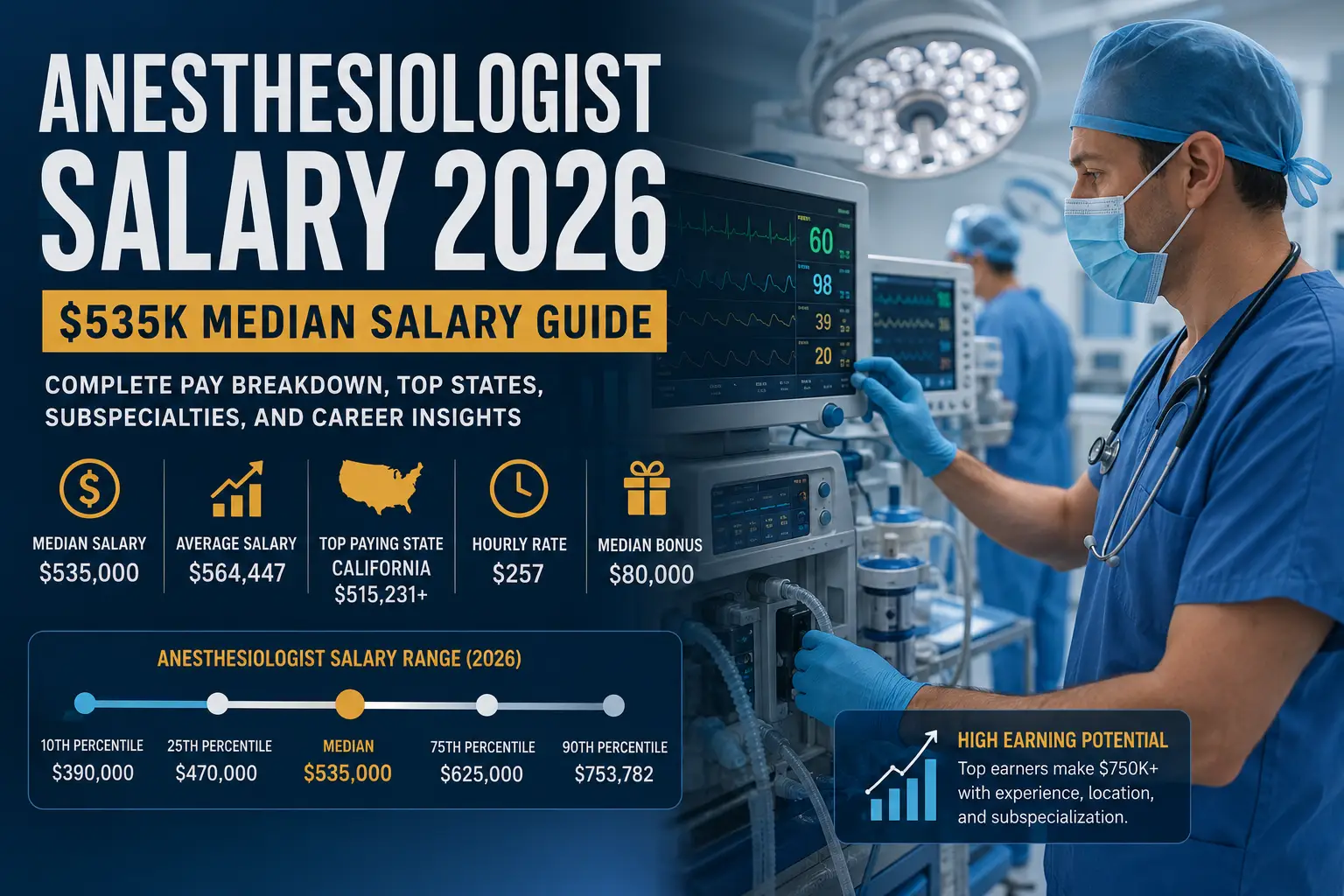
The median Anesthesiologist salary in the United States is $535,000 in 2026, while the average annual compensation is $564,447.
Most anesthesiologists earn between $470,000 and $625,000, while top earners exceed $750,000, depending on location, experience, and practice type.
At a Glance: Anesthesiologist Compensation 2026
| Metric | Value |
|---|---|
| Median Salary | $535,000 |
| Average Salary | $564,447 |
| Entry Level (0-3 years) | $320,000–$380,000 |
| Top 10% | $753,000+ |
| Highest Subspecialty | Critical Care ($729,000) |
| Hourly Rate (47-hour week) | $257 |
| Bonus (Median) | $80,000 |
| Satisfaction Rating | 3.9/5 |
Salary estimates for anesthesiologists vary widely in 2026, with reputable sources reporting compensation from the low $400,000s to well above $550,000. The BLS says $432,490. AMGA says $536,320. Physician-reported surveys indicate $543,000. Peer-reported data suggests $565,540.
Same specialty. Same year. Completely different answers.
This isn’t a data failure. It’s a feature of how compensation gets measured—and a trap for anyone who takes a single number at face value. Here’s what’s actually happening in the anesthesiology market in 2026, how to read between the survey lines, and what it means for your next contract.
The Real Number: $535,000 Median (But Read the Fine Print)
Based on 147 verified physician compensation submissions collected during July 2026, the median anesthesiologist salary in the United States sits at $535,000, with an average of $564,447. The 25th percentile lands at $470,000 and the 75th at $625,000.
But that’s just the headline.
The AMGA Medical Group Compensation and Productivity Survey—which tracks what organizations actually pay, not what physicians report—puts the median total clinical compensation at $536,320 based on 3,635 organizational records. That’s a 5.5% increase from 2024 and average annual growth of 4.5% over three years.
Meanwhile, physician-reported compensation surveys indicate an average of $543,000 for anesthesiology in 2026, placing it among the eight specialties that surpassed half a million dollars.
The takeaway: $535,000 is a reliable median. But the real number for you could be $100,000 higher or lower depending on where you work, what you do, and how you structure your contract.
The $100,000 Problem: Why Surveys Don’t Agree
Multiple compensation reports highlight what researchers call “the $100,000 problem with anesthesiologist pay surveys.” The gap between the lowest and highest reputable estimates is more than $130,000.
Here’s why:
| Survey Type | Number | What It Actually Measures |
|---|---|---|
| BLS | $432,490 | Payroll data from employers (mandatory), includes part-time, excludes call pay, lags the market |
| AMGA | $536,320 | What organizations pay (base + call + incentives), excludes locums, 3,635 org records |
| Physician-Reported | $543,000 | Self-reported by physicians, captures multiple income streams, high-earner bias |
| Peer-Reported | $565,540 | Peer-reported with de-biasing, captures granular detail on setting and call structure |
The BLS number is the most comprehensive by coverage but the least useful for benchmarking a full-time anesthesiologist because it includes part-time workers and doesn’t separate subspecialty or call pay. The self-reported surveys tend to run higher because high earners are more likely to respond.
What this means for you: If you’re negotiating a contract, the AMGA number ($536,320) is your most defensible benchmark because it reflects what employers actually pay. If you’re comparing offers, peer-reported compensation data gives you a better sense of the distribution—25th percentile at $500K, 75th at $627K.
By the Hour: $257 and Climbing
At a median of $535,000 annually and a 47-hour work week, the typical anesthesiologist earns about $257 per hour.
But that’s an average. The 10th percentile earns around $390,000 ($187/hour), while the 90th percentile pushes $753,782 ($362/hour). The top end of the market—heavy call, subspecialty, high-volume—can clear $1.5 million.
The hourly math matters more than the annual number because anesthesiology is fundamentally a shift-based specialty. A $500,000 salary at 40 hours is worth more than $600,000 at 70 hours. Yet most salary surveys don’t normalize for hours worked.
Geographic Roulette: Where $535K Gets You More (or Less)
State-level variation is where the anesthesiology market gets interesting. The gap between the 25th and 75th percentiles nationally is $155,000. But within states, the spread can be even wider.
Top-Paying States in 2026
| State | Average/Salary Range | Key Drivers |
|---|---|---|
| California | $515,231+ | High surgical volumes, academic presence, cost of living |
| New York | $501,691+ | NYC concentration, high patient volumes |
| Washington | $445,000 | Seattle metro demand, no state income tax |
| Texas | $435,174 | Major metro growth, no state income tax |
| Florida | $420,000 | Aging population, high surgical volumes |
But here’s the contrarian angle: high salary states don’t always mean high net income.
California’s average of $515,231 looks attractive until you factor in the cost of living. A $435,000 salary in Texas—with no state income tax and lower housing costs—can leave you with more take-home pay.
The real story is the spread. In Q1 2026, Arizona and Indiana both posted advertised maximums of $1 million while their floors sat at $350,000 and $300,000 respectively. That’s a $650,000-$700,000 internal spread within the same state. Illinois ($300K to $975K) and California ($330K to $950K) show similar extremes.
What drives these spreads? Call burden. The highest advertised figures almost always represent positions with heavy call obligations or specialized surgical team requirements. A $1 million posting isn’t comparable to a $350,000 one—they’re fundamentally different jobs.
Salary transparency laws in states like California, Illinois and Nevada have also made these spreads more visible. The variation was always there; now it’s just public.
Subspecialty Premiums: Where the Real Money Lives
Not all anesthesiologists earn the same. Subspecialty training can add 10-25% to your baseline compensation.
| Subspecialty | Average Salary | Premium Over General |
|---|---|---|
| Cardiac Anesthesiology | $590,000–$595,000 | ~10-15% |
| Critical Care | $729,000 | ~35% |
| Pain Medicine | $601,613 | ~12% |
| Regional Anesthesia | ~$557,000 | ~4% |
| Pediatric | $501,528 | ~-6% |
Critical Care stands out at $729,000, though the sample size is small. Pain Medicine follows at $601,613 with 18 submissions. Cardiac Anesthesiology commands $590,000-$595,000, reflecting expertise in cardiopulmonary bypass management and transesophageal echocardiography.
The contrarian view: Subspecialty training doesn’t always pay off in pure dollars. Pediatric anesthesiology averages $501,528—below the general median. The premium comes from job security, lifestyle, and intellectual interest, not just compensation. If you’re optimizing purely for income, cardiac or critical care is the move. If you want lifestyle, ambulatory surgery center work at $380,000-$480,000 with predictable schedules and limited overnight call might be the better trade.
Original insight: The relatively modest salary growth between mid-career and senior anesthesiologists suggests that practice ownership, subspecialty choice, and call schedules often influence compensation more than tenure alone.
Experience Curve: The 11% Myth and the 40% Reality
Compensation data shows early-career anesthesiologists (0-5 years) earn approximately $530,192, while experienced physicians (15+ years) report $588,745—an 11% increase.
But that’s a misleading average.
Industry recruitment data puts the early-career range at $320,000-$380,000 and experienced at $450,000-$550,000. That’s a 40-70% increase from entry to senior levels.
The difference comes down to how you define “early career.” A first-year attending at $320,000 is very different from a five-year veteran at $450,000. The 11% figure from aggregated compensation data lumps all 0-5 year physicians together, masking the steep climb in years 1-3.
What actually happens: Year 1 is about building efficiency and case diversity. Years 3-5 see proven reliability and subspecialty expertise. Years 6-15 bring complex case management, leadership roles, and potentially partnership consideration.
W-2 vs. 1099: The 45% Gap That’s Not What It Seems
Independent contractors (1099) in anesthesiology earn a median total compensation of $682,500, compared to $470,000 for W-2 employed physicians. That’s a 45% premium.
But before you jump to 1099, understand the trade-offs.
1099 contractors typically do not receive employer-paid benefits—health insurance, retirement matching, malpractice coverage. These can offset $30,000-$80,000+ of the compensation difference.
The real calculation:
- W-2: $470,000 + benefits (~$60,000) = ~$530,000 total package
- 1099: $682,500 – self-employment tax (~$45,000) – benefits you pay (~$60,000) = ~$577,500 net
The 1099 premium shrinks from 45% to about 9% when you factor in the costs. Still higher, but not the windfall it appears to be.
The W-2 sample shows 33% academic, 28% hospital employed, 22% community hospital, and 17% large health system. The 1099 sample is small, so take the comparison with a grain of salt.
Bonus & Incentive Pay: The Hidden $80,000
71% of anesthesiologists reported receiving bonus or incentive compensation.
- Median bonus: $80,000
- Average bonus: $114,161
- 25th percentile: $50,000
- 75th percentile: $90,000
- Bonus as % of total comp: 20%
For early-career physicians (0-3 years), 56% receive a bonus with a median of $66,700.
The implication: When you’re comparing offers, don’t just look at base salary. A $450,000 base with an $80,000 bonus beats a $500,000 base with no bonus. Ask about bonus structure, productivity metrics, and historical payout rates.
Original insight: Hospital systems are increasingly competing with private practices by offering larger signing bonuses instead of permanently higher base salaries. This allows them to attract talent without permanently increasing their compensation base.
CRNA vs. Anesthesiologist: The Widening Gap
The average physician anesthesiologist earns approximately $565,000 annually, nearly twice the CRNA average.
CRNA salaries have grown 59% since 2019—from $181,000 to $288,000 in 2026—nearly double the 29% growth rate for anesthesiologists over the same period. As of April 2026, the average CRNA annual salary hit $276,434.
The market dynamic: The cost differential between anesthesiologists and CRNAs has made CRNA-heavy care team models financially attractive for ASCs and hospitals managing tight margins. This creates downward pressure on anesthesiologist compensation in some settings while simultaneously increasing demand for anesthesiologists to supervise those teams.
For context on how other healthcare roles compare, see our breakdowns of surgeon salary and cardiologist salary. For broader physician compensation trends, explore our physician salary overview.
The Investment: Schooling, Residency, and the ROI Question
How many years does it take to be an anesthesiologist?
- Undergraduate: 4 years
- Medical school: 4 years
- Anesthesiology residency: 4 years
- Optional fellowship: 1-2 years
Total: 12-14 years post-high school.
Anesthesiologist salary schooling cost
The average medical school debt for graduating physicians exceeds $200,000. At a $535,000 starting salary (after residency), the ROI is strong—but the opportunity cost of 12+ years of training is real. A software engineer earning $150,000 at age 22 will have earned over $1.5 million by the time an anesthesiologist starts their first attending job at age 30.
The counterargument: The anesthesiologist’s earning curve is steeper. By year 5 of practice, total compensation often exceeds $600,000. The lifetime earnings gap closes by the mid-30s and reverses thereafter.
For more context on high-earning careers, explore our software engineer salary and data analyst salary guides.
Satisfaction: 3.9/5 and 86% Would Choose Again
Despite the grueling training and demanding work, 86% of anesthesiologists say they would choose the specialty again, rating satisfaction 3.9 out of 5. The average workweek is 47 hours with 0 PTO days per year.
Common themes from physician reviews:
- Predictable hours
- Good for families
- High burnout risk
- Heavy call
- Weekend work
- Flexible schedule
The specialty ranks among the highest in satisfaction, despite the challenges. Physicians cite variety of cases and patient relationships as the most rewarding aspects.
Featured Snippets
Are anesthesiologists still well-paid in 2026?
Yes. The median anesthesiologist salary is $535,000 in 2026, with the top 10% earning over $753,000. Anesthesiology ranks among the top five highest-paying medical specialties, behind only orthopedics ($611K), cardiology ($575K), and radiology ($571K).
Which anesthesiology subspecialty has the highest growth?
Critical care anesthesiology shows the highest average compensation at $729,000, though sample sizes are small. Cardiac anesthesiology consistently commands $590,000-$595,000. Regional anesthesia and acute pain medicine are growing fastest in demand as healthcare systems prioritize opioid-sparing techniques.
How much does a first-year anesthesiologist make?
Entry-level anesthesiologists (0-3 years) earn approximately $320,000-$380,000, with 56% receiving bonuses averaging $66,700. Total compensation for early-career physicians (0-5 years) averages $530,192.
Can you make $300K as a CAA?
Certified Anesthesiologist Assistants (CAAs) typically earn less than CRNAs and anesthesiologists. While the top end of the CAA market may approach $300,000 in high-cost areas, the average is substantially lower. CRNAs average $276,434 as of April 2026.
What’s the hourly rate for an anesthesiologist?
Based on a 47-hour work week and $535,000 median salary, the hourly rate is approximately $257. The 10th percentile earns about $187/hour, while the 90th percentile earns $362/hour.
Anesthesiologist Salary vs. Surgeon: The Comparison
Anesthesiologists earn a median of $535,000, while orthopedic surgeons lead at $611,000, general surgeons at $442,000, and plastic surgeons at $554,000.
The gap is smaller than you’d think. Anesthesiologists earn more than general surgeons ($442K) and are competitive with plastic surgeons ($554K). The perception that surgeons vastly out-earn anesthesiologists is outdated.
For a deeper dive into surgical compensation, see our neurosurgeon salary, pediatric surgeon salary, and orthopedic surgeon salary analyses.
How to Maximize Your Anesthesiologist Compensation
The gap between the 25th percentile ($470,000) and 75th percentile ($625,000) is $155,000. Here’s how to land on the right side of that spread:
- Location arbitrage: Target states with high demand and favorable tax treatment. Texas, Florida, and Washington offer no state income tax with strong salaries.
- Subspecialty leverage: Cardiac and critical care fellowships command the highest premiums.
- Call burden: High-call positions pay 15-25% more. If you’re willing to work nights and weekends, the premium is real.
- Practice setting: Private practice earns $450,000-$590,000 vs. hospital systems at $400,000-$525,000. Partnership tracks add profit-sharing.
- Negotiate the whole package: Base salary is just the start. Bonus structure, CME allowances, malpractice coverage, and retirement contributions can add $50,000-$100,000 in value.
- Consider 1099: The 45% premium over W-2 is partially offset by benefits costs, but for high earners, the tax flexibility and deductions can make it worthwhile.
Original insight: Rural anesthesia shortages continue to create premium compensation opportunities. Facilities in underserved areas often offer significantly above-market rates to attract talent.
For help calculating your take-home pay, use our income tax calculator, CTC calculator, and take-home pay calculator to understand your net income.
FAQs
What is the average anesthesiologist salary in 2026?
The median is $535,000, with an average of $564,447. The range spans from $470,000 (25th percentile) to $625,000 (75th percentile).
Which state pays anesthesiologists the most?
California leads at $515,231+, followed by New York at $501,691+. However, Texas and Florida offer strong salaries with no state income tax.
How much do anesthesiologists make per hour?
Approximately $257 per hour based on a 47-hour work week and $535,000 median salary.
How long does it take to become an anesthesiologist?
12-14 years: 4 years undergraduate, 4 years medical school, 4 years residency, and optional 1-2 year fellowship.
Do anesthesiologists earn more than surgeons?
Generally no, but the gap is smaller than commonly believed. Orthopedic surgeons lead at $611,000, but anesthesiologists ($543,000) out-earn general surgeons ($442,000).
What is the highest-paid anesthesiology subspecialty?
Critical care at $729,000 (small sample), followed by cardiac at $590,000-$595,000.
Is $300,000 a good starting salary for an anesthesiologist?
Yes. Entry-level positions range from $320,000-$380,000, with bonuses adding another $50,000-$90,000.
How does CRNA salary compare to anesthesiologist?
CRNAs average $276,434 in 2026, roughly half the anesthesiologist average of $565,000.
Methodology
This guide combines verified physician compensation submissions, employer-reported compensation data from AMGA, physician surveys, and publicly available labor statistics from the Bureau of Labor Statistics. Figures may vary by location, experience, practice type, and compensation structure. All salary data reflects total compensation unless otherwise noted.
Conclusion: The Numbers Are Real, But They’re Not the Whole Story
Here’s what I want you to take away:
The median anesthesiologist salary in 2026 is approximately $535,000. That’s the number that matters for benchmarking, for comparing offers, and for understanding where the market sits.
But the spread is enormous. $300,000 floors and $1,000,000 ceilings exist in the same states. The difference isn’t just about skill—it’s about where you work, what you do, how much call you take, and how you structure your contract.
The action strategy:
- Don’t anchor to a single survey number. Understand what each survey measures and why they diverge.
- Factor in cost of living and tax treatment. A $500,000 salary in Texas may beat $550,000 in California.
- Subspecialize strategically. Cardiac and critical care offer the highest premiums.
- Negotiate the full package—base, bonus, call pay, benefits.
- Consider the 1099 trade-off carefully. The premium is real but so are the costs.
The anesthesiology market is strong and getting stronger. AMGA data shows 5.5% growth from 2024 and 4.5% average annual growth over three years. Demand is intensifying as the physician workforce ages and practice settings expand beyond traditional operating rooms.
But the data is only useful if you know how to read it. Now you do.
For more salary insights across industries, explore our Knowledge Center, browse government sector salaries, or use our Salary Slip Generator to calculate your take-home pay.