
How We Compile Salary Data
Salary information in this report is analyzed from government employment statistics, occupational outlook publications, verified employer compensation research, and editorial analysis. When multiple sources report different figures, we prioritize official government wage data from the U.S. Bureau of Labor Statistics while providing context on why variations exist. Our methodology emphasizes transparency, allowing readers to understand both the numbers and the factors that influence them.
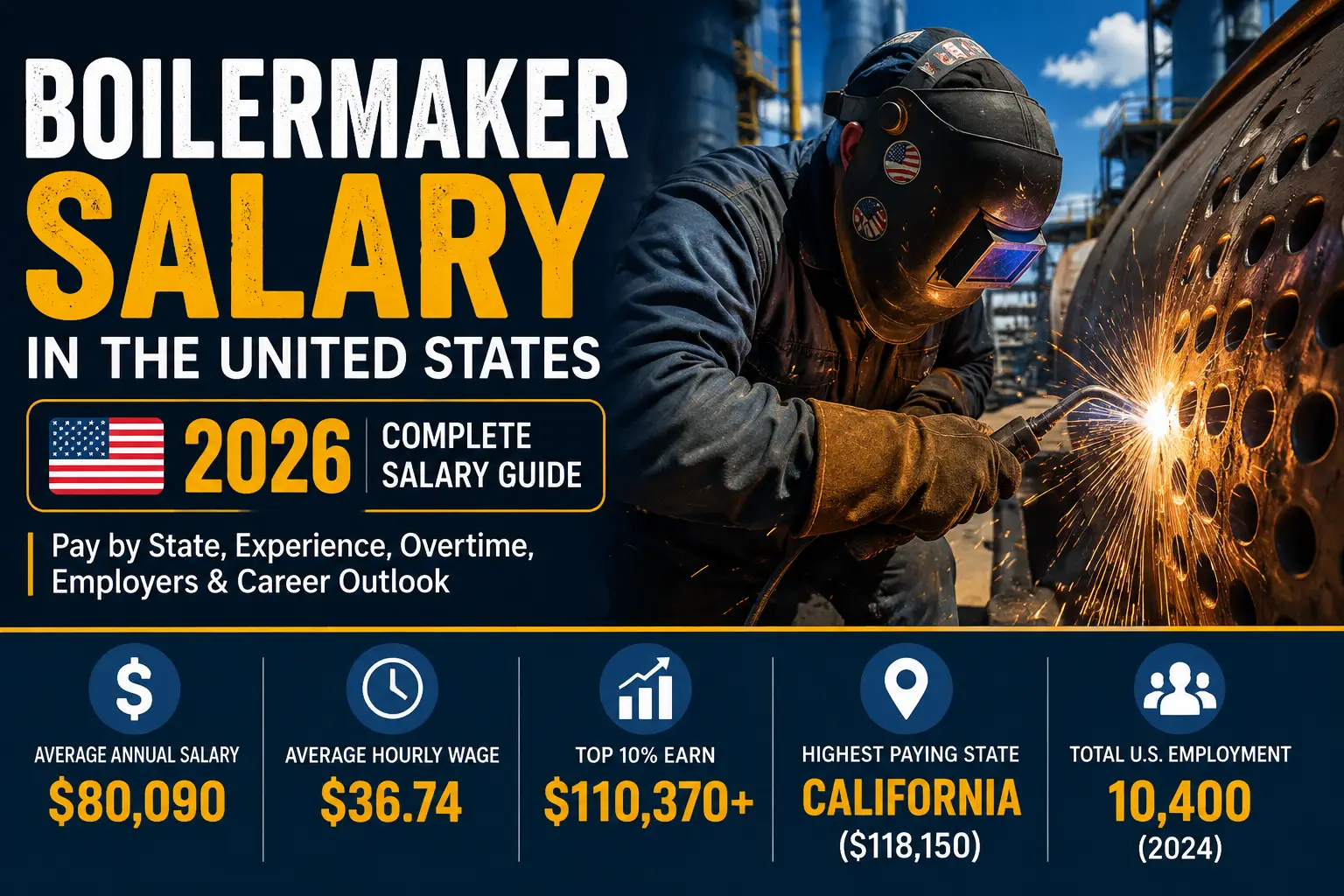
Quick Answer: Boilermaker Salary (2026)
| Metric | Value |
|---|---|
| Average Annual Salary | $80,090 |
| Median Annual Salary | $76,410 |
| Average Hourly Wage | $36.74 |
| Highest Paying State | California ($118,150) |
| Top 10% Annual Earnings | $110,370+ |
| Bottom 10% Annual Earnings | $50,490 |
| Total U.S. Employment | 10,400 |
People Also Ask: Quick Answers
Do boilermakers make six figures?
Yes. The top 10% earn $110,370+ annually. With overtime, specialized certifications, and work in high-paying states like California, many boilermakers earn well over $100,000.
Is boilermaking a good career?
For the right person, yes. It offers solid earnings ($76,410 median), the potential for significantly more through overtime and specialization, and the satisfaction of tangible, important work. The trade-off is physical demands, travel requirements, and employment volatility.
What state pays boilermakers the most?
California leads at $118,150 median annual salary, followed by Mississippi ($105,910), New Mexico ($101,200), Illinois ($99,730), and Michigan ($98,220). Consider cost of living—Mississippi’s $105,910 may go further than California’s $118,150.
Is boilermaker harder than welding?
Boilermakers do weld, but their scope is broader. They also perform assembly, installation, maintenance, and repair of complex pressure systems. The work is more physically demanding and requires a wider skill set, which is why boilermakers earn significantly more than welders.
Market Snapshot: The Numbers That Actually Matter
Different compensation sources often report different salary figures. The official government data from the Bureau of Labor Statistics provides the most authoritative benchmark.
Boilermakers earn an average of $80,090 per year—nearly $11,000 above the national average for all occupations. In some states, experienced professionals clear $110,000 to $136,000 annually.
But the compensation comes with trade-offs. Boilermakers work in conditions most professionals wouldn’t tolerate—cramped, dark, noisy spaces inside boilers, often hundreds of feet in the air, in extreme heat and cold. They travel constantly. They face periods of unemployment between contracts.
Estimate Your Earnings: Use our Salary Calculator and Overtime Calculator to estimate yearly income based on hourly wages.
| Metric | Value |
|---|---|
| National Mean Annual Wage (2025) | $80,090 |
| National Median Annual Wage | $76,410 |
| National Mean Hourly Wage | $36.74 |
| Bottom 10% Annual Wage | $50,490 |
| Top 10% Annual Wage | $110,370+ |
| Total U.S. Employment (2024) | 10,400 |
| Projected Employment (2034) | 10,100 |
| Annual Job Openings | ~800 |
SalaryInfo Observation: The gap between the 10th percentile ($50,490) and the 90th percentile ($110,370) is nearly $60,000. That’s not just experience talking—it’s location, specialization, and employer choice. Location alone can add or subtract nearly half your salary.
Career Comparison: How Boilermakers Stack Up
For many readers, the first question is how this career compares to similar options. Here’s a snapshot:
| Occupation | Median Annual Wage | Key Difference |
|---|---|---|
| Boilermaker | $76,410 | — |
| Electrician | $61,590 | Lower pay, more consistent work, less travel |
| Plumber/Pipefitter | $63,800 | Lower pay, more urban, less physically demanding |
| Welder | $51,000 | Lower pay, broader skill set, less specialized |
| Ironworker | $61,940 | Lower pay, similar physical demands, more construction focus |
Explore These Careers:
Career Outlook: The Contradiction You Need to Understand
Employment is declining, but opportunities remain steady.
The Bureau of Labor Statistics projects a 2% decline in boilermaker employment from 2024 to 2034. Yet approximately 800 openings are projected each year.
Why? Retirement. The workforce is aging, and replacing those who leave creates steady demand even as total employment shrinks.
The bigger story: The shift away from coal-fired electricity generation is reducing demand for traditional boiler work. Renewable energy systems—photovoltaic solar and wind—don’t use boilers. Natural gas plants require less ongoing maintenance than coal plants. This is a structural shift, not a temporary dip.
Career Strategy: The future isn’t in coal. It’s in:
- Industrial pressure vessels for chemical and pharmaceutical processing
- Air pollution abatement equipment (environmental regulations aren’t going away)
- Hydroelectric power generation infrastructure
- Maintenance of existing natural gas infrastructure
SalaryInfo Verdict: The profession isn’t growing, but it’s not dying either. The 800 annual openings represent steady replacement demand. Based on current employment projections and industry trends, long-term demand is expected to be supported primarily by replacement hiring and maintenance work.
Why Salary Surveys Disagree: A Reality Check
Different compensation sources often report different salary figures.
| Source | Reported Salary | Why It Differs |
|---|---|---|
| BLS (2025) | $80,090 mean / $76,410 median | Official government survey of employers—most authoritative |
| Job Posting Data | ~$64,688/year | Based on advertised rates, not actual employee reports—skews toward entry-level |
| Compensation Aggregators | ~$56,233/year | Proprietary algorithms using platform data—often lower |
| Industry-Specific Data | ~$87,095/year | Company or sector-specific, not industry-wide |
Which number should you trust?
- For understanding the overall market: BLS data is the gold standard
- For actual job hunting: Advertised rates reflect current market conditions
- For employer-specific decisions: Industry-specific compensation research provides targeted insights
Why the gap exists:
Job posting sites often reflect lower salaries because:
- They include entry-level positions disproportionately
- They capture advertised rates, not total compensation (benefits, overtime, per diem)
- Geographic distribution differs from actual employment
SalaryInfo Insight: The BLS number ($80,090) is the most reliable benchmark. But if you’re looking at job postings, expect advertised rates around $56,000–$65,000—and plan to negotiate upward based on experience and location.
Highest Paying Employers: Who Actually Pays Above Market
Not all boilermaker employers pay the same. Verified compensation data reveals significant variation:
| Employer Type | Reported Pay | What You Should Know |
|---|---|---|
| Specialized Contractors | $140,000–$196,000+ | Job posting data—may include total compensation, overtime, per diem |
| Industrial Equipment Manufacturers | $160,000+ | Specialized roles requiring advanced certifications |
| Government (Municipal) | $125,000+ | Stable employment, strong benefits, union presence |
| Boilermakers Local 744 (Union) | $85,365 average | Verified union compensation data |
| Boilermakers International | $87,095 average | Industry standard for union shops |
Important caveat: The highest numbers ($196,000+) come from job postings, not verified employee salaries. These may represent:
- Total compensation packages (including benefits and per diem)
- Overtime-heavy positions
- Specialized contractor roles with irregular hours
What actually matters for most boilermakers:
The union premium is real. Union shops pay an average of $85,365–$87,095 annually, significantly above the national median. Non-union positions often pay less but may offer different work arrangements.
Industry pay differences:
The Energy, Mining & Utilities sector pays a median of $63,000+, with top payers including major industrial service companies. The Construction, Repair & Maintenance sector also offers competitive compensation.
SalaryInfo Career Strategy: If you’re targeting maximum earnings, prioritize:
- Union membership — the premium is well-documented
- Energy sector employers — higher base pay and more overtime
- Specialized contractors — premium rates for specialized skills
- Locations with strong union presence — Illinois, California, the Northeast
Salary by State: Where Location Changes Everything
State-level differences are massive—and not always predictable.
Top 10 Highest-Paying States for Boilermakers
| Rank | State | Median Salary | Employment |
|---|---|---|---|
| 1 | California | $118,150 | 720 |
| 2 | Mississippi | $105,910 | 280 |
| 3 | New Mexico | $101,200 | 300 |
| 4 | Illinois | $99,730 | 110 |
| 5 | Michigan | $98,220 | N/A |
| 6 | Wisconsin | $97,590 | 170 |
| 7 | Minnesota | $96,190 | 140 |
| 8 | Washington | $95,200 | 190 |
| 9 | Indiana | $91,410 | 170 |
| 10 | Colorado | $89,350 | 40 |
The California Premium
In California, the numbers are extraordinary:
- Mean annual wage: $118,150
- Top 10% earn: $136,900+
- San Francisco metro area mean: $135,290
- San Francisco top 10%: $162,760
Why California pays so much:
- Strong union presence
- High cost of living (though the wage premium exceeds COL differences)
- Concentration of industrial facilities and power generation
- Strict environmental regulations requiring specialized equipment
SalaryInfo Reality Check: The $118,150 California number sounds impressive. But consider the cost of living. A $118,000 salary in California might not stretch as far as an $85,000 salary in Mississippi. The Mississippi median of $105,910 actually offers better purchasing power given the dramatically lower cost of living.
The Mississippi Paradox
Mississippi ranks #2 nationally at $105,910—and it’s not an anomaly. Why does a state with a lower cost of living pay so well?
- Industrial concentration: Mississippi has significant chemical, oil refining, and manufacturing facilities
- Union presence: Strong union density in industrial sectors
- Specialization: Boilermakers in Mississippi often work in specialized industrial settings that command premium rates
- Supply and demand: Fewer workers relative to industrial demand
Career Strategy: If you’re considering relocation for higher pay:
- California offers the highest nominal wages but the highest cost of living
- Mississippi and New Mexico offer strong wages with lower living costs
- Illinois and Michigan offer solid wages with moderate costs
- Avoid states with minimal industrial presence—the opportunities simply aren’t there
Experience Premium: How Earnings Grow Over Time
The salary progression for boilermakers follows a predictable but significant curve.
The Apprenticeship Years (Years 1–4)
Apprentices start at roughly 50–60% of journeyman wages, with increases at each level.
In New York State:
- Starting salary: $53,190
- Median salary: $81,270
- Experienced salary: $97,000
The 4-year apprenticeship combines on-the-job training with classroom instruction. Each year brings a wage increase as skills develop.
The Journeyman Years (Years 5–15)
Once fully certified, boilermakers reach the median wage range of $76,000–$80,000 nationally.
This is where location and specialization start to matter most. A journeyman in California earns $118,150 on average. The same journeyman in a lower-paying state might earn $30,000–$40,000 less.
The Senior Years (Years 15+)
Top earners reach the 90th percentile and above: $110,370+ nationally, and $136,900+ in California.
What separates senior earners from the median?
- Specialized welding certifications (pressure vessel, pipe, structural)
- Supervisory roles (foreman, crew leader)
- Complex industrial work (nuclear, chemical, pharmaceutical)
- Willingness to travel for premium contracts
SalaryInfo Observation: The earnings curve isn’t linear. Most boilermakers hit their peak earning years between years 10–20. After that, the physically demanding nature of the work often leads to career transitions or reduced hours.
Union vs. Non-Union: The Real Difference
Union membership is one of the most consequential decisions a boilermaker can make.
Union Premium: What the Numbers Show
- Boilermakers Local 744 average: $85,365/year
- Boilermakers Local 744 range: $74,646–$97,673
- National median (all workers): $76,410
The union premium appears to be roughly $9,000–$12,000 annually—and that’s before benefits.
What Union Membership Actually Gets You
Beyond base pay, union membership typically includes:
- Pension plans — often more generous than non-union 401(k)s
- Healthcare benefits — comprehensive coverage with lower out-of-pocket costs
- Apprenticeship training — structured, high-quality programs
- Job placement — union halls actively place members
- Wage protection — collectively bargained rates that rise with inflation
- Safety enforcement — stronger workplace safety standards
The Trade-Offs:
- Union dues — typically 1–3% of wages
- Less flexibility — union rules govern work assignments and conditions
- Political contributions — dues may fund political activities you don’t support
- Work availability — depends on union hall assignments
SalaryInfo Verdict: For most boilermakers, the union premium is worth it. The combination of higher pay, better benefits, and stronger job protection makes union membership the dominant choice in the profession. But the decision depends on individual circumstances—some non-union positions offer comparable total compensation, particularly in right-to-work states.
The Overtime Factor: Where Real Money Gets Made
Here’s what the salary averages don’t capture: overtime.
Boilermakers work extended periods of overtime when equipment is shut down for maintenance or when deadlines loom. These shutdowns can mean:
- 60–80 hour weeks during peak periods
- Per diem for travel and living expenses
- Double-time for weekends and holidays
- Emergency call-out rates
A realistic earning scenario:
A boilermaker earning the median $36.74/hour who works:
- 40 regular hours: $1,469.60/week
- 10 overtime hours at time-and-a-half: $551.10/week
- Weekly total: $2,020.70
- Annualized (50 weeks): $101,035
That’s $25,000 above the median—entirely from overtime.
The Catch: Overtime isn’t guaranteed. It depends on project schedules, employer needs, and economic conditions. And it comes at a cost—physical exhaustion, time away from family, and the health impacts of long hours in demanding conditions.
Estimate Your Earnings: Use our Overtime Calculator to calculate your potential income based on overtime hours.
Education and Certification ROI
The Apprenticeship Path
Duration: 4 years
Cost: Typically free (paid for by union or employer), with wages earned throughout
ROI: Apprentices earn while learning, starting at 50–60% of journeyman wages and progressing to full scale
What You Learn:
- Blueprint reading and sketching
- Metals and installation techniques
- Safety practices
- Welding (various processes)
- Rigging and hoisting
- Pressure vessel codes and standards
Certification Premium
Certain certifications command premium pay:
| Certification | Potential Premium |
|---|---|
| Pressure Vessel Welding | +10–20% |
| Pipe Welding | +15–25% |
| Structural Welding | +5–15% |
| NCCER Certification | +5–10% |
| State Licensure | Varies by state |
Important Note: Some states require boilermakers to hold a license. Requirements typically include work experience and passing an exam.
Career Strategy: The highest-earning boilermakers typically hold multiple welding certifications and are willing to travel to high-paying locations. The certification premium compounds—each additional certification opens new job opportunities and higher pay scales.
Understand Your Compensation:
- CTC Full Form Explained — Understand total compensation packages
- What Is a Salary Slip? — Learn to read your payslip
- CTC Calculator — Compare job offers effectively
Career Risks: What Nobody Tells You
Physical Demands
This is not an office job. Boilermakers:
- Work in cramped, dark, poorly ventilated spaces
- Frequently work hundreds of feet above ground
- Lift heavy components regularly
- Work in extreme heat and cold
- Face noise, dust, and fumes
Injury risks: Boilermakers must wear hardhats, earplugs, safety glasses, and respirators. The work is inherently dangerous, and injuries—while preventable—are more common than in many other professions.
Employment Volatility
Periods of unemployment are common. Because most work is contract-based, there can be gaps between projects. This isn’t a 9-to-5 career with steady paychecks.
Travel requirements: Boilermakers may be away from home for extended periods. This is particularly true for those who chase the highest-paying contracts.
Health and Longevity
The physical demands take a toll. Many boilermakers transition to supervisory or training roles in their 40s and 50s as the physical work becomes harder to sustain. Retirement age tends to be earlier than in less physically demanding careers.
SalaryInfo Warning: The high pay reflects the demanding conditions. Before entering this career, understand what you’re signing up for. This isn’t a profession for everyone—and that’s precisely why it pays well.
Future Outlook: Where This Career Is Headed
The Structural Shift
The decline of coal-fired electricity generation is the single biggest factor affecting boilermaker employment. Renewable energy systems—solar and wind—don’t use boilers. Natural gas plants require less maintenance than coal plants.
The Result: Fewer new boiler installations and less maintenance work overall.
Where the Opportunities Are
Despite the overall decline, opportunities exist in:
- Environmental compliance — air pollution abatement equipment is increasingly required
- Industrial processing — chemical, pharmaceutical, and food processing facilities all use pressure vessels
- Infrastructure maintenance — existing boilers and pressure vessels need ongoing maintenance and repair
- Hydroelectric power — dams and turbines require boilermaker skills
- Nuclear power — specialized boilermaker skills remain in demand
The Replacement Demand Factor
The 800 annual openings are driven primarily by retirements. The workforce is aging, and replacements are needed even as total employment declines. For new entrants, this means steady opportunities—just not growth.
SalaryInfo Future Outlook: Based on current employment projections and industry trends, long-term demand is expected to be supported primarily by replacement hiring and maintenance work. The key to job security is adaptability—workers who can handle multiple types of equipment and multiple industries will have the best prospects.
How Boilermakers Compare to Similar Trades
| Occupation | Median Annual Wage | Key Difference |
|---|---|---|
| Boilermaker | $76,410 | — |
| Stationary Engineer/Boiler Operator | $75,190 | Similar pay, less travel, more shift work |
| Elevator Installer/Repairer | $109,820 | Higher pay, less physically demanding, more urban |
| Plumber/Pipefitter/Steamfitter | $63,800 | Lower pay, more consistent work, less travel |
| Ironworker | $61,940 | Lower pay, similar physical demands, more construction focus |
| Millwright | $66,382 | Lower pay, similar skills, more factory work |
| Welder | $51,000 | Lower pay, more varied work settings, less specialized |
| Industrial Machinery Mechanic | $63,510 | Lower pay, more stable hours, less travel |
SalaryInfo Observation: Boilermakers earn more than most construction trades. Only elevator installers/repairers consistently out-earn them among similar professions. The trade-off is the physical demands, travel requirements, and employment volatility.
Explore Alternative Careers:
- Electrician Salary Guide
- Master Plumber Salary Guide
- Underwater Welder Salary Guide
- Management Consultant Salary Guide — White-collar alternative
- Software Engineer Salary Guide — Technology alternative
Common Myths About Boilermaker Salaries
Myth 1: “Boilermakers and Welders Earn the Same”
False. Boilermakers earn a median of $76,410, while welders earn a median of $51,000. That’s a $25,000 difference.
Why? Boilermakers are specialized—they weld, but they also do much more: blueprint reading, assembly, installation, maintenance, and repair of complex pressure systems. The specialization commands a premium.
Myth 2: “The Highest Salary Is Always the Best Opportunity”
Not necessarily. A $118,000 salary in California might buy less than an $85,000 salary in Mississippi once cost of living is factored in. Always consider purchasing power, not just nominal salary.
Myth 3: “Apprenticeships Don’t Pay Well”
False. Apprentices start at 50–60% of journeyman wages and receive regular increases. In New York, starting salary is $53,190—well above minimum wage and comparable to many entry-level professional positions.
Myth 4: “Boilermakers Only Work in Coal Plants”
False. Boilermakers work in:
- Chemical processing plants
- Pharmaceutical facilities
- Food processing plants
- Hydroelectric dams
- Nuclear power plants
- Oil refineries
- Manufacturing facilities
- Commercial and residential buildings
Myth 5: “The Job Is Going Away”
Partially false. Employment is declining (down 2% over the decade), but 800 openings per year represent steady replacement demand. The profession isn’t growing, but it’s not disappearing either.
Professional Recommendations
For Those Considering This Career
- Join the union. The union premium is real and well-documented.
- Get certified. Multiple welding certifications significantly increase earning potential.
- Be willing to travel. The highest-paying contracts require mobility.
- Understand the physical demands. This isn’t a career for everyone—and that’s okay.
- Plan for the long term. Have a transition plan for your 40s and 50s when the physical work becomes harder.
For Current Boilermakers
- Maximize certifications. Each certification adds to your market value.
- Consider high-paying states. California, Mississippi, and New Mexico offer the highest wages.
- Pursue supervisory roles. Foreman and crew leader positions pay premium rates.
- Network aggressively. Many of the best opportunities come through personal connections.
- Save aggressively. Periods of unemployment are part of the career—prepare for them.
For Employers
- Invest in training. Certified boilermakers are worth the investment.
- Offer competitive benefits. Union compensation packages set the standard.
- Prioritize safety. Injuries are costly in every sense.
- Provide clear career paths. Boilermakers who see advancement opportunities stay longer.
Career Resources:
- Salary Slip Generator — Create professional salary slips
- Notice Period Calculator — Plan your career transitions
SalaryInfo Editorial Verdict
Boilermaking offers solid middle-class earnings with the potential for significantly more through overtime, specialization, and strategic location choices.
The median wage of $76,410 is respectable—above the national average and above most construction trades. The top 10% earn $110,000+, putting them in the top tier of blue-collar earners.
But the money comes with real trade-offs:
- Physical demands that limit career longevity
- Travel requirements that strain personal relationships
- Employment volatility that requires financial discipline
- Working conditions that aren’t for everyone
Who should pursue this career:
- Those comfortable with physical work in challenging conditions
- Those willing to travel and be away from home
- Those who value hands-on, tangible work
- Those seeking a career that pays well without a four-year degree
Who should look elsewhere:
- Those who prefer stable, predictable hours
- Those who can’t tolerate confined spaces or heights
- Those who want to stay in one location
- Those who prefer office or technology-based work
The bottom line: Boilermaking isn’t for everyone. But for the right person, it offers a path to solid earnings, valuable skills, and a career that matters—keeping the lights on, the factories running, and the infrastructure functioning.
Frequently Asked Questions
Is boilermaker a hard job?
Yes. Boilermakers work in cramped, dark, poorly ventilated spaces inside boilers and vats. They frequently work at great heights—sometimes hundreds of feet above ground—and in all types of weather, including extreme heat and cold. The work involves lifting heavy components, operating dangerous equipment, and following strict safety protocols. It’s physically demanding and mentally challenging. That’s precisely why it pays well.
Do boilermakers make more than welders?
Yes. Boilermakers earn a median of $76,410 while welders earn a median of $51,000—a difference of approximately $25,000. Boilermakers do weld, but they also perform assembly, installation, maintenance, and repair of complex pressure systems. The additional skills and responsibilities command a significant premium.
What’s the highest paid boilermaker?
The highest earners—the top 10% nationally—make $110,370 or more. In California, the top 10% earn $136,900+, and in the San Francisco metro area, top earners reach $162,760. The highest-paid boilermakers typically hold multiple welding certifications, work in high-paying industries (energy, chemical processing), and are willing to travel for premium contracts.
Is a boilermaker a welder?
Not exactly. Boilermakers do weld, but welding is just one part of the job. Boilermakers also read blueprints, lay out and assemble components, install and maintain boiler systems, test for leaks and defects, clean vats and tanks, and replace or repair valves, pipes, and joints. Welders focus specifically on joining metal parts. Boilermakers have a broader skill set and earn significantly more.
How much does a boilermaker apprentice make?
Apprentices typically earn 50–60% of journeyman wages, with regular increases throughout the 4-year program. In New York State, starting salary is $53,190, progressing to the median of $81,270. Apprentices earn while they learn, making this a viable career path without incurring student debt.
What states pay boilermakers the most?
California leads at $118,150 median annual salary, followed by Mississippi at $105,910, New Mexico at $101,200, Illinois at $99,730, and Michigan at $98,220. However, consider cost of living—Mississippi’s $105,910 may go further than California’s $118,150.
How many boilermaker jobs are there?
There were 10,400 boilermaker jobs in the United States in 2024. Employment is projected to decline by 2% to 10,100 by 2034. Despite the decline, about 800 openings are projected each year due to retirements and workers leaving the occupation.
Do boilermakers travel a lot?
Yes. Boilermakers frequently travel to worksites and may be away from home for extended periods. This is especially true for those working on large industrial projects, power plants, and infrastructure projects. The travel requirement is one of the main trade-offs of the profession.
What industries employ the most boilermakers?
The largest employers include utility system construction (23%), plumbing/heating/air-conditioning contractors (14%), nonresidential building construction (13%), fabricated metal product manufacturing (6%), and other building equipment contractors (5%).
Is boilermaker a good career?
For the right person, yes. It offers solid earnings ($76,410 median), the potential for significantly more through overtime and specialization, and the satisfaction of tangible, important work. But it’s physically demanding, requires travel, and involves periods of unemployment between contracts. It’s not for everyone—but for those who can handle the demands, it’s a well-paying career without a four-year degree requirement.
What’s the difference between union and non-union boilermaker pay?
Union boilermakers typically earn $9,000–$12,000 more annually than non-union workers. Union members also receive stronger benefits, pension plans, and job placement assistance. However, union membership comes with dues (1–3% of wages) and less flexibility in work assignments. The union premium is one of the most significant factors in boilermaker compensation.
Can boilermakers earn six figures?
Yes. The top 10% of boilermakers earn $110,370+ nationally. With overtime, specialized certifications, and work in high-paying states like California, many boilermakers earn well over $100,000 annually. The path to six-figure earnings typically requires 10+ years of experience, multiple certifications, and willingness to travel or work extensive overtime.
Research Note: All salary figures are presented in U.S. dollars (USD) and reflect U.S. employment conditions. Compensation estimates are based on the latest publicly available datasets and editorial analysis available at the time of publication.
📅 Last Updated: August 2026