
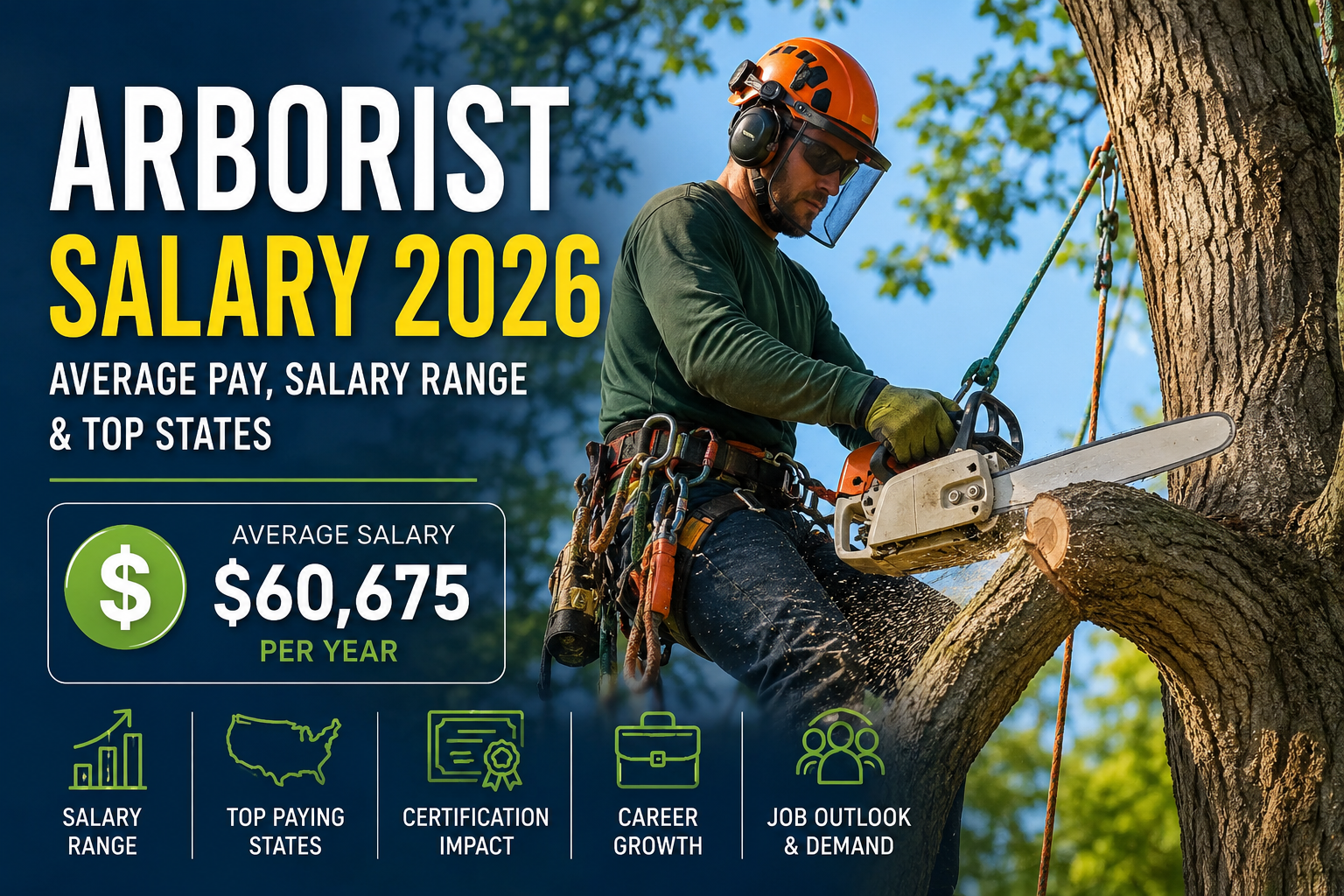
| Arborist Salary Metric | 2026 Estimate |
|---|---|
| Average salary | $60,675/year |
| Average hourly pay | $29.17/hour |
| Monthly equivalent | $5,056/month |
| Weekly equivalent | $1,166/week |
| 25th percentile | $46,500 |
| 75th percentile | $69,000 |
| 90th percentile | $88,000 |
| Reported range | $32,000–$104,000 |
The Salary Landscape: Why No Single Number Tells the Full Story
The most dangerous number in any salary guide is the average.
Current 2026 salary estimates put the average Arborist salary in the United States at approximately $60,675 per year, or $29.17 per hour. Reported salaries range from about $32,000 to $104,000, with the 25th percentile around $46,500, the 75th percentile around $69,000, and the 90th percentile around $88,000. Other salary datasets produce somewhat different figures because they use different methodologies, job samples and reporting populations.
None of these numbers are necessarily wrong. They simply measure different things.
Some sources aggregate active job postings, which tend to skew toward higher-paying, specialised roles that employers are actively trying to fill. Others rely on what actual workers report earning, which captures a broader cross-section including entry-level ground crew and smaller operations. Government labor data classifies arborist-related employment under Tree Trimmers and Pruners and reported a median annual wage of $50,430 in 2024.
SalaryInfo Insight: The real 2026 arborist salary in the US sits in a wide band. Entry-level ground work starts around $32,000. A competent climbing arborist with a few years of experience lands between $45,000 and $75,000. Experienced consulting arborists and successful business owners can potentially earn six figures or more. The average is misleading because the profession spans everything from brush draggers to expert witnesses in court.
What matters is not the average. What matters is where you fit on that spectrum and how you move up.
One of the Strongest Ways to Increase Earning Potential
One of the strongest ways to increase arborist earning potential is professional arborist certification.
Certification can improve an arborist’s earning potential by qualifying them for more specialized positions, supervisory responsibilities, consulting work and certain utility or municipal roles. However, the exact salary premium varies by employer, location, experience and job duties.
Why this matters: Certification signals more than knowledge. It signals commitment to professional standards, continuing education, and ethical practice. Employers pay for that signal because it reduces liability, improves client confidence, and often correlates with higher-quality work that generates repeat business.
The credential ladder matters too. The highest level of professional arborist certification reflects advanced knowledge and extensive experience. Utility arborist positions frequently list certification as a requirement or strong preference, and those roles often come with premium pay and benefits.
Key Takeaway: For many arborists, certification can be a worthwhile investment in long-term career growth and earning potential.
Where This Career Pays Most: State-by-State Reality Check
Arborist pay varies significantly by state and metro area. Local demand, cost of living, employer type, experience, certification and the type of tree-care work can all influence compensation.
| State | Market Context | Typical Salary Indicators |
|---|---|---|
| California | High cost of living; dense urban forests; strong municipal demand | Above national average |
| New York | NYC salaries significantly above state average; competitive market | Above national average |
| Texas | Lower cost of living; growing but less established market | Near or slightly below national average |
| Florida | Seasonal demand; hurricane response can spike earnings | Near or slightly below national average |
| Washington | Strong utility and municipal contracts; Seattle premium | Above national average |
| Virginia | Mixed market; DC commuter premium in northern Virginia | Varies substantially by metro area |
SalaryInfo Observation: The cost-of-living trap is real. A $60,000 salary in Texas goes further than $75,000 in San Francisco. When evaluating job offers, always adjust for housing costs, state income tax (or lack thereof in Texas and Florida), and local competition. The highest nominal salary is not always the highest real income.
The Career Ladder: From Ground Crew to Six Figures
Arborist pay follows a predictable progression. Understanding that progression is the first step to accelerating it.
Ground Crew and Laborer
$32,000 – $42,000 per year
This is where nearly everyone starts. Ground crew handles chipping, dragging brush, setting up rigging, and feeding the chipper. The work is physical, the hours can be long, and the pay sits at the bottom of the spectrum.
What changes: The transition from ground to climbing is the first major pay inflection point.
Climbing Arborist
$45,000 – $75,000 per year (estimated market range)
Climbing arborists do the work that commands premium prices: removals, technical rigging, crane work, and high-risk pruning. Current 2026 salary estimates for arborists overall put average pay at $60,675 per year, or $29.17 per hour. Climbing-arborist pay can vary depending on experience, technical skill, location and employer. Top climbers can exceed $35 per hour in competitive markets.
What changes: Climbing skill, speed, and safety record determine pay within this band.
Crew Leader and Foreman
$50,000 – $80,000 per year
The bump reflects added responsibility: managing a team, reading job sites for hazards, sequencing removals, and ensuring crew safety. Crew leaders are the field-level decision-makers. Employers pay for judgment, not just physical ability.
What changes: Leadership and communication skills become as important as climbing ability.
Certified Arborist
Potential for above-average earnings
Certification can qualify arborists for specialized, supervisory, consulting, plant-health-care and utility positions. Actual compensation varies by experience, location, employer and responsibilities.
What changes: The job shifts from cutting trees to managing tree health and client relationships.
Consulting Arborist
$70,000 – $110,000+ per year (estimated market range)
Consulting arborists do formal tree appraisals, court testimony, municipal risk assessments, and development project reviews. The work is less physical and more analytical. Pay varies widely based on reputation, specialisation, and geographic market.
What changes: Writing ability, analytical skills, and professional network determine earning potential.
Business Owner
Income varies dramatically
A solo operator with a consistently full schedule may generate substantially more personal income than an employee, while owners running multiple crews can potentially reach much higher income levels. However, owner earnings depend on revenue, labor costs, equipment, insurance, debt, overhead, taxes and profit margins, so business revenue should not be confused with personal salary.
SalaryInfo Insight: The gap between employee and owner is the largest in the entire profession. The skills that make a great climber do not automatically make a great business owner. Pricing, job costing, crew scheduling, and client acquisition are entirely different competencies. Some of the highest earning potential in arboriculture comes from building and managing a successful tree-care business rather than remaining solely in field work.
What Employers Actually Pay: Private vs. Public vs. Utility
Not all employers pay the same. The type of employer shapes base pay, benefits, and earning trajectory.
Private Tree Service Companies
Private tree-care companies can offer hourly wages, salaries, overtime, commission, benefits and production incentives. Compensation varies significantly by market, experience and specialization. Sales arborists with commission structures frequently exceed six figures, while production climbers earn competitive hourly rates with overtime during busy seasons.
Trade-offs: Private companies offer faster advancement and commission potential but often demand longer hours and more aggressive sales targets.
Municipal and Government Employers
Cities, counties, and public utilities offer stability and benefits. Government roles offer pensions, predictable schedules, and job security. Base pay can be competitive, but advancement is slower and tied to civil service timelines.
Trade-offs: Government roles offer stability and benefits but slower advancement.
Utility Line Clearance
Utility arborists working for power companies or contractors earn premium wages due to high-voltage hazards, strict safety protocols, and emergency storm response. The work is repetitive and safety-critical, but the pay and benefits are consistently above average.
Trade-offs: Utility work is less varied than residential tree care and often requires travel, but compensation is strong.
Expert Tip: The highest-paying employer is not always the best career move. Early-career arborists should prioritise employers who invest in training, certification, and climbing development over those offering the highest starting wage. The skills you build in the first five years determine your earning ceiling for the next twenty.
The Future of Arborist Pay: Demand and What’s Coming
Arborist employment is projected to grow steadily through 2034. Government labor data classifies arborist-related employment under Tree Trimmers and Pruners. The occupation had about 60,100 jobs in 2024 and is projected to reach 62,100 by 2034, an increase of about 3%. About 7,400 openings per year are projected across the occupation. The 2024 median annual wage was $50,430.
What is driving demand:
- Urban canopy programs in major cities
- Climate resilience and storm preparation projects
- Aging urban tree populations requiring management
- Increasing awareness of tree health and property value
What is not driving demand: AI. Arborist work is difficult to automate because it combines physical climbing, equipment operation, tree assessment, hazard recognition, rigging decisions and changing outdoor conditions. Technology may assist with planning, documentation and diagnostics, but the core field work remains highly hands-on.
SalaryInfo Verdict: Demand for qualified tree-care workers can remain strong as employers replace workers who leave the occupation and as communities continue to invest in tree maintenance, urban forestry and storm-related work. Skilled arborists with strong technical abilities and relevant credentials may have better opportunities in competitive markets.
Salary Negotiation: How to Get Paid What You’re Worth
Arborists can sometimes leave money on the table by not negotiating. Here is what works.
1. Get certified before you negotiate.
Certification qualifies you for more specialized positions and higher-paying roles. Many companies will pay for the exam and study materials as a retention investment.
2. Track your production value.
Arborists who track their hours, job completion times, and revenue generated have concrete data for negotiations. If you are consistently completing jobs faster than estimated or generating repeat business from satisfied clients, document it.
3. Know your market rate.
Use the data in this guide. If the average arborist in your state earns $29 per hour and you are earning $24, you have a case. Bring job postings, salary data, and competitor offers to the conversation.
4. Negotiate more than base pay.
If the base salary is fixed, negotiate commission, overtime guarantees, gear allowances, certification reimbursement, or performance bonuses. Production-based pay rewards efficiency and can significantly outpace hourly wages.
5. Be willing to walk.
The strongest negotiation position is a competing offer. If you are genuinely underpaid and your employer will not adjust, the market will pay you what you are worth elsewhere.
Career Strategy: The best time to negotiate is not during annual reviews. It is after a major storm event when you have worked sixty-hour weeks, after you complete a difficult removal safely, or when you bring in a new certification. Strike when your value is most visible.
Frequently Asked Questions
Is being an arborist a hard job?
Yes, physically and mentally. Climbing arborists work at height in variable weather, handle heavy equipment, and make complex rigging decisions under pressure. The job carries real injury risk. But for those who enjoy physical work, problem-solving, and working outdoors, it is deeply satisfying.
What type of arborist makes the most money?
Business owners and specialized consulting roles can have some of the highest earning potential in arboriculture, although actual income varies significantly by business scale, market, specialization and compensation structure. Among employees, sales arborists with commission structures frequently exceed six figures.
How much do arborists make in Virginia?
Virginia arborist salaries vary substantially by metro area, experience, certification and employer type. Northern Virginia can offer higher wages than some other parts of the state because of its higher cost of living and proximity to the Washington, D.C. labor market.
Are arborists in demand?
Yes. Government labor data projects about 3% growth through 2034, with about 7,400 annual openings across the occupation. Urban forestry programs, climate resilience projects, and aging tree populations sustain demand.
How much does a certified arborist make?
Certified arborist pay varies widely by experience, location, employer and responsibilities. Certification can open access to specialized and higher-responsibility positions, including consulting, utility and supervisory roles.
What is the salary for a climbing arborist?
Current 2026 salary estimates for arborists overall put average pay at $60,675 annually or $29.17 per hour. Climbing-arborist pay can vary depending on experience, technical skill, location and employer, with estimated market ranges of $45,000 to $75,000.
How much does a master arborist make?
The highest level of professional arborist certification reflects advanced knowledge and extensive experience. This credential typically leads to premium compensation, especially in consulting, expert witness work, and senior advisory positions.
What is the starting salary for an arborist?
Entry-level ground crew starts around $32,000–$42,000 annually. Entry-level climbing positions start at competitive hourly rates that increase with experience and skill development.
Do arborists get bonuses?
Yes. Performance bonuses, production-based pay, and commissions are common, especially in sales roles and private tree service companies. Profit-sharing and gear allowances also appear in competitive markets.
Related Careers
If you are exploring arborist careers, you may also want to consider these skilled trades and professional roles:
- Electrician Salary – Skilled trade with strong earning potential
- Master Plumber Salary – Advanced trade certification and income
- Boilermaker Salary – Physically demanding skilled trade
- Underwater Welder Salary – Specialized high-risk trade with premium pay
- Civil Engineering Salary – Professional career comparison