
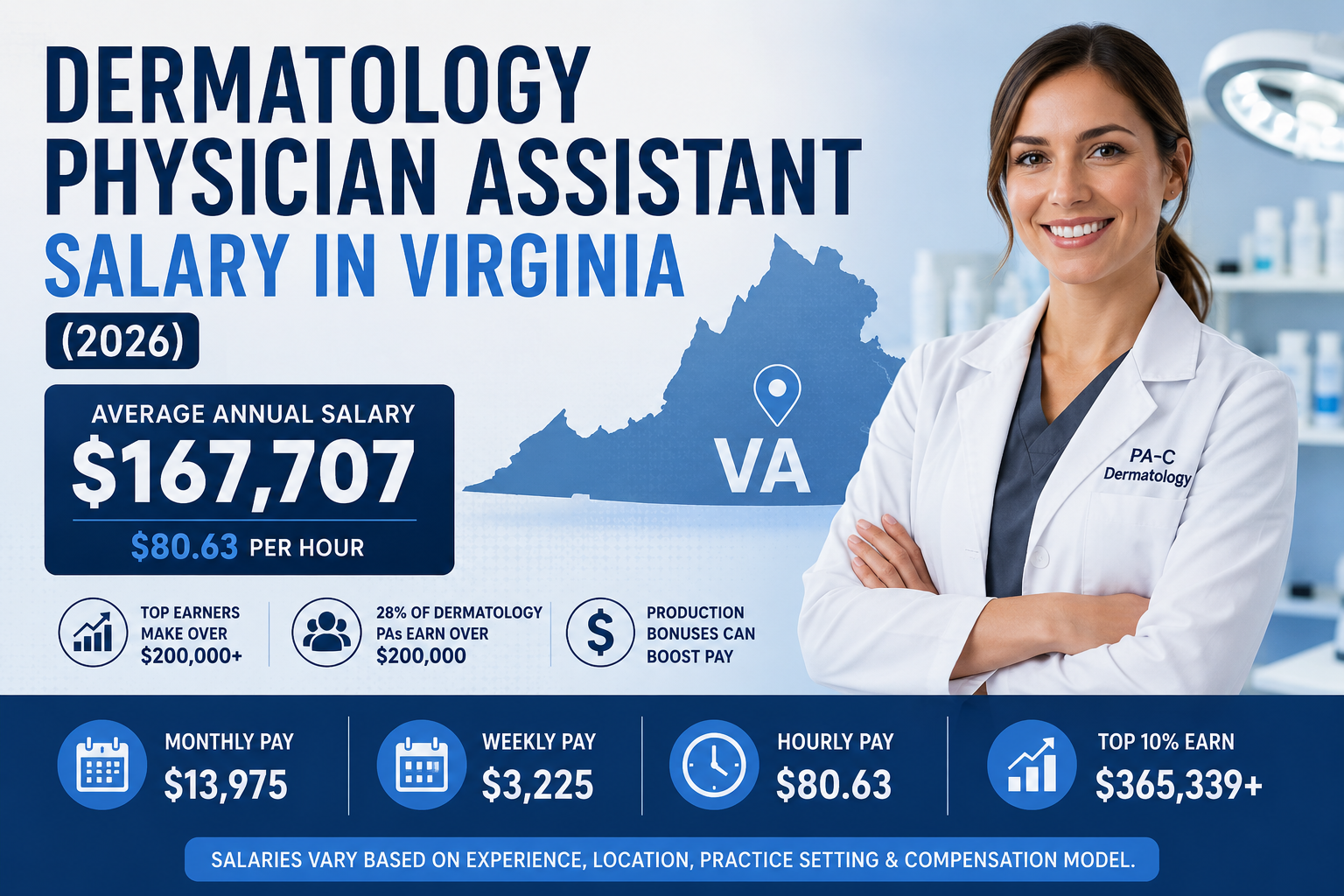
Dermatology PA Salary
The average annual salary for a Dermatology Physician Assistant in Virginia is $167,707, or roughly $80.63 per hour, slightly below the national average of $169,157. But this headline number masks a profession where total compensation can swing wildly—from $99,100 at the low end to over $365,000 for top earners.
💡 Here is the part many salary averages don’t capture: the way you are paid can matter more than the headline average.
How Dermatology PAs Actually Get Paid in Virginia
The Median Isn’t the Whole Story
Virginia’s Dermatology PA market shows significant wage dispersion. The 25th percentile sits at $99,100 annually, while the 75th percentile reaches $173,000. That $73,900 gap represents more than just variation—it reflects different employers, practice models, and negotiation outcomes.
| Percentile | Annual Salary | Hourly Equivalent |
|---|---|---|
| 25th | $99,100 | $47.64 |
| 50th (Median) | ~$127,800 | $61.44 |
| 75th | $173,000 | $83.17 |
| 90th | $365,339 | $175.64 |
The gap between the median and the 90th percentile is $237,539 annually. That is not a salary range—that is a different career entirely.
What Virginia Employers Are Actually Offering
The numbers from employer postings confirm this wide band:
- University of Virginia (Charlottesville): $116,123 – $171,163, based on qualifications and experience.
- Dermatology Associates of Virginia (Mechanicsville): $120,000 – $220,000, with base salary plus monthly production bonuses.
- Fairfax Area Opportunity: $120,000 – $160,000 estimated, with production-based upside.
Notice the pattern: the employers with production incentives offer the highest ceilings. The University of Virginia, a public institution, caps out around $171,000—the same point where private practices’ base salaries begin.
The Productivity Factor: Why Production Models Outperform Fixed Salaries
A 2025 survey of Dermatology PAs conducted by the Pennsylvania Dermatology Physician Assistants association found that 28% of respondents earned over $200,000 annually. The median total W-2 income was $167,000, with a mean of $180,599.
The key insight? Compensation structure drives outcomes.
- 54.5% received base salary plus production bonuses.
- 36.8% were production-only (percentage of collections).
- Median base salary: $120,000.
- Most bonuses: $10,000 – $60,000.
But the real story comes from a peer-reviewed study published in the Journal of Dermatology for Physician Assistants (Fall 2025). The research analyzed compensation across multiple states and found dramatic differences by pay model:
| Compensation Model | Mean Compensation |
|---|---|
| Fixed percentage of collections (no base salary) | $249,323 |
| Hourly pay | Significantly less |
| Fixed base salary only | $134,258 |
| Base salary + bonuses | Lower than production-only models |
PAs paid purely on production—especially with tiered or variable percentage rates—earned nearly double those on fixed salaries. The difference was statistically significant (p < 0.001).
SalaryInfo Career Strategy: If you are negotiating a role in Virginia, prioritize a compensation structure that includes a percentage of collections. A $120,000 base with a production-based collections bonus can potentially produce higher total compensation than a $150,000 fixed salary, depending on collections and the contract structure.
Location Matters Within Virginia
Among the Virginia locations highlighted in this analysis, Arlington has the highest reported average salary:
| City | Annual Salary | Hourly Wage | Premium Over State Average |
|---|---|---|---|
| Arlington | $193,273 | $92.92 | +15.2% |
| Reston | $175,984 | $84.61 | +4.9% |
| Ashburn | $172,981 | $83.16 | +3.1% |
| Fairfax | $172,907 | $83.13 | +3.1% |
| Oakton | $171,483 | $82.44 | +2.3% |
| Richmond | $167,783 | $80.66 | ≈ Average |
| Charlottesville | $167,814 | $80.68 | ≈ Average |
Arlington stands out with a $25,566 premium over the state average. This reflects proximity to Washington, D.C., higher cost of living, and competition from federal and private healthcare employers.
What Employers Actually Value
Autonomy Correlates with Higher Pay
The peer-reviewed study found that higher compensation was significantly correlated with autonomy in practice (p = 0.0076). PAs who have more independence in clinical decision-making earn more. This suggests that employers willing to trust their PAs also pay them more.
Experience Does NOT Predict Productivity
The same study found that years of experience did not predict productivity (p = 0.855). Seniority alone doesn’t drive earnings—productivity does. A new PA who generates high collections can out-earn a decade-long veteran.
Practice Setting Affects Productivity
- Academic settings: Fewer patients seen per hour (lower productivity).
- Corporate settings: More patients seen per hour.
- Private practice: Intermediate productivity.
This explains the pay gap between academic institutions (UVA) and private practices (Dermatology Associates of Virginia).
Is Virginia a Good State for Dermatology PAs?
Salary rankings alone do not tell the entire story. Compensation for dermatology PAs depends heavily on cost of living, production incentives, geographic demand, patient volume, and practice setting.
- Cost of living: A $167,000 salary in Virginia goes further than $180,000 in San Francisco.
- Production incentives: Virginia has a strong private-practice presence that offers production bonuses unavailable in salary-capped states.
- Geographic demand: Proximity to D.C. creates a competitive market for skilled PAs.
- Patient volume: Practice density in Northern Virginia allows for higher patient loads and, consequently, higher collections.
SalaryInfo Verdict: Virginia can be an attractive market for dermatology PAs, particularly for professionals who prefer production-based compensation. The state’s healthcare infrastructure and mix of academic and private employers provide options that raw salary rankings do not capture.
Career Stage and Earning Progression
The following ranges reflect compensation discussed throughout this analysis and are not official state salary statistics. Actual earnings depend on practice setting, compensation structure, and individual productivity.
| Career Stage | Typical Compensation |
|---|---|
| Entry-level | $100,000 – $120,000 base |
| Early career | $110,000 – $150,000+ |
| Mid-career | $120,000 – $160,000+ base |
| Production-focused | $160,000 – $220,000+ total |
| High-producing PA | $200,000 – $300,000+ |
The National Context
Virginia ($167,707) sits slightly below the national average of $169,157. The national salary distribution looks similar:
| Percentile | National Annual Salary |
|---|---|
| 25th | $100,000 |
| 50th (Median) | ~$128,900 |
| 75th | $174,500 |
| 90th | $368,500 |
For broader context on U.S. compensation trends, see our guide to the average salary in the U.S..
Why Dermatology PA Salary Estimates Vary
Different salary datasets can produce substantially different estimates because they use different methodologies, sample sizes, and compensation definitions. Here is why the numbers seem to conflict:
- Employer postings vs. reported salaries: Postings show offered ranges, while surveys show actual total compensation.
- Base salary vs. total compensation: Some datasets capture only base pay; others include bonuses, production incentives, and benefits.
- Survey sample size and geography: A national survey may include few respondents from Virginia, skewing the state-specific estimate.
- Job-title definitions: Some surveys include all PAs with dermatology skills; others focus strictly on full-time dermatology specialists.
This explains why you might see figures as low as $110,000 (from generalist surveys) and as high as $400,000 (from production-heavy specialist surveys) for the same profession.
How This Compares to Other Healthcare Professions
If you are evaluating career paths in healthcare, here is how Dermatology PA compensation compares to other advanced-practice and clinical roles:
- Nurse Practitioner Salary: NPs earn a national average of approximately $126,000, with similar state variations.
- CRNA Salary: Certified Registered Nurse Anesthetists are among the highest-paid advanced-practice nurses, with averages exceeding $200,000.
- Registered Nurse Salary: RNs earn approximately $86,000 nationally, making the PA pathway a significant step up in earning potential.
- Medical Assistant Salary: Medical assistants earn around $40,000, highlighting the substantial pay progression in the dermatology career ladder.
- Radiology Tech Salary: Radiology technicians earn a median of roughly $73,000, another point of comparison within the medical imaging and support ecosystem.
- Psychologist Salary: Clinical psychologists earn approximately $92,000, offering a cross-disciplinary comparison in the healthcare and mental health sectors.
Strategic Takeaways
1. Negotiate compensation structure, not just base salary. A lower base salary with meaningful production incentives can sometimes produce higher total compensation than a higher fixed salary, depending on collections and the contract structure.
2. Understand collections. PAs who know their annual collections can negotiate better percentage splits. The study found that over one-quarter of respondents did not know their total collections—a costly oversight.
3. Target production-heavy practices. Private practice and corporate settings often offer higher productivity potential than academic medicine.
4. Consider Arlington or the D.C. corridor. The highest-paying Virginia cities cluster around the national capital.
5. Build autonomy. The correlation between autonomy and compensation suggests that gaining clinical independence directly increases earning potential.
Methodology & Data Sources
SalaryInfo compares government data, employer pay disclosures, industry compensation reports, and job market trends to produce balanced salary analysis. No single survey represents the entire market.
For this article, the primary state-level figures are derived from a national compensation dataset that includes employer postings and reported wages for Virginia. The production-based compensation analysis is sourced from the Journal of Dermatology for Physician Assistants (Fall 2025) and the Pennsylvania Dermatology Physician Assistants 2025 survey.
Salary estimates can vary because:
- Different datasets use different sample sizes.
- Some estimates include bonuses; others do not.
- Employer postings reflect offered ranges, while employee surveys reflect actual earned income.
Featured Snippet Answers
What is the average Dermatology PA salary in Virginia?
The average annual salary for a Dermatology Physician Assistant in Virginia is $167,707, or approximately $80.63 per hour. Salaries range from $99,100 at the 25th percentile to over $365,000 for top earners.
Can a dermatology PA make $200,000 in Virginia?
Yes. A 2025 survey reported that 28% of dermatology PA respondents earned over $200,000 annually. Top performers in Virginia can reach this threshold through production-based compensation models and high patient volume.
What is the highest paying city for Dermatology PAs in Virginia?
Among the Virginia locations highlighted in this analysis, Arlington has the highest reported average salary at $193,273 per year, 15.2% above the state average. Reston and Ashburn also offer above-average compensation.
How does Virginia’s Dermatology PA salary compare to the national average?
Virginia’s average of $167,707 is slightly below the national average of $169,157. The difference is minimal and often offset by cost of living considerations and the prevalence of production bonuses in the state.
What compensation model pays Dermatology PAs the most?
Production-only models with tiered or variable percentage collections yield the highest compensation, averaging $249,323. This significantly out-earns fixed base salary models which average $134,258, based on peer-reviewed survey data.
Frequently Asked Questions
What is the highest-paid PA specialty?
Dermatology is consistently among the highest-paid PA specialties. The PDPA survey found median total income of $167,000, with top earners exceeding $500,000 in some cases. Other high-paying specialties include cardiovascular/cardiothoracic surgery and emergency medicine.
Is it hard to become a dermatology PA?
Becoming a Dermatology PA requires completing an accredited PA program, passing the PANCE exam, and obtaining state licensure. Securing a dermatology position is competitive due to the specialty’s desirable work-life balance and compensation. Additional training or a dermatology-specific fellowship can improve candidacy.
What benefits do dermatology PAs typically receive?
Benefits vary widely. The PDPA survey found average PTO of approximately 14 days, though over 20% reported receiving no paid time off. Over one-quarter reported no CME allowance. Benefits are often more generous in academic and hospital settings than in private practice.
How does experience affect dermatology PA salary?
While experience may help secure higher base salaries, the peer-reviewed study found that years of experience did not predict productivity, which is the primary driver of compensation in production-based models. A high-performing new graduate can out-earn a less productive senior PA.
Can a dermatology PA make $300,000?
Yes. The PDPA survey documented total income up to $514,000, and 28% of respondents earned over $200,000. Reaching $300,000 requires a production-heavy compensation structure and high patient volume.
What skills increase a dermatology PA’s earning potential?
Autonomy in clinical decision-making, procedural skills (biopsies, excisions, cosmetic procedures), productivity, collections awareness, and the ability to negotiate compensation structure all correlate with higher earnings.
Which states pay dermatology PAs the most?
Compensation varies considerably by state, practice setting and compensation model. Virginia’s average salary is slightly below the national average in the dataset used for this article, but production-based opportunities can create substantially higher total compensation.
Pingback:PA Salary In India 2026: Physician Assistant Salary Guide