
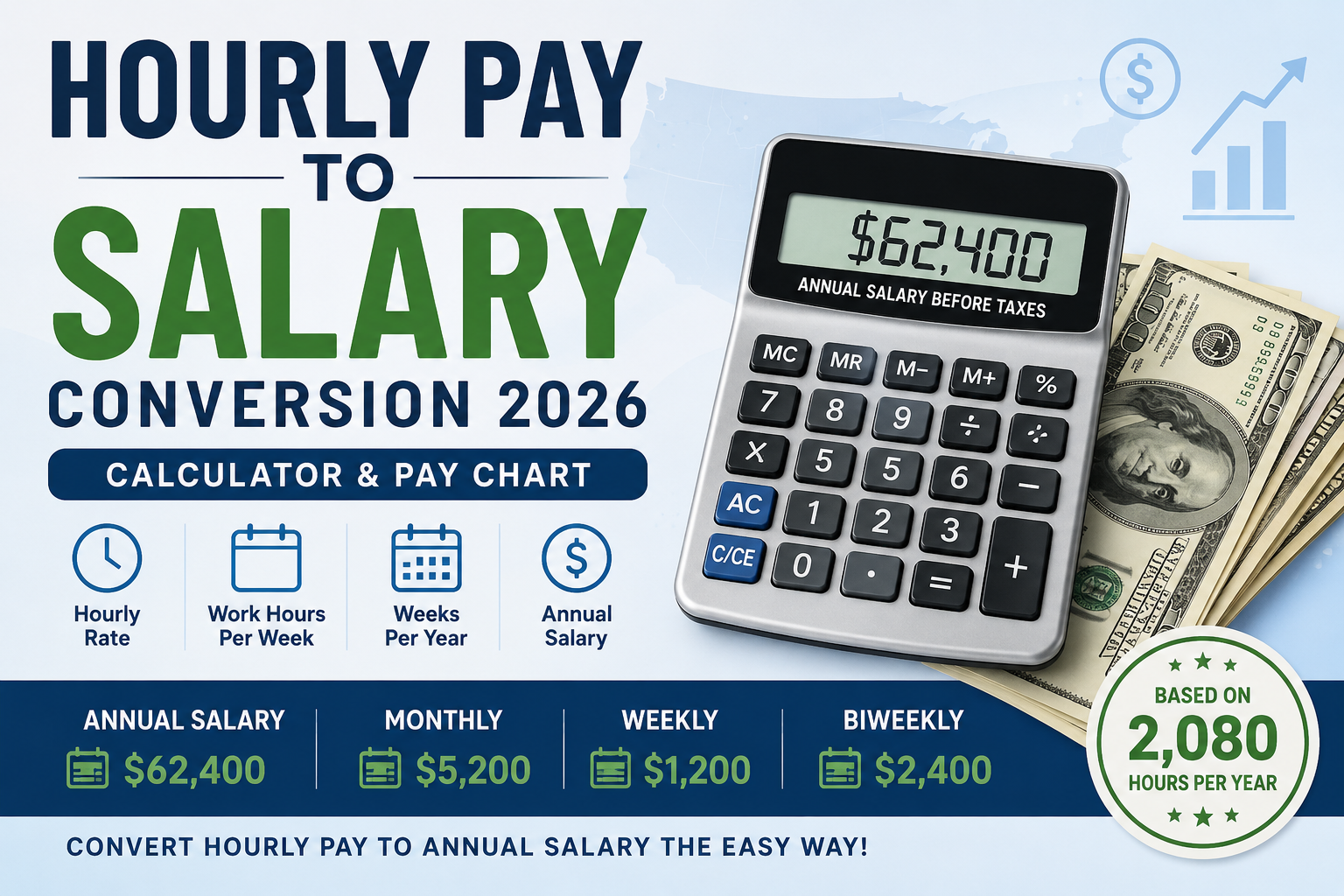
Convert any hourly wage to annual salary in 2026. See $15–$100/hr salary equivalents, the 2,080-hour formula, overtime, taxes, and take-home pay.
Salary Calculator
Convert Hourly Pay to Salary
Quick Answer: How to Convert Hourly Pay to Salary
To convert an hourly wage to an annual salary, multiply your hourly rate by 2,080—the standard number of work hours in a year for a full-time U.S. employee (40 hours × 52 weeks).
| Hourly Rate | Annual Salary (Gross) | Monthly (Gross) | Biweekly (Gross) |
|---|---|---|---|
| $15.00 | $31,200 | $2,600 | $1,200 |
| $18.00 | $37,440 | $3,120 | $1,440 |
| $20.00 | $41,600 | $3,467 | $1,600 |
| $22.00 | $45,760 | $3,813 | $1,760 |
| $25.00 | $52,000 | $4,333 | $2,000 |
| $28.00 | $58,240 | $4,853 | $2,240 |
| $30.00 | $62,400 | $5,200 | $2,400 |
| $32.00 | $66,560 | $5,547 | $2,560 |
| $33.00 | $68,640 | $5,720 | $2,640 |
| $35.00 | $72,800 | $6,067 | $2,800 |
| $40.00 | $83,200 | $6,933 | $3,200 |
| $45.00 | $93,600 | $7,800 | $3,600 |
| $50.00 | $104,000 | $8,667 | $4,000 |
| $60.00 | $124,800 | $10,400 | $4,800 |
| $75.00 | $156,000 | $13,000 | $6,000 |
| $100.00 | $208,000 | $17,333 | $8,000 |
All figures are gross pay before federal, state, and FICA taxes.
Double your hourly rate and add three zeros. $25/hour → 25 × 2 = 50 → $50,000 (close to the actual $52,000).
Divide annual salary by 2,080. A $70,000 salary equals $33.65 per hour. A $100,000 salary equals $48.08 per hour.
Common Hourly-to-Salary Conversions for 2026
$20 an hour is how much a year?
$20 per hour equals $41,600 per year before taxes, based on a 40-hour work week and 52 weeks per year. Monthly gross pay is approximately $3,467. Weekly gross pay is $800. Biweekly gross pay is $1,600. After typical federal taxes for a single filer using the 2026 standard deduction, estimated federal-only take-home is approximately $34,000–$35,000 annually.
$25 an hour is how much a year?
$25 per hour equals $52,000 per year before taxes. Monthly gross pay is approximately $4,333. Weekly gross pay is $1,000. Biweekly gross pay is $2,000. After federal taxes, Social Security (6.2% up to $184,500), and Medicare (1.45%), estimated federal-only take-home is approximately $44,200 for a single filer before state taxes.
$30 an hour is how much a year?
$30 per hour equals $62,400 per year before taxes. Monthly gross pay is approximately $5,200. Weekly gross pay is $1,200. Biweekly gross pay is $2,400. After federal taxes, Social Security, and Medicare, estimated federal-only take-home for a single filer using the standard deduction is approximately $52,300 before state taxes.
$35 an hour is how much a year?
$35 per hour equals $72,800 per year before taxes. Monthly gross pay is approximately $6,067. Weekly gross pay is $1,400. Biweekly gross pay is $2,800. After federal taxes, Social Security, and Medicare, estimated federal-only take-home is approximately $60,400 for a single filer before state taxes.
$40 an hour is how much a year?
$40 per hour equals $83,200 per year before taxes. Monthly gross pay is approximately $6,933. Weekly gross pay is $1,600. Biweekly gross pay is $3,200. After federal taxes, Social Security, and Medicare, estimated federal-only take-home is approximately $68,300 for a single filer before state taxes.
$50 an hour is how much a year?
$50 per hour equals $104,000 per year before taxes. Monthly gross pay is approximately $8,667. Weekly gross pay is $2,000. Biweekly gross pay is $4,000. After federal taxes, Social Security, and Medicare, estimated federal-only take-home is approximately $84,000 for a single filer before state taxes.
How Many Hours Are in a Work Year?
The standard calculation uses 2,080 hours (40 hours × 52 weeks). But actual hours worked are typically lower.
Why actual hours matter:
- Paid time off (PTO): 10–20 days per year
- Federal holidays: 6–11 days per year
- Sick leave: 5–10 days per year
A worker with 15 days PTO and 10 federal holidays actually works about 1,960 hours per year.
Example:
- Annual salary: $60,000
- Divide by 2,080 (standard) = $28.85/hour
- Divide by 1,960 (actual hours worked) = $30.61/hour
When comparing a salaried offer against an hourly job, use actual working hours—not the 2,080 shortcut. Salaried roles with generous PTO often pay more per actual hour worked than the headline number suggests.
What Changes the 2,080-Hour Calculation?
Part-Time Work
For part-time employees, multiply hourly rate by actual weekly hours and then by 52.
Example: $25/hour × 30 hours/week × 52 weeks = $39,000/year
37.5-Hour Workweek
Some professional roles use a 37.5-hour workweek. This equals 1,950 hours per year (37.5 × 52).
Example: $30/hour × 1,950 = $58,500/year—$3,900 less than the standard 40-hour calculation.
Unpaid Time Off
Unpaid leave reduces annual earnings. Subtract unpaid hours from total hours.
Example: $30/hour × 2,080 hours = $62,400. Two weeks unpaid = 80 hours × $30 = $2,400 less. Actual annual: $60,000.
Overtime Calculation
Overtime is typically paid at 1.5× the regular hourly rate for hours worked beyond 40 in a workweek under the Fair Labor Standards Act (FLSA).
Example: $25/hour regular rate. 45-hour workweek:
- Regular pay: 40 × $25 = $1,000
- Overtime: 5 × $37.50 = $187.50
- Weekly total: $1,187.50
- Annual (52 weeks): $61,750
Salary-to-Hourly Conversion
To convert annual salary to hourly rate, divide salary by 2,080.
| Annual Salary | Hourly Rate (40-hour week) |
|---|---|
| $30,000 | $14.42 |
| $35,000 | $16.83 |
| $40,000 | $19.23 |
| $45,000 | $21.63 |
| $50,000 | $24.04 |
| $55,000 | $26.44 |
| $60,000 | $28.85 |
| $65,000 | $31.25 |
| $70,000 | $33.65 |
| $75,000 | $36.06 |
| $80,000 | $38.46 |
| $85,000 | $40.87 |
| $90,000 | $43.27 |
| $95,000 | $45.67 |
| $100,000 | $48.08 |
| $150,000 | $72.12 |
| $200,000 | $96.15 |
After-Tax Salary Estimates for 2026
Your gross salary isn’t your take-home pay. Federal income tax, Social Security, Medicare, and state taxes all reduce your paycheck.
2026 Federal Tax Basics
Illustrative 2026 federal tax estimate — single filer, standard deduction, before state/local taxes and other payroll deductions.
| Gross Annual Salary | Approx. Federal Income Tax | Social Security (6.2%) | Medicare (1.45%) | Estimated Federal-Only Take-Home |
|---|---|---|---|---|
| $31,200 | $1,500 | $1,934 | $452 | $27,300 |
| $41,600 | $2,600 | $2,579 | $603 | $35,800 |
| $52,000 | $3,800 | $3,224 | $754 | $44,200 |
| $62,400 | $5,300 | $3,869 | $905 | $52,300 |
| $72,800 | $6,800 | $4,514 | $1,056 | $60,400 |
| $83,200 | $8,500 | $5,158 | $1,206 | $68,300 |
| $104,000 | $12,000 | $6,448 | $1,508 | $84,000 |
Estimates based on 2026 federal tax brackets, standard deduction of $16,100 for single filers, and Social Security wage base of $184,500. Actual take-home varies by filing status, deductions, state taxes, and other factors.
State Tax Differences
Nine states have no income tax: Texas, Florida, Washington, Nevada, Alaska, South Dakota, Wyoming, Tennessee, and New Hampshire.
California’s top marginal rate reaches 13.3%. A $100,000 salary in Texas takes home significantly more than the same salary in California. State tax can shift net pay by $200–$1,000 per month on a six-figure income.
SalaryInfo Market View: Location is a compensation decision, not just a lifestyle one. A $35/hour job in Dallas may out-earn a $40/hour job in San Francisco after taxes and cost of living.
Hourly vs Salaried Jobs
Salary Advantages
- Predictable income: Same paycheck every period
- Benefits access: Health insurance, retirement plans, PTO
- Career advancement: Salaried roles often lead to promotions faster
Salary Disadvantages
- Unpaid overtime: Salaried exempt employees don’t receive overtime pay
- Effective rate erosion: A $75,000 salary with 55-hour weeks = $26.30/hour
- Work-life balance challenges
Hourly Advantages
- Overtime pay: 1.5× after 40 hours under FLSA
- Paid for actual time worked
- Flexibility: Hours adjust with workload
Hourly Disadvantages
- Income volatility: Hours can be cut
- Fewer benefits for part-time workers
- Less predictable career trajectory
The FLSA Exemption Threshold
The federal overtime exemption threshold remains $684 per week ($35,568 per year) in 2026. However, being paid above this threshold does not automatically make an employee exempt. Exempt status also requires meeting specific duties tests (executive, administrative, professional, outside sales, or computer employee) and salary basis requirements.
Several states have set higher thresholds. Always verify your classification with the Department of Labor’s Wage and Hour Division or an employment attorney if uncertain.
Converting a high-overtime hourly worker to a salaried exempt position can be a significant pay cut. An hourly worker earning $25/hour who regularly logs 48 hours per week makes $57,200 annually including overtime. Converting them to a $52,000 salary—above the federal salary threshold—may reduce earnings by $5,200 while eliminating overtime protection if they meet the duties test.
Salary isn’t always better. Hourly isn’t always worse. The right structure depends on expected hours, benefits access, income stability needs, and career goals—not the pay structure itself.
How Benefits Change the Comparison
Employer-provided benefits represent a significant portion of total compensation. According to the Bureau of Labor Statistics, for private-industry workers, benefits represented 30.1% of total employer compensation costs as of March 2026, with benefits averaging $14.01 per hour worked. Wages and salaries averaged $32.60 per hour.
Common benefits and their approximate annual value:
| Benefit | Typical Annual Value |
|---|---|
| Health insurance (employer contribution) | $7,000–$15,000 |
| 401(k) match (3–6% of salary) | $1,500–$6,000 |
| Paid time off (2–4 weeks) | $3,000–$8,000 |
| Dental/vision insurance | $500–$1,500 |
| Life/disability insurance | $200–$800 |
| Total benefits value | $12,000–$31,000 |
Always calculate total compensation (salary + benefits) when comparing offers. A $62,000 salary with excellent benefits often out-earns a $72,000 hourly position with minimal benefits.
Real-World Job Offer Examples
Example 1: The Promotion Trap
A warehouse supervisor earns $28/hour with regular overtime (45 hours/week). Annual earnings: $28 × 40 × 52 = $58,240 + overtime ($28 × 1.5 × 5 × 52 = $10,920) = $69,160.
A promotion to salaried manager offers $68,000. No overtime. The “promotion” is a $1,160 pay cut for more responsibility.
Example 2: The Benefits Trade-Off
A retail store manager earns $62,000 salary with health insurance, 401(k) match, and three weeks PTO. A competing hourly offer pays $32/hour—$66,560 annually before taxes.
The salary offer pays less on paper. But benefits worth $10,000–$15,000 annually close the gap. The hourly job may offer fewer or no benefits.
Example 3: The Cost-of-Living Calculation
A tech support specialist earns $35/hour in Austin, Texas ($72,800/year). A similar role in San Francisco pays $45/hour ($93,600/year)—a $20,800 difference.
After Texas’s 0% state income tax versus California’s ~9.3%, the gap narrows to ~$13,000. After housing costs (Austin median rent ~$1,800 vs San Francisco ~$3,400), the Austin role comes out ahead by over $6,000 annually.
Never compare salary offers in isolation. Calculate total compensation (salary + benefits + bonuses) and adjust for cost of living and taxes.
2026 U.S. Wage Trends
The average American private-sector worker earned $37.64 per hour in June 2026, according to the Bureau of Labor Statistics. That’s up 3.5% from $36.36 a year earlier. Average weekly earnings reached $1,290.
For private-industry workers, wages and salaries averaged $32.60 per hour, with benefits averaging $14.01 per hour worked in March 2026. Benefits represented 30.1% of total employer compensation costs.
For broader context, see our guide to the average salary in the U.S. in 2026.
Real wages have faced pressure from inflation in recent years. This context matters when converting hourly wages—the number on paper isn’t the number in your wallet.
Salaried workers may receive substantial benefits, but a higher nominal salary does not necessarily mean a higher effective hourly rate when working hours increase.
Real-World Hourly Wage Examples
Walmart Hourly Pay
Walmart employs hundreds of thousands of hourly workers across the U.S. Pay varies considerably by role and location. For detailed compensation breakdowns and comparisons, see our guide to Walmart hourly pay.
Costco Hourly Pay
Costco is known for offering above-market hourly wages. Pay varies by position and location, with experienced workers and supervisors earning significantly more than starting rates. See our detailed breakdown of Costco hourly pay.
Electrician Hourly Pay
Skilled trades demonstrate how hourly compensation translates into annual earnings. Electricians in the U.S. typically earn $28–$45/hour, with overtime opportunities significantly increasing annual income. For a complete breakdown, see our electrician salary in the U.S. guide.
Registered Nurse Hourly Pay
Registered nurses are commonly paid on an hourly or salaried basis, depending on the employer, setting, and role. RNs typically earn $35–$55/hour depending on specialty and location, with overtime and shift differentials boosting earnings. See our registered nurse salary in the U.S. for comprehensive compensation data.
Professional Salary Examples
For salaried professional roles, conversion to hourly rates helps contextualize compensation. A Business Intelligence Analyst earning $95,000/year works out to approximately $45.67/hour. A Management Consultant earning $150,000/year has an effective hourly rate of approximately $72.12/hour.
Common Salary Conversion Myths
Myth 1: “Salaried employees earn more than hourly workers.”
Salaried workers earn higher median incomes but often work significantly more hours. A $75,000 salary requiring 55 hours per week yields an effective hourly rate of $26.30—lower than a $28/hour machine operator working strictly 40 hours.
Myth 2: “Hourly workers don’t get benefits.”
Full-time hourly workers at companies with 50+ employees are covered under the ACA employer mandate, which generally requires applicable large employers to offer affordable, minimum-value coverage to full-time employees and their dependents or potentially make an employer payment. Benefits represent 30.1% of total compensation for private-industry workers.
Myth 3: “Salary and hourly workers pay different tax rates.”
The IRS makes no distinction. Both file the same forms, pay the same federal brackets, and face the same FICA tax rates: 6.2% Social Security (up to $184,500 in 2026) and 1.45% Medicare.
Myth 4: “Converting to salary is always a promotion.”
As shown above, converting a high-overtime hourly worker to a salaried exempt position can reduce annual earnings by thousands of dollars while eliminating overtime protection.
Career Risks: What Can Go Wrong
Overtime misclassification. Employers sometimes misclassify workers as exempt to avoid overtime pay. The FLSA requires all three criteria (salary basis, salary level, and duties test) to be met for exempt status.
Income instability. Hourly workers face variable hours. A 10% reduction in hours equals a 10% reduction in pay.
Benefits gaps. Part-time hourly workers often lack access to employer-sponsored benefits.
Salary stagnation. Salaried workers without overtime protection can see their effective hourly rate decline as hours increase.
Always verify your FLSA classification. If you’re salaried but performing non-exempt duties, you may be entitled to overtime pay. Consult the DOL’s Wage and Hour Division or an employment attorney if uncertain.
Frequently Asked Questions
How do I convert hourly to salary?
Multiply your hourly rate by the number of hours worked per week (typically 40) and then by 52 weeks. The standard formula is hourly rate × 2,080 = annual salary. For example, $25/hour × 2,080 = $52,000/year.
What is $33 an hour converted to salary?
$33/hour × 2,080 hours = $68,640 per year before taxes. Monthly gross pay is approximately $5,720. Biweekly gross pay is approximately $2,640.
What is a 37.5-hour work week salary?
A 37.5-hour work week equals 1,950 hours per year (37.5 × 52). Multiply your hourly rate by 1,950. At $30/hour, that’s $58,500/year—$3,900 less than the standard 40-hour calculation.
How much is $70,000 a year hourly?
Divide $70,000 by 2,080 hours. $70,000 ÷ 2,080 = $33.65 per hour. For a 40-hour week, that’s $1,346 weekly and $5,833 monthly.
How do I convert hourly to salary with taxes?
Start with gross annual salary (hourly × 2,080). Subtract federal income tax (based on 2026 brackets and your filing status), Social Security (6.2% up to $184,500), Medicare (1.45%), and state income tax (varies by state). Use a paycheck calculator for accurate net pay estimates.
Is salary better than hourly pay?
It depends. Salary offers predictable income and benefits access. Hourly pay offers overtime protection and compensation for all hours worked. The best choice depends on expected hours, benefits needs, income stability requirements, and career goals.
How many hours are in a work year?
The standard is 2,080 hours (40 hours × 52 weeks). Actual hours worked are typically lower: 1,920–1,960 hours after accounting for 2–3 weeks of PTO and 6–10 holidays.
How do I calculate my hourly rate from salary?
Divide your annual salary by 2,080. A $60,000 salary equals $28.85 per hour. For a more accurate rate, divide by actual hours worked (e.g., 1,960).
What’s the difference between exempt and non-exempt employees?
Exempt employees are not entitled to overtime pay under the FLSA. Non-exempt employees must receive 1.5× pay for hours worked beyond 40 in a workweek. Exempt status requires meeting salary basis, salary level, and duties tests.
How much is $30 an hour annually?
$30/hour × 2,080 hours = $62,400 per year. Monthly gross is $5,200. Weekly gross is $1,200. Biweekly gross is $2,400.
How much is $35 an hour annually?
$35/hour × 2,080 hours = $72,800 per year. Monthly gross is approximately $6,067. Weekly gross is $1,400. Biweekly gross is $2,800.
How much is $40 an hour annually?
$40/hour × 2,080 hours = $83,200 per year. Monthly gross is approximately $6,933. Weekly gross is $1,600. Biweekly gross is $3,200.
How much is $50 an hour annually?
$50/hour × 2,080 hours = $104,000 per year. Monthly gross is approximately $8,667. Weekly gross is $2,000. Biweekly gross is $4,000.
How much is $26 an hour annually?
$26/hour × 2,080 hours = $54,080 per year before taxes. Monthly gross is approximately $4,507. Weekly gross is $1,040. For a detailed breakdown including taxes and overtime, see our comprehensive guide on $26 an hour is how much a year.
How SalaryInfo Calculates These Figures
SalaryInfo compares data from multiple authoritative sources:
- Bureau of Labor Statistics: Occupational Employment and Wage Statistics, Employer Costs for Employee Compensation, and Current Employment Statistics
- Internal Revenue Service: Federal tax brackets, standard deduction amounts, and Social Security wage base
- U.S. Department of Labor: FLSA regulations, overtime rules, and exemption requirements
- State labor departments: State minimum wages and overtime thresholds
- Employer pay disclosures: Publicly reported compensation data from major employers
We combine these sources with editorial analysis to produce balanced salary estimates. No single survey represents the entire market, and actual pay varies significantly by employer, location, experience, and individual performance.