
Look, you’ve probably spent months decoding the exam pattern.
Now you just want a straight answer: how much actually lands in your account each month, and what does the next decade look like?
Let’s cut through the noise.
What Is the SBI PO In-Hand Salary in 2026?
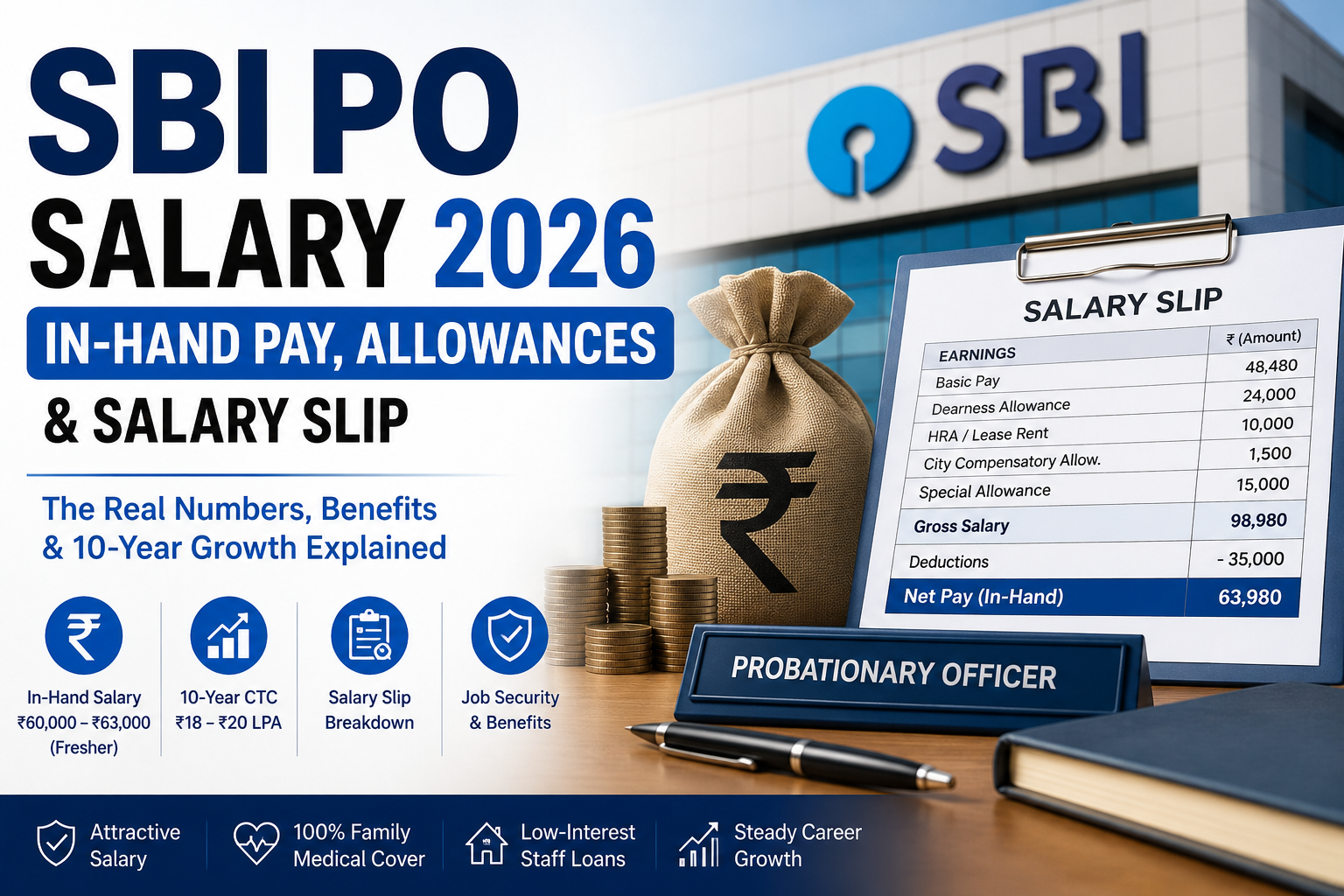
The SBI PO in-hand salary in 2026 ranges from ₹60,000 to ₹63,000 per month after NPS contributions, professional tax, and other deductions. Gross monthly earnings typically range between ₹93,000 and ₹96,000 depending on your posting location and whether you take a leased flat or HRA. Those first few months might look fatter because of one-time joining allowances—don’t bank on that. Plan your budget around ₹60k–63k and treat anything extra as a bonus.
SBI PO Salary 2026: Quick Facts
| Metric | Detail |
|---|---|
| Basic Pay (Starting) | ₹48,480 |
| Gross Monthly Salary | ₹93,000 – ₹96,000 |
| In-Hand Salary (Fresher) | ₹60,000 – ₹63,000 |
| Annual CTC (Year 1) | ₹13 – 14 LPA |
| Annual CTC (Year 10) | ₹18 – 20 LPA |
| Promotion Path | Scale I → Scale VII |
| Pension | NPS (Defined Contribution) |
| Medical | 100% Family Coverage |
These numbers come straight from the latest bipartite wage settlement and assume a metro posting. The ranges exist because city classification changes how much HRA you pocket.
SBI PO Salary Structure 2026
Your salary slip isn’t just a bottom-line figure. The real money is buried in allowances, and some of it never shows up as cash but saves you a ton.
| Component | Monthly Amount (Approx.) |
|---|---|
| Basic Pay | ₹48,480 |
| Dearness Allowance (DA) | ₹23,000 – ₹25,000 |
| House Rent Allowance (HRA) / Lease | ₹7,000 – ₹15,000 |
| City Compensatory Allowance (CCA) | ₹1,500 |
| Special Allowance | ₹15,000+ |
| Gross Monthly Emolument | ₹93,000 – ₹96,000 |
Here’s the thing nobody tells you upfront: if you opt for a leased accommodation, the HRA cash vanishes from your slip, but your rent outgo practically drops to zero. A ₹15,000 non-cash benefit in a metro easily equates to a ₹25,000 pre-tax salary bump for a private-sector employee. It’s a quiet wealth builder.
SBI PO In-Hand Salary: What You’ll Actually See in Your Account
After all the mandatory deductions, your account gets credited with ₹60,000 – ₹63,000 every month as a fresher. The first couple of salary credits might look higher because of relocation grants and joining perks—don’t let that fool you into a lifestyle you can’t sustain.
Deductions that nibble away at your gross:
- NPS Contribution (10% of Basic + DA)
- Professional Tax
- Union dues (small, but present)
Fast forward five years with two increments and possibly some JAIIB/CAIIB clearances, and your in-hand climbs to ₹75,000 – ₹80,000. This is where your surplus becomes real, and you can start investing seriously.
SBI PO Salary After 5 Years
By now, you’re likely a Deputy Manager (MMGS II) or a senior Scale I officer. Your basic crosses ₹55,000, and DA keeps chipping in. Posting in a metro? Your gross monthly easily touches ₹1,00,000+.
- In-hand: ₹75,000 – ₹80,000
- Annual package: ₹16 – 18 LPA gross
And then there’s the stealth advantage: a staff housing loan at near-repo rates (think sub-7% when everyone else pays 9%+). That interest rate gap saves you lakhs over the loan tenure, even though it never shows up on your salary slip.
SBI PO Salary After 10 Years
You’re now a Chief Manager (Scale III), running a branch with a serious balance sheet. The numbers get comfortable.
- Basic Pay: ₹75,000+
- Gross monthly: ₹1,40,000 – ₹1,60,000
- In-hand: ₹1,10,000 – ₹1,25,000
- Annual CTC: ₹18 – 20 LPA
That “2 lakh per month” fantasy floating on forums? That’s gross CTC, not the money you can spend. Cash-in-bank stays below that threshold for most operational roles.
SBI PO Promotion Hierarchy
Promotions are a mix of seniority and merit, and the timeline is usually quicker than in smaller PSU banks. But exact years depend on vacancies, your own performance, and clearing internal exams.
- Probationary Officer (Scale I) – Entry
- Deputy Manager (MMGS II) – Typically 4-6 years
- Chief Manager (MMGS III) – 8-12 years
- Assistant General Manager (SMGS IV) – 13+ years
- Deputy General Manager (SMGS V) – 18+ years
- General Manager (TEGS VI/S) – 22+ years
The jump from Scale III to IV is where your pay really bends upward. It’s also where leadership, people management, and institutional relationships start mattering as much as your credit analysis skills.
SBI PO Salary Slip Breakdown
If you’ve just got your first salary slip and are staring at a dozen line items, here’s what each one actually means for your wallet.
- Basic Pay: The backbone—all allowances and NPS deductions are calculated on this.
- DA (Dearness Allowance): Quarterly inflation adjustment. Your built-in hedge.
- HRA/Lease Rental: Either cash or a rent-free flat, depending on your choice.
- CCA: Extra for high-cost city postings.
- Special Allowance: The somewhat mysterious top-up that bridges the gap to the gross figure.
- NPS Deduction: Forced retirement saving. Treat it like a mandatory long-term investment.
- Net Pay: The only number your monthly SIP or EMI planning should be anchored to.
Knowing how to read a salary slip is crucial—when you apply for that staff housing loan, the bank’s own credit team will dissect this document.
SBI PO vs IBPS PO Salary: The Difference That Actually Matters
On paper, the IBPS PO salary pay scale looks almost identical. But the day-to-day reality differs.
- Medical benefits: SBI’s in-house network is deeper and less bureaucratic, especially for family.
- Staff loans: SBI sets the benchmark interest rate for employee loans; other PSU banks usually follow. You borrow at the cheapest possible cost.
- Posting clout: An SBI branch manager’s word carries more weight than that of an officer from a smaller RRB-sponsored bank. That matters when you’re negotiating locally.
The in-hand cash gap is tiny. Over a lifetime, the borrowing cost savings are substantial.
LIC AAO vs SBI PO: It’s About Where You Want to Be in 15 Years
This isn’t a ₹5,000 salary difference debate. It’s about career lock-in.
- LIC AAO is a specialist insurance role. You’ll master underwriting and claims, but your expertise stays within the insurance world.
- SBI PO is a banking generalist. You’ll handle forex, retail liabilities, corporate credit, and NPA recovery. If you ever want to move to a private bank, NBFC, or fintech, that breadth matters.
Choose LIC AAO if you want a quieter, state-level posting with minimal transfers. Pick SBI PO if you want a national canvas and future optionality.
SBI PO vs RBI Grade B Salary
RBI Grade B officers start higher and rarely get transferred. SBI, though, gives you wider operational exposure—retail, corporate, international banking.
If you care most about upfront cash and stability, RBI Grade B wins. If you want scale, leadership opportunities, and the heft of a massive institution, SBI PO holds its own.
Quick Comparison
| Component | Monthly Amount (Approx.) |
|---|---|
| Basic Pay | ₹48,480 |
| Dearness Allowance (DA) | ₹23,000 – ₹25,000 |
| House Rent Allowance (HRA) / Lease | ₹7,000 – ₹15,000 |
| City Compensatory Allowance (CCA) | ₹1,500 |
| Special Allowance | ₹15,000+ |
| Gross Monthly Emolument | ₹93,000 – ₹96,000 |
SBI PO Eligibility & Syllabus: Two Different Things
Many candidates search for “SBI PO Salary Syllabus,” mixing up two unrelated concepts. The selection syllabus (Prelims, Mains, GD/PI) has zero effect on your pay. Your salary is set by bipartite wage settlements between IBA and unions. Eligibility—graduate, age 21-30—gets you into the exam hall, not into salary negotiations.
Is SBI PO a High Paying Job? Let’s Be Real
Compared to the average Indian paycheck? Absolutely. Compared to the top 10% of private-sector packages? No.
Think of SBI PO salary as a low-risk, steadily growing income stream with a built-in retirement cushion (NPS + gratuity). It won’t make you rich overnight, but it won’t vanish in a layoff either. The trade-off is the transfer policy—frequent moves can mess up your plans to buy a home. Smart officers I’ve seen treat this job as a consistent cash flow engine and invest aggressively in index funds instead of piling everything into a house they can’t live in.
Frequently Asked Questions (FAQ)
Q: Can SBI PO earn 2 lakh per month?
No. Even at Scale III, cash-in-hand is around ₹1.1–1.25 lakh. The ₹2 lakh figure is gross CTC with employer contributions—it looks good on paper, not in your bank account.
Q: Is Bank PO a Class 1 officer?
No. That’s an old Central Government classification. SBI PO is a Junior Management Scale I officer. You’re a bank officer, not a gazetted officer with attestation powers.
Q: What is the SBI PO in-hand salary for freshers?
Between ₹60,000 and ₹63,000 per month after NPS, professional tax, and union dues. Exact amount depends on your posting city and whether you opt for leased accommodation.
Q: Does SBI PO get a pension?
SBI POs are covered under NPS, a defined contribution scheme. There’s no old-style defined benefit pension. Your retirement corpus depends on market returns and the annuity you choose.
Q: What are the main SBI PO allowances?
DA, HRA (or leased flat), CCA, and Special Allowance form the core. Medical benefits and concessional loans are valuable non-cash perks.
Q: What is the SBI PO salary after probation?
After the two-year probation, your in-hand stabilizes at ₹60,000–₹63,000. Annual increments and DA revisions then steadily push it higher.
Q: Is SBI PO better than RBI Grade B?
RBI Grade B pays more upfront and has fewer transfers. SBI PO offers broader exposure and faster leadership scale-up. Both are excellent; your choice depends on what you value more—stability or diversity of experience.
Q: What is the SBI PO gross salary in metro cities?
In metros, gross monthly salary for a fresher typically sits between ₹93,000 and ₹96,000, boosted by higher HRA and CCA. In-hand remains around ₹60,000–₹63,000.
Official References
- State Bank of India PO Recruitment Notification (2026)
- Indian Banks’ Association Bipartite Settlement Documents
- National Pension System (NPS) Guidelines
- SBI Employee Welfare and Medical Benefit Policies
Sources and Methodology
Figures are drawn from SBI recruitment notifications, IBA wage settlements, publicly available disclosures, and insights from serving officers. All numbers are approximate and cross-checked against the latest bipartite settlement. Actual in-hand pay varies with posting location, HRA classification, and individual allowances. Nothing here is a guarantee—just realistic, current-year projections.
The Bottom Line
SBI PO salary isn’t a get-rich-quick number. It’s a steady, inflation-resistant income with a deferred payoff. The real value hides in subsidized loans, medical security, and the near-impossibility of a pink slip. Compare it side-by-side with a startup offer on cash alone, and you’ll miss the point. Model the lifetime consumption power, not just the excitement of that first paycheque.
Author: Aashish Pal covers government sector salaries, banking compensation trends, and public-sector employment economics for Salaryinfo. This article was updated in June 2026.
📌 Editorial Note: Salary figures are based on SBI wage settlements, official notifications, and industry estimates. Actual in-hand pay varies by posting location, HRA classification, and individual allowances.