
Quick Answer: Neurosurgeon Salary in India (2026)
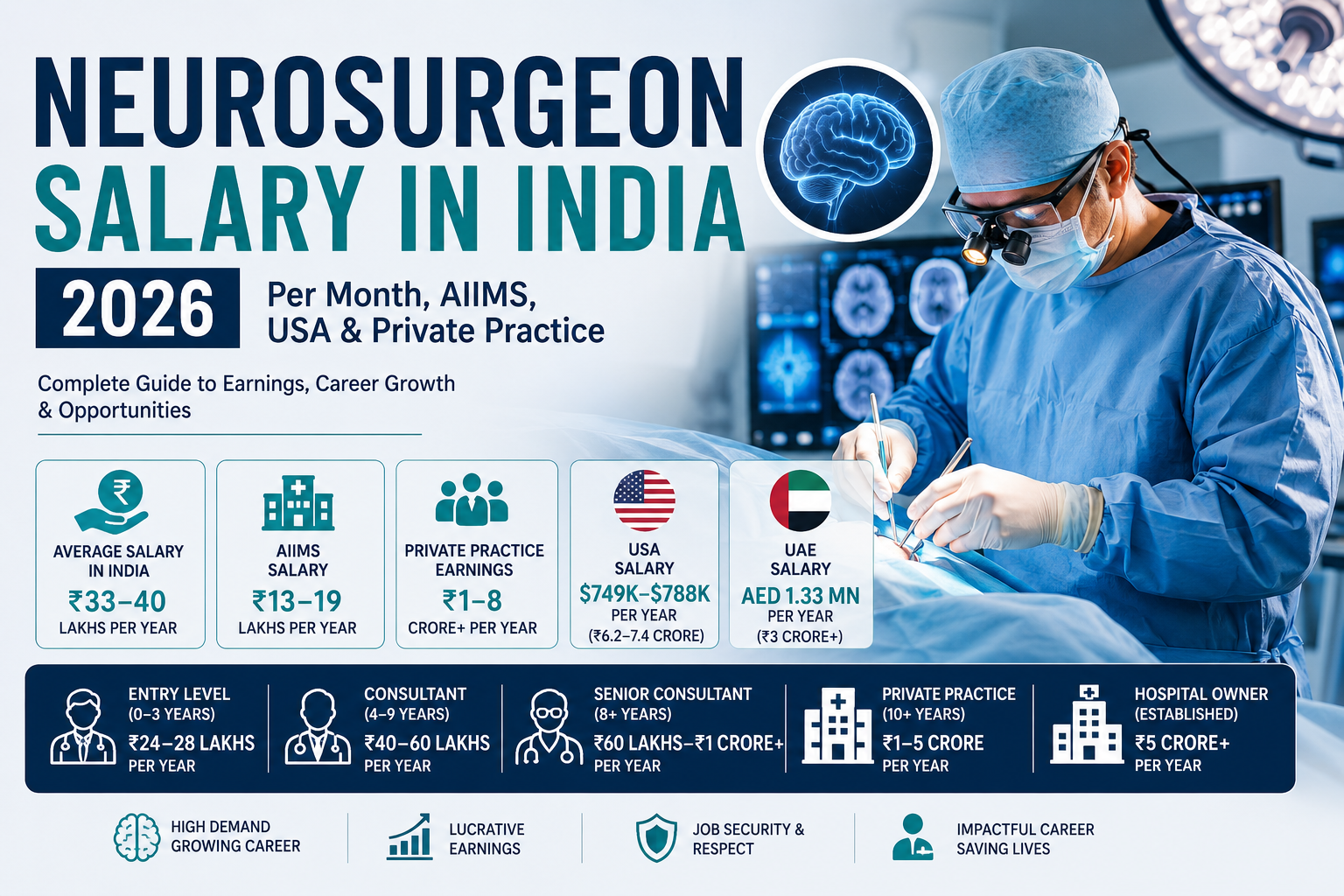
- Average Annual Salary: ₹33–40 lakhs
- Entry-Level (0–3 years): ₹24–28 lakhs
- Senior Consultants: ₹55 lakhs–₹1 crore+
- Top Private Practitioners: ₹2–8 crore (hospital ownership, high-volume practice)
- AIIMS Neurosurgeons: ₹13–19 lakhs
- USA Neurosurgeons: ~$749,000–$788,000 (approximately ₹6.2–7.4 crore)
- UAE Neurosurgeons: Tax-free earnings of roughly ₹3 crore annually
- MCh Neurosurgery Starting Salary: ₹2–4 lakhs per month
- Consultant Neurosurgeon: ₹41.6–47 lakhs annually
Ask five different sources what a neurosurgeon earns in India, and you’ll get five different answers. Payscale says ₹25.6 lakhs average. SalaryExpert says ₹51 lakhs. AmbitionBox says AIIMS neurosurgeons make ₹13-19 lakhs. A senior consultant at Apollo might clear ₹70 lakhs. A top-tier private practitioner in Mumbai? Could be ₹2-3 crore. The guy running his own super-speciality centre? In exceptional cases involving hospital ownership, medical tourism, and large referral networks, earnings can reach several crores annually.
Here’s the thing: they’re all right. And that’s precisely what makes this conversation interesting.
The neurosurgeon salary isn’t a single number. It’s a distribution with extreme variance. The 10th percentile and the 90th percentile are separated by a factor of 20x. That’s not a salary range—that’s a different economic reality altogether.
Let’s break down what’s actually happening.
The Indian Market: What the Data Actually Says
The Raw Numbers (2026)
Multiple sources, multiple methodologies, multiple truths:
| Source | Average Annual Salary | Notes |
|---|---|---|
| Payscale | ₹25.6 lakhs | Base salary, 2026 data |
| Salary.com | ₹49.4 lakhs | Global IQ data, April 2025 |
| ERI Economic Research | ₹51 lakhs | Physician Neurosurgeon, June 2026 |
| SalaryExpert | ₹45-51 lakhs | Varies by city, 2026 |
The gap between Payscale and the others isn’t a mistake—it’s a methodology difference. Payscale includes all neurosurgeons (including junior residents, government employees, and early-career professionals). The others lean toward experienced practitioners and total compensation.
Here’s what the distribution actually looks like:
- Entry-level (0-3 years): ₹24.5-27.8 lakhs
- Mid-career (4-9 years): ₹25-35 lakhs
- Senior (8+ years): ₹55.5 lakhs+
- Top 10%: > ₹65.4 lakhs
- Top 1%: > ₹96.3 lakhs
But these are hospital-employed numbers. Private practice is a completely different animal.
The Government vs Private Divide
This is where the narrative gets interesting.
Government hospitals (AIIMS, state medical colleges):
- AIIMS New Delhi: ₹13.5-18.7 lakhs (2-6 years experience)
- AIIMS New Delhi (25th-75th percentile): ₹16.6-77.5 lakhs (senior faculty members with administrative responsibilities and additional allowances may earn substantially more)
- Central government pay scales: Fixed, class-1 officer equivalent
- Perks: Pension, job security, research opportunities
Private hospitals:
- Apollo Hospitals: ₹42.9-62.6 lakhs
- Asian Vivekanand: ₹59.5-65.8 lakhs
- Medanta: ₹33.3-36.8 lakhs
- Consultant level in Delhi: ₹39.7-57.2 lakhs starting
Private practice:
- This is where the ceiling disappears
- 10+ years experience: Often clears ₹1 crore+
- Top practitioners: Several crores possible
Hospital-Wise Salary Comparison
| Hospital | Annual Salary Range | Notes |
|---|---|---|
| All India Institute of Medical Sciences (AIIMS) | ₹13–19 lakhs | Fixed pay scale, 2-6 years experience |
| Apollo Hospitals | ₹43–63 lakhs | Corporate hospital, variable pay |
| Medanta | ₹33–37 lakhs | Superspeciality corporate |
| Fortis Healthcare | ₹17–19 lakhs | Entry-mid level |
| Max Healthcare | ₹30–50 lakhs | Experience-dependent |
| Asian Vivekanand | ₹59–66 lakhs | High-paying private |
| PGIMER | ₹33–37 lakhs | Government, better than AIIMS |
Career Stage Comparison Table
| Career Stage | Annual Salary | Monthly Salary |
|---|---|---|
| Junior Neurosurgeon | ₹24–28 lakh | ₹2–2.3 lakh |
| Consultant | ₹40–60 lakh | ₹3.3–5 lakh |
| Senior Consultant | ₹60 lakh–₹1 crore+ | ₹5–8 lakh |
| Private Practice | ₹1–5 crore | ₹8–40 lakh |
| Hospital Owner | ₹5 crore+ | ₹40 lakh+ |
The City Factor
Location isn’t just about cost of living—it’s about patient volume, medical tourism, and ability to charge premium rates.
| City | Average Annual Salary | Source |
|---|---|---|
| Mumbai | ₹53.6 lakhs | Highest-paying city |
| Delhi | ₹29.5-47.5 lakhs | Varies by experience |
| Delhi (Consultant) | ₹39.7-57.2 lakhs | Senior level |
| Delhi (Mid-Career) | ₹47.5 lakhs | 5-9 years experience |
| Varanasi | ₹45.6 lakhs | 11% below national average |
What the data doesn’t tell you: The Delhi neurosurgeon making ₹30 lakhs at a government hospital and the one making ₹2 crore in private practice might work in the same city, treat similar conditions, and have comparable training. The difference isn’t skill—it’s structural.
Sub-Specialisation Salary Breakdown
| Specialisation | Estimated Annual Earnings |
|---|---|
| Spine Neurosurgery | ₹50 lakhs–₹3 crore |
| Pediatric Neurosurgery | ₹40 lakhs–₹2 crore |
| Neuro-Oncology | ₹45 lakhs–₹2.5 crore |
| Functional Neurosurgery | ₹60 lakhs–₹4 crore |
| Skull Base/Cerebrovascular | ₹1 crore+ |
The pattern: The more complex the procedure, the higher the premium. The more specialised the skillset, the less competition. Functional neurosurgery (epilepsy, movement disorders) and skull base surgery command the highest premiums due to limited specialists and extreme technical demands.
The International Reality Check
Global Salary Data (2026)
| Country | Average Annual Salary (Local) | INR Equivalent (Approx.) |
|---|---|---|
| USA | $749,000–$788,000 | ₹6.2–7.4 crore |
| USA (Range) | $394,000–$936,000 | ₹3.4–8.2 crore |
| UK | £244,678 | ₹2.6 crore |
| Canada | $486,927 CAD | ₹3.0 crore |
| Australia | AU$289,823 | ₹1.6 crore |
| UAE | AED 1.33 million | ₹3.0 crore (tax-free) |
But here’s the catch: These are gross numbers. What matters is net take-home and purchasing power.
The Tax and Cost Arbitrage
The UAE stands out for a reason. Zero income tax on AED 1.33 million ($362,000) means you keep everything. The USA at $788,000 puts you in the 37% federal bracket plus state taxes—you’re losing $250,000+ annually to taxes. The UK’s 45% top rate isn’t kind either.
Real take-home comparison (rough estimates):
| Country | Gross | Tax Rate | Net | Cost of Living | Effective Savings |
|---|---|---|---|---|---|
| UAE | ₹3.0Cr | ~0% | ₹3.0Cr | Moderate | Excellent |
| USA | ₹7.4Cr | ~40% | ₹4.4Cr | High | Good |
| Canada | ₹3.0Cr | ~35% | ₹2.0Cr | Moderate | Moderate |
| UK | ₹2.6Cr | ~40% | ₹1.6Cr | High | Moderate |
The US pays more gross. The UAE lets you keep more of what you earn. Which is “better” depends on your priorities—and whether you’re willing to practice in a system where malpractice insurance can run $100,000+ annually.
The Questions People Actually Ask
What is the highest salary of a neurosurgeon?
In India, the ceiling is theoretical. Top private practitioners and hospital owners can earn several crores annually. Globally, US neurosurgeons at the 90th percentile clear $949,000+. The highest reported? Some US practitioners exceed $1 million. But these are outliers—the 1% of the 1%.
Can a neurosurgeon earn 1 lakh per day?
Yes, but this is a function of volume and pricing, not a guaranteed daily rate. A neurosurgeon charging ₹50,000-1,00,000 per surgery and performing 2-3 surgeries weekly is already there. The top tier charging ₹2-5 lakh per complex procedure and operating 3-4 times weekly? They’re well past that threshold. But this assumes:
- Consistent patient volume
- Ability to charge premium rates
- Operating facilities available
- No complications eating into time
What is the salary of a neurosurgeon per month in India?
Average monthly salary ranges from ₹2.1 lakhs to ₹4.1 lakhs for employed neurosurgeons. Senior private practitioners can earn ₹5-20 lakhs+ monthly. MCh graduates typically start at ₹2-4 lakhs per month.
What is the salary of a neurosurgeon at AIIMS?
AIIMS New Delhi neurosurgeons earn ₹13.5-18.7 lakhs annually (2-6 years experience). The 25th-75th percentile ranges from ₹16.6 lakhs to ₹77.5 lakhs. Senior faculty members with administrative responsibilities and additional allowances may earn substantially more. The ceiling is lower than private hospitals, but job security and research opportunities are unmatched.
Does a neurosurgeon need NEET?
Yes. NEET PG is required for MS/MD admission. NEET SS (Super Speciality) is required for MCh Neurosurgery admission. The path: 12th → NEET UG → MBBS → NEET PG → MS/MD General Surgery → NEET SS → MCh Neurosurgery. Total: 13-15 years after 12th.
What is the highest paid type of neurosurgeon?
Sub-specialisation drives premiums:
- Cerebrovascular/Skull Base: Highest complexity, highest pay
- Functional neurosurgery (epilepsy, movement disorders): Growing demand
- Pediatric neurosurgery: Niche, high skill premium
- Spinal surgery: High volume, good income
- Neuro-oncology: Constant demand
Is neurosurgery worth it in 2026?
Financially, yes—if you’re willing to accept the 15-year training timeline, lifestyle sacrifices, and emotional demands. The ROI is back-loaded: low returns for the first 15 years, potentially exceptional returns for the next 20-25 years. The average MCh graduate starts at ₹2-4 lakhs monthly, but senior consultants can exceed ₹1 crore annually.
What is the salary of a consultant neurosurgeon in India?
Consultant neurosurgeons average ₹41.6-47 lakhs annually. Starting salaries range from ₹41.6-47 lakhs, with the highest reaching ₹56.4-84.2 lakhs. Senior consultants earn ₹61.4-67.9 lakhs on average, with top 10% exceeding ₹1 crore.
What is the neurosurgeon salary in the USA in rupees?
US neurosurgeons earn approximately $749,000–$788,000 annually, equivalent to ₹6.2–7.4 crore. The range extends from $394,000 to $936,000 (₹3.4–8.2 crore).
The Hidden Variables No One Talks About
1. The Reputation Compound Effect
Unlike software engineering where skills are somewhat fungible, neurosurgery is a reputation business. A neurosurgeon with 15 years of clean outcomes, published research, and word-of-mouth referrals can charge 3-5x what an equally qualified but unknown surgeon charges. The compound effect of reputation over a career is the single biggest determinant of lifetime earnings.
2. The Infrastructure Trap
Private practice income isn’t just about surgical fees. It’s about owning or controlling the infrastructure—the operating theatre, the ICU beds, the diagnostic equipment. A neurosurgeon who owns a share in a hospital or runs their own centre captures facility fees, diagnostic margins, and referral economics. This is how the several crores figure becomes achievable.
3. The Opportunity Cost of Training
This is the part most articles skip.
- MBBS: 5.5 years (opportunity cost: earning ₹0)
- MS/MD: 3 years (earning resident stipend: ~₹1 lakh/month)
- MCh: 3-6 years (earning ₹1-1.5 lakh/month)
- Total training: 12-15 years post-12th
A software engineer starting at 22 earns ₹15-20 lakhs by 25 and ₹40-50 lakhs by 30. A neurosurgeon starts earning real money at 35. The cumulative earnings gap over those 13 years is easily ₹2-3 crore. The high salary later in career is partially catching up to the opportunity cost.
4. The Lifestyle Tax
The profession demands long hours, emergency responsibilities, and significant emotional resilience despite its financial rewards. 65-80 hour work weeks. 24-hour on-call. Emergencies that don’t respect weekends. The emotional weight of outcomes where “good” means the patient isn’t permanently disabled. The salary is compensation for the sacrifice, not just the skill.
The Decision Framework: India vs Abroad
When India Makes Sense
- You want to build a private practice with unlimited upside
- You have family/community ties that support patient acquisition
- You’re willing to work in Tier-2 cities where competition is lower and margins are higher
- You want to own infrastructure eventually (hospital shares, diagnostic centres)
- You value professional autonomy over structured schedules
When Abroad Makes Sense
- You want structured work hours and predictable income
- You value research infrastructure and academic medicine
- You want better work-life balance (relatively speaking)
- You’re willing to trade gross income for net savings (UAE)
- You want malpractice protection and clear medicolegal frameworks
The Middle Path
Many senior Indian neurosurgeons maintain a hybrid model: hospital employment for stability + private practice for upside + consulting/teaching for income diversification. The smartest operators don’t choose one model—they layer them.
Related Salary Comparisons
- IPS Salary in India
- SBI PO Salary
- Software Engineer Salary
- Data Analyst Salary
- IBPS PO Salary
- SSC MTS Salary
- SBI Clerk Salary
- SDM Salary
- Merchant Navy Salary
- IB Security Assistant Salary
- SPG Commando Salary
- 4 LPA In-Hand Salary
- 30 LPA In-Hand Salary
- 50 LPA Salary In-Hand
- 5 LPA In-Hand Salary
- Full Form of CTC
- LPA Full Form
- What is a Salary Slip or Payslip?
- PF Passbook Online
- PCS Full Form
- SSC CHSL Salary
Frequently Asked Questions
Q: What is the starting salary of a neurosurgeon in India?
Entry-level (0-3 years) ranges from ₹24.5 lakhs to ₹27.8 lakhs annually, depending on hospital type and location. Government hospitals pay less; corporate hospitals pay more.
Q: What is the salary of a neurosurgeon at AIIMS?
AIIMS New Delhi neurosurgeons earn ₹13.5-18.7 lakhs annually (2-6 years experience). Senior faculty/professors earn more, but the ceiling is lower than private hospitals.
Q: How much does a neurosurgeon earn per month in India?
Average monthly salary ranges from ₹2.1 lakhs to ₹4.1 lakhs for employed neurosurgeons. Senior private practitioners can earn ₹5-20 lakhs+ monthly.
Q: Can a neurosurgeon become a billionaire?
Theoretically, yes—through hospital chains, healthcare startups, or medical device innovation. Practically, it’s extremely rare and requires entrepreneurship beyond clinical practice.
Q: Is neurosurgery worth it in 2026?
Financially, yes—if you’re willing to accept the 15-year training timeline, lifestyle sacrifices, and emotional demands. The ROI is back-loaded: low returns for the first 15 years, potentially exceptional returns for the next 20-25 years.
Q: What is the highest paid type of neurosurgeon?
Skull base/cerebrovascular and functional neurosurgery command the highest premiums. Senior consultants in these sub-specialities can exceed ₹1 crore annually.
Q: What is the salary of a consultant neurosurgeon in India?
Consultant neurosurgeons average ₹41.6-47 lakhs annually. Senior consultants earn ₹61.4-67.9 lakhs on average, with top 10% exceeding ₹1 crore.
Q: What is the neurosurgeon salary in the USA in rupees?
US neurosurgeons earn approximately $749,000–$788,000 annually, equivalent to ₹6.2–7.4 crore. The range extends from $394,000 to $936,000 (₹3.4–8.2 crore).
Q: What is the neurosurgeon salary near Uttar Pradesh?
Salaries in Uttar Pradesh vary by city. Varanasi averages ₹45.6 lakhs (11% below national average), while Lucknow and Noida command higher rates due to better healthcare infrastructure and proximity to Delhi.
Conclusion: The Real Takeaway
Neurosurgery isn’t a salary—it’s a career architecture. The numbers look impressive on paper, but they’re meaningless without context:
- AIIMS neurosurgeon at ₹18 lakhs: Stable, prestigious, research-focused, capped income
- Apollo consultant at ₹60 lakhs: Corporate structure, high volume, good but not exceptional
- Private practitioner at ₹2 crore: Unlimited upside, unlimited risk, reputation-dependent
- US neurosurgeon at $788k: High gross, high tax, high cost, structured system
- UAE neurosurgeon at AED 1.33M: Tax-free, good savings, lifestyle-oriented
The strategy: Don’t chase the headline number. Understand the structure behind it. The neurosurgeon making several crores in India isn’t just a good surgeon—they’re a good businessperson. The one making ₹18 lakhs at AIIMS isn’t underpaid—they’re trading income for stability, prestige, and research access.
Neither is wrong. Both are rational choices in a system where the same degree leads to vastly different economic outcomes.
Choose your structure. The salary follows.
📊 Data Sources: Salary estimates are compiled from Payscale (2026), SalaryExpert (2026), ERI Economic Research Institute (2026), AmbitionBox (2026), Salary.com (2025–2026), and the U.S. Bureau of Labor Statistics (2026). All figures are presented in Indian Rupees (₹) unless otherwise specified. Currency conversions are approximate and based on prevailing exchange rates as of June 2026. :contentReference[oaicite:0]{index=0}