
Quick Answers: The Numbers You Actually Came For
What is the average cardiologist salary in India in 2026?
Around ₹39.7 lakh per year (gross) for a general cardiologist, according to SalaryExpert 2026 data. Invasive cardiologists average higher at ₹45.6 lakh annually.
What is the highest salary a cardiologist can earn?
Top-tier interventional and consultant cardiologists can earn more than ₹1 crore annually. The top 1% of Consultant Interventional Cardiologists reportedly exceed ₹1.1 crore per year.
Can a cardiologist earn ₹1 crore?
Yes—but not immediately after completing DM. Senior interventional cardiologists with 10+ years of experience, international fellowships, corporate hospital affiliations, or thriving private practices routinely cross the ₹1 crore milestone.
Do cardiologists need NEET?
Yes. NEET is required for MBBS admission, NEET-PG for MD programs, and NEET-SS remains the primary pathway to DM Cardiology in most government institutions.
What is the top 1% salary in India?
Within cardiology, the top 1% earns more than ₹90 lakh annually, while Consultant Interventional Cardiologists at the highest end exceed ₹1.1 crore per year.
Cardiologist Salary in India 2026: Quick Reference Table
| Category | Annual Salary | Monthly Salary |
|---|---|---|
| Average Cardiologist | ₹39.7 lakh | ₹3.3 lakh |
| Invasive/Interventional Cardiologist | ₹45.6 lakh | ₹3.8 lakh |
| Non-Invasive Cardiologist | ₹39.7 lakh | ₹3.3 lakh |
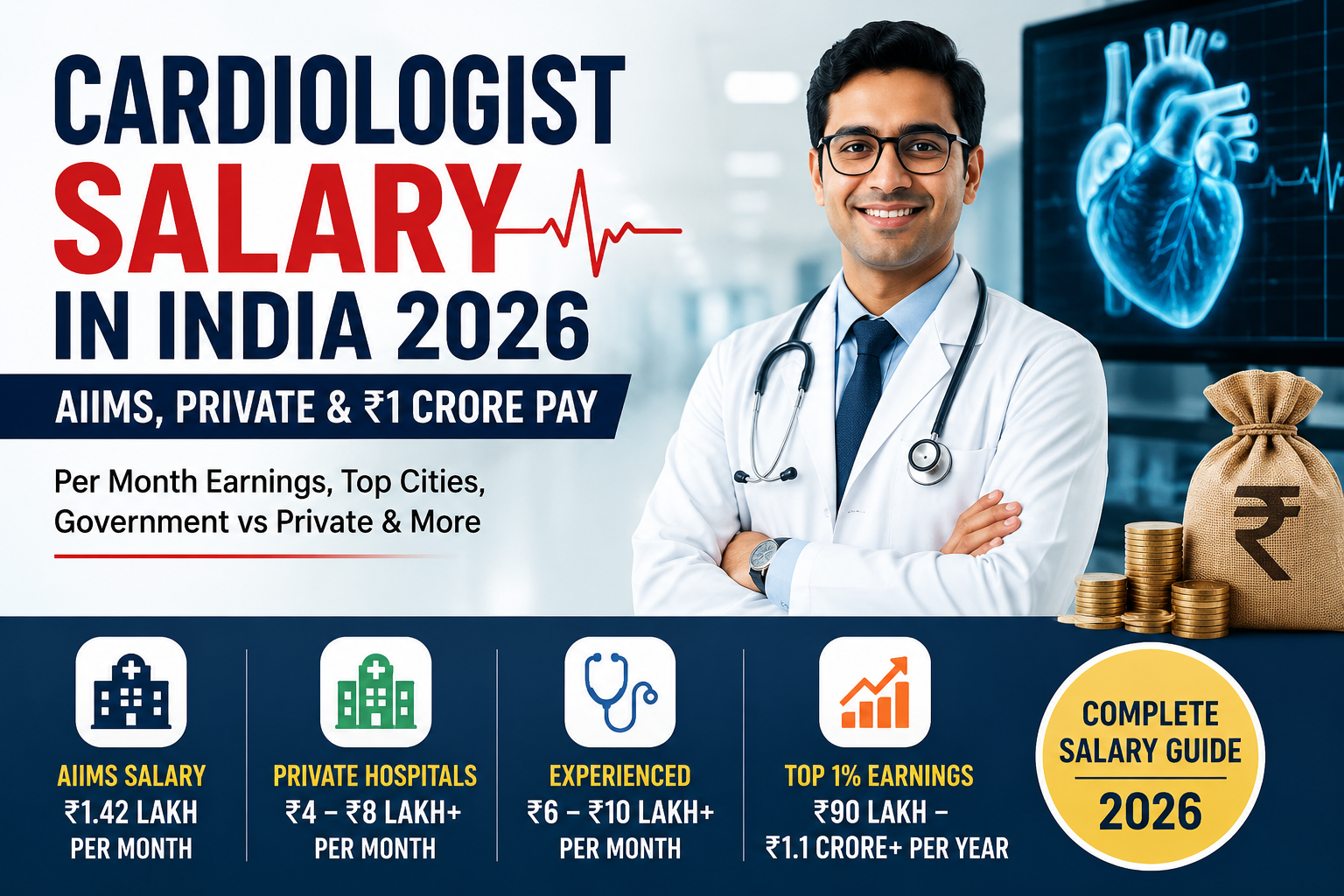
| AIIMS Assistant Professor | ₹17.1 lakh | ₹1.42 lakh |
| Corporate Hospital Consultant | ₹48–96 lakh | ₹4–8 lakh |
| Top 10% of Cardiologists | ₹60.6 lakh+ | ₹5 lakh+ |
| Top 1% of Cardiologists | ₹90 lakh–₹1.1 crore+ | ₹7.5 lakh–₹9.2 lakh+ |
Sources: SalaryExpert 2026, AmbitionBox 2026, AIIMS Delhi Recruitment 2026
Cardiologist Salary Per Month in India (2026)
Let’s be precise about monthly cash flow—because that’s what actually hits your bank account and dictates your lifestyle.
| Experience Level | Monthly Salary Range | Typical Setting |
|---|---|---|
| Fresher (0–3 years) | ₹70,000 – ₹1.2 lakh | Government hospitals, smaller private hospitals |
| Fresher (Top Corporate) | ₹4 – ₹5 lakh | Select metro-based corporate hospitals (highly competitive) |
| 5 Years Experience | ₹1.5 – ₹2.5 lakh | Mid-level consultant in Tier-2/3 cities |
| 8–10 Years Experience | ₹3 – ₹6 lakh | Senior consultant, metro corporate hospitals |
| Senior Consultant (12+ Years) | ₹6 – ₹10 lakh+ | Top-tier corporate hospitals, established private practice |
The monthly take-home for a cardiologist is highly volatile. A government cardiologist in Uttar Pradesh might take home ₹70,000–80,000 per month after deductions. Meanwhile, a senior interventionalist at a Mumbai corporate hospital could see ₹8 lakh+ credited monthly. The variance is massive, and understanding this range is critical before committing to the speciality.
For a deeper understanding of how in-hand salaries differ from CTC, read our explainer on Full Form of CTC and LPA Full Form.
The Average Is a Trap: Breaking Down the Real Distribution
Here’s the problem with averages: they hide more than they reveal.
The ₹39.7 lakh average sounds impressive until you realise the distribution is wildly skewed. A fresher coming out of DM Cardiology might start at ₹8–14 lakh per year in a government or smaller private setup. A senior interventional cardiologist at a top corporate hospital in Mumbai or Delhi might clear ₹1.5 crore.
The same average. Completely different realities.
The actual breakdown looks like this:
Entry-Level (0–3 years): ₹8–14 lakh per year. This is the reality check. You’ve spent 7+ years post-MBBS in training. The payoff hasn’t started yet. However, a tiny fraction of fresh DM graduates who secure roles in top-tier corporate hospitals in metros can command ₹4–5 lakh per month (₹48–60 LPA), though these offers represent the top 5% of entry-level placements.
Mid-Level (4–7 years): ₹18–30 lakh per year. This is where the earnings curve starts bending. You’re competent. You’re doing procedures. But you’re still building reputation.
Senior (8+ years): ₹40 lakh to ₹1 crore+ per year. This is where the magic happens—if you’ve chosen the right subspecialty, the right city, and the right practice model. The 8+ year mark is also where SalaryExpert data shows senior cardiologists averaging ₹46 lakh.
Top 10%: Over ₹60.6 lakh per year.
Top 1%: Over ₹90 lakh per year, and for Consultant Interventional Cardiologists specifically, over ₹1.1 crore.
The Subspecialty Premium: Which Cardiologists Make the Most
Not all cardiologists are created equal—at least not in the eyes of the compensation committee.
- Invasive/Interventional Cardiologists lead the pack. Average gross salary: ₹45.6 lakh, with bonuses pushing effective compensation higher. The premium comes from procedure volume (angioplasties, stent placements, cath lab procedures).
- Non-Invasive Cardiologists average around ₹39.7 lakh. Still excellent, but the gap widens with experience.
- Consultant Cardiologists in corporate settings average ₹36.9–40.8 lakh per year, with the top 10% exceeding ₹60 lakh.
- Consultant Interventional Cardiologists command even higher premiums, averaging ₹43.1–52.9 lakh per year. The top 1% exceed ₹1.1 crore.
- Cardiac Surgeons (CTVS) operate in a different strata entirely, earning ₹7–12+ lakh per month in super-specialty hospitals.
The takeaway? The subspecialty you choose coming out of DM dictates your ceiling more than your medical school grades. Interventional cardiology offers the highest procedure volume and reimbursement rates.
For readers comparing medical careers, our detailed guide on Neurosurgeon Salary shows how compensation differs between high-risk specialties.
Government vs Private: The Stability Premium vs The Upside
This is where the real trade-off lives.
Government vs Private: Quick Comparison
| Sector | Average Monthly Salary | Key Benefits | Trade-Offs |
|---|---|---|---|
| AIIMS (Assistant Professor) | ₹1.42 lakh | Pension, fixed hours, prestige | Capped earnings |
| State Government Hospitals | ₹68k–₹2 lakh | 7th CPC indexation, NPA | Limited upside |
| Corporate Hospitals | ₹4–8 lakh | High earning potential | Procedure targets, no pension |
| Private Practice | ₹5–10 lakh+ | Unlimited upside | Entrepreneurial risk |
Government hospitals offer stability, fixed hours (relative to private practice), and pensions. AIIMS Delhi’s 2026 recruitment for Assistant Professors offers ₹1,42,506 per month consolidated. Professors at AIIMS fall in the Level-14A pay scale: ₹1,68,900 to ₹2,20,400 per month. Government doctors also receive a Non-Practicing Allowance (NPA) of 20% of basic pay under the 7th Pay Commission.
Private and corporate hospitals offer significantly higher pay—but with strings attached. Higher procedure targets. Longer hours. No pension. The upside is real: DM cardiologists in corporate hospitals can command ₹4–8 lakh per month depending on experience and location.
The question isn’t which pays more—it’s obvious. The question is: what’s your risk tolerance? The government route gives you a predictable, indexed income and a pension. The private route gives you upside but demands volume, reputation-building, and entrepreneurial hustle.
For context on how government pay scales compare across elite services, see our breakdown of IPS Salary India and SBI PO Salary.
Location, Location, Location: The Geography of Compensation
The geographic premium in cardiology is real and substantial.
- Delhi NCR commands a premium. Non-invasive cardiologists in New Delhi average ₹41.4 lakh—about 4% above the national average.
- Bangalore pushes even higher. Non-invasive cardiologists in Bangalore average ₹45.3 lakh, with ranges from ₹29.4 lakh to ₹59.9 lakh.
- Mumbai, Chennai, and Hyderabad round out the top-tier cities, paying 15–30% more than Tier-2 cities.
- Uttar Pradesh offers around ₹45–47 lakh per year for senior roles, with some positions offering ₹7 lakh per month. However, purchasing power in Lucknow significantly outpaces South Mumbai.
For those evaluating government administrative roles in the state, our guide on SDM Salary provides useful comparison points.
The Training Cost: What You Sacrifice to Get There
This is the part most articles conveniently ignore.
Becoming a cardiologist in India requires: MBBS (5.5 years) + MD Medicine (3 years) + DM Cardiology (3 years). That’s 11.5 years of training after Class 12. You’re looking at age 30–32 before you start earning a consultant’s salary.
During those years, you’re earning a stipend—not a salary. Junior residents at AIIMS earn ₹56,100 per month under Level-10 Pay Matrix. DM Cardiology postgraduates at AIIMS Delhi saw median placements of ₹48 lakh per year in 2025.
The opportunity cost is brutal. A B.Tech graduate who joins a product company at 22 is earning significantly more by 28, while a cardiologist is just finishing training. The payoff, if it comes, comes later. The break-even point is real and worth calculating before you commit.
The Risk Factors No One Talks About
Let’s talk about what could go wrong.
- Burnout is real. Cardiology is high-stakes, high-stress, and high-hours. The cath lab doesn’t care about your work-life balance.
- Malpractice risk is growing. India’s medical litigation environment is becoming more aggressive. One complication, one lawsuit—and your reputation (and income) takes a hit.
- The rise of corporate hospital chains is consolidating power. Hospitals are getting better at capturing the revenue from procedures. Your take-home as a percentage of what you generate is declining in many corporate settings.
- AI and automation are coming for diagnostics. Non-invasive cardiology—reading ECGs, interpreting imaging—is increasingly being augmented (and in some cases replaced) by AI tools. The impact on compensation is uncertain, but it’s not zero.
The ₹1 Crore Question: Who Actually Gets There?
Yes, cardiologists can earn ₹1 crore. But let’s be specific about who does.
The ₹1 crore+ club typically includes:
- Senior Consultant Interventional Cardiologists (10+ years) at top corporate hospitals in metros. The top 1% exceed ₹1.1 crore.
- Cardiac surgeons at super-specialty hospitals.
- Cardiologists with successful private practices who’ve built a patient base and do procedures in their own or partner facilities.
- Consultants with international telemedicine practices (remote consultations at $300–400/hour for US/UK-based patients).
What ₹1 crore is NOT:
- It’s not automatic.
- It’s not guaranteed with just a DM degree.
- It requires subspecialisation, reputation, volume, and often entrepreneurial risk.
The top 1% of Consultant Interventional Cardiologists clear ₹1.1 crore. That’s the 99th percentile. Most cardiologists will earn significantly less, but the ceiling exists for those who play their cards right.
For perspective on what other top-tier government salaries look like, see our breakdown of SPG Commando Salary and IB Security Assistant Salary.
Cardiologist Salary Abroad: How India Compares
For cardiologists considering international opportunities, the compensation landscape is dramatically different:
| Country | Average Annual Salary (USD) | Equivalent (INR) | Source |
|---|---|---|---|
| USA (General Cardiology) | $450,000–$500,000 | ₹3.7–4.1 crore | Medscape Physician Comp Report 2026 |
| USA (Interventional) | $500,000–$650,000 | ₹4.1–5.4 crore | Doximity Compensation Survey 2026 |
| UAE/Dubai | $500,000+ | ₹4.1 crore+ | GulfTalent / Industry Postings 2026 |
| Oman (Consultant) | ~$11,000/month (tax-free) | ₹1.1 crore/year | SalaryExpert Middle East 2026 |
| UK (Consultant) | £120,000–£150,000 | ₹1.3–1.6 crore | NHS / BMA Data 2026 |
The gap is staggering. A cardiologist in the US earns 5–10x what an Indian counterpart earns. However, the path is arduous: USMLE exams, residency matching, and fellowship programmes add years to the training timeline.
2026 Outlook: Where Is This Headed?
The 5-year salary potential for cardiologists is projected to increase by 11% (ERI data). That’s modest but steady growth.
Drivers of growth: Rising prevalence of lifestyle diseases, ageing population, expansion of health insurance, and growth of corporate hospitals in Tier-2/3 cities.
Headwinds: Consolidation of hospital bargaining power, AI disruption in diagnostics, and increasing supply of cardiologists (more DM seats).
The demand-supply equation remains favourable, but the days of automatic riches are over. Smart career moves—subspecialisation, strategic location, and practice model choice—matter more than ever.
FAQ
What is the starting salary of a cardiologist in India?
Entry-level cardiologists (0–3 years) typically earn ₹8–14 lakh per year in government and smaller private settings. However, top-tier corporate hospitals in metros may offer fresh DM graduates ₹4–5 lakh per month (₹48–60 lakh/year), though these are highly competitive roles.
What is the salary of a cardiologist at AIIMS Delhi?
Assistant Professors at AIIMS Delhi earn ₹1,42,506 per month consolidated, which is approximately ₹17.1 lakh per year.
How much does a cardiologist earn per month in India?
The average is around ₹3.3 lakh, but the range is extreme: from ₹70,000–1 lakh in government hospitals for freshers to ₹6–10 lakh+ for senior interventional cardiologists in corporate hospitals.
Which type of cardiologist earns the most?
Invasive/interventional cardiologists earn the highest, averaging ₹45.6 lakh per year, with top Consultant Interventional Cardiologists exceeding ₹1.1 crore.
Is cardiology the highest-paid medical speciality in India?
Cardiology is among the top 2–3 highest-paid medical specialities, alongside neurosurgery.
What qualifications are needed to become a cardiologist in India?
MBBS + MD (Medicine) + DM (Cardiology). NEET for MBBS, NEET-PG for MD, and NEET-SS for DM Cardiology.
Can a cardiologist earn ₹1 crore in India?
Yes—senior interventional cardiologists and cardiac surgeons with 10+ years of experience and successful practices or corporate hospital positions can exceed ₹1 crore annually.
Key Takeaways
- The average is misleading. ₹39.7 lakh hides the fact that most earn less and the top 1% earn significantly more.
- Subspecialty is king. Interventional cardiology pays a premium that widens with experience.
- Location is a lever. Metros pay 15–30% more, but cost of living eats into that premium.
- Government vs private is a lifestyle choice. Stability and pension vs upside and uncertainty.
- The ₹1 crore figure is real but not typical. It’s the 99th percentile for Interventional Consultants.
- Factor in the training cost. You’re sacrificing your 20s and early 30s. The payoff comes later, but it does come.
Editorial Note & Author Bio
⚠️ Editorial Disclaimer: This analysis was prepared by the SalaryInfo Editorial Team using verified compensation datasets. Figures are indicative and may vary based on specialization, geography, experience, employer type, and practice model. This article is provided for informational purposes only and should not be considered financial, educational, or career advice.