
Salary figures are based primarily on May 2025 BLS wage data, while employment counts and projections reflect the latest available 2024–2034 BLS estimates. Current hiring examples are included where relevant.
The $60,000 question: Why do two radiologic technologists with the same ARRT certification and similar experience earn dramatically different paychecks—sometimes a gap of $50,000 or more—for doing essentially the same job?
The answer has nothing to do with skill and everything to do with where they work, who they work for, and what they’ve chosen to specialise in. That’s the reality of radiology tech compensation in 2026, and it’s the single most important thing to understand before you commit to this career path.
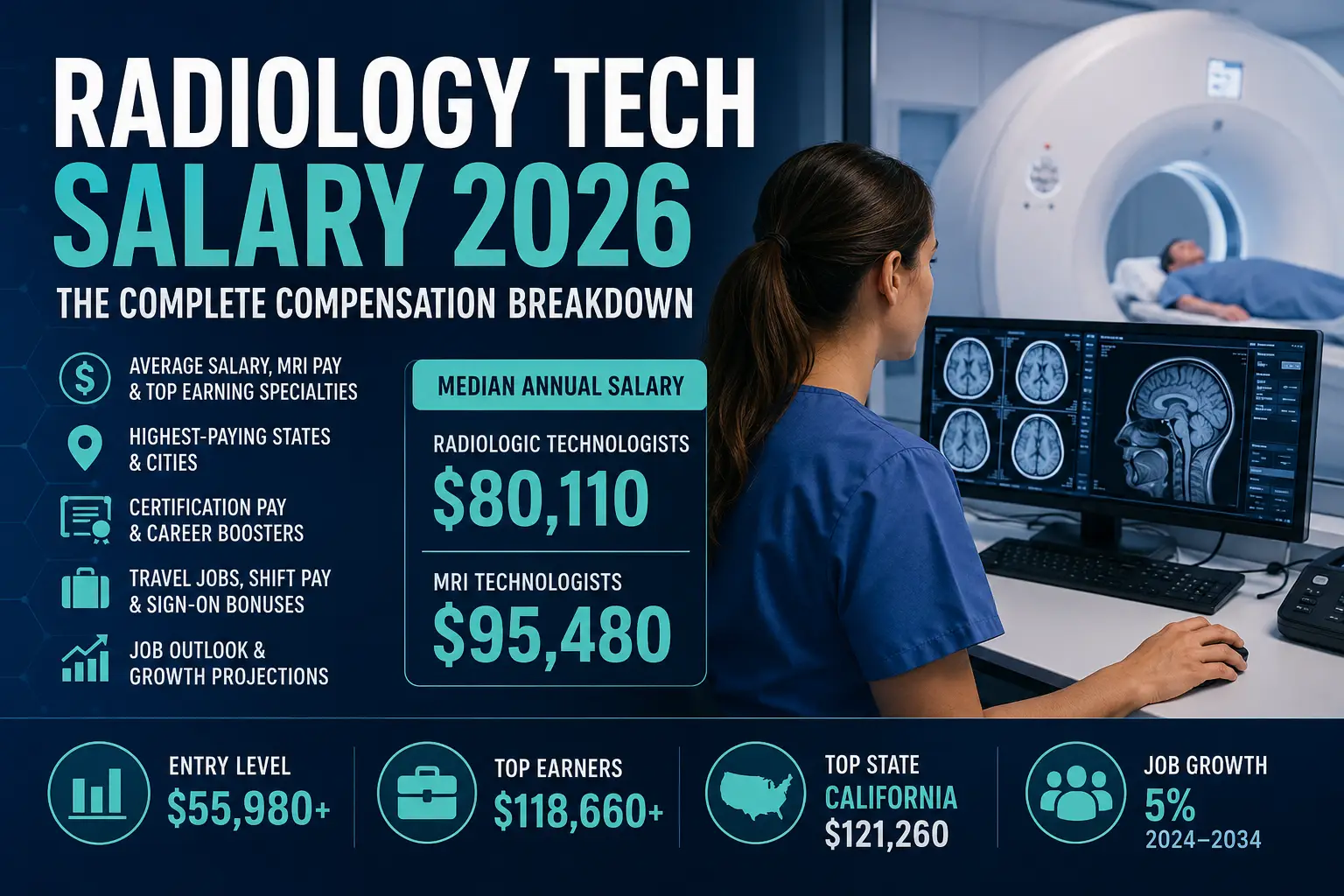
Quick Salary Summary
| Metric | Radiologic Technologists | MRI Technologists |
|---|---|---|
| Median Annual Wage | $80,110 | $95,480 |
| Median Hourly Wage | $38.52 | $45.90 |
| Entry Level (10th percentile) | $55,980 or less | $68,890 or less |
| Top Earners (90th percentile) | $118,660 or more | $127,670 or more |
| Total Employed (2024) | 228,000 | 41,530 |
| Projected Growth (2024–2034) | 4% | 7% |
Source: Bureau of Labor Statistics, May 2025 wage data and 2024–2034 employment projections
Quick Answers
What is the average radiology tech salary?
The median annual salary for radiologic technologists and technicians is $80,110 as of May 2025, according to the Bureau of Labor Statistics. The lowest 10% earn $55,980 or less, while the highest 10% earn $118,660 or more.
How much do MRI technologists earn?
MRI technologists earn a median annual salary of $95,480 — about $15,000 more than general radiologic technologists. The top 10% of MRI techs earn over $127,670 annually.
Which state pays radiologic technologists the most?
California pays the highest median wages at $121,260 annually, followed by Massachusetts ($103,620), District of Columbia ($102,770), Oregon ($102,290), and Washington ($102,090).
Is radiologic technology a good career?
Yes. The profession offers solid middle-class earnings with a clear path to six-figure income through specialisation (MRI, CT, interventional radiology), strategic location choices, and travel contracts. Job growth is faster than average at 5% through 2034.
Key Takeaways
- MRI technologists earn about $15,000 more than general radiologic technologists at the median
- California offers the highest median salaries at $121,260
- Federal government and outpatient centres typically pay the most
- Travel assignments can increase total compensation by 30–60%
- Additional ARRT certifications often provide the biggest salary gains
Market Snapshot: The Numbers That Actually Matter
Let’s cut through the noise. Salary data for radiologic technologists varies across different sources, and that’s not because the data is wrong—it’s because the profession itself is fragmented across different settings, specialties, and regions.
The Bureau of Labor Statistics (May 2025 data):
| Metric | Radiologic Technologists & Technicians | MRI Technologists |
|---|---|---|
| Median annual wage | $80,110 | $95,480 |
| Median hourly wage | $38.52 | $45.90 |
| 10th percentile | $55,980 or less | $68,890 or less |
| 90th percentile | $118,660 or more | $127,670 or more |
| Total employed | 228,000 | 41,530 |
Source: BLS Occupational Employment and Wage Statistics, May 2025
Why different sources report different numbers:
Salary estimates vary because different organisations use employer surveys, government employment data, and active job listings. Government labour statistics—like the BLS data above—provide the most comprehensive benchmark, covering employers across all industries and regions. Job posting data, by contrast, reflects current hiring demand and often includes sign-on bonuses and other incentives that raise the effective pay rate.
In practice, most full-time radiologic technologists earn salaries within a broad range depending on experience, employer, certification, and location. The national median serves as the best benchmark, while actual earnings vary considerably across markets.
Why Location Matters More Than Most People Think
The gap between the highest- and lowest-paying states for radiology techs is staggering—nearly $62,000 between California and Mississippi.
Highest-paying states for radiologic technologists (BLS May 2025):
| Rank | State | Median Annual Wage |
|---|---|---|
| 1 | California | $121,260 |
| 2 | Massachusetts | $103,620 |
| 3 | District of Columbia | $102,770 |
| 4 | Oregon | $102,290 |
| 5 | Washington | $102,090 |
Lowest-paying states:
- Mississippi: $59,300
- Alabama: $60,700
- Arkansas: $63,640
SalaryInfo Observation: The California premium isn’t just about cost of living. California has strong union presence in healthcare, higher staffing ratios mandated by law, a tech-driven economy that bids up wages across all skilled professions, and significant healthcare infrastructure concentrated in high-cost metro areas.
But here’s the contrarian take: moving to California doesn’t automatically increase your purchasing power. A $121,260 salary in San Francisco buys less than an $80,000 salary in Dallas when you factor in housing costs. The real winners are techs who live in lower-cost areas but work travel contracts that pay California-level wages.
Salary by Metro Area: The City-Level Picture
National and state averages hide enormous variation within states. Here’s how salaries differ across Texas metros, for example:
| Metro Area | Median Annual Wage |
|---|---|
| Austin-Round Rock-San Marcos | $83,870 |
| Dallas-Fort Worth-Arlington | $83,140 |
| Houston-Pasadena-The Woodlands | $80,780 |
| Midland | $80,700 |
| Texas (state average) | $78,630 |
| Killeen-Temple | $77,990 |
| El Paso | $72,810 |
| Lubbock | $67,110 |
| McAllen-Edinburg-Mission | $59,870 |
Key takeaway: Within a single state, the gap between the highest and lowest paying metros can exceed $24,000. Location isn’t just about which state—it’s about which city.
What Employers Actually Pay Above Market
Not all employers are created equal. The setting where you work has a direct, measurable impact on your compensation.
Radiologic Technologists & Technicians—Top Industries by Wage (May 2024):
| Industry | Median Annual Wage |
|---|---|
| Federal government (excluding postal service) | $93,970 |
| Outpatient care centres | $81,000 |
| Hospitals (state, local, private) | $78,560 |
| Medical and diagnostic laboratories | $76,770 |
| Offices of physicians | $66,060 |
MRI Technologists—Top Industries by Wage (May 2024):
| Industry | Median Annual Wage |
|---|---|
| Outpatient care centres | $128,290 |
| Hospitals (state, local, private) | $89,100 |
| Medical and diagnostic laboratories | $87,270 |
| Offices of physicians | $83,970 |
Why federal government pays more: The GS pay scale includes locality adjustments, step increases based on tenure, and benefits that often exceed private sector offerings. A GS-9 diagnostic radiologic technologist can earn $75,241–$97,819 annually.
Why outpatient centres pay MRI techs so well: These facilities are often owned by private equity or large healthcare systems competing for limited MRI talent. They can offer higher base pay because they don’t carry the overhead of 24/7 hospital operations.
Reality Check: The “offices of physicians” category consistently pays the least—often 15–20% below hospital rates. The trade-off is predictable hours, no weekends, and lower stress. For many mid-career professionals, that’s a worthwhile compromise.
Radiology Tech Salary by Experience Level
BLS doesn’t publish formal “experience level” buckets, but the wage percentiles offer a reasonable proxy:
| Experience Level | Percentile Range | Annual Salary Range |
|---|---|---|
| Entry level | 10th–25th percentile | $55,980 – $64,810 |
| Mid-career | Around the median | ~$80,110 |
| Experienced | 75th–90th percentile | $98,750 – $118,660 |
Source: BLS May 2025 wage data
New ARRT-certified rad techs typically start near the lower end of this range; long tenure plus advanced certifications push pay toward the upper end.
SalaryInfo Insight: The earnings curve for radiology techs is relatively steep in the first 5–7 years, then flattens significantly. Most professionals hit their salary ceiling around year 10 unless they:
- Move into management (lead or chief technologist)
- Add multiple certifications
- Transition to travel or contract work
- Shift to higher-paying specialities
Certification Premium: What ARRT Actually Gets You
The American Registry of Radiologic Technologists (ARRT) certification isn’t just a credential—it’s a requirement for employment at most hospitals and a gateway to higher pay.
What ARRT certification signals to employers:
- You’ve passed a national standardised exam
- You’ve completed an accredited educational program
- You maintain continuing education credits
- You’re eligible for state licensure (required in most states)
Post-primary certifications that increase earning potential:
| Certification | Estimated Annual Premium |
|---|---|
| CT (Computed Tomography) | +$5,000 – $10,000 |
| MRI (Magnetic Resonance Imaging) | +$10,000 – $15,000 |
| Mammography | +$3,000 – $7,000 |
| Vascular-Interventional Radiography | +$10,000 – $20,000 |
SalaryInfo Observation: Employers don’t typically pay a “certification bonus”—they simply won’t hire uncertified techs except in the most desperate situations. The premium isn’t in the base pay; it’s in employability. Uncertified techs are largely locked out of hospital jobs, limiting them to lower-paying private clinics.
The RT-to-MRI Transition: The Smartest Career Move
Here’s a pattern that’s becoming increasingly common: radiologic technologists who add MRI certification see their earnings jump by $10,000–$15,000 within 12–18 months of certification.
Why this works:
- MRI scanners are expensive and complex—facilities pay a premium for operators who can keep them running efficiently
- MRI demand is growing faster than general radiography (7% projected growth vs. 4% for radiologic techs)
- MRI techs often work in outpatient centres that pay higher rates than hospitals
- Cross-trained techs (X-ray + MRI) are more valuable to employers than single-modality techs
The typical pathway:
- Work 2–3 years as a general radiologic technologist
- Complete cross-training in MRI (often employer-sponsored)
- Pass the ARRT MRI post-primary exam
- Transition to an MRI role with a 10–15% pay increase
SalaryInfo Career Strategy: If you’re early in your radiology career, adding MRI certification is one of the highest-ROI moves you can make. The additional education is relatively inexpensive (often $2,000–$5,000), and the pay bump pays for itself within a year.
Travel Radiology: The 30–60% Earnings Premium
Travel radiology techs consistently earn significantly more than their permanent counterparts—often 30% to 60% higher total compensation, with housing stipends, meal per diems, and travel reimbursement on top of hourly rates.
Recent travel assignments (2026):
- Detroit, MI: $2,200 per week (Anders Group)
- Charlotte, NC: $3,147 per week (Voca Healthcare)
- Billings, MT: $2,480 – $2,646 per week (American Traveler)
- Interventional radiology travel: $3,680 per week (including per diem)
How travel pay works:
- Taxable hourly wage: ~$40–$45/hour
- Non-taxable stipends: Housing, meals, and incidentals ($1,500–$2,000/week)
- Total weekly gross: Often exceeds $3,000 for specialised roles
SalaryInfo Career Strategy: Travel contracts are ideal for early-to-mid-career techs who:
- Don’t have family obligations tying them to one location
- Want to pay down student debt quickly
- Are building experience toward a specialisation
- Want to test different work environments before committing to a permanent role
The downside: no guaranteed hours between assignments, no seniority-based benefits, and the constant disruption of moving every 13 weeks.
MRI vs CT vs X-ray: The Specialisation Pay Gap
Not all imaging modalities pay equally. Here’s how the major specialities compare:
| Speciality | Median Annual Wage | Typical Premium Over General RT |
|---|---|---|
| Interventional Radiology | $90,000 – $130,000+ | Highest |
| Diagnostic Medical Sonographer | $96,590 | +$16,000+ |
| MRI Technologist | $95,480 | +$15,000+ |
| CT Technologist | $72,000 – $88,000 | +$5,000 – $10,000 |
| General Radiologic Tech | $80,110 | Baseline |
| Surgical Technologist | $64,650 | -$15,000 |
Source: BLS May 2025 wage data
Why interventional radiology pays the most: These professionals assist in minimally invasive procedures like angiograms, biopsies, and stent placements. The work is more demanding (longer procedures, on-call requirements, higher stress), but the compensation reflects that. Interventional radiology technologists at Kaiser Permanente in Denver earn $49.59 – $66.22/hour, and entry-level roles at Mass General Brigham start at $40.95/hour.
SalaryInfo Insight: Diagnostic medical sonographers actually earn slightly more than MRI technologists at the median ($96,590 vs. $95,480). If you’re choosing a specialisation purely on salary, sonography is worth considering alongside MRI.
Radiology Tech vs. Related Healthcare Careers
How does radiology tech pay compare to other allied health professions?
| Career | Median Annual Wage (BLS May 2025) |
|---|---|
| Registered Nurse | $97,550 |
| Diagnostic Medical Sonographer | $96,590 |
| MRI Technologist | $95,480 |
| Radiologic Technologist | $80,110 |
| CRNA | $212,650 |
| Radiologist | $250,000+ |
| Cardiologist | $300,000+ |
| Surgeon | $250,000+ |
| Anesthesiologist | $270,000+ |
| Surgical Technologist | $64,650 |
Source: Bureau of Labor Statistics, May 2025
Key observations:
- RNs earn about $17,400 more than radiologic techs at the median
- MRI techs earn nearly $15,000 more than general radiologic techs
- Surgical technologists earn about $15,500 less than radiologic techs
Shift Differentials: The Hidden Income Driver
One of the most overlooked factors in radiology tech compensation is shift differentials—the additional pay for working evenings, nights, weekends, or holidays.
How shift differentials work:
- Evening shift: typically +5–10%
- Night shift: typically +10–15%
- Weekend shifts: typically +10–20%
- Holiday shifts: typically +50–100%
For a tech earning $38.52/hour (the median), a 10% night shift differential adds $3.85/hour, or $8,000+ annually for a full-time schedule.
Real-world examples:
- Boston Medical Center: Enhanced pay rates for per diem MRI techs + $15,000 sign-on bonus
- Kaiser Permanente (Denver): $52.08 – $69.54/hour for interventional radiology
SalaryInfo Strategy: If you’re willing to work nights or weekends, you can add $5,000–$15,000 to your annual earnings without changing employers or adding certifications.
Sign-On Bonuses: The New Normal
Hospitals in competitive markets are increasingly offering substantial sign-on bonuses to attract qualified technologists:
- Boston Medical Center: $15,000 sign-on bonus + $5,000 relocation assistance for MRI techs
- Johns Hopkins: $15,000 sign-on bonus for interventional radiology technologists
- Atrium Health (North Carolina): $15,000 sign-on bonus for new MRI tech hires, $10,000 for new graduates
These bonuses are typically paid in instalments over 1–2 years and may require a commitment to stay with the employer for a specified period.
The Biggest Salary Myth About This Profession
Myth: “Radiology techs earn the same regardless of where they work.”
Reality: The difference between the highest and lowest paying settings for MRI technologists is $44,000 per year ($128,290 in outpatient centres vs. $83,970 in physician offices).
For radiologic technologists, the gap between federal government ($93,970) and physician offices ($66,060) is $27,910.
SalaryInfo Verdict: If you’re earning below the median, the single most effective thing you can do is change employers—not improve your skills. Many techs stay in low-paying roles for years because they’re comfortable, not because better opportunities don’t exist.
Future Outlook: What the Next Five Years Look Like
Employment projections (2024–2034):
- Radiologic technologists and technicians: 4% growth (9,800 new jobs)
- MRI technologists: 7% growth (3,100 new jobs)
- Overall radiologic and MRI technologists: 5% growth (12,900 new jobs)
Why demand is growing:
- The U.S. population aged 65+ is projected to grow significantly, increasing the incidence of conditions that require diagnostic imaging
- Falls and associated injuries in older adults require X-rays and CT scans
- Cancer cases—which require MRI for detection and monitoring—are rising
- Chronic disease prevalence continues to increase, driving demand for diagnostic procedures
Annual openings: ~15,400 per year, with most resulting from retirements and career changes rather than new job creation.
SalaryInfo Market View: The job market for radiology techs remains healthy, but the growth is uneven. MRI and CT specialities are growing faster than general radiography. Techs who add multiple modalities will have the best job security and earning potential.
The Salary Ceiling: When More Experience Doesn’t Mean More Money
Most radiology techs hit a compensation ceiling around year 10–12 of their career. After that point, annual raises typically track inflation (2–3%) rather than reflecting meaningful career progression.
How to break through the ceiling:
- Move into management: Lead technologist, chief technologist, or imaging manager roles pay $90,000–$130,000+
- Add multiple certifications: CT + MRI + interventional radiology can push earnings above $120,000
- Transition to travel work: $100,000–$130,000 with flexibility
- Move to a higher-paying region: California, Massachusetts, or Washington D.C.
- Switch to outpatient or federal settings: Higher base pay and better benefits
- Move into PACS administration or imaging informatics—tech-adjacent roles with higher ceilings
SalaryInfo Warning: Don’t assume that time in role automatically leads to higher pay. Many techs stay at the same salary for years because they don’t actively manage their careers. The professionals who earn in the top quartile are intentional about their career moves—they don’t wait for raises to happen.
Understand Your Take-Home Pay
Once you know your expected salary, understanding your actual take-home pay is just as important. Use these tools to calculate your net income after taxes and deductions:
- Income Tax Calculator — Estimate your federal and state tax liability
- CTC Calculator — Understand your total compensation package
- Salary Slip Generator — See how your pay is structured
- HRA Calculator — Calculate your House Rent Allowance
- EPF Calculator — Estimate your retirement savings
- Gratuity Calculator — Plan for long-term benefits
- Overtime Calculator — See how extra hours boost your pay
If you’re planning a career in medical imaging, compare your expected salary with related healthcare professions and use our salary tools to estimate take-home pay after taxes.
FAQs
Is becoming a radiology tech hard?
The academic path is challenging but manageable. Most programs require 2 years of full-time study, including classroom instruction and clinical rotations. The ARRT exam has a pass rate of around 85–90% for first-time test-takers from accredited programs. The harder part is the work itself—you’re on your feet for long shifts, you need to lift and move patients, and you must maintain focus during repetitive procedures. The difficulty is comparable to nursing but with less direct patient care and more technical precision.
What type of radiology tech makes the most money?
Interventional radiology technologists consistently earn the highest salaries—often $90,000–$130,000+. These professionals assist in minimally invasive procedures like angiograms, biopsies, and stent placements. MRI technologists follow at $95,480 median, with CT technologists earning $72,000–$88,000.
Is radiology tech harder than RN?
They’re different kinds of hard. RNs manage more direct patient care, longer shifts (often 12 hours), and higher emotional demands. Radiology techs have more technical complexity, more physical demands (lifting patients, standing for long periods), and exposure to radiation (though carefully monitored). Both require associate’s degrees, both have similar earning potential, and both are in high demand. The choice comes down to whether you prefer patient interaction (nursing) or technical precision (radiology).
How fast can you become a radiology tech?
The fastest path is an associate’s degree program, which typically takes 2 years of full-time study. Some accelerated programs offer 18-month tracks, but these are intense. Prerequisites (anatomy, biology, chemistry, physics) may add 1–2 semesters if you don’t have them from high school. Certificate programs exist for professionals already holding degrees in related fields, but associate’s degrees are the standard entry point.
What’s the starting salary for a radiology tech?
Entry-level radiologic technologists typically earn $55,980–$64,810 annually (10th–25th percentile). MRI technologists start slightly higher, with entry-level roles often starting at or near the upper quartile of general RT compensation. These figures vary significantly by region—entry-level techs in California might start at $70,000+, while those in rural Southern states might start below $50,000.
Do radiology techs get paid hourly or salary?
Most radiology techs are hourly employees, which means overtime pay (typically 1.5x base rate) for hours worked beyond 40 per week. This is actually advantageous—many techs significantly boost their earnings through overtime, especially in hospitals that are perpetually understaffed. Salaried positions exist but are more common in management roles or outpatient settings with predictable schedules.
What’s the job outlook for radiology techs?
Positive but not explosive. The BLS projects 5% growth from 2024–2034, faster than the average for all occupations. About 15,400 openings are projected annually. MRI technologists have stronger growth at 7%. The real opportunity is in specialisation—general radiography is growing slowly, but CT, MRI, and interventional radiology are all growing faster.
Which state pays radiologic technologists the most?
California pays the highest median wages at $121,260 annually. Massachusetts ($103,620), District of Columbia ($102,770), Oregon ($102,290), and Washington ($102,090) round out the top five.
What’s the difference between a radiologic technologist and a radiology technician?
The terms are often used interchangeably, but “radiologic technologist” is the more accurate professional title for someone who has completed an accredited program and passed the ARRT certification exam. “Radiology technician” is sometimes used for assistants with less training. In practice, most job postings use “technologist” for ARRT-credentialed professionals.
How much do travel radiology techs make?
Travel radiology techs typically earn $2,000–$3,500+ per week, which translates to $95,000–$130,000+ annually. This includes a taxable hourly wage plus non-taxable stipends for housing, meals, and incidentals. Specialised roles like interventional radiology can earn even more, with some assignments paying over $3,600 per week.
Sources
- Bureau of Labor Statistics, Occupational Employment and Wage Statistics (May 2025)
- Bureau of Labor Statistics, Employment Projections program (2024–2034)
- American Registry of Radiologic Technologists (ARRT)
- Employer compensation information used where noted
SalaryInfo Editorial Verdict
Radiologic technology offers solid, middle-class earnings with a clear path to six-figure income through specialisation and strategic career moves.
The base salary of $80,110 is respectable—above the national median for all occupations and competitive with other healthcare technician roles. But the real story is the upside. Techs who:
- Add MRI or CT certification
- Work in high-paying regions
- Take travel contracts
- Move into interventional radiology or management
…can earn well into six figures within 5–10 years of starting their careers.
The biggest risk is stagnation. Many techs settle into comfortable hospital roles and stop advancing. Their earnings plateau, and they miss out on the significant premiums available for specialisation and strategic job changes.
The bottom line: If you’re willing to invest in additional certifications and make intentional career moves, radiology tech offers strong earning potential. If you’re looking for a stable job with predictable pay and minimal advancement, it’s still a solid career—just don’t expect to crack the top decile without effort.
Our salary analysis combines official U.S. government wage statistics from the Bureau of Labor Statistics (BLS) Occupational Employment and Wage Statistics (OEWS) program using May 2025 wage data, employment outlook information from the BLS Employment Projections Program (2024–2034), verified industry compensation reports, and current hiring market trends. This multi-source methodology helps provide a comprehensive view of salary expectations across the United States.
Editorial Note: Salary figures are national estimates intended for informational purposes. Actual earnings may vary based on education, certification, employer, industry, geographic location, specialization, overtime opportunities, and years of professional experience.