
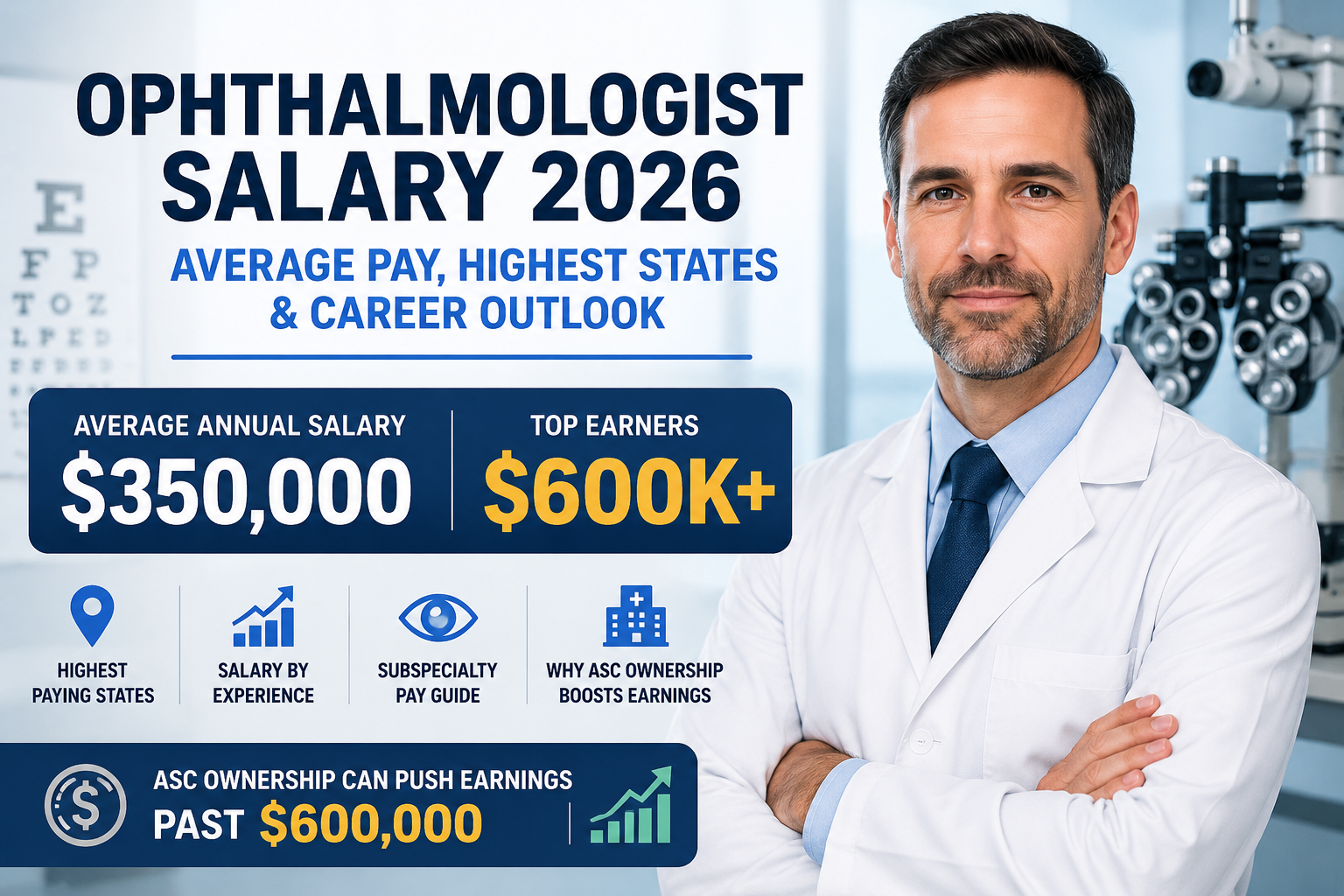
Quick Facts: Ophthalmologist Salary 2026
| Metric | Value |
|---|---|
| Average Annual Salary | $350,000 |
| Top Earners | $600,000 – $1,000,000+ |
| Total Training | 8 Years (4 med school + 4 residency/fellowship) |
| Job Growth (2024–2034) | 4.3% |
| Average Workweek | 40–50 Hours |
| AI Risk | Low (72/100 resilience) |
| Career Satisfaction | 88% would choose again |
The Real Numbers Behind Ophthalmologist Pay
Average ophthalmologist salary is approximately $350,000 per year. Depending on compensation methodology, published estimates range from roughly $300,000 to over $460,000, while physicians with ownership stakes can exceed $600,000 annually.
Ask five different sources what an ophthalmologist makes in 2026, and you’ll get five different numbers. National employment estimates show around $301,500. Physician compensation surveys report $464,000 at the high end. Industry research suggests the median sits near $350,000.
Who’s right?
All of them. And none of them.
Welcome to physician compensation data in 2026 — where the headline number is less important than understanding why the spread is this wide, and where you need to sit in the distribution to actually make money.
Ophthalmologist Salary Snapshot (2026)
| Salary Metric | Amount |
|---|---|
| Average Annual Salary | $350,000 |
| Hourly Rate (40-hour week) | $163–$180 |
| Monthly Pay | $29,167 |
| Top 10% Earners | $600,000+ |
| Entry-Level (First Attending) | $250,000–$300,000 |
| Experienced (10+ Years) | $450,000+ |
| Resident Salary | $68,500–$77,800 |
The Real Money Isn’t in the Salary — It’s in the Structure
Here’s what most salary articles won’t tell you.
The difference between a $350,000 ophthalmologist and a $600,000+ ophthalmologist isn’t skill. It’s structure.
ASC ownership is the single biggest lever in this specialty. A high-volume cataract surgeon with ambulatory surgery center ownership routinely clears $700,000 to over $1 million annually. Why? Because you’re not just earning professional fees for the surgery — you’re earning a cut of the facility revenue on every case performed at your center.
Cataract surgery is a 15-minute outpatient procedure that generates $1,500 to $2,500 per case. A surgeon performing 1,000 cataracts per year generates $1.5 million to $2.5 million in professional and facility revenue combined. The surgeon who owns the facility keeps a significantly larger share.
Premium lens implants (multifocal, toric) create a private-pay revenue stream that supplements insurance-based income. LASIK adds another cash-pay layer.
Recent physician compensation research confirms that earnings are separating based on procedural volume, surgery center ownership, and private practice exposure — not seniority.
The market insight: Ophthalmology is one of the few remaining specialties where private practice ownership still offers a genuine path to generational wealth. That window isn’t closing — but it’s getting narrower as hospital employment expands.
What Kind of Ophthalmologist Makes the Most Money?
Short answer: The one who owns the surgery center.
Longer answer: Subspecialty matters less than practice structure. Retina specialists average around $286,000 in employed settings. Comprehensive ophthalmologists with high cataract volume and ASC ownership can clear $600,000+.
The hierarchy looks something like this:
| Practice Structure | Average Annual Compensation |
|---|---|
| Private practice partner with ASC ownership | $600,000 – $1,000,000+ |
| High-volume employed surgeon (productivity bonus) | $450,000 – $600,000 |
| General ophthalmologist (employed, standard productivity) | $340,000 – $400,000 |
| Retina specialist (employed) | $280,000 – $350,000 |
| Academic ophthalmologist | $220,000 – $300,000 |
The retina number looks low because retina call is brutal — retinal detachments don’t wait for business hours. The pay reflects the lifestyle trade-off.
Ophthalmologist Salary by Experience Level
| Experience Level | Average Annual Salary |
|---|---|
| Resident (PGY-1 to PGY-4) | $68,500 – $77,800 |
| Entry Level (0–1 year) | $212,000 – $250,000 |
| 1–5 Years | $250,000 – $320,000 |
| 5–10 Years | $320,000 – $400,000 |
| 10–20 Years | $400,000 – $500,000 |
| 20+ Years | $500,000+ |
Ophthalmologist Salary by State: Where Your Dollar Goes Furthest
Gross salary is one thing. What you keep is another.
National employment data shows top-line salaries varying significantly by state, but the real story is after-tax income — because a $358,490 salary in New Hampshire looks very different from a $340,300 salary in California after state taxes.
| State | Gross Annual Salary | Estimated After-Tax Income | Demand Signal |
|---|---|---|---|
| New Hampshire | $358,490 | $250,677 | Limited |
| Ohio | $367,750 | $244,343 | Low |
| New York | $348,610 | $218,341 | High |
| California | $340,300 | $192,000 | Very High |
| Texas | $335,000 | $238,000 | High |
| Florida | $330,000 | $235,000 | Very High |
| Pennsylvania | $325,000 | $223,000 | Moderate |
| Illinois | $320,000 | $218,000 | Moderate |
| Michigan | $315,000 | $220,000 | Low |
| Massachusetts | $310,000 | $202,000 | Moderate |
The gap: An ophthalmologist in New Hampshire keeps roughly $132,862 more per year than one in Utah, despite similar gross salaries.
The contrarian view: High-tax states like California and New York offer something that doesn’t show up in the spreadsheet — massive patient volume driven by aging populations. Retirement-heavy markets (Florida, Arizona, the Sun Belt) generate cataract volume that supports $600,000+ practices without cosmetic supplementation.
The play: If you’re early-career, go where the volume is. Build your surgical numbers. Then decide where you want to keep your income.
Highest Paying Cities for Ophthalmologists
| City | Average Annual Salary |
|---|---|
| Beckley, WV | $500,000 |
| Charleston, WV | $484,714 |
| Phoenix, AZ | $369,589 |
| Lubbock, TX | $350,000 |
| Staten Island, NY | $336,858 |
| Brooklyn, NY | $314,399 |
| Gilford, NH | $300,000 |
| Teaneck, NJ | $293,392 |
| Bronx, NY | $273,871 |
Highest Paying Employers for Ophthalmologists
| Employer | Average Annual Salary |
|---|---|
| Talent | $500,000 |
| Eye Care for the Adirondacks | $500,000 |
| All Star Healthcare Solutions | $486,500 |
| The Medicus Firm | $482,442 |
| Curative Talent | $463,357 |
| Optum | $461,532 |
Pros and Cons of Ophthalmology as a Career
| Pros | Cons |
|---|---|
| Excellent work-life balance | Long education pathway (8+ years) |
| High earning potential ($350K–$1M+) | Competitive residency matching |
| Strong and growing demand (4.3% growth) | High surgical responsibility |
| Minimal emergency call | Expensive malpractice insurance |
| Patients often see immediate improvement | ASC ownership requires capital |
| 88% would choose again | Only 49% feel fairly compensated |
Is Ophthalmology a Stressful Job?
Short answer: Less stressful than most surgical specialties. More stressful than you think.
Ophthalmology consistently ranks near the top for career satisfaction. Around 88% of ophthalmologists would choose the specialty again — second only to dermatology.
Why it’s low-stress relative to other surgical fields:
- Minimal call, rare overnight emergencies (retinal detachments are the exception)
- Predictable clinic-to-OR schedule
- No hospital rounds at 5 AM
- Cataract surgery is quick, low-risk, and highly rewarding — patients often see immediate improvement
Why it’s still stressful:
- High surgical volume creates productivity pressure
- The move toward employed models means RVU targets and administrative oversight
- Only 49% of ophthalmologists feel fairly compensated — despite high earnings
- The gap between high-earners and everyone else is widening, creating internal pressure
Physician satisfaction surveys show that satisfaction and compensation are decoupled — two ophthalmologists earning similar amounts can have very different experiences depending on administrative burden, staffing support, and ownership structure.
The read: The specialty is great. The employment model matters more than the specialty itself.
Will Ophthalmology Be Replaced by AI?
Short answer: No. But the practice of ophthalmology will change more in the next decade than in the previous five.
The bullish case for ophthalmologists:
AI is already FDA-cleared for autonomous diabetic retinopathy screening. Algorithms match human accuracy for OCT analysis and glaucoma detection.
The bearish case for AI replacing ophthalmologists:
AI outputs probabilities, not diagnoses. It doesn’t read a patient’s fear. It doesn’t weigh values alongside evidence. It doesn’t perform surgery.
Industry analysis shows that AI in retina care outputs probabilities, not diagnoses — and will not replace retinal expertise or clinical judgement.
The real threat isn’t replacement. It’s commoditization.
If AI handles screening, diagnosis, and even surgical planning (intraocular lens calculations are already AI-assisted), then the value shifts from interpretation to management and surgery. The ophthalmologist who simply reads scans will be squeezed. The ophthalmologist who operates and manages complex cases will be fine.
AI resilience score: 72/100 — high resilience, but not immunity.
The market insight: AI won’t replace ophthalmologists. But ophthalmologists who use AI will replace those who don’t.
Ophthalmologist Salary Per Month / Per Hour
Based on the $350,000 average range:
| Metric | Calculation |
|---|---|
| Per month | $29,167 |
| Per hour (40-hour week) | $168 |
| Per week | $6,731 |
Reality check: Most ophthalmologists work more than 40 hours. And the hourly rate for a high-volume surgeon doing 1,000 cataracts a year is significantly higher — $1,500–$2,500 per case means the effective hourly rate during OR time is astronomical.
Common Benefits for Ophthalmologists
Beyond base salary, ophthalmologists typically receive:
| Benefit | Typical Value |
|---|---|
| Health Insurance | Employer-sponsored |
| Malpractice Coverage | Employer-covered |
| Retirement Plans (401k/403b) | Employer match |
| CME Allowance | $3,000 – $5,000/year |
| Performance Bonuses | 10–20% of base |
| Paid Vacation | 4–6 weeks/year |
| Signing Bonuses | $20,000 – $50,000 (rural areas) |
Job Outlook for Ophthalmologists (2024–2034)
| Metric | Data |
|---|---|
| Projected Growth | 4.3% |
| Growth Comparison | As fast as average |
| Current Practicing | 12,500 |
| New Positions by 2034 | +600 |
| Demand Drivers | Aging population, cataract volume |
Source: Bureau of Labor Statistics data, Employment Projections 2024-2034.
Ophthalmologist Salary Trends (2022–2026)
| Year | Average Annual Salary |
|---|---|
| 2022 | $308,000 |
| 2023 | $328,000 |
| 2024 | $338,000 |
| 2025 | $345,000 |
| 2026 | $350,000+ |
Trend analysis: Ophthalmologist compensation has grown approximately 3–4% annually over the past five years, with higher growth among private practice owners and ASC partners.
Ophthalmologist Salary by Country
| Country | Average Annual Salary (USD) |
|---|---|
| United States | $340,000 – $464,000 |
| Switzerland | $348,000+ |
| Australia | $280,000+ |
| Canada | $242,000 – $325,000 |
| United Kingdom (NHS Consultant) | $135,000 – $180,000 |
The gap: A U.S. ophthalmologist earns 2–3x what a UK NHS consultant earns. But the U.S. system comes with higher malpractice costs, higher overhead, and no guaranteed pension.
Starting Ophthalmologist Salary (Entry-Level)
| Career Stage | Annual Salary |
|---|---|
| Resident (PGY-1 to PGY-4) | $68,500 – $77,800 |
| First attending position | $250,000 – $300,000 |
| Early-career (0–3 years post-training) | $250,000 – $320,000 |
Key insight: Early-career data suggests this is the period where you’re building surgical volume and productivity. Your starting salary matters less than your growth trajectory.
How to Become an Ophthalmologist: Career Roadmap
| Step | Duration | Details |
|---|---|---|
| 1. Bachelor’s Degree | 4 years | Pre-med coursework (biology, chemistry, physics) |
| 2. Medical School | 4 years | MD or DO degree |
| 3. Internship | 1 year | Foundation training |
| 4. Ophthalmology Residency | 3 years | Clinical and surgical training |
| 5. Fellowship (Optional) | 1–2 years | Retina, glaucoma, cornea, oculoplastics |
| 6. Board Certification | Ongoing | American Board of Ophthalmology |
Total training: 4 years medical school + 4 years residency/fellowship = approximately 8 years after undergraduate degree.
Essential Skills for Ophthalmologists
| Skill Category | Key Competencies |
|---|---|
| Surgical Skills | Microsurgery, manual dexterity, 3D depth perception |
| Diagnostics | Ophthalmoscopes, slit lamps, imaging interpretation |
| Patient Communication | Explaining diagnoses, treatment plans, reassurance |
| Clinical Decision-Making | Problem-solving, risk assessment |
| Leadership | Team management, multidisciplinary coordination |
| Technical Proficiency | Laser systems, surgical microscopes |
Why Ophthalmology Remains a Top Career Choice
Career Score: 68/100 (Very Good)
| Metric | Score |
|---|---|
| Salary | 45 |
| Satisfaction | 84 |
| Demand | 63 |
| Would Choose Again | 82 |
| Work-Life Balance | 74 |
| Training ROI | 71 |
| AI Resilience | 72 |
Key insights:
- Second-highest “would choose again” rate in medicine
- 88% would choose again — only dermatology scores higher
- Surgical income with lifestyle-specialty hours
- Minimal call, no overnight emergencies (except retinal detachments)
- Four-year training pipeline with strong ROI
FAQs
Are ophthalmologists well-paid in 2026?
Yes. Average compensation is approximately $350,000, placing ophthalmology among the top-paying physician specialties. High-volume surgeons with ASC ownership can earn well over $600,000.
Which ophthalmology subspecialty pays the most?
Comprehensive ophthalmologists with high cataract volume and ASC ownership earn the most — often $600,000+. Retina specialists in employed settings average around $286,000.
Is ophthalmology a stressful career?
Less stressful than most surgical specialties. Minimal call, predictable hours, and high satisfaction rates (88% would choose again). However, productivity pressure and the gap between high and low earners create stress for some.
Will AI replace ophthalmologists?
No. AI enhances diagnostic accuracy and workflow efficiency but cannot replace surgical skills, clinical judgement, or patient communication. The role will shift toward management and complex cases.
How much does an ophthalmologist make per month?
Based on the $350,000 average range, monthly pay is approximately $29,167.
How does U.S. ophthalmologist salary compare to the UK?
U.S. ophthalmologists earn roughly 2–3x more than UK NHS consultants. UK consultant salaries range from £109,725 to £145,478 ($135,000–$180,000 USD).
What is the starting salary for an ophthalmologist?
First attending positions typically start at $250,000–$300,000. Resident salaries range from $68,500–$77,800 during training.
Which state pays ophthalmologists the highest?
West Virginia (Beckley) shows salaries near $500,000, followed by Ohio ($367,750) and New Hampshire ($358,490). However, after-tax income varies significantly.
Can ophthalmologists earn over $1 million?
Yes. Ophthalmologists with ambulatory surgery center ownership and high surgical volume can earn $700,000 to over $1 million annually.
Is private practice better than employed for ophthalmologists?
Private practice with ASC ownership offers significantly higher income potential ($600,000+). Employed positions offer stability, benefits, and no administrative burden but lower compensation ($340,000–$400,000).
How many hours do ophthalmologists work?
Most ophthalmologists work 40–50 hours per week, with predictable clinic-to-OR schedules. Call is minimal compared to other surgical specialties.
Can ophthalmologists work part-time?
Yes. Part-time opportunities exist in employed settings and locum tenens work. Part-time compensation scales proportionally, typically $150,000–$250,000 for 20–30 hours per week.
Is ophthalmology one of the highest-paying medical specialties?
Yes. Ophthalmology consistently ranks among the top 5–10 highest-paying specialties, behind neurosurgery, orthopedic surgery, and cardiology, but ahead of most internal medicine subspecialties.
How We Compiled This Salary Guide
Salary estimates in this guide were compiled by analyzing U.S. physician compensation reports, government employment data, healthcare workforce research, ophthalmology practice trends, and recent job postings. Actual earnings vary based on location, experience, subspecialty, and practice ownership.
Data sources include:
- U.S. government employment statistics
- Physician compensation surveys
- Healthcare workforce research
- National ophthalmology compensation studies
- Public physician recruitment data
Related Salary Guides
| Occupation | Salary Guide |
|---|---|
| Physician | Surgeon Salary |
| Surgeon | Neurosurgeon Salary |
| Dermatologist | Cardiologist Salary |
| Radiologist | Radiologist Salary |
| Psychologist | Psychologist Salary |
| Accountant | Accountant Salary |
Key Takeaways
- The average ophthalmologist salary in the U.S. in 2026 is approximately $350,000, with total compensation reaching $464,000 at the high end and exceeding $600,000 for ASC owners.
- Practice structure matters more than subspecialty. ASC ownership and high surgical volume separate the top earners from the average.
- State taxes significantly impact take-home pay. An ophthalmologist in New Hampshire keeps roughly $132,862 more per year than one in Utah, despite similar gross salaries.
- AI is transforming the field but not replacing ophthalmologists. The technology handles screening and diagnostics — surgery and complex case management remain human.
- Career satisfaction is high (88% would choose again), but only 49% feel fairly compensated — highlighting the gap between earnings and perceived value.
- The job market is growing at 4.3% through 2034, driven by an aging population and increasing cataract volume.
Action Strategy for 2026–2027
- If you’re in training: prioritize surgical volume. Numbers matter.
- If you’re employed: understand your productivity bonus structure. Negotiate.
- If you’re considering a move: calculate after-tax income, not just gross salary.
- If you’re in practice: evaluate ASC ownership opportunities. That’s where the real upside is.
Ophthalmology continues to be one of the highest-paying and most rewarding medical specialties in the United States, combining strong earning potential with favorable work-life balance and long-term demand.
👤 Reviewed & Published By
⚠️ AI Health Disclaimer
This article is for informational purposes only and does not constitute financial, career, or medical advice. Salary data is based on publicly available sources and may vary by region, employer, and individual circumstances.