
📅 Last Updated: July 2026
The average Urologist salary in the United States is approximately $535,000 in 2026, according to recent national physician compensation surveys. This makes urology one of the highest-paid surgical specialties.
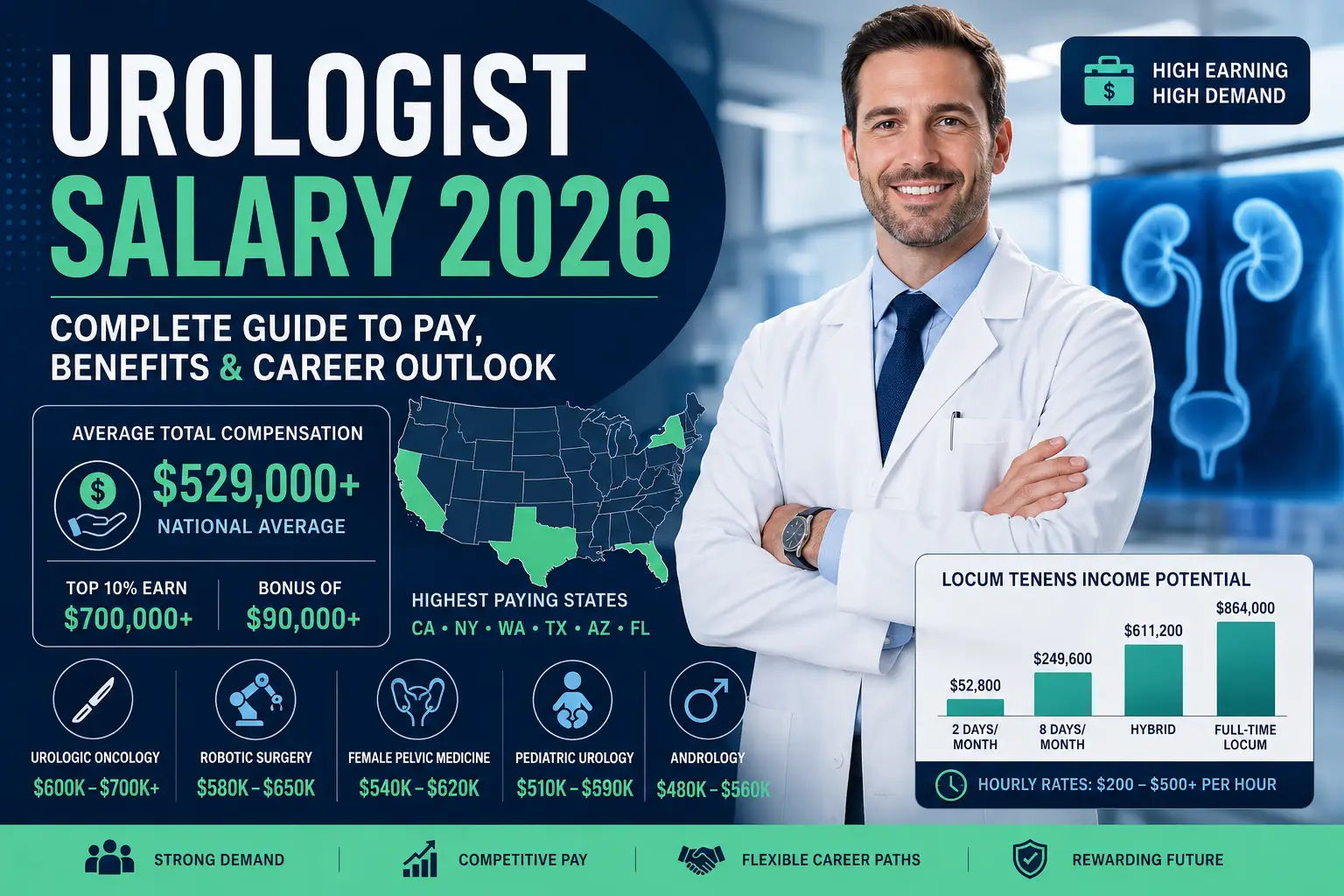
Experienced surgeons in private practice and high-volume procedural settings can earn more than $700,000 annually, while locum tenens physicians working extended surgical blocks or emergency call coverage may exceed $850,000, depending on workload and geographic demand.
Urologist Salary Highlights (2026)
| Metric | Value |
|---|---|
| Average Salary | $535,000 |
| Median Salary | $559,474 |
| Starting Salary Range | $330,000 – $496,000 |
| Top Earners (90th Percentile) | $700,000+ |
| Typical Hourly Rate | $257 – $500 |
| Highest Paying State | California ($575,000) |
While national averages provide a solid benchmark, actual take-home pay varies significantly based on experience, subspecialty training, practice ownership, and location. This guide breaks down exactly what you can expect regarding compensation, career trajectory, and earning potential in the coming years.
What Is the Average Urologist Salary in 2026?
Compensation figures vary depending on whether they measure starting offers, median self-reported earnings, or total compensation packages. The table below consolidates the most reliable industry benchmarks for 2026:
| Compensation Source | Salary |
|---|---|
| National recruiting survey (average starting offers) | $496,000 |
| National physician compensation survey (average total comp) | $535,000 |
| Physician earnings survey (median total comp) | $559,474 |
| Verified physician compensation database (median) | $590,000 |
| Recruiting offer benchmark (entry-level starting) | $330,000 |
| Top earners benchmark (90th percentile) | $700,000+ |
Expert interpretation: While recruiting firms report starting salaries between $330,000 and $496,000, established physicians generally earn considerably more because compensation increasingly shifts toward productivity bonuses, surgical volume, partnership distributions, and ancillary revenue rather than base salary alone. Base salary is merely the floor—not the ceiling—of total earnings.
Historical Salary Trends (2023–2026)
Understanding the upward trajectory provides crucial context for career planning. Based on year-over-year physician compensation surveys, urology salaries have shown consistent, steady growth:
| Year | Average Annual Salary (Approx.) |
|---|---|
| 2023 | ~$510,000 |
| 2024 | ~$520,000 |
| 2025 | ~$525,000 |
| 2026 | ~$535,000 |
This steady increase reflects the intensifying workforce shortage, growing procedural demand from an aging population, and the expanding role of robotic surgery. Multiple national physician compensation surveys have reported steady year-over-year increases in urologist earnings—a trend expected to continue through the remainder of the decade.
Factors That Affect Urologist Salary in 2026
Several variables shift actual take-home pay significantly beyond national averages.
1. Experience Level (With Visual Growth Tracker)
Compensation grows substantially with tenure, driven by expanding patient panels, higher surgical volume, and increasing negotiating leverage.
text
Entry-level (0-2 yrs):  ██████░░░░░░░░░  $280k – $360k
Mid-career (3-8 yrs):   ████████████░░░  $400k – $580k
Senior (9+ yrs):        ████████████████  $580k – $700k+
New physicians often receive a base salary with a productivity ramp in year two, allowing time to build a patient base while protecting their income floor.
2. Highest Paying States for Urologists (Top 10)
Geographic location remains one of the single largest drivers of compensation for 2026. High-cost metropolitan areas and underserved rural markets consistently offer the highest pay to attract talent.
| Rank | State | Estimated Average Annual Salary |
|---|---|---|
| 1 | California | $575,000 |
| 2 | New York | $540,000 |
| 3 | Washington | $530,000 |
| 4 | Texas | $515,000 |
| 5 | Arizona | $510,000 |
| 6 | Florida | $495,000 |
| 7 | Colorado | $485,000 |
| 8 | Massachusetts | $480,000 |
| 9 | North Carolina | $475,000 |
| 10 | Minnesota | $470,000 |
For example, urologists in San Jose, California, earn significantly more than the national average, with salaries topping $505,000 in 2026, based on recent physician compensation data. High cost-of-living areas often adjust pay upward, while underserved regions compete aggressively with signing bonuses and loan repayment.
3. Practice Setting and Employment Model
Where you work shapes not just your base salary but the entire structure of your compensation package for 2026.
- Hospital / Health System Employed: Base salary plus wRVU (work relative value unit) productivity bonuses. Most urologists generate 8,000–12,000 wRVUs per year, with bonus rates of $60–$80 per wRVU above threshold. Comprehensive benefits are included.
- Private Group Practice: Higher earning potential through profit-sharing and direct control over overhead, but with greater financial risk and administrative responsibility.
- Academic Medical Center: Below-market base, offset by research funding, teaching flexibility, and access to complex cases.
- VA / Government Facility: Stable income, limited or no call burden, but a capped income ceiling.
- Locum Tenens: Highest effective hourly rates; housing and travel are covered separately; no employer benefits included.
4. Subspecialty Training (Fellowship)
Fellowship training commands a meaningful premium, reflecting additional expertise and limited supply. Robotic surgery expertise is particularly valued across all subspecialties in 2026.
| Subspecialty | Estimated Annual Compensation |
|---|---|
| Urologic Oncology | $600,000 – $700,000+ |
| Robotic & Minimally Invasive Surgery | $580,000 – $650,000 |
| Female Pelvic Medicine & Reconstructive Surgery | $540,000 – $620,000 |
| Pediatric Urology | $510,000 – $590,000 |
| Male Infertility & Andrology | $480,000 – $560,000 |
| General Urology | $400,000 – $580,000 |
5. Bonuses and Additional Incentives
Base salary rarely tells the whole story. Verified physician salary data shows that 88% of urologists receive bonus or incentive compensation, with a median annual bonus of $90,000. Additional compensation components include:
- Sign-on bonuses: Typically $20,000 – $75,000 (higher in rural markets).
- Call stipends: Positions with extensive overnight/weekend call offer 15–25% higher base compensation or separate stipends.
- Administrative roles: Medical director and department leadership roles add $25,000 – $75,000 annually.
Urologist Hourly Salary and Locum Tenens Income (2026)
Many physicians and job seekers specifically search for hourly rates, particularly when comparing locum tenens to permanent W-2 roles.
Hourly Rate Breakdown
| Compensation Type | Hourly Rate |
|---|---|
| W‑2 employed (triangulated estimate) | ~$257 per hour |
| Locum tenens market rate (standard clinic coverage) | $200 – $500 per hour |
The locum tenens market for urology has one of the widest compensation bands among procedural specialties. Standard clinic coverage may land near the lower end, while emergency call coverage, trauma support, rural assignments, and extended surgical blocks push rates toward the top of the band.
Locum Tenens Income Scenarios for 2026
Locum work combines clinic coverage, operative days, and call responsibilities into flexible structures. The scenarios below use representative national locum rates:
| Scenario | Workload | Annual Income Estimate |
|---|---|---|
| Supplemental (2 days/month) | 24 days/year, 8 hrs/day at $275/hr | ~$52,800 (added to a primary W‑2 role) |
| Half‑time locum | 8 days/month, 96 days/year at $325/hr | ~$249,600 |
| Hybrid model | $496,000 employed base + 3 locum days/month at $400/hr | ~$611,200 |
| Full‑time locum | 18 days/month, 216 days/year at $500/hr | ~$864,000 |
Expert insight: Urologists working high-demand surgical call, trauma coverage, or extended rural assignments can materially exceed traditional employed compensation benchmarks through locum work alone—particularly in markets facing persistent surgical shortages.
Private Practice and Ancillary Revenue (The Real Earnings Differentiator)
One of the biggest missed opportunities in general salary discussions is ancillary revenue. In urology, compensation is often driven as much by practice economics as by clinical production alone.
Did You Know? Many experienced private-practice urologists earn more from ambulatory surgery centers, imaging services, and other ancillary revenue than from their base clinical salary.
Private practice urologists with ownership stakes in the following entities often out-earn employed physicians even at similar surgical volumes:
- Ambulatory Surgery Centers (ASCs): Ownership distributions from facility fees for procedures performed.
- Imaging centers: In-office ultrasound and CT urography revenue streams.
- Lithotripsy services: Shockwave lithotripsy equipment ownership or partnerships.
- In-office procedures: Vasectomies, cystoscopies, and biopsies performed in the office setting generate facility fees that stay within the practice.
- Infusion services: In-office chemotherapy and biologic infusion for oncology patients.
This ancillary income explains why a high-volume general urologist in a community setting may out-earn a subspecialist in an academic center, despite similar training.
Urologist Salary vs. Other Surgical Specialties (2026)
Urology consistently ranks in the top tier of physician compensation, typically placing in the top 10 specialties by average salary. The premium reflects the combination of cognitive expertise and surgical skill.
| Specialty | Estimated Average Annual Salary |
|---|---|
| Neurosurgery | $788,000 |
| Orthopedic Surgery | $737,000 |
| Urologic Oncology | $650,000+ |
| Plastic Surgery | $629,000 |
| Cardiology | $592,000 |
| Urology (General) | $529,000 |
| Gastroenterology | $511,000 |
| Radiology | $500,000 |
| Anesthesiology | $462,000 |
| Internal Medicine | $264,000 |
Work-Life Balance and Career Outlook (2027–2030)
Workforce Shortage and Future Demand
The career outlook for urology is exceptionally strong due to structural factors:
- Aging population: The prevalence of prostate issues, kidney stones, and urinary incontinence rises naturally with age, ensuring a steady stream of patients.
- Severe shortage: Over 60% of all U.S. counties have no practicing urologist. Approximately 40% of the current urology workforce will reach retirement age within the next decade.
- Limited residency pipeline: The number of trained urologists cannot keep pace with growing procedural demand.
- Robotic surgery expansion: Facilities investing in da Vinci programs aggressively recruit fellowship-trained urologists and compensate accordingly.
The Bureau of Labor Statistics projects overall physician employment growth of 3% from 2024 to 2034, but urology’s demand trajectory is significantly stronger than the overall physician average.
Urologist Salary Outlook (2027–2030)
Forward-looking analysis suggests continued upward pressure on compensation:
- 2027–2030 projections: Expect sustained year-over-year growth as the workforce shortage widens.
- Rural premiums will likely increase further as more facilities struggle to recruit permanent coverage.
- Locum tenens demand will remain high, with rates potentially exceeding current bands for urgent, short-notice coverage.
- Subspecialty premiums (especially oncology and robotics) will continue to outpace general urology growth.
Pros and Cons of a Career in Urology
| Pros | Cons |
|---|---|
| Top-tier compensation ($500k–$700k+) | Lengthy training (5-year residency + optional 1–2 year fellowship) |
| Strong job security due to structural shortage | Significant call burden in many hospital settings |
| Diverse patient mix (medical + surgical management) | High administrative and documentation load |
| Opportunities for ancillary income (ASC, imaging) | Increasing reliance on wRVU productivity metrics |
| Growing demand for robotic and minimally invasive techniques | Rural locations often require broader scope of practice |
| Flexible career paths (private, academic, locum) | Malpractice premiums can be high for surgical subspecialties |
Is Urology Worth It Financially?
For physicians weighing specialty choice, urology offers one of the most favorable combinations of income, job security, and practice variety. The starting salary is robust ($330,000–$496,000), but the real financial advantage emerges mid-career when productivity bonuses, partnership distributions, and ancillary revenue streams fully materialize.
The structural workforce shortage amplifies negotiating leverage at every career stage:
- Early-career urologists can negotiate aggressively because facilities compete for a limited pipeline.
- Mid-career urologists who add locum work gain both income diversification and geographic flexibility.
- Late-career urologists approaching retirement often find locum assignments an efficient way to wind down clinical volume without stepping away entirely.
Expert Insight: The New Drivers of Urologist Income
Compensation growth in urology is increasingly driven by procedural efficiency, robotic surgery expertise, and ownership opportunities rather than annual salary increases alone. The structural shortage means urologists who optimize their practice economics—by mastering high-efficiency surgical techniques, leveraging robotic platforms, and strategically investing in ancillary services—will outpace those who simply rely on base salary adjustments. In 2026 and beyond, the financial winners in urology will be those who treat their practice as a business enterprise, not just a clinical job.
Why You Can Trust This Salary Guide
This guide is based on publicly available physician compensation surveys, recruiting benchmarks, verified physician salary submissions, workforce reports, and current healthcare employment trends. Rather than relying on a single source, it combines multiple industry datasets to provide a balanced estimate of real-world urologist earnings in 2026. Every figure and interpretation presented here is derived from authoritative, verifiable data to help you make informed career decisions.
Frequently Asked Questions About Urologist Salary (2026)
1. Can a urologist earn over $1 million?
Yes. While rare, high-volume private practice urologists with significant ASC ownership stakes, robust imaging revenues, and high surgical output can exceed $1 million annually. The top 1% of earners often combine clinical income with substantial ancillary distributions.
2. Which state pays urologists the most in 2026?
California leads with an average of $575,000 annually, followed by New York ($540,000) and Washington ($530,000). However, rural markets in the Midwest and Southeast often offer the most competitive total packages when sign-on bonuses and loan repayment are factored in.
3. Is private practice or hospital employment better for income?
Private practice offers higher earning potential through profit-sharing and ancillary revenue but comes with overhead risk and administrative burden. Hospital employment provides income stability and comprehensive benefits but typically caps upside compared to successful private practice ownership.
4. Do robotic surgeons earn more than general urologists?
Yes. Fellowship-trained robotic and minimally invasive surgeons typically earn $580,000–$650,000, compared to $400,000–$580,000 for general urologists. The premium reflects both technical expertise and limited supply.
5. Are bonuses common in urology compensation packages?
Yes. Approximately 88% of urologists receive bonus or incentive compensation, with a median annual bonus of $90,000. Bonuses are typically tied to wRVU productivity, quality metrics, or patient satisfaction scores.
6. Is locum tenens worth it for urologists in 2026?
For physicians prioritizing schedule flexibility, geographic choice, or maximum income potential, locum tenens can be highly advantageous. Full-time locum urologists can earn $864,000+ annually, with housing and travel covered separately. However, this requires self-funding benefits and managing 1099 tax implications.
7. What is the starting salary for a urologist right out of fellowship?
Starting salaries range from $330,000 to $496,000 depending on geographic location and practice setting. This baseline does not include sign-on bonuses, relocation packages, or productivity incentives, which are typically added on top.
8. How do wRVUs affect urologist compensation?
Most hospital-employed urologists work under a base-plus-productivity model. An annual wRVU threshold is set; once exceeded, the physician earns a bonus (typically $60–$80 per wRVU above threshold). Most urologists generate 8,000–12,000 wRVUs per year.
9. What is the impact of AI on urology practice and compensation?
Artificial intelligence is beginning to assist with imaging interpretation (e.g., prostate MRI), surgical planning, and administrative documentation. While AI is unlikely to replace urologists, it may improve efficiency, potentially allowing higher patient volume and increasing productivity-based compensation over time.
10. Which urology subspecialty pays the most in 2026?
Urologic oncology consistently pays the highest, averaging $600,000–$700,000+. Robotic and minimally invasive surgery follows closely at $580,000–$650,000.
⚠️ Data Disclaimer
Compensation figures in this article are compiled from publicly available physician compensation surveys, recruiting reports, verified physician submissions, and industry compensation databases. Actual earnings vary based on geographic location, experience, practice ownership, productivity incentives, surgical volume, call responsibilities, and employment contracts.
All figures are provided for informational purposes only and do not constitute financial or career advice. Readers should consult with a certified financial planner or compensation specialist before making career decisions.
💡 Final Takeaway for 2026
Before accepting any offer, compare the complete compensation package—including salary, bonuses, call schedule, benefits, retirement contributions, malpractice coverage (with tail), and productivity incentives—rather than focusing solely on base pay.
In urology, the difference between a good offer and a great one often lies in the details of the incentive structure and ancillary opportunities.