
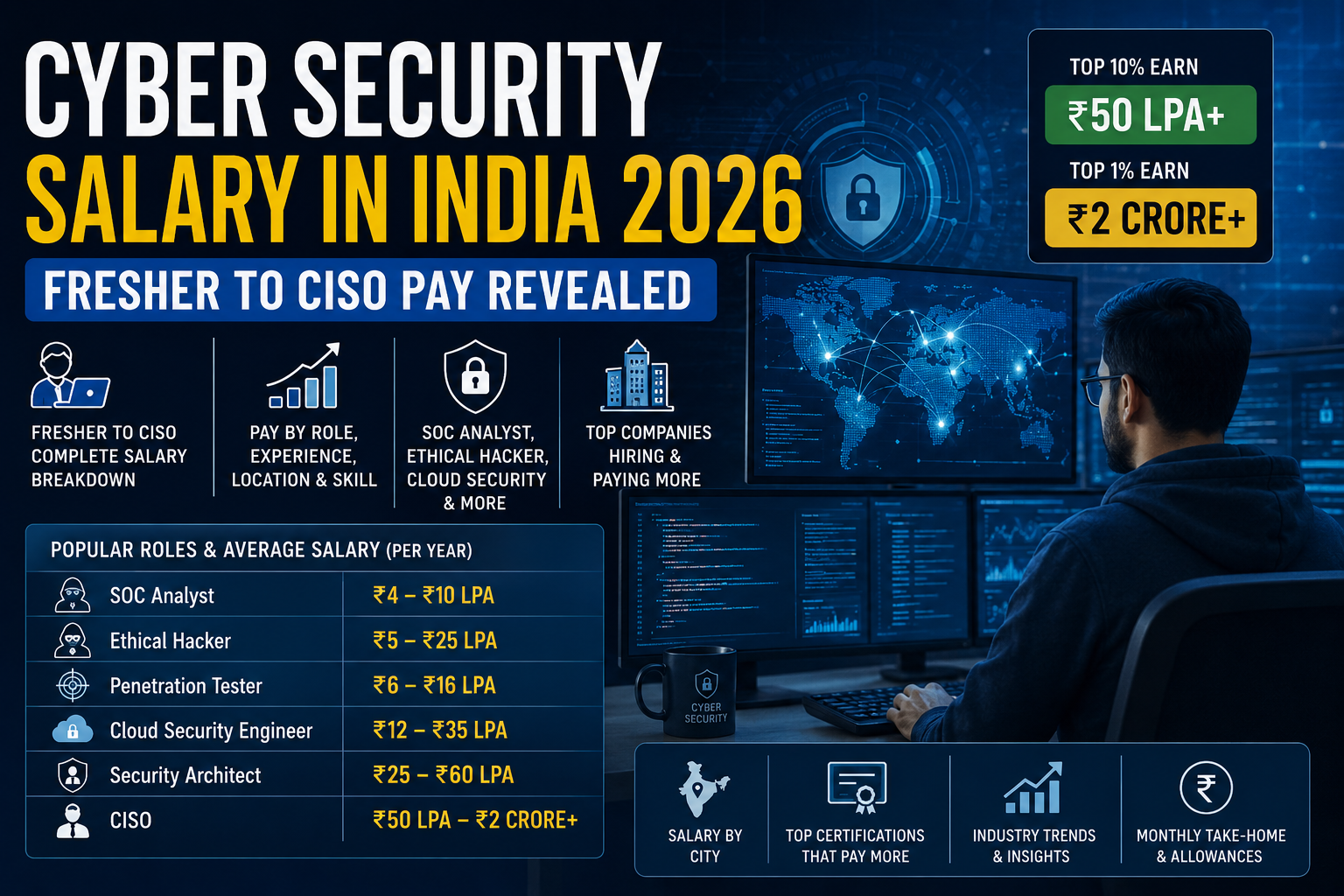
The Short Answer: What Does Cyber Security Pay in 2026?
Cyber security salary in India averages ₹9–15 LPA for mid-level professionals, with freshers starting at ₹4–10 LPA and senior roles crossing ₹40 LPA+. The top 10% of earners — Security Architects, CISOs, and specialized cloud security engineers — command ₹50 LPA to ₹2+ crore annually.
But here’s what most salary guides won’t tell you: the averages are misleading.
A SOC analyst in a service company earns ₹4 LPA while a cloud security engineer at a product company with the same years of experience earns ₹18 LPA. Same experience. Double the pay. The difference isn’t luck — it’s choice.
Cyber Security Salary Per Month (India, 2026):
- Fresher: ₹33,000 – ₹83,000/month
- Mid-Level (3–7 yrs): ₹1L – ₹2L/month
- Senior (8+ yrs): ₹2L – ₹5L+/month
- CISO/Leadership: ₹4L – ₹16L+/month
Let’s break down exactly what drives these numbers — and how you can position yourself on the right side of the curve.
Cyber Security Salary in India Per Month: Complete Breakdown
Monthly cyber security salaries in India range from ₹33,000 for freshers to over ₹16 lakhs for CISOs. Here’s the reality by experience level:
| Experience Level | Monthly Salary Range | Annual Salary Range |
|---|---|---|
| Fresher (0–2 yrs) | ₹33,000 – ₹83,000 | ₹4 – ₹10 LPA |
| Early Career (2–4 yrs) | ₹67,000 – ₹1.25L | ₹8 – ₹15 LPA |
| Mid-Level (4–7 yrs) | ₹1L – ₹2L | ₹12 – ₹25 LPA |
| Senior (7–10 yrs) | ₹2L – ₹4L | ₹25 – ₹50 LPA |
| Leadership (10+ yrs) | ₹4L – ₹16L+ | ₹50 LPA – ₹2 Cr+ |
The catch: These are averages. Your actual monthly take-home depends on company type, location, and specialization — not just years of experience.
Fresher Cyber Security Salary: Entry-Level Pay in 2026
Entry-level cyber security salary in India ranges from ₹4 LPA to ₹10 LPA, depending entirely on where you land.
The floor is brutal. Entry-level security operations centre (SOC) analysts earn around ₹4–8 lakh per year. Without a verified internship or structured training, fresher offers cluster at the bottom of this range — significantly lower than software engineering freshers at top product companies (₹6–12 LPA). This is why the “cyber security pays nothing” narrative exists. It’s not false — it’s incomplete.
What moves you to the top of the fresher band:
| Fresher Profile | Salary Range (₹ LPA) |
|---|---|
| SOC L1 / GRC trainee at service companies | 4 – 6 |
| SOC Analyst with internship / junior pentester | 6 – 8 |
| Cloud security junior / product company hire | 8 – 10 |
| OSCP-certified fresher at top firms | 10 – 20 |
Cyber security salary for freshers per month: ₹33,000 – ₹83,000
The OSCP exception: Freshers with OSCP (Offensive Security Certified Professional) at top product companies or security firms may earn ₹10–20 LPA — a 2–3× premium over non-certified peers. Exceptional cases can go higher, but ₹18–30 LPA is not the typical starting point. The certification is brutally difficult (24-hour exam, buffer overflows, custom exploits, no hints), but the payoff is real for those who crack it.
The catch: The median cyber security salary more than doubled from ₹5.7 LPA in 2015 to ₹11.5 LPA in 2025. But fresher salaries haven’t kept pace with that trajectory. The premium goes to experienced talent, not fresh graduates.
Cyber Security Salary by Role: SOC Analyst, Ethical Hacker, Penetration Tester & More
SOC Analyst Salary in India
SOC Analyst salary in India ranges from ₹4–8 LPA at entry-level to ₹10–15 LPA at senior levels.
SOC (Security Operations Center) roles represent the largest hiring volume in cybersecurity — but also the lowest pay band. Entry-level SOC analysts earn ₹4–8 LPA, with senior positions reaching ₹10–15 LPA.
The reality: SOC is where most people start, but it’s also where many get stuck. The work is monitoring-intensive, involves 24×7 rotations, and the learning curve plateaus quickly unless you actively upskill.
For context on how this compares to other government and private roles, see our guides on IB Security Assistant salary and SSC MTS salary.
Ethical Hacker Salary in India 2026
Ethical Hacker salary in India averages ₹12.7 LPA, with entry-level at ₹4.5–8 LPA and senior roles exceeding ₹25 LPA.
According to Salary.com data (April 2025), the average annual salary for an Ethical Hacker in India is ₹12,72,608. Erieri’s compensation survey puts the average even higher at ₹20.67 LPA.
The wide range reflects certification differences:
- CEH (Certified Ethical Hacker) freshers: ₹4.5–8 LPA
- OSCP-certified professionals: average ₹27 LPA, top experts exceeding ₹50 LPA
Penetration Tester Salary in India
Penetration Tester salary in India ranges from ₹5–8 LPA at entry-level to ₹16+ LPA for senior roles.
Entry-level penetration testers with less than 1 year experience earn approximately ₹5.1 LPA on average. Senior penetration testers (Level IV) command ₹16.6 LPA.
The differentiator: Hands-on offensive security skills and OSCP certification separate the ₹5 LPA testers from the ₹25 LPA+ red teamers.
Cloud Security Engineer Salary in India
Cloud Security Engineer salary in India ranges from ₹12–35 LPA for mid-senior roles.
Cloud security is the highest-paying mainstream cybersecurity role. Mid-senior cloud security engineers command ₹12–35 lakh, with top performers at product companies and GCCs crossing ₹40 LPA.
AWS Security Engineers average ₹17.7 LPA. The premium for cloud security skills — especially in Zero Trust architecture — is estimated at 30–60% higher than comparable engineering jobs.
Security Architect Salary in India
Security Architect salary in India ranges from ₹20–40 LPA at mid-level to ₹50 LPA+ at senior levels.
Security Architect roles saw 43% year-on-year demand growth in 2025. The supply-demand gap for security architects has reached 45–60%, which is exactly why salaries keep climbing.
Cyber Security Engineer Salary in India
Cyber Security Engineer salary in India averages ₹8–18 LPA, with significant variation by company and specialization.
This is the broadest category — encompassing everyone from security engineers at product companies (₹12–18 LPA) to infrastructure security engineers at service firms (₹6–10 LPA). To understand how this compares with other engineering roles, check out our software engineer salary and software developer salary guides.
Cyber Security Salary Comparison Table
| Role | Fresher (₹ LPA) | Mid-Level (₹ LPA) | Senior (₹ LPA) |
|---|---|---|---|
| SOC Analyst | 4 – 8 | 8 – 12 | 12 – 18 |
| Ethical Hacker | 4.5 – 8 | 10 – 20 | 25 – 40 |
| Penetration Tester | 5 – 8 | 10 – 18 | 16 – 30 |
| Cloud Security Engineer | 7 – 10 | 15 – 30 | 35 – 60 |
| Security Architect | — | 20 – 35 | 40 – 60+ |
| CISO | — | — | 60 – 200+ |
Top Companies Paying the Highest Cyber Security Salaries in India (2026)
Global capability centres (GCCs) and FAANG companies pay 40–60% more than Indian service firms for the same cyber security roles.
| Company | Approx Salary Range (₹ LPA) | Typical Roles |
|---|---|---|
| 25 – 70 | Security Engineer, AppSec, Cloud Security | |
| Microsoft | 20 – 60 | Security Engineer, Incident Response |
| Amazon | 20 – 65 | Security Engineer, Cloud Security |
| Cisco | 15 – 40 | Network Security, Security Architect |
| Palo Alto Networks | 18 – 50 | Cloud Security, Threat Research |
| Deloitte | 8 – 25 | GRC, SOC, Pen Testing |
| Accenture | 6 – 20 | SOC, GRC, Cloud Security |
| PwC | 8 – 25 | GRC, Cyber Consulting |
| Wipro | 5 – 18 | SOC, Network Security |
| TCS | 4 – 16 | SOC, GRC, Network Security |
The gap is widening. Product companies and GCCs now pay cybersecurity professionals 1.5–2× what Indian IT services firms offer for equivalent experience. The same OSCP-certified engineer with 5 years experience earns ₹20 LPA at TCS and ₹40 LPA at Google. That’s not a typo — it’s the market reality of 2026.
If you’re targeting government roles, understand the trade-offs by reviewing our breakdowns of SDM salary, PCS full form and related government positions.
By City: Where You Work Matters More Than You Think
Bangalore leads with 20–30% higher cyber security salaries than the national average.
| City | Fresher (LPA) | Mid-Level (LPA) | Senior (LPA) |
|---|---|---|---|
| Bangalore | 7 – 12 | 18 – 32 | 35 – 65 |
| Hyderabad | 6 – 12 | 17 – 32 | 32 – 65 |
| Mumbai | 6 – 11 | 16 – 28 | 30 – 55 |
| Delhi-NCR | 5 – 10 | 14 – 25 | 28 – 50 |
| Chennai | 5 – 9 | 12 – 22 | 25 – 45 |
| Tier-2 cities | 15–25% lower across all levels |
India currently has around 25,000 to 30,000 active cybersecurity openings — a nearly 30% rise from 2023 and more than double since 2021. Bangalore, Hyderabad, and Delhi-NCR account for the majority of these roles.
The insight: Remote work is narrowing the gap, but not equally. Companies still anchor offers to location. If you’re in a tier-2 city, expect a 15–25% haircut unless you’re negotiating from a position of specialized scarcity.
By Sector: Government vs. Private
Government Cyber Security Salary in India
Government cyber security salaries are lower but offer stability and perks.
- Entry-level government roles: ₹44,900–₹50,000 per month (Pay Level 7–8)
- Cyber Security Analyst (Govt. of India): ₹7.8–11.8 LPA (3–15 years experience)
- Senior Threat Research Consultant: Up to ₹1.2 lakhs per month
- RBI Young Professional (Cyber Security): ₹1.5 lakh/month stipend
- Ministry of Defence Analyst (1–3 yrs): ₹5.8–6.5 LPA
Government cyber security salary per month: ₹45,000–₹1,50,000, depending on grade and role.
The trade-off: Government roles pay 30–50% less than private sector equivalents but offer job security, pensions, and predictable hours. Private sector pays more but demands more — on-call rotations, faster learning curves, and higher accountability.
For specific government roles, you can also explore our guides on IPS salary, SBI PO salary, and SBI Clerk salary.
The 7 Types of Cybersecurity: Which Pays Most?
Cybersecurity isn’t one career — it’s seven distinct domains, each with its own salary trajectory:
- Network Security — Protecting network infrastructure. Mid-level: ₹10–18 LPA
- Application Security (AppSec) — Securing software during development. Mid-level: ₹12–25 LPA
- Cloud Security — AWS/Azure/GCP security. Fastest-growing, highest-paying. Mid-level: ₹15–35 LPA
- Security Operations (SOC) — Monitoring and incident response. Largest hiring volume, lower pay. Mid-level: ₹8–15 LPA
- Identity & Access Management (IAM) — Authentication and authorization. Mid-level: ₹10–18 LPA
- GRC (Governance, Risk & Compliance) — Policies, audits, compliance. Mid-level: ₹12–26 LPA
- Data Security & Privacy — Protecting data assets. Mid-level: ₹12–22 LPA
The pay hierarchy (highest to lowest):
Cloud Security > AppSec > GRC > IAM > Network Security > SOC
Which cyber security job pays the most in 2026? Cloud Security Specialist and Security Architect — both consistently cross ₹30 LPA at mid-level and ₹50+ LPA at senior.
If you’re comparing career paths, it’s worth understanding how salaries stack up across other high-paying roles like neurosurgeon salary, cardiologist salary, and surgeon salary.
How to Join Cyber Security After 12th: The Real Path
The short answer: You can start after 12th from any stream — science, commerce, or arts. But the how matters more than the what.
Step 1: Choose your entry path
- Degree route (recommended): B.Tech in CSE/IT, BCA, or specialized B.Sc in Cyber Security
- Diploma route: 1-year diploma courses after 12th
- Certification-first route: Start with CompTIA Security+, CEH, or OSCP without a degree (harder but possible)
Step 2: Build foundational skills
- Networking (TCP/IP, routing, firewalls)
- Operating systems (Linux, Windows security)
- Coding (Python, Bash, JavaScript)
- Security fundamentals (encryption, authentication, threat modeling)
Step 3: Get hands-on
- Practice on platforms like TryHackMe, HackTheBox
- Build a home lab
- Contribute to open-source security tools
Step 4: Certify strategically
- Entry-level: CompTIA Security+, CEH
- Mid-level: OSCP (adds significant premium over base salary), CISSP
- Specialized: AWS Security, Azure Security Engineer
Step 5: Land your first role
- Junior Security Analyst, SOC L1, or Penetration Tester
- Target product companies over service companies for higher starting pay
The timeline: A focused 12-month investment in certifications and practice can translate into a ₹2+ lakh annual salary jump.
The Catch: What No Salary Guide Tells You
“Not all cybersecurity roles are created equal.”
1. The fresher trap. Entry-level salaries cluster at ₹4–8 LPA — lower than software engineering freshers at top product companies. The “cyber security pays well” narrative applies to experienced professionals, not fresh graduates.
2. The learning curve. Cyber threats evolve weekly. New vulnerabilities, new attack patterns, new defences. Engineers who stop learning after 2–3 years get stuck at L2 forever. This isn’t a “learn once, coast forever” career.
3. The on-call reality. Most SOC roles include 24×7 rotations for the first 2–3 years. Security incidents don’t respect business hours. If you want predictable 9-to-5 work, this field will disappoint you.
4. The certification treadmill. OSCP-certified professionals command significantly higher salaries than peers without advanced offensive-security certifications. But certs expire, and the cycle never ends.
5. The salary plateau. Without moving into architecture or leadership, many professionals hit a ceiling around ₹20–25 LPA. Breaking past that requires either deep specialization (cloud, AppSec) or people management.
6. The talent shortage is real — but selective. India’s cybersecurity talent gap has reached 30–50% for roles like cloud security, architecture, and zero trust. But the shortage is at the mid-senior level, not entry-level. Freshers still face intense competition for limited junior roles.
Understanding salary structures, like how CTC full form and LPA full form impact take-home pay, can help you negotiate better. Also check our guides on 4 LPA in hand salary and 30 LPA in hand salary to understand the difference between offered and in-hand amounts.
Is Cyber Security a High Salary Career in 2026?
Yes — but only for the right people in the right roles.
The median cyber security salary in India crossed ₹11.5 LPA in 2025, up from ₹5.7 LPA in 2015. Demand is growing rapidly — cybersecurity hiring remained a bright spot in 2025, with high-value IT and InfoSec roles up 42% year-on-year. Positions such as Application Security Engineer (+52%), Manager Information Security (+50%), and Security Architect (+43%) saw the sharpest demand.
India alone expects over 1.5 million cybersecurity vacancies by 2026. The global cybersecurity workforce shortage is projected at 3.5–4.8 million unfilled roles.
But here’s the contrarian take: Cyber security isn’t the highest-paying tech career anymore. AI engineers, ML specialists, and certain data science roles now command higher fresher salaries. Cyber security’s edge isn’t top-end pay — it’s job security. Cybersecurity is recession-resistant in a way most tech specialisations aren’t. When budgets get cut, security is the last thing companies stop spending on.
The real question isn’t “can I afford to study cybersecurity?” It’s “can I afford NOT to?”
Compare this with other career tracks like digital marketing salary, civil engineering salary, or even unconventional roles like underwater welder salary to see how cyber security stacks up.
FAQ: Cyber Security Salary
Is cyber security a high-paying career in India?
Yes, for experienced professionals with specialized skills. Freshers start at ₹4–10 LPA, but mid-level (3–7 years) earns ₹12–25 LPA, and senior roles cross ₹40 LPA+. The top 10% — CISOs, Security Architects, Cloud Security Specialists — earn ₹50 LPA to ₹2+ crore. However, entry-level SOC analysts earn just ₹4–8 LPA, so the “high-paying” label depends heavily on your specialization.
What is the monthly salary of a cyber security fresher?
₹33,000–₹83,000 per month. The variation depends on company type (product vs. service), location (Bangalore pays 20–30% more), and certifications. OSCP-certified freshers at top product companies may earn ₹10–20 LPA — 2–3× higher than non-certified peers.
Which cyber security job pays the most in India?
Chief Information Security Officer (CISO) — ₹60 LPA to ₹2+ crore at large enterprises, banks, and global capability centres. Among individual contributor roles, Cloud Security Specialist and Security Architect pay the highest, consistently crossing ₹30 LPA at mid-level. Cloud security engineers command ₹12–35 LPA, while Security Architects saw 43% demand growth in 2025.
What is the government cyber security salary per month?
₹45,000–₹1,50,000 per month, depending on grade and experience. Entry-level roles start at ₹44,900–50,000/month, while senior consultant roles can reach ₹1.2 lakhs/month. RBI offers ₹1.5 lakh/month for young professionals.
How to join cyber security after 12th?
From any stream — science, commerce, or arts. Options include: B.Tech/B.Sc in Cyber Security, diploma courses, or certification-first paths (CompTIA Security+, CEH). Start with networking, coding (Python), and hands-on practice on platforms like TryHackMe.
What are the 7 types of cybersecurity?
1. Network Security, 2. Application Security, 3. Cloud Security, 4. Security Operations (SOC), 5. Identity & Access Management, 6. GRC (Governance, Risk & Compliance), 7. Data Security. Cloud Security and AppSec pay the highest (₹15–35 LPA mid-level); SOC has the largest hiring volume but lower pay (₹4–8 LPA entry).
Does cyber security have good scope in 2026?
Yes — 42% YoY hiring growth for high-value InfoSec roles. India expects over 1.5 million cybersecurity vacancies by 2026. Demand is concentrated in SOC operations, cloud security (highest pay), and GRC. The talent gap is 30–50% for mid-senior roles like security architects and cloud security engineers.
What is the salary of an ethical hacker in India?
Average ₹12.7 LPA, ranging from ₹4.5 LPA (entry-level CEH) to ₹50 LPA+ (OSCP-certified experts). OSCP-certified professionals average ₹27 LPA, while CEH freshers start at ₹4.5–8 LPA.
Which companies pay the highest cyber security salaries in India?
Google, Microsoft, Amazon, and Palo Alto Networks top the list, offering ₹25–70 LPA for experienced roles. Global capability centres and product companies pay 40–60% more than Indian IT services firms like TCS, Wipro, and Infosys.
Conclusion: The Strategy
Key takeaways:
- Cyber security salary in India ranges from ₹4 LPA (fresher SOC analyst) to ₹2+ crore (CISO) — but the averages hide massive variation by role, city, and certification.
- Your choices matter more than your degree. Cloud security pays ₹12–35 LPA — ₹8+ LPA more than SOC with the same experience. Product companies pay ₹2–5 LPA more than service companies. Bangalore pays ₹4–6 LPA more than tier-2 cities.
- OSCP-certified professionals command significantly higher salaries than peers without advanced offensive-security certifications. Fresher OSCP at top product companies → ₹10–20 LPA vs CEH → ₹6–12 LPA.
- The field is recession-resistant — cybersecurity hiring grew 42% YoY in 2025 with 1.5 million+ vacancies projected in India by 2026. But it’s not easy money. Fresher salaries are modest. On-call rotations are real. Continuous learning is non-negotiable.
- The ceiling is high but the floor is low. If you’re willing to specialize (cloud, AppSec, architecture) and commit to lifelong learning, cybersecurity offers one of the most secure and lucrative career paths in India. If you’re looking for a 9-to-5 with predictable pay, look elsewhere.
Your action plan:
- Target product companies and GCCs over service companies
- Prioritize cloud security or AppSec specialization (highest pay bands)
- Get OSCP or equivalent hands-on certification (significant salary premium)
- Build a portfolio (home lab, CTF achievements, bug bounties)
- Network in Bangalore or Hyderabad for highest pay
The real question isn’t whether cyber security pays well. It’s whether you’re willing to do what it takes to earn the top-tier pay. The field is wide open. The opportunities are there. But they’re not handed out — they’re earned through specialization, certification, and relentless learning.
For more salary insights across industries, explore our guides on data analyst salary, merchant navy salary, and even Google CEO salary for perspective at the very top.
Author: Senior Financial Journalist, Salaryinfo
Reviewed: July 2026 | Data sources: Salary.com, Erieri, Payscale, Glassdoor, Economic Times, Financial Express, Industry talent reports
Methodology: Salary ranges compiled from multiple verified sources and adjusted for 2026 market conditions. Figures represent market benchmarks, not individual guarantees.