
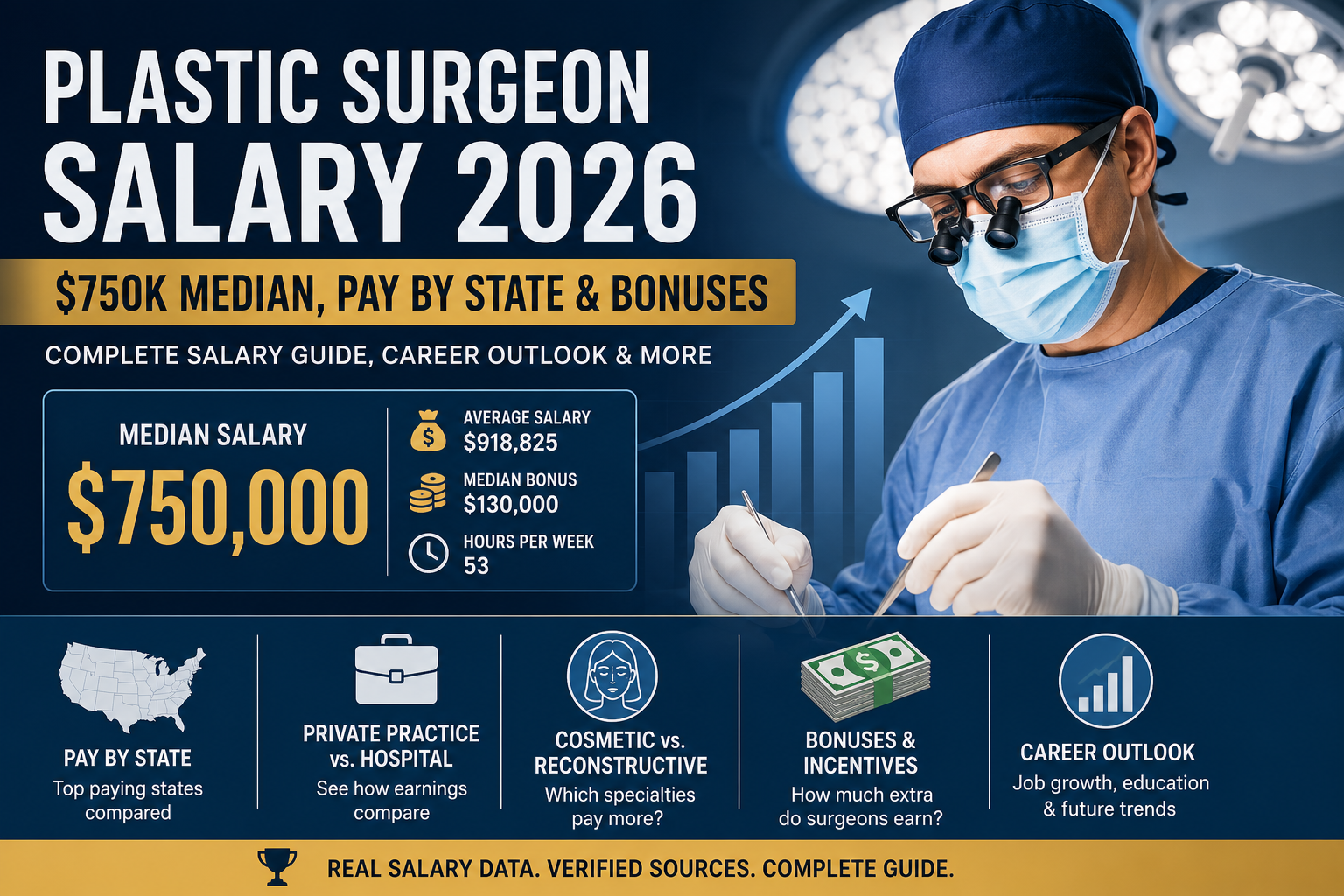
At a Glance: Plastic Surgeon Salary 2026
| Metric | Value |
|---|---|
| Median Annual Salary | $750,000 |
| Average Annual Salary | $918,825 |
| 25th Percentile | $710,000 |
| 75th Percentile | $900,000 |
| 90th Percentile | $1,215,000 |
| Highest Reported | $4,000,000 |
| Hourly Rate (53 hrs/week) | $361 |
| Monthly Salary (Median) | $62,500 |
| Typical Work Hours | 53/week |
| Years of Education | 14–15 years post-high school |
| Job Outlook | 3% growth projected through 2033 |
| % Who Would Choose Again | 88% |
| Satisfaction Rating | ⭐ 4.6/5 |
Figures are compiled from verified physician compensation submissions and publicly available compensation research.
Why Plastic Surgeon Salary Estimates Vary So Much
Ask Google “plastic surgeon salary” and you’ll get back numbers that look like they came from different planets.
Various compensation databases report figures ranging from around $250,000 to over $900,000 because each measures different compensation components and uses different data collection methods. Some capture only base salary. Others include bonuses, profit-sharing, and productivity incentives. Some rely on self-reported user data; others use algorithmic estimates from job postings.
Same job title. Same year. Same country.
This isn’t a data error. It’s a feature of how compensation works in this field.
The gap between the 25th percentile ($710,000) and the 75th percentile ($900,000) is $190,000. That’s bigger than most American household incomes combined. And that’s just the middle 50%. The spread from the 10th percentile ($610,000) to the 90th ($1,215,000) is over half a million dollars.
Here’s the real question: Which number applies to you?
Why Plastic Surgeon Salary Estimates Differ
Let’s cut through the noise.
| Source Type | Figure | What It Actually Measures |
|---|---|---|
| Self-reported databases | $253,000-$464,000 | Base salary only, wide sample variation |
| Large physician surveys | $554,000 | Total compensation, broad national sample |
| Verified physician data | $750,000 (median) | Total compensation, vetted submissions |
| Verified physician data | $918,825 (average) | Skewed by outliers, same dataset |
| Top earners | $4,000,000 | Extreme outlier, private practice cosmetic |
The lower-end figures are effectively useless for understanding actual plastic surgeon earnings. They typically capture base salary only and rely on self-selected samples that disproportionately include early-career and hospital-employed surgeons.
The verified median ($750,000) is the most credible single number because it represents total compensation (base + bonus + incentives) from verified physicians. 88% of plastic surgeons in that dataset reported receiving bonus compensation, with a median bonus of $130,000.
But even $750K tells an incomplete story.
Plastic Surgeon Salary By Experience Level
Income progression follows a predictable but steep curve. The gap between early-career and senior surgeons can exceed $1 million annually.
| Career Stage | Years Post-Residency | Typical Salary Range |
|---|---|---|
| Resident | Training years | $70,000–$90,000 |
| Early Career | 0–3 years | $350,000–$550,000 |
| Mid Career | 4–9 years | $550,000–$800,000 |
| Established | 10–20 years | $800,000–$1,200,000 |
| Senior | 20+ years | $1,500,000+ |
The inflection point typically occurs around years 5-7, when referral networks are established, surgical volumes increase, and partnership opportunities emerge. Surgeons who successfully transition to practice ownership see the most dramatic income growth.
Where The Real Money Lives: Salary By State
Location isn’t just a variable. It’s the variable.
| State | Median Salary | Submissions |
|---|---|---|
| Florida | $1,207,500 | 6 |
| New York | $1,000,000 | 5 |
| Massachusetts | $780,000 | 9 |
| California | $750,000 | 15 |
| Pennsylvania | $740,000 | 14 |
Florida isn’t paying double because surgeons there work twice as hard. The difference is the payer mix.
In Florida, particularly in cities like Miami, the patient population is older, wealthier, and more willing to pay cash for elective procedures. Insurance-based reconstructive work pays less per case than self-pay cosmetic surgery. A surgeon who builds a practice around cash-pay cosmetic procedures in a high-demand market can charge what the market bears. A surgeon who primarily does insurance-based reconstructive work in a saturated market gets whatever the payers decide to reimburse.
The takeaway: Geography isn’t about cost of living. It’s about the ratio of cash-pay to insurance-based patients in your specific market.
Private Practice vs. Academic: The $55,000 Question
The practice setting gap is real but narrower than you’d expect.
| Practice Setting | Median Compensation | Pros | Cons |
|---|---|---|---|
| Private Practice | $755,000 | Higher earning potential, case selection autonomy, equity opportunities | 65% overhead, business management responsibilities |
| Hospital Employed | $730,000 | Stable salary, benefits, no business risk | Less flexibility, institutional constraints |
| Academic | $700,000 | Research time, teaching, predictable hours | Lower upside, administrative layers |
But here’s what nobody tells you: That $55K difference between private practice and academic doesn’t account for the 65% overhead that private practice surgeons eat. One plastic surgeon on Blind reported that his clinic generates $1M in revenue but he takes home only $350K-$400K after overhead.
The lifetime value calculation is more complex than the annual salary number suggests.
Practice Type Comparison: Which Pays More?
| Practice Type | Income Potential | Key Drivers |
|---|---|---|
| Cosmetic Surgery | Highest ($1M+) | Cash-pay patients, self-set fees, affluent markets |
| Reconstructive Surgery | High ($600K–$800K) | Insurance reimbursement, hospital contracts, trauma cases |
| Hand Surgery | High ($550K–$750K) | Steady demand, mix of elective and trauma |
| Craniofacial Surgery | High ($700K–$900K) | Specialized skills, academic centers, children’s hospitals |
| Microsurgery | High ($650K–$850K) | Complex procedures, major medical centers |
The distinction between reconstructive and cosmetic work significantly impacts earning potential. Cosmetic procedures (not covered by insurance) allow surgeons to set their own fees based on market demand, while reconstructive work depends on insurance reimbursement rates that vary by region and payer.
Hourly Rate: The $361 Question
If you do the math on the $750K median with a 53-hour workweek (the reported average for plastic surgeons):
$750,000 / 52 weeks / 53 hours = $272 per hour
$918,825 / 52 / 53 = $333 per hour
$4,000,000 / 52 / 53 = $1,451 per hour
Verified data calculates the hourly rate at $361 based on the full dataset. Other sources range from $200 to $500 per hour.
The real hourly rate depends entirely on two things: how many hours you work and how much of your revenue goes to overhead. A surgeon who works 60 hours and keeps 40% of collections has a very different effective hourly rate than one who works 45 hours and keeps 70%.
The Bonus Structure: 88% Get It, But It’s Not What You Think
88% of plastic surgeons report receiving bonus or incentive compensation.
The bonus numbers:
Average bonus: $318,972
Median bonus: $130,000
25th percentile: $120,000
75th percentile: $250,000
Bonus as percentage of total comp: 35%
That 35% is the real story. More than a third of total compensation is at risk. It’s tied to productivity, collections, patient volume, or some combination. In a bad year—economic downturn, reduced patient demand, insurance reimbursement cuts—that bonus can evaporate.
Early-career surgeons (0-3 years) actually report higher median bonuses ($362,500), which suggests signing bonuses and relocation packages skew the early-career numbers upward.
The Gender Gap Nobody Wants To Talk About
The data is unambiguous.
15.6% gender pay gap in plastic surgery. Men average $644,397; women average $543,846.
In academic plastic surgery, female full professors earn roughly $150,000 less than their male counterparts ($553,326 vs $704,390). Female division chiefs are paid approximately $100,000 less than male chiefs.
Even controlling for practice volume and style, male plastic surgeons earn approximately $9,000 more annually—a 12% pay gap.
The gap varies by geography. States like Iowa and Texas show larger earnings disparities for men, while Nebraska and Oklahoma are exceptions where female surgeons out-earn their male counterparts.
This gap reflects a combination of factors: differences in negotiation opportunities, referral patterns, leadership representation, practice ownership rates, and procedure mix. Women in surgery are less likely to be offered partnership tracks, less likely to be included in lucrative call schedules, and more likely to be steered toward lower-paying reconstructive work rather than higher-paying cosmetic procedures.
The Specialty Rankings: Where Plastic Surgery Actually Stands
Plastic surgery ranks #6 among surgical specialties by median total compensation:
- Neurosurgery: $810,000
- Orthopedic Surgery: $700,000
- Cardiothoracic Surgery: $690,000
- Plastic Surgery: $575,000 (broader dataset)
- Vascular Surgery: $560,000
Wait—$575K? That’s different from the $750K median.
The discrepancy: the broader surgical specialty comparison uses consistent methodology across all surgical fields and may reflect a different sample composition. The $750K figure is specific to plastic surgery and may represent a more focused sample.
The $575K number is arguably more comparable to other specialties because it uses consistent methodology. The $750K number reflects the most current plastic surgery-specific data.
How Long To Become A Plastic Surgeon: The Timeline
The path to earning a plastic surgeon’s salary requires 14-15 years of post-high school education and training:
| Stage | Duration | Typical Age |
|---|---|---|
| High School | 4 years | 14–18 |
| Bachelor’s Degree | 4 years | 18–22 |
| Medical School | 4 years | 22–26 |
| General Surgery Residency | 3 years | 26–29 |
| Plastic Surgery Residency | 3–4 years | 29–32/33 |
| Optional Fellowship | 1–2 years | 33–35 |
| Board Certification | Ongoing | 35+ |
The opportunity cost is enormous. A plastic surgeon’s training period includes years of 80-hour weeks, six-figure student loan debt, and delayed entry into the workforce. A software engineer who starts working at 22 and climbs to a FAANG salary by 30 has a very different lifetime earnings trajectory than a surgeon who starts earning attending-level income at 35.
Pros And Cons Of Becoming A Plastic Surgeon
| Pros | Cons |
|---|---|
| Very high earning potential ($750K median) | Long training period (14+ years) |
| Strong patient impact and outcomes | High malpractice insurance costs ($50K+/year) |
| Diverse career paths (cosmetic, reconstructive, hand, craniofacial) | Demanding workload (53+ hours/week) |
| Opportunity for private practice ownership | Income can fluctuate with elective procedure demand |
| High job satisfaction (88% would choose again) | On-call responsibilities and emergencies |
| Intellectual challenge and continuous learning | Administrative burden and paperwork |
| Growing demand from aging population | Insurance reimbursement pressures |
Who Should Become A Plastic Surgeon?
Plastic surgery rewards those who combine surgical precision with aesthetic judgment. The field attracts individuals who:
- Enjoy both technical skill and artistry—the work requires exacting surgical technique plus an eye for proportion and symmetry.
- Thrive in competitive environments—matching into plastic surgery residency is among the most competitive in medicine.
- Can handle uncertainty—cosmetic outcomes are subjective, and patient satisfaction depends on managing expectations as much as surgical results.
- Want business exposure—many plastic surgeons eventually run their own practices, requiring management skills beyond clinical training.
- Are comfortable with elective medicine—patients who pay out-of-pocket have different expectations than those covered by insurance.
The field may not suit those who prefer predictable hours, dislike marketing themselves, or are uncomfortable with the financial pressures of fee-for-service medicine.
Why Salary Estimates Differ: The Myths vs. Reality
Myth 1: All Plastic Surgeons Earn The Same
Reality: The gap between the 25th and 75th percentiles is $190,000. Location, practice type, and subspecialty create massive variation.
Myth 2: Private Practice Always Pays More
Reality: Private practice pays $55K more on average, but overhead can consume 65% of revenue. The take-home difference may be smaller than the headline number suggests.
Myth 3: Cosmetic Surgeons Always Earn More
Reality: Cosmetic surgeons typically earn more per procedure, but reconstructive surgeons often have higher patient volumes and more consistent referrals. The total income depends on case mix and practice efficiency.
Myth 4: Academic Jobs Pay Poorly
Reality: Academic positions pay $700K median—still higher than most medical specialties. The trade-off is lower upside, not poverty.
The 2026 Outlook: Growth, Risk, And Uncertainty
Job growth: 3% projected through 2033 for all physicians and surgeons, roughly in line with the national average.
Compensation growth: Plastic surgery salaries are projected to increase approximately 1.5% in 2026, slower than orthopedic surgery (8%).
The Medicare factor: The new TEAM Model, effective January 2026, expands procedure bundle accountability to over 700 acute care hospitals, tying quality and cost performance to high-volume surgical episodes. This shifts risk onto providers and may compress margins for surgeons who rely heavily on Medicare patients.
The cosmetic market: Economic downturns reduce demand for elective procedures. A recession in 2026 or 2027 would hit cosmetic-heavy practices harder than reconstructive-focused ones.
Technology and AI-assisted planning tools are improving surgical workflows, but board-certified plastic surgeons remain responsible for clinical judgment and patient care. AI is enhancing surgical precision and planning capabilities, not replacing surgical decision-making.
Practical Takeaways For Surgeons And Aspiring Candidates
1. Know your baseline. The median compensation is $750K. The 75th percentile is $900K. The 90th is $1.215M.
2. Adjust for geography. Florida pays $1.207M median. California pays $750K. Same job, different state, different paycheck.
3. Understand your setting. Private practice pays more but eats overhead. Academic pays less but offers stability.
4. The 75th percentile ($900,000) can serve as one reference point when evaluating compensation packages, alongside location, benefits, productivity incentives, and practice type.
5. Look beyond base salary. Bonuses are 35% of total comp on average. Signing bonuses, relocation, student loan repayment, and partnership tracks matter more than the base number.
6. Research suggests compensation differences may be influenced by factors such as negotiation opportunities, referral patterns, leadership representation, practice ownership, and procedure mix.
7. Consider the overhead trap. $1M in collections doesn’t mean $1M in take-home. Understand your practice’s overhead structure before you sign anything.
FAQs
What is the actual plastic surgeon salary in 2026?
The median total compensation is $750,000, with an average of $918,825. The 25th percentile is $710,000 and the 75th is $900,000. Top earners exceed $1.2 million.
Is plastic surgery one of the highest-paying medical specialties?
Yes. Plastic surgery ranks among the top 6 surgical specialties by compensation. Neurosurgery ($810,000) and orthopedic surgery ($700,000) pay more, but plastic surgery consistently outperforms most other medical and surgical fields.
Who is the highest paid plastic surgeon?
The highest-paid plastic surgeons are in private cosmetic surgery practices in high-demand markets like Florida and New York, earning up to $4,000,000 annually.
Where do plastic surgeons make the most money?
Florida pays the highest median at $1,207,500, followed by New York at $1,000,000 and Massachusetts at $780,000.
How much do plastic surgeons make per hour?
Based on a 53-hour workweek and the $750,000 median, the hourly rate is approximately $272. The average works out to $333 per hour, and the 90th percentile to $440 per hour.
How much do plastic surgeons make per month?
The median monthly salary is $62,500. For top earners at the $1.2M level, monthly compensation exceeds $100,000.
Is private practice or academic plastic surgery more lucrative?
Private practice pays a median of $755,000 vs $700,000 in academic settings—a $55,000 difference. However, private practice surgeons also bear overhead costs that can consume 65% or more of gross revenue.
What is the gender pay gap in plastic surgery?
The gender pay gap is 15.6%, with men averaging $644,397 and women $543,846. Even controlling for practice volume, male surgeons earn approximately $9,000 more annually.
How long does it take to become a plastic surgeon?
After high school: 4 years college + 4 years medical school + 6-7 years residency = 14-15 years total. Optional fellowships add 1-2 more years.
What is the job outlook for plastic surgeons?
The U.S. Bureau of Labor Statistics projects 3% job growth through 2033, driven by aging population, advances in surgical techniques, increased social acceptance of cosmetic procedures, and ongoing trauma and reconstruction needs.
Related Articles
- Surgeon Salary
- Neurosurgeon Salary
- Cardiologist Salary
- Radiologist Salary
- Pediatric Surgeon Salary
- Orthopedic Surgeon Salary
- Obstetrician Salary
- Ophthalmologist Salary
⚠️ Disclaimer
Compensation figures in this article are based on publicly available data from verified physician submissions, surveys, and compensation databases. Actual salaries vary significantly based on location, years of experience, practice type, procedure mix, practice ownership, bonuses, productivity incentives, and other factors.
Figures are for informational purposes only and should not be considered financial or career advice. Always consult with compensation professionals and review specific employment contracts for accurate compensation details.
The Bottom Line
Plastic surgery remains one of the highest-compensated medical specialties in 2026.
But the headline numbers mask enormous variation. Geography alone can move your compensation by half a million dollars. Practice setting adds another $55,000 spread. Your subspecialty focus—cosmetic vs reconstructive—can double your earning potential.
The $750,000 median is real. So is the lower-end figure. They measure different things: total compensation vs base salary, verified physicians vs self-reported data, top-tier practices vs the broad market.
If you’re negotiating, the 75th percentile ($900,000) can serve as one reference point alongside location, benefits, productivity incentives, and practice type. If you’re comparing offers, adjust for geography and overhead. If you’re choosing a career path, understand that the ceiling is high but the floor exists.
📊 The data is clear. The interpretation is up to you.