
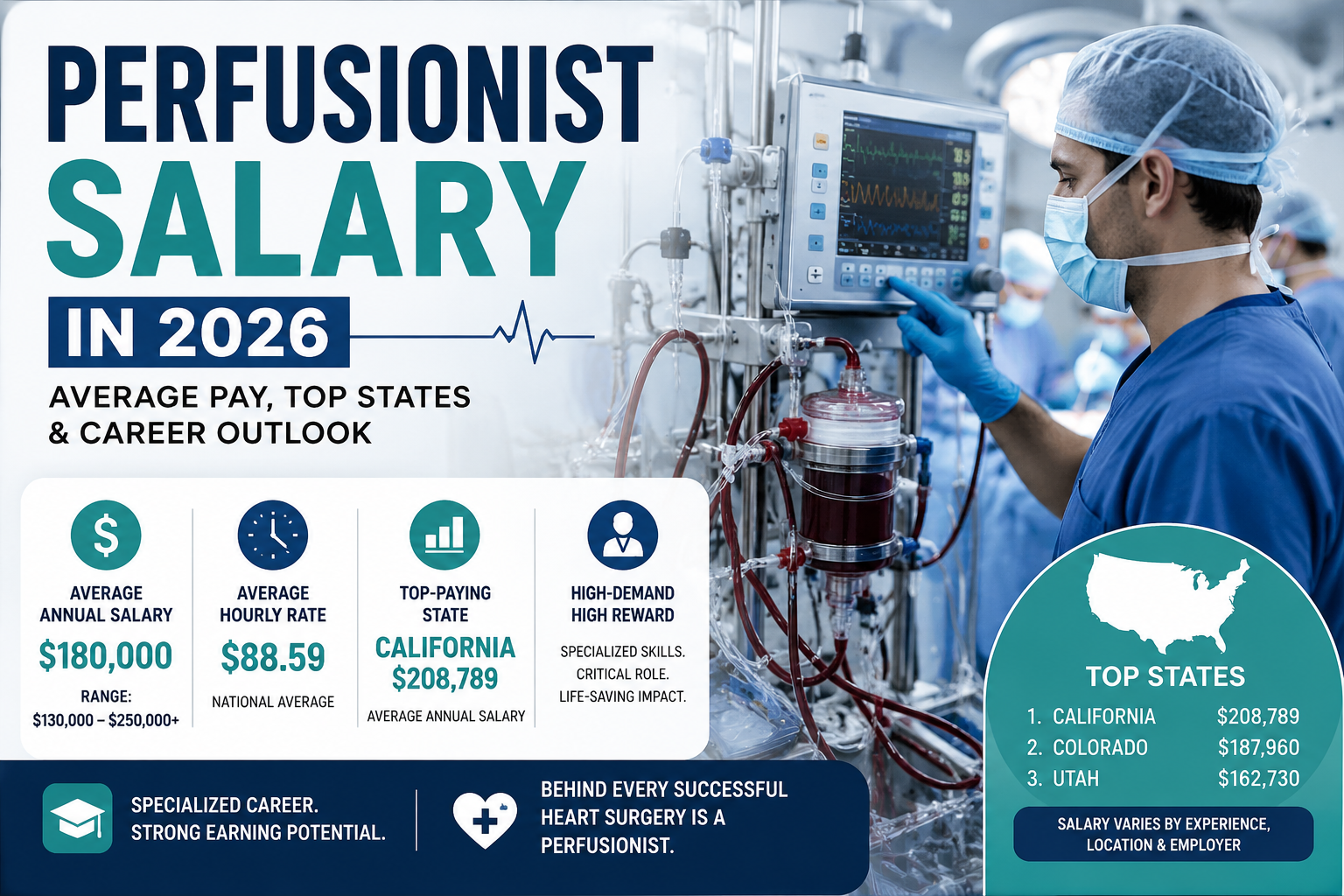
Current salary-market data reviewed for 2026 put average perfusionist compensation around $180,000 per year, while current salary data show an average hourly rate of $88.59. Actual compensation varies substantially by employer, location, experience, call requirements and contract type.
Current salary data show a wide compensation range, with lower-end estimates around $130,000 and higher-end compensation approaching $250,000 or more depending on location, experience, employer and contract type.
Here’s what’s actually happening in the perfusion job market in 2026—and what it means for anyone considering this career, negotiating an offer, or planning their next move.
What Perfusionists Actually Do—And Why It Pays
Before the salary discussion makes sense, you need to understand the job.
Perfusionists operate the heart-lung machine during cardiac surgery. They manage the patient’s circulatory and respiratory functions while the heart is stopped. They monitor blood gases, temperature, and pressure in real time. They make split-second decisions that literally keep patients alive.
This isn’t a role where you can coast. The margin for error is extremely small. The stress is substantial. The call schedule can be punishing.
That’s why hospitals pay what they pay.
Most clinical perfusionists spend the majority of their working time in operating rooms and other acute-care environments. They work alongside cardiac surgeons and anesthesiologists in high-stakes settings. The training pipeline is relatively specialized, with eligibility for ABCP examination tied to graduation from an accredited cardiovascular perfusion education program.
SalaryInfo Insight: The perfusionist salary premium isn’t primarily about education length or clinical complexity. It’s about scarcity. The limited number of accredited training programs, combined with growing demand from an aging population with cardiovascular disease, creates a supply-demand imbalance that directly benefits working perfusionists. This is a structural advantage, not a temporary market quirk.
The Salary Reality: National Averages vs. What You’ll Actually Earn
The national average tells one story. The distribution tells another.
National Compensation Snapshot
| Metric | 2026 Estimate |
|---|---|
| Average annual salary | ~$180,000 |
| Average hourly rate | $88.59 |
| Typical lower range | ~$130,000 |
| Higher-end compensation | ~$250,000+ |
Source note: Salary estimates are compiled from publicly available 2026 compensation and job-posting data. Figures can vary by employer, location, experience and contract type.
Vivian’s current data puts perfusionist hourly pay at about $88.59, substantially above its reported practicing U.S. average of $46.04/hour.
But averages hide the real variation.
Entry-level perfusionists typically start in the $100,000–$130,000 range. This is the apprenticeship phase—learning institutional protocols, building case volume, and earning your stripes.
Mid-career professionals with 5–10 years of experience see salaries accelerate to $130,000–$165,000. At this stage, you’re handling complex cases, taking call regularly, and potentially supervising junior staff.
Senior perfusionists with 8+ years of experience can earn $200,000 or more. In high-cost markets like California, senior-level compensation frequently exceeds $200,000.
The career trajectory isn’t linear—it accelerates. The biggest jumps happen when you move from staff perfusionist to senior roles, when you add specialized certifications, and when you position yourself in high-demand regions.
Where This Career Pays the Most: A State-by-State Analysis
Location is the single biggest variable in perfusion compensation. The difference between working in California and working in Utah can exceed $40,000 annually.
State Comparison: California, Colorado, Utah
| State | Average Annual Salary | Hourly Rate | Key Context |
|---|---|---|---|
| California | $208,789 | $100 | One of the highest-paying markets; driven by cost of living and major medical centers |
| Colorado | $187,960 | $90.37 | Strong pay; lower cost of living than California |
| Utah | $162,730 | $78.24 | Below national average; lower demand and cost of living |
Sources: ERI (California); ZipRecruiter (Colorado, Utah)
California: One of the Highest-Paying Markets
California is one of the highest-paying markets in the salary data reviewed for this guide, with an estimated average of $208,789—$100 per hour. The salary range spans $141,977 to $255,558.
But the premium comes with trade-offs. Housing costs in cities like Los Angeles, San Jose, and San Francisco are among the highest in the country. The state’s income tax burden is significant.
Yet for many perfusionists, the math still works. UCLA Health pays senior perfusionists $97.10–$128.04 per hour. Kaiser Permanente in Santa Clara offers $94.47–$122.21 per hour. SpecialtyCare positions in Upland and Palmdale range from $180,000–$240,000 annually.
Colorado: Mountain West Strength
Colorado’s average of $187,960 sits above the national average. The 25th percentile is $146,700; the 75th percentile is $205,600; top earners clear $294,950.
Employers in Colorado are actively hiring. A Greeley-based staff perfusionist position offers $165,000–$200,000 depending on experience. SpecialtyCare in Denver estimates $155,000–$175,000.
Utah: Below Average but Growing
Utah’s $162,730 average is about 10% below the national figure. The range spans from $127,000 (25th percentile) to $178,000 (75th percentile), with top earners at $255,359.
University of Utah Health lists cardiovascular perfusionist positions with pay ranges from $75,900 to $172,372. The wide spread reflects the difference between entry-level and experienced practitioners.
SalaryInfo Observation: The Utah-Colorado-California corridor illustrates a fundamental principle of perfusion compensation: pay tracks cost of living, but it also tracks the density of cardiac surgery programs. California has volume AND cost. Colorado has growing volume with moderate cost. Utah has lower volume and lower cost. Choose accordingly.
The Certification Premium: What Credentials Actually Pay
Board certification through the American Board of Cardiovascular Perfusion (ABCP) is the single largest salary lever available to perfusionists. Eligibility for ABCP examinations requires attendance and graduation from an AC-PE accredited perfusion program in the U.S. or an EQUAL™ Canada accredited perfusion program in Canada.
Most hospitals and staffing agencies require it. Certified Clinical Perfusionists (CCPs) earn substantially more than non-certified candidates.
But the premium doesn’t stop at basic certification.
Specialization Adds Real Value
| Certification/Specialization | Estimated Impact |
|---|---|
| ECMO expertise | Can improve access to specialized and higher-paying positions |
| VAD (Ventricular Assist Device) training | Faster placement, bonus-heavy roles |
| Pediatric perfusion specialization | Premium compensation |
| Multiple specializations | Compound effect |
ECMO-trained perfusionists are in particularly high demand as hospitals expand advanced support programs.
Board-certified perfusionists who pursue additional specializations—pediatric perfusion, ECMO specialist, VAD coordination—command premium compensation.
Certification can improve eligibility for competitive positions, while advanced education and specialization may also influence long-term earning potential.
Career Strategy: If you’re early in your perfusion career, prioritize ABCP certification above everything else. Once certified, pursue ECMO and VAD training. These specializations can improve access to competitive positions and may increase earning potential, although the financial benefit varies by employer and market.
How Experience Changes Your Earnings
The salary progression for perfusionists follows a predictable but important pattern.
Career Stage Breakdown
Years 0–3: Entry Level
- Salary range: $100,000–$130,000
- Focus: Building case volume, learning institutional protocols
- Key constraint: Limited autonomy, lower call frequency
Years 4–7: Mid-Career
- Salary range: $130,000–$165,000
- Focus: Complex cases, regular call, potential supervision of junior staff
- Key drivers: Case volume, call frequency, hospital employment vs. agency
Years 8–15: Senior
- Salary range: $165,000–$200,000+
- Focus: Leadership roles, specialization, high-volume centers
- Key drivers: Senior titles, certifications, geographic location
Years 15+: Principal/Leadership
- Salary range: $200,000–$250,000+
- Focus: Department leadership, education, research
- Key drivers: Administrative responsibilities, reputation, institutional need
The typical career progression moves from staff perfusionist to senior perfusionist to lead or chief perfusionist. Each step brings not just higher base pay but also greater control over schedule, case selection, and professional development.
SalaryInfo Insight: The biggest mistake early-career perfusionists make is optimizing for starting salary rather than career trajectory. A $110,000 offer at a high-volume academic center with robust ECMO and VAD programs is worth more over 10 years than a $130,000 offer at a low-volume community hospital. The experience and certification opportunities compound.
Highest Reported Contract Compensation
| Employer | Reported Annual Compensation |
|---|---|
| Zenex Partners | $374,400 |
| RapidStaff | $369,200 |
| Gale Healthcare Solutions | $366,964 |
| Mader Medx | $366,000 |
| Superbeo | $365,690 |
| Integrated Resources Inc | $353,600 |
Source note: Figures reflect publicly available 2026 job-posting and compensation data reviewed for this article.
Important: These figures represent reported job-posting compensation and should not be interpreted as typical staff-perfusionist salaries. Contract, travel, overtime, call and premium assignments can produce compensation well above conventional hospital employment. The lifestyle involves constant relocation, unfamiliar teams, and the pressure of stepping into new OR environments every few months. Benefits are often minimal compared to hospital employment.
Hospital Systems
Hospital-employed perfusionists typically earn less than travel contractors but gain stability, benefits, and predictable schedules.
- SpecialtyCare: $180,000–$240,000 for California positions
- UCLA Health: $87.42–$96.53/hour for staff; $97.10–$128.04/hour for senior
- Kaiser Permanente: $94.47–$122.21/hour
- UW Health (Madison): $161,000–$225,000
- Northwestern Medicine: $79.40–$111.16/hour
Reality Check: Some of the highest reported compensation figures come from staffing agencies and travel contracts, although hospital systems can also offer highly competitive compensation. The trade-off is real—travel perfusionists sacrifice stability, benefits, and schedule predictability for higher pay. Hospital employees trade some income for consistency and institutional investment in their development.
The Travel Perfusionist Premium
Travel perfusionists—those who take short-term contracts at hospitals across the country—represent a distinct compensation tier.
Hourly rates for travel positions frequently exceed $100/hour. Staffing agencies regularly advertise positions in the $350,000+ range.
But travel work isn’t for everyone.
The lifestyle involves constant relocation, unfamiliar teams, and the pressure of stepping into new OR environments every few months. Call schedules can be unpredictable. Benefits are often minimal compared to hospital employment.
SalaryInfo Observation: The travel premium exists because hospitals are desperate. If you’re willing to accept the lifestyle trade-offs, travel perfusion offers the highest immediate income. But many perfusionists find the stability and professional relationships of hospital employment more valuable over the long term. There’s no universally correct answer—it depends on your priorities.
Perfusionist vs. RN: The Salary Comparison
One of the most common questions from career-changers is how perfusionist pay compares to registered nursing.
The short answer: perfusionists earn significantly more.
A registered nurse in the United States earns approximately $86,000 annually on average. A perfusionist earns around $180,000. The difference is roughly $94,000 per year.
Even specialized nursing roles like CVICU or cardiac operating room nurses typically earn in the $98,000–$139,000 range. Perfusionists still out-earn them.
SalaryInfo Verdict: If you’re a nurse considering perfusion training, the income upside is substantial. But the path is long—accredited perfusion programs typically require a bachelor’s degree plus 1–2 years of specialized training. The investment pays off, but it’s not a quick transition. See our full Registered Nurse Salary guide for comparison.
Perfusionist vs. CRNA: Who Earns More?
Certified Registered Nurse Anesthetists (CRNAs) are often considered the gold standard for allied health compensation.
CRNAs earn approximately $200,000–$220,000 annually on average.
Perfusionists earn around $180,000. The CRNA premium is roughly $20,000–$40,000 annually.
But the comparison isn’t straightforward. CRNAs require a master’s or doctoral degree in nurse anesthesia—typically 2–3 years of full-time graduate education beyond nursing. Perfusionists require a bachelor’s degree plus an accredited perfusion program (1–2 years).
The educational investment is comparable. The compensation gap is real but not massive.
Career Strategy: If you’re choosing between these paths, consider more than salary. CRNAs have broader practice settings (hospitals, surgery centers, dental offices) and more autonomy in some states. Perfusionists work almost exclusively in cardiac surgery. The lifestyle, call schedules, and daily work are fundamentally different. Compare with our CRNA Salary guide for more details.
The Future Outlook: 5-Year Projections
The perfusion profession faces an interesting—and somewhat uncertain—future.
Growth Projections
Official employment data do not provide a separate BLS growth projection specifically for perfusionists. BLS reports a 3% projected growth rate from 2024 to 2034 for the broader cardiovascular technologists and technicians occupational category. Because perfusionists are a specialized profession within this broader labor-market classification, that figure should not be presented as a perfusionist-specific forecast.
Salary Projections
Salary growth will depend on inflation, regional demand, employer competition, specialty skills and the overall supply of qualified perfusionists.
Key Drivers of Future Demand
- Aging population: Cardiovascular disease prevalence increases with age. The US population is aging.
- ECMO expansion: Extracorporeal membrane oxygenation is being used in more settings—not just cardiac surgery but also critical care and emergency medicine.
- Training program expansion: More programs mean more supply, which could moderate salary growth.
- Cardiac surgery volumes: Uncertainty about procedure volumes affects demand.
- Technology: Automation and AI may change some aspects of perfusion practice, particularly monitoring, documentation and decision-support systems. However, clinical perfusion remains highly hands-on and patient-specific.
SalaryInfo Market View: The perfusion job market is likely to remain favorable for workers over the next 5–10 years. The aging population and ECMO expansion create structural demand. However, the expansion of training programs could gradually increase supply and moderate salary growth. The best hedge against stagnation is specialization—ECMO, VAD, and pediatric perfusion will remain premium skills.
The Biggest Salary Myth About This Career
The most persistent myth about perfusionist salaries is that the national average represents what you’ll actually earn.
It doesn’t.
The national average is a statistical artifact. It combines entry-level staff perfusionists in low-cost states with senior travel perfusionists in high-cost states. The actual range is massive.
A new perfusionist in Utah might earn $75,900. A senior travel perfusionist in California might earn $374,400. Both are perfusionists. Both are accurately reported. Neither represents the “typical” experience.
The second myth is that higher salary always means better career.
It doesn’t.
A $200,000 travel contract with no benefits and constant relocation is not necessarily better than a $160,000 hospital position with comprehensive benefits, predictable scheduling, and professional development opportunities. Total compensation matters. Work-life balance matters. Career trajectory matters.
SalaryInfo Insight: When evaluating perfusion offers, calculate total compensation—not just base salary. Include health insurance, retirement contributions, continuing education support, and call pay. A $170,000 hospital offer with a 401(k) match, health insurance, and tuition reimbursement can be worth more than a $200,000 contract with none of those things.
How to Negotiate Your Perfusionist Salary
Negotiation in perfusion is different from negotiation in most professions. The supply of qualified candidates is limited. Qualified perfusionists can have meaningful negotiating leverage in markets where employers are competing for experienced talent.
What to Negotiate
1. Base salary. This is the obvious starting point. Know your market—use the data in this guide to benchmark your worth.
2. Sign-on bonuses. Many perfusion positions offer $10,000–$20,000 signing bonuses. Ask for one. The worst they can say is no.
3. Call pay. Call schedules can be brutal. Ensure you’re compensated appropriately for after-hours and weekend coverage.
4. Continuing education. Certification maintenance requires ongoing education. Ask employers to cover conference attendance and certification fees.
5. Relocation assistance. If you’re moving for a position, relocation packages are common.
6. Schedule flexibility. Not all compensation is monetary. Flexible scheduling, reduced call frequency, and predictable hours have real value.
What to Know Before Negotiating
Know your certifications. CCP certification is table stakes—if you don’t have it, get it before negotiating. ECMO and VAD certifications give you real leverage.
Know the local market. California pays more than Utah. That’s not a secret. But within each state, individual hospitals vary. Research specific employers.
Know your value. A perfusionist with 10 years of experience, ECMO certification, and a track record of handling complex cases is worth more than a new graduate. Don’t apologize for your experience—it’s your primary asset.
For more detailed strategies, see our How to Negotiate Salary guide.
Common Career Mistakes Perfusionists Make
Mistake 1: Optimizing for starting salary over career trajectory.
The $130,000 offer at the high-volume academic center with ECMO programs is worth more over 10 years than the $150,000 offer at the low-volume community hospital. Experience compounds.
Mistake 2: Neglecting certification.
ABCP certification is the single most important credential. Without it, your options are limited and your earning potential is capped.
Mistake 3: Staying too long in one place.
Salary growth often requires mobility—either geographic moves or moves between employers. Loyalty is rarely rewarded in healthcare compensation.
Mistake 4: Ignoring total compensation.
Base salary matters, but benefits matter too. Health insurance, retirement contributions, and continuing education support add substantial value.
Mistake 5: Failing to specialize.
Specialized perfusionists may command higher compensation than generalists, depending on the employer, market and responsibilities.
How to Become a Perfusionist: The Education Path
The path to becoming a perfusionist requires:
- Bachelor’s degree (typically in biology, chemistry, or a related field)
- Completion of an accredited perfusion program (1–2 years)—attendance and graduation from an AC-PE accredited perfusion program in the U.S. is required for ABCP examination eligibility
- Clinical experience requirements: The ABCP examination process includes specific clinical case requirements, including 75 cardiopulmonary bypass (CPB) cases for PBSE eligibility and 40 independent clinical perfusions for CAPE eligibility
- Board certification through the American Board of Cardiovascular Perfusion (ABCP)
Entry-level salaries for new perfusionists range from $100,000–$130,000. The median annual salary for perfusionists is approximately $175,000.
SalaryInfo Career Strategy: If you’re considering perfusion as a career, the investment can be substantial, but the career offers relatively high earning potential compared with many other allied health professions.
Industry Risks to Consider
No career analysis is complete without discussing risks.
Automation and AI. Automation and AI may change some aspects of perfusion practice, particularly monitoring, documentation and decision-support systems. However, clinical perfusion remains highly hands-on and patient-specific.
Cardiac surgery volume. If less invasive cardiac procedures reduce the need for traditional bypass surgery, demand for perfusionists could decline.
Training program expansion. More perfusion programs mean more graduates, which could moderate salary growth over time.
Geographic concentration. Perfusion jobs are concentrated in areas with major cardiac surgery programs. If you want to live somewhere without a major medical center, your options are limited.
Call burden. The call schedule in perfusion can be demanding. Work-life balance is a real concern for many practitioners.
Related Healthcare Careers
Curious how perfusionist compensation compares to other allied health professions?
- Physical Therapist Salary — Physical therapists earn approximately $95,000–$100,000 annually, significantly less than perfusionists, though the educational path is comparable in length.
- Nurse Practitioner Salary — NPs earn around $120,000–$130,000 annually, below perfusionist compensation, with similar master’s-level educational requirements.
- Radiology Tech Salary — Radiology technologists earn approximately $70,000–$80,000 annually, representing a substantially different compensation tier.
- Medical Dosimetrist Salary — Medical dosimetrists earn around $130,000–$150,000 annually, making them one of the better-compensated allied health professions, though still below perfusionists.
- Average Salary in the US — The average practicing US wage is $46.04 per hour, making perfusionist compensation substantially higher than the national average.
FAQs
How long is schooling to become a perfusionist?
Most perfusionists complete a bachelor’s degree (4 years) followed by an accredited perfusion program (1–2 years). Total education time is typically 5–6 years. Certification through the American Board of Cardiovascular Perfusion is required for most positions. The ABCP also requires 75 CPB cases and 40 independent clinical perfusions for examination eligibility.
Who makes more, RN or perfusionist?
Perfusionists earn significantly more. The average registered nurse earns approximately $86,000 annually, while perfusionists average around $180,000. Even specialized cardiac nurses typically earn $98,000–$139,000—well below perfusionist compensation.
Is it hard to be a perfusionist?
Yes. The work involves managing a patient’s circulatory and respiratory functions during cardiac surgery—essentially keeping patients alive while the heart is stopped. The stress is high, the margin for error is extremely small, and call schedules can be demanding. Most clinical perfusionists spend the majority of their working time in operating rooms and other acute-care environments.
Who makes more, CRNA or perfusionist?
CRNAs typically earn more—approximately $200,000–$220,000 annually versus around $180,000 for perfusionists. However, the educational paths are comparable in length, and both are among the highest-paid allied health professions. The choice between them should consider practice setting, autonomy, and lifestyle preferences more than salary alone. See our full CRNA Salary guide.
Which states pay perfusionists the most?
California is among the higher-paying markets in the salary data reviewed for this guide, with an estimated average of $208,789. Actual pay varies by employer, experience, specialty, call requirements and location. Senior perfusionists in California frequently earn $200,000–$250,000. However, the state’s high cost of living and tax burden should be factored into any relocation decision.
Do perfusionists get paid hourly or salary?
Both. Staff perfusionists are typically salaried with additional compensation for call, overtime, and on-call hours. Travel and contract perfusionists are often paid hourly with rates frequently exceeding $100/hour. Hospital-employed perfusionists may also receive shift differentials for nights and weekends.
What skills increase a perfusionist’s salary?
Board certification (CCP) is the foundation. Beyond that, ECMO expertise can improve access to specialized and higher-paying positions. VAD training accelerates job placement and access to bonus-heavy roles. Pediatric perfusion specialization commands premium compensation. Advanced clinical skills and leadership experience also drive higher pay.
Is perfusionist a good career for the future?
Official employment data do not provide a separate BLS growth projection specifically for perfusionists. BLS reports a 3% projected growth rate from 2024 to 2034 for the broader cardiovascular technologists and technicians occupational category. Salary growth will depend on inflation, regional demand, employer competition, specialty skills and the overall supply of qualified perfusionists. The aging US population and expansion of ECMO programs create structural demand.
What is the starting salary for a perfusionist?
Entry-level perfusionists typically earn $100,000–$130,000. Geographic variation is significant—California entry-level positions pay more than Utah or other lower-cost states. Sign-on bonuses of $10,000–$20,000 are common for new graduates in competitive markets.
Can perfusionists work remotely?
No. Perfusion is an inherently clinical role that requires physical presence in the operating room. Remote work is not possible. Some administrative or educational roles may offer hybrid arrangements, but clinical perfusion requires on-site presence.