
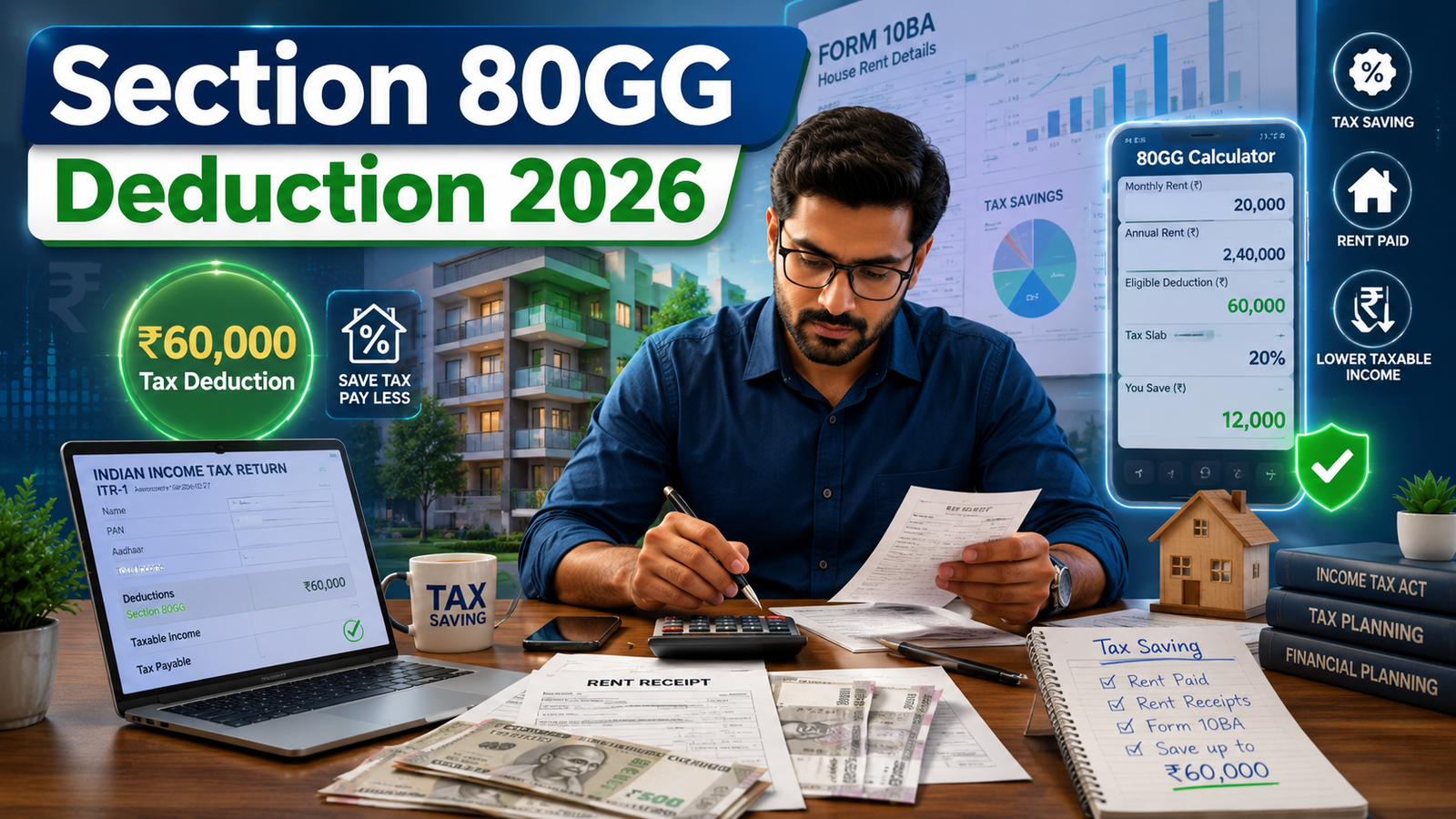
- Maximum deduction: ₹60,000 annually (₹5,000 per month).
- Available only under the old tax regime.
- Filing Form 10BA is mandatory.
- Cannot be claimed if HRA exemption has already been taken.
- The deduction equals the least of the three prescribed limits.
• Maximum deduction: ₹60,000 annually (₹5,000/month).
• Available only under the old tax regime.
• Filing <strong>Form 10BA</strong> is mandatory.
• Cannot be claimed if HRA exemption is taken.
• Deduction equals the least of three prescribed limits.
What Is Section 80GG of the Income Tax Act?
Section 80GG is a deduction under Chapter VI-A of the Income Tax Act that allows resident individuals to claim tax relief on rent paid for residential accommodation when they do not receive House Rent Allowance (HRA) from their employer.
The section provides a maximum deduction of ₹60,000 per annum (₹5,000 per month), subject to certain conditions and calculations.
Why it exists: Section 80GG was introduced to reduce the burden of housing rent for self-employed individuals and salaried taxpayers who don’t receive HRA, ensuring they aren’t penalized for not having an employer-provided housing allowance.
The 2026 Reality Check: Section 80GG Is Still Alive—But Only If You Know Where to Look
Here’s the uncomfortable truth most tax articles won’t tell you: Section 80GG is one of the most underutilized deductions in the Income Tax Act, and for Assessment Year 2026-27, it comes with a catch that trips up even seasoned filers.
The deduction itself is straightforward—up to ₹60,000 annually on rent paid when you don’t receive HRA. But the regime choice is the silent killer. Section 80GG is not available under the new tax regime. If you’ve defaulted into the new regime (which became the default in 2020), you’ve already lost this deduction before you even started calculating.
This isn’t a minor detail. For a self-employed professional paying ₹15,000 monthly rent, the deduction could save roughly ₹13,000–₹18,000 in tax (depending on your slab). That’s real money. And most people leave it on the table because they assume—incorrectly—that rent benefits are only for salaried employees with HRAs.
The operator’s view: The new regime’s lower rates look attractive on paper, but for anyone with significant Chapter VI-A deductions (80C, 80D, 80GG, etc.), the old regime often wins. Run the numbers both ways. Don’t let the default choice cost you.
Who Can Claim Section 80GG? (And Who Absolutely Cannot)
Short answer: Any resident individual—salaried, self-employed, freelancer, or pensioner—who pays rent for residential accommodation and does not receive HRA can claim Section 80GG.
The five eligibility gates you must clear:
- No HRA received — If your salary slip shows HRA and you claim exemption under Section 10(13A), you cannot use 80GG. It’s one or the other.
- You pay rent — For furnished or unfurnished residential accommodation you occupy as your own residence.
- No owned house at your work/residence location — Neither you, your spouse, your minor child, nor your HUF can own a residential property in the city where you live or work.
- You opt for the old tax regime — This is non-negotiable for AY 2026-27.
- You file Form 10BA — More on this below. It’s mandatory.
Pensioners, take note: Pension is treated as salary under Section 4 of the Act. If you’re a pensioner paying rent and not receiving HRA, you are eligible. This is a frequently overlooked benefit for retirees.
Who cannot claim it: Companies, firms, and anyone already claiming HRA exemption. Also, if you own a self-occupied property anywhere (not just at your work location), you’re blocked.
The Calculation: Three Numbers, One Winner
Section 80GG deduction = the lowest of these three amounts:
| Test | Formula | Cap |
|---|---|---|
| Test 1 | Rent paid – 10% of adjusted total income | No upper cap (but capped by others) |
| Test 2 | 25% of adjusted total income | Variable |
| Test 3 | ₹5,000 per month | ₹60,000 per year |
Adjusted total income means your total income before allowing any deduction under Section 80GG, but after other deductions under Chapter VI-A. This is where people mess up—using gross income instead of adjusted income inflates the calculation and leads to overclaiming.
Worked example:
- Annual rent: ₹1,80,000 (₹15,000/month)
- Adjusted total income: ₹8,00,000
- Test 1: ₹1,80,000 – (10% × ₹8,00,000) = ₹1,80,000 – ₹80,000 = ₹1,00,000
- Test 2: 25% × ₹8,00,000 = ₹2,00,000
- Test 3: ₹60,000
Deduction = ₹60,000 (the lowest).
Notice how Test 3 (the ₹5,000/month cap) is almost always the binding constraint for anyone with decent income. That ₹60,000 ceiling hasn’t changed since FY 2016-17. In inflation-adjusted terms, it’s eroded significantly—but it’s still free money if you qualify.
Section 80GG Calculator 2026
Want to skip the math? Use our free Section 80GG Calculator to determine your exact deduction in seconds. Just enter your annual rent and adjusted total income, and the tool will compute the least of the three limits automatically.
Section 80GG Calculator
Calculation Result
₹60,000 Limit:
25% of Income:
Rent Paid – 10% of Income:
- ₹5,000 per month (₹60,000 yearly)
- 25% of total income
- Actual rent paid minus 10% of total income
Form 10BA: The Mandatory Declaration
Is filing a declaration mandatory for claiming 80GG? Yes. Absolutely. Non-negotiable.
The ITAT Bangalore has ruled that submission of Form 10BA is necessary for claiming the deduction under Section 80GG. Failure to file it renders the taxpayer ineligible.
Form 10BA requires:
- Your name and PAN/Aadhaar
- Address of the rented accommodation
- Rent period and amount
- Landlord's name, PAN, and complete address (PAN is mandatory if annual rent exceeds ₹1 lakh)
The institutional insight: The Income Tax Department has been tightening scrutiny on rent deductions. In AY 2026-27, ITR forms have expanded reporting requirements across multiple deduction sections. This isn't a passive filing exercise anymore—it's an active compliance regime. If your landlord's PAN doesn't match their ITR filings, expect a notice.
The 7 Most Common 80GG Mistakes (That Will Get Your Claim Rejected)
1. Claiming 80GG while receiving HRA
This is the #1 error. You cannot claim both. If your employer gives you an HRA, use the HRA exemption route. Section 80GG is for people who don't get HRA.
2. Not filing Form 10BA
As discussed, mandatory. No form, no deduction.
3. Using the wrong income figure for calculation
Adjusted total income ≠ gross total income. Using gross income inflates Test 1 and Test 2, leading to overclaiming and potential penalties.
4. Owning a house in the same city
If you or your spouse owns a residential property where you live/work, you're disqualified—even if you're paying rent elsewhere.
5. Claiming under the new tax regime
Section 80GG is not allowed under the new regime. This is the most common mistake in 2026 filings.
6. Incorrect Form 10BA filing
A wrongly filed declaration can cancel a valid deduction. Double-check every detail—especially landlord PAN.
7. No proof of rent payment
While not strictly required at filing, rent receipts and bank transfer records are essential if the Department asks for substantiation.
Section 80GG vs. HRA: Know the Difference
The strategic takeaway: HRA is almost always more generous because it scales with your salary and city classification. But if you don't have HRA, 80GG is your only option—and ₹60,000 is better than zero.
How to Remove 80GG Deduction in ITR (If You Claimed It By Mistake)
If you've already filed your return and claimed 80GG incorrectly:
- File a revised return under Section 139(5) before the assessment year ends.
- Remove the 80GG claim from Schedule VI-A.
- Recalculate your tax liability.
- Pay any additional tax due (with interest, if applicable).
Don't ignore it. An incorrect claim, even if unintentional, can result in:
- Notice under Section 143(1) for defective return
- Interest under Section 234B/234C for short payment
- In extreme cases, penalty under Section 270A for underreporting
The safer play: If you're unsure about eligibility, consult a CA before filing—not after.
FAQ
Q1: Is Section 80GG applicable for pensioners?
Yes. Pension is treated as salary under Section 4, and pensioners who pay rent and do not receive HRA can claim the deduction.
Q2: What form is mandatory for claiming Section 80GG?
Q3: Can I claim 80GG under the new tax regime?
No. Section 80GG is not allowed under the new tax regime. You must opt for the old regime to claim it.
Q4: What is the maximum deduction under Section 80GG?
₹60,000 per annum (₹5,000 per month), subject to the other two tests (rent minus 10% of income and 25% of income).
Q5: Can I claim 80GG if I own a house in another city?
Yes. The ownership disqualification applies only to the city where you reside or work.
Q6: How to remove an 80GG deduction in ITR if claimed by mistake?
File a revised return under Section 139(5) before the assessment ends, remove the claim, and pay any additional tax due.
Q7: Can I claim both HRA and Section 80GG?
No. It's one or the other.
Conclusion: The 80GG Decision Framework
Key takeaways:
- Regime first, deduction second. Section 80GG only works in the old regime. If you're in the new regime, you can't claim it—period.
- ₹60,000 is the practical cap. For most taxpayers, the monthly ₹5,000 limit is the binding constraint. The other two tests rarely produce a lower number.
- Form 10BA is mandatory. No declaration = no deduction. This isn't optional—it's a statutory requirement.
- Eligibility is narrower than you think. No HRA, no owned house in the same city, and you must actually occupy the rented premises.
- Document everything. Rent receipts, bank transfers, landlord PAN—keep it all. The Department is scrutinizing rent deductions more closely.
Action strategy for 2026 filings:
- Step 1: Decide your regime. If you have significant 80C, 80D, and 80GG claims, the old regime likely wins.
- Step 2: Confirm eligibility. Check your salary structure for HRA. Check property ownership.
- Step 3: Calculate correctly. Use adjusted total income, not gross income.
- Step 4: File Form 10BA with your ITR.
- Step 5: Keep proof. Rent receipts and bank statements for at least 6 years.
Section 80GG isn't a massive deduction—₹60,000 is modest compared to 80C's ₹1.5 lakh. But in a world where every rupee of tax saved compounds, it's worth claiming correctly. Just don't let the regime choice kill it before you start.
Disclaimer: This article is for informational purposes only and does not constitute tax advice. Tax laws are complex and change frequently. Consult a qualified chartered accountant for advice specific to your situation.