How We Estimated Salaries
Salary ranges in this guide are based on analysis of publicly available compensation data, hiring trends, recruiter insights, employer disclosures, and current technology market conditions in 2026. Actual salaries vary by company, city, skills, negotiation, and total compensation structure. All figures represent industry estimates and should be used as benchmarks rather than guarantees.
The Short Answer (For People Who Don’t Have Time)
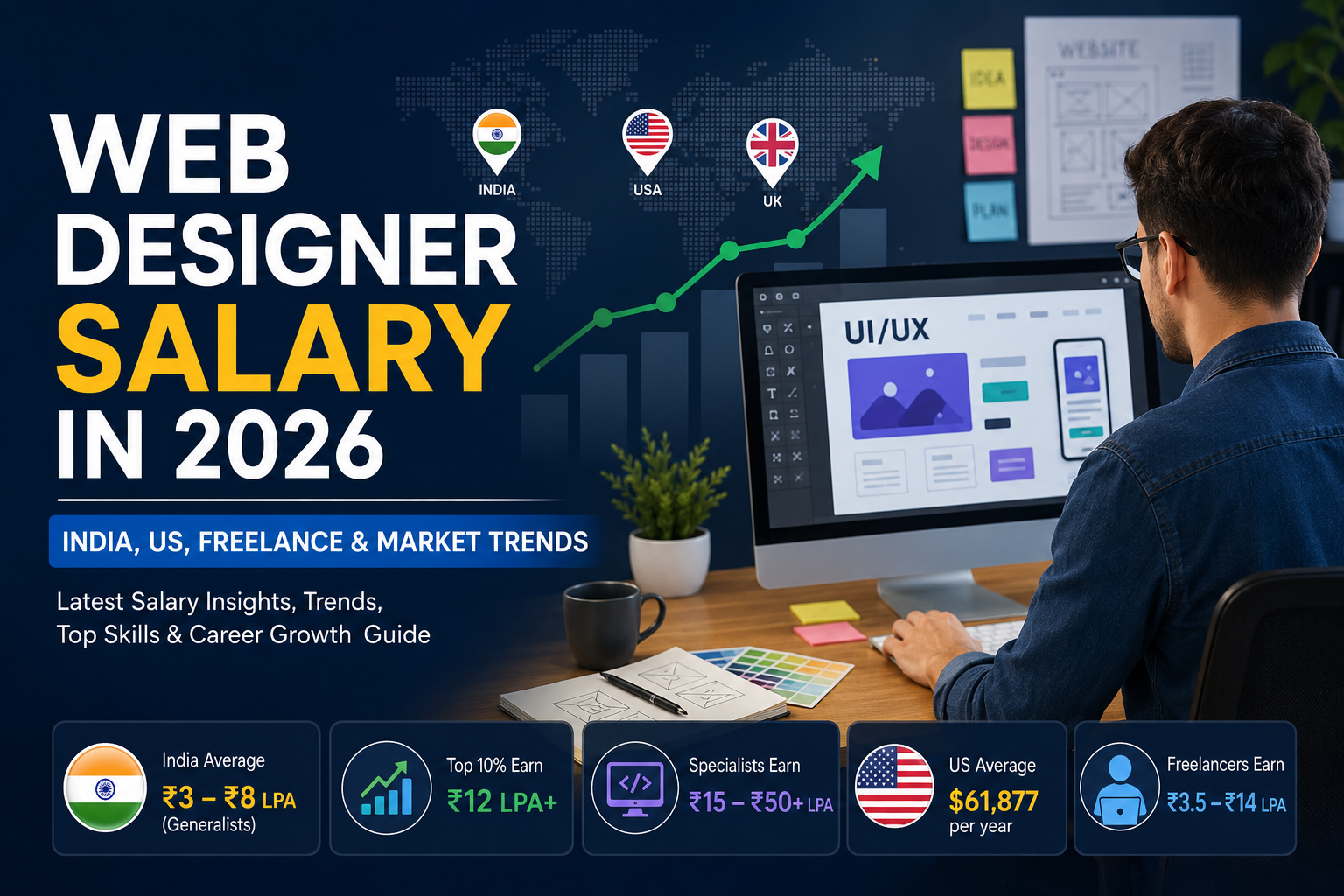
Most web designers in India earn between ₹3 LPA and ₹8 LPA. Specialists in UX, product design, and design leadership can earn ₹15–50+ LPA depending on skills and company.
Here’s what actually matters:
- Entry-level (0-1 year): ₹2.5–3.5 LPA
- Mid-career (3-6 years): ₹4–6 LPA
- Senior (6-9 years): ₹6–10 LPA
- Top 10% of earners: ₹12+ LPA
- US average: $61,877/year
- UK median: £45,000/year
The gap between a commodity designer and a strategic designer is now wider than the gap between a junior developer and a CTO. That’s not hyperbole — that’s the 2026 market.
The 2026 Web Designer Salary Landscape: A Market Operator’s Perspective
Let’s cut through the noise.
Every salary guide you’ll read tells you the same thing: “Web designers earn between X and Y, depending on experience.” That’s like saying “stocks go up and down.” Technically true. Completely useless.
Here’s what the data actually tells us — and what it doesn’t.
Web Designer Salaries: By Experience Level
The average web designer in India earns between ₹3 LPA and ₹8 LPA. But averages are dangerous. They hide the distribution.
The real story is in the experience bands:
| Level | Annual Salary (India) |
|---|---|
| Entry (0-1 yr) | ₹2.5L – ₹3.5L |
| Early (1-3 yrs) | ₹3L – ₹4.5L |
| Mid (3-6 yrs) | ₹4L – ₹6L |
| Senior (6-9 yrs) | ₹6L – ₹10L |
| Top 10% | ₹12L+ |
| Top 1% (Specialists) | ₹15L – ₹50L+ |
That ₹3 LPA to ₹50+ LPA spread isn’t just experience. It’s role. It’s specialization. It’s leverage.
US Market Comparison
American web designers earn significantly more — but the same stratification applies.
| Level | Annual Salary (US) |
|---|---|
| Entry (<1 yr) | ~$49,349 |
| Early (1-4 yrs) | ~$56,755 |
| Average | $61,877 |
| Top earners | $89,000+ |
The US market is projected to see 14,500 job openings annually for web developers and designers over the next decade. That’s steady, not explosive — and it tells you something about where the market is headed.
UI/UX Designer Salaries: The Specialization Premium
Here’s where the market gets interesting.
A UI designer in India earns ₹10,000–61,000/month. A UX designer earns ₹51,000–83,000/month. That’s not a small gap — that’s a different income bracket.
The 2026 hierarchy is now clear:
| Role | Pay Tier | Entry (India) | Senior (India) |
|---|---|---|---|
| Visual Designer | Lowest | ₹3–5 LPA | ₹18–30 LPA |
| UI Designer | Lower-mid | ₹3.5–6 LPA | ₹24–40 LPA |
| UX Designer | Upper-mid | ₹5–9 LPA | ₹35–55 LPA |
| Product Designer | High | ₹6–11 LPA | ₹45–75 LPA |
| Design Systems Lead | Highest IC | ₹16–30 LPA | ₹55–90 LPA |
Based on hiring trends across India’s technology sector (2025-26)
Product designers earn 30–50% more than pure visual designers at the same experience level. Why? Because their work spans research, interaction design, and business impact — not just pixels.
The market has spoken. If you’re still calling yourself a “web designer” in 2026, you’re competing on price. If you’re a product designer or UX strategist, you’re competing on value.
City Arbitrage: Where Your Salary Goes Furthest
Location matters more than most guides admit.
India’s Top-Paying Cities
| City | Estimated Annual Salary | Premium vs National |
|---|---|---|
| Bengaluru (Bangalore) | ₹19 LPA | +14% |
| Mumbai | ₹18.5 LPA | +10% |
| Hyderabad | ₹4–4.5 LPA | — |
| Delhi | ~₹20,500/month | — |
Bengaluru pays 14% above the national average. Mumbai pays 10% above. But these are gross figures — cost of living eats into the premium.
The real arbitrage isn’t city-to-city. It’s remote work. A designer in Indore earning Bengaluru rates is capturing the spread. That’s how you win the salary game without moving.
Global Comparison
| Country | Average (Local Currency) |
|---|---|
| US | $61,877/year |
| UK | £45,000/year (median) |
| Canada | Job outlook: Limited in Ontario |
| Australia | Premium market, limited data |
The US market is the ceiling. But competition is fierce, and the AI question looms large.
The Freelance Reality: ₹3.5 LPA to ₹14 LPA
Freelance web designers in India earn ₹3.5–4.5 LPA on average. The top 1% earn over ₹14 LPA.
The catch: These numbers hide massive volatility.
| Experience | Freelance Annual Salary Range |
|---|---|
| 0-1 yr | ₹1.7–2 LPA |
| 1-3 yrs | ₹2.5–3 LPA |
| 3-6 yrs | ₹3.5–4 LPA |
| 6-9 yrs | ₹4.5–5 LPA |
| 12+ yrs | ₹7.5–8.5 LPA |
Monthly freelance earnings in India average ₹16,500. Compare that to the ₹18,388/month average for salaried designers — the premium for stability is real.
Freelance isn’t a shortcut to higher pay. It’s a different risk-reward profile. Some months you make bank. Some months you don’t.
The AI Elephant in the Room
Let’s address what everyone’s thinking but few are saying clearly.
AI is increasingly automating repetitive design work, while demand for strategic UX and product design continues to grow. Entry-level roles are under pressure as template customization and basic visual work become commoditized.
But here’s the contrarian view:
The global web design services market is still $41.8 billion, with steady projected growth. Premium clients still demand custom strategy. The work isn’t disappearing — it’s shifting.
AI tools have compressed pay for execution-focused visual work while widening the premium for strategy, research, and systems work. A Senior Product Designer at a top product company now earns roughly what a Senior Software Engineer earns. A Senior UI Designer at an IT services company earns less than half of that.
The market isn’t replacing designers. It’s replacing commodity designers with AI and paying more for strategic designers.
The 2026 Verdict: Is Web Design a High-Paying Job?
Yes — if you’re the right kind of designer.
No — if you’re competing on price.
The market has bifurcated. One path leads to ₹3–5 LPA and increasing automation pressure. The other leads to ₹15–50+ LPA and growing demand for human-centered strategy.
The difference isn’t talent. It’s positioning.
Where the Money Actually Is in 2026:
- UX/Product Design — ₹35–75 LPA at senior levels
- Design Systems — ₹55–90 LPA at senior levels
- AI-Enhanced Workflows — Premium rates for designers who use AI tools effectively
- Bengaluru/Mumbai — 10-14% above national average
- Top 1% of freelancers — ₹14 LPA+
Where the Pressure Is:
- Pure visual/UI design — Commoditizing fast
- Basic template work — Increasing automation
- Entry-level roles — Shrinking, not growing
- Smaller cities without remote leverage — Lower rates, less mobility
Can You Become a Web Designer in 3 Months?
You can learn the tools in 3 months.
You cannot become a market-ready strategic designer in 3 months.
Complete beginners investing 10-15 hours weekly in structured learning can develop basic competency within 3-6 months. Professional proficiency generally requires 12-18 months of consistent practice.
The 3-month courses teach you Figma, HTML, and CSS. They don’t teach you user psychology, business strategy, or design systems — which is where the money actually is.
If you want to earn ₹15+ LPA, plan for 18-24 months of deliberate skill-building. Not 3 months of clicking through tutorials.
Featured Snippets
Q: Is web design a high-paying job in 2026?
Yes. Web design remains a high-paying career in 2026, especially in UX, product design, and design systems, where experienced professionals can earn ₹15–50+ LPA depending on skills and company.
Q: What is the highest-paying web design specialization in 2026?
Design Systems Lead pays ₹55-90 LPA at senior levels in India. Product Design pays ₹45-75 LPA. Both require strategic thinking, not just visual skills.
Q: Which cities pay web designers the most in India?
Bengaluru pays 14% above the national average (₹19 LPA). Mumbai pays 10% above (₹18.5 LPA). Remote work allows designers to capture these premiums without relocating.
Q: How much does a freelance web designer earn in India?
Average freelance earnings are ₹3.5-4.5 LPA. Top 1% earn over ₹14 LPA. Monthly average is ₹16,500 — comparable to salaried roles but with higher volatility.
Q: Which web design role has the highest growth potential?
UX/Product Design and Design Systems. Product designers earn 30-50% more than visual designers at the same experience level because their work spans research, interaction, and business impact.
Estimated Salary Ranges at Leading Employers
The company you work for significantly impacts your earning potential. Here’s what top employers are paying in 2026:
| Company | Estimated Annual Salary Range (₹) |
|---|---|
| 17 L – 24 L | |
| Adobe | 11 L – 19 L |
| Razorpay | 16 L – 28 L |
| Accenture | 4 L – 8 L |
| TCS | 3.5 L – 6 L |
| Infosys | 3 L – 6 L |
| Cognizant | 3.8 L – 6.5 L |
| IBM | 4.5 L – 8 L |
| Zoho | 4.8 L – 7.5 L |
| Deloitte | 8.5 L – 15 L |
Based on aggregated market salary estimates and public compensation data (2026)
Key Insight: Product companies (Google, Razorpay, Adobe) pay 2-3x more than service companies (TCS, Infosys, Cognizant) for similar experience levels. The premium for working on the product side is substantial and growing.
Monthly In-Hand Salary Breakdown
Understanding your monthly take-home pay is crucial for financial planning. Here’s what different annual packages translate to in monthly in-hand salary (post-tax, post-deductions):
| Annual Package | Approx Monthly In-Hand | Notes |
|---|---|---|
| ₹3 LPA | ₹21,500 – ₹23,000 | Entry-level, basic deductions |
| ₹5 LPA | ₹35,000 – ₹37,500 | Early career, standard PF/IT |
| ₹8 LPA | ₹54,000 – ₹58,000 | Mid-level, some tax liability |
| ₹10 LPA | ₹66,000 – ₹71,000 | Senior individual contributor |
| ₹15 LPA | ₹95,000 – ₹1,02,000 | Lead/Manager level |
| ₹20 LPA | ₹1,24,000 – ₹1,33,000 | Director/Principal level |
| ₹30 LPA | ₹1,80,000 – ₹1,95,000 | Senior leadership, specialized roles |
Assumptions: Standard PF (12%), Professional Tax, and Income Tax as per new regime. Figures are approximate and vary by city and company policies.
Read more:
- 4 LPA In-Hand Salary — Detailed breakdown of ₹4 LPA take-home
- 5 LPA In-Hand Salary — What ₹5 LPA actually means in your bank account
- 30 LPA In-Hand Salary — Top-tier salary post-tax analysis
- 50 LPA Salary In Hand — Understanding senior executive compensation
Skills vs Salary: What Actually Pays in 2026
Your skill set directly determines your earning capacity. Here’s the premium each skill commands in the current market:
| Skill | Estimated Salary Impact | Market Demand |
|---|---|---|
| Figma | +15-25% | Essential — basic requirement |
| UX Research | +30-50% | High — strategic skill |
| Product Strategy | +40-60% | Very High — leadership skill |
| Design Systems | +50-80% | Highest — specialized skill |
| AI Tools (Midjourney, etc.) | +15-30% | Growing — efficiency multiplier |
| Webflow | +20-35% | High — no-code premium |
| Shopify | +10-20% | Moderate — e-commerce focus |
| WordPress | 0-10% | Low — commoditized |
| Motion Graphics | +15-25% | Moderate — visual differentiation |
| HTML/CSS/JavaScript | +10-20% | Baseline — technical fluency |
The pattern is clear: Strategic skills (Research, Product Strategy, Design Systems) command significantly higher premiums than execution skills. The market rewards design thinkers, not just design makers.
Compare with related roles:
- UI/UX Designer Salary — Deep dive into the highest-paying design specialization
- Graphic Designer Salary — How pure visual design compares
- Software Engineer Salary — Design vs. engineering compensation comparison
- Data Analyst Salary — Another tech-adjacent salary comparison
Career Roadmap: From Junior to Design Leadership
Your earning trajectory follows a clear career progression. Here’s the typical path and corresponding salary bands:
Key Inflection Points
Year 2–3: Moving from generalist to specialist (UI/UX) — 40–60% salary increase
Year 5–7: Transitioning to product design or leadership — 50–80% jump
Year 10+: Moving into leadership or principal roles — 2x+ increase
Related career paths:
- Software Developer Salary — Compare with development career progression
- Cyber Security Salary — Another high-growth tech specialization
- Digital Marketing Salary — Marketing career path comparison
Industry Comparison: Which Sectors Pay Best?
Not all industries value design equally. Here’s how different sectors compare in 2026:
| Industry | Entry-Level (₹ LPA) | Senior (₹ LPA) | Premium vs Average |
|---|---|---|---|
| SaaS / Software Product | 6-9 | 25-45 | +60-80% |
| Fintech | 5-8 | 20-35 | +40-60% |
| AI/ML Companies | 5-7 | 18-30 | +30-50% |
| E-commerce | 4-7 | 15-25 | +20-40% |
| Gaming | 4-6 | 14-22 | +10-30% |
| Healthcare/MedTech | 3.5-5 | 12-18 | +0-10% |
| EdTech | 3-4.5 | 10-15 | -10-0% |
| Digital Agencies | 2.5-3.5 | 8-12 | -20-30% |
| Government / PSU | 2-3 | 6-9 | -30-50% |
Based on technology sector hiring patterns and employer compensation disclosures (2026)
SaaS and Fintech lead the pack, offering 60-80% premiums over the average. Agencies and government roles lag significantly behind.
Specialized Design Roles and Their Salary
Beyond generalist web design, specialized roles command premium rates:
| Role | Estimated Annual Salary Range (₹) | Key Requirements |
|---|---|---|
| WordPress Designer | 3 – 6 LPA | Theme customization, PHP basics |
| Shopify Designer | 3.5 – 7 LPA | Liquid, e-commerce UX |
| Webflow Designer | 4 – 9 LPA | Webflow, CSS, interactions |
| Framer Designer | 4.5 – 10 LPA | Framer, prototyping, interactions |
| No-Code Designer | 4 – 8 LPA | Bubble, Webflow, Wix Studio |
| Motion Designer | 5 – 12 LPA | After Effects, Lottie, animations |
No-code and Webflow specialists are increasingly in demand as companies look to build faster without extensive development resources. The premium for these skills is growing as the talent pool remains limited.
Remote vs Office: The New Salary Arbitrage
The shift to remote work has created new dynamics in web designer compensation. Here’s how the two compare:
| Factor | Remote | In-Office |
|---|---|---|
| Average Salary | ₹18,500/month | ₹18,388/month |
| Location Premium | Potential to earn Bengaluru rates from lower-cost cities | Limited to local market rates |
| Flexibility | High — work from anywhere | Limited — fixed location |
| Career Growth | Variable — depends on company culture | Often faster in early career |
| Networking | Requires conscious effort | Natural interaction |
The remote arbitrage opportunity: A designer in Indore or Jaipur earning Bengaluru rates (14% premium) while paying lower rent and living costs can significantly out-earn their peers on a purchasing power basis.
Related calculators:
- HRA Calculator — Optimize your housing allowance
- Income Tax Calculator — Maximize your post-tax income
- CTC Calculator — Understand your total compensation package
Freelance Hourly Rates in India
Freelance web designers typically charge by the hour or project. Here’s what the market looks like:
| Experience Level | Hourly Rate (₹) | Typical Project (₹) |
|---|---|---|
| Entry (0-2 yrs) | ₹500 – ₹800 | ₹15,000 – ₹50,000 |
| Mid (3-6 yrs) | ₹1,000 – ₹2,000 | ₹50,000 – ₹2,00,000 |
| Senior (7+ yrs) | ₹2,500 – ₹5,000 | ₹2,00,000 – ₹10,00,000+ |
| Expert/Specialist | ₹5,000 – ₹10,000+ | ₹5,00,000+ |
Platform averages:
- General Freelance Platforms: ₹1,200 – ₹2,500/hour
- Premium Freelance Platforms: ₹1,500 – ₹3,000/hour
- Direct Clients: ₹2,500 – ₹5,000/hour
- International Clients: $30 – $100/hour
Direct clients and international projects pay 50-100% more than platform-based work. Building a portfolio and reputation outside platforms is a key strategy for premium pricing.
Real Salary Examples: What Designers Actually Earn
Here are three real-world scenarios that illustrate the range of earnings in the market:
Example 1: Fresher at a Digital Agency in Jaipur
Profile: 0-1 years experience, visual design focus, basic HTML/CSS knowledge
| Component | Amount |
|---|---|
| Annual Package | ₹3.2 LPA |
| Monthly Take-Home | ₹23,000 |
| Location | Jaipur (Tier 2 city) |
| Growth Path | Moving to UI/UX specialization in 1-2 years |
Reality check: This is the most common entry point. Competition is high, and the work is execution-focused. The designer will need to upskill significantly to move up the pay ladder.
Example 2: Mid-Level Designer at a Product Startup in Bengaluru
Profile: 3 years experience, UI/UX specialization, Figma expert, some research exposure
| Component | Amount |
|---|---|
| Annual Package | ₹8.5 LPA |
| Monthly Take-Home | ₹58,000 |
| Location | Bengaluru (Tier 1 city) |
| Growth Path | Moving to senior designer within 1-2 years |
Reality check: This is where specialization starts paying off. The shift from “web designer” to “UI/UX designer” unlocked a 60%+ salary increase.
Example 3: Senior UX Designer (Remote)
Profile: 8 years experience, product strategy focus, design systems experience, strong research background
| Component | Amount |
|---|---|
| Annual Package | ₹22 LPA |
| Monthly Take-Home | ₹1.3 lakh |
| Location | Remote (based in Tier 2 city) |
| Growth Path | Moving to design leadership or principal track |
Reality check: This designer has captured the remote arbitrage — earning top-tier rates while living in a lower-cost city. The focus on strategy and systems thinking has created leverage that pure visual designers rarely achieve.
Salary Negotiation: How to Increase Your Offer
Negotiating your salary effectively can increase your compensation by 20-40%. Here’s a proven framework:
Before the interview:
- Research market rates for your specific role + location
- Know your minimum acceptable number and your stretch target
- Build a portfolio that demonstrates business impact, not just visual work
During the offer stage:
- Let them name the number first
- Anchor 20-30% above their offer
- Negotiate total package (base + bonus + equity + benefits), not just base salary
- Ask about performance review cycles and promotion paths
Your leverage points:
- Skills: UX research, product strategy, design systems
- Experience: Relevant industry experience
- Location: Willingness to work in-office or remote
- Timing: Multiple offers in hand
Certifications That Increase Salary
Strategic certification choices can accelerate your salary growth:
| Certification | Provider Type | Potential Salary Increase |
|---|---|---|
| Professional UX Design Certification | Major tech education platform | +10-20% |
| Product Design Certification | Industry learning platform | +15-25% |
| Design Systems Certification | Professional design institute | +20-30% |
| UX Research Certification | Professional design institute | +20-35% |
| Advanced No-Code Web Design Certification | Specialized training provider | +15-25% |
| Professional UI/UX Design Course | Design bootcamp | +10-20% |
| Advanced Prototyping Certification | Design software training | +10-15% |
Certifications from recognized institutions carry more weight than generic course completions. However, portfolio and real-world experience remain the primary determinants of earning potential.
Future Salary Forecast (2026-2030)
Based on current trends and market data, here’s what the next 5 years look like for web designer salaries:
| Year | Entry Level (₹ LPA) | Mid Level (₹ LPA) | Senior (₹ LPA) |
|---|---|---|---|
| 2026 | 2.5 – 3.5 | 4.5 – 6.5 | 8 – 15 |
| 2027 | 2.8 – 3.8 | 5.0 – 7.0 | 9 – 17 |
| 2028 | 3.0 – 4.2 | 5.5 – 7.8 | 10 – 19 |
| 2029 | 3.2 – 4.5 | 6.0 – 8.5 | 12 – 22 |
| 2030 | 3.5 – 5.0 | 6.5 – 9.5 | 14 – 26 |
Projected CAGR: 8-12% for mid-level and senior roles. Entry-level growth may be slower (5-8%) due to automation pressure.
Key drivers:
- AI tools reducing demand for basic execution work
- Increasing demand for strategic design thinking
- Growth of product-led companies in India
- Global remote work opportunities
Internal Resources for Further Reading
Salary Guides & Comparisons
- UI/UX Designer Salary — Deep dive into the highest-paying design specialization
- Graphic Designer Salary — Compare visual design salaries
- Software Engineer Salary — Design vs. development compensation
- Software Developer Salary — Another tech career comparison
- Data Analyst Salary — Analytics career earnings
- Digital Marketing Salary — Marketing vs. design compensation
- Cyber Security Salary — Security specialization earnings
In-Hand Salary Analysis
- 4 LPA In-Hand Salary — Entry-level take-home breakdown
- 5 LPA In-Hand Salary — Early career salary analysis
- 30 LPA In-Hand Salary — Senior-level post-tax income
- 50 LPA Salary In Hand — Executive compensation breakdown
Government & Public Sector
- IPS Salary India — Civil service compensation
- SDM Salary — Administrative service earnings
- SBI PO Salary — Banking sector salaries
- SBI Clerk Salary — Entry-level banking pay
- IBPS PO Salary — Banking officer compensation
- SSC MTS Salary — Government staff earnings
- SSC CHSL Salary — Higher secondary level government pay
Salary Calculators
- CTC Calculator — Understand your total package
- Income Tax Calculator — Know your post-tax income
- HRA Calculator — Maximize your housing allowance
- EPF Calculator — Plan your retirement contributions
- Gratuity Calculator — Know your long-term benefits
- Salary Slip Generator — Generate professional payslips
- Overtime Calculator — Calculate your overtime pay
- Notice Period Calculator — Plan your transition
Specialized Roles
- Stenographer Salary — Government office staff
- Game Developer Salary — Gaming industry earnings
- Merchant Navy Salary — Maritime careers
- Underwater Welder Salary — Specialized technical roles
- Neurosurgeon Salary — Medical specialist earnings
- Cardiologist Salary — Cardiology compensation
- Surgeon Salary — Surgical career earnings
- Radiologist Salary — Radiology specialist pay
- Psychologist Salary — Mental health career earnings
- Civil Engineering Salary — Engineering career pay
- Accountant Salary — Finance career earnings
Compensation Basics
- CTC Full Form — Decoding your compensation package
- LPA Full Form — Understanding annual compensation
- What is a Salary Slip? — How to read your payslip
- PCS Full Form — Government service acronyms
- PF Passbook Online — Manage your provident fund
FAQs
1. What is the average web designer salary in India in 2026?
Most web designers earn between ₹3 LPA and ₹8 LPA. Specialists in UX, product design, and design leadership can earn ₹15–50+ LPA depending on skills and company.
2. Is web design a good career in 2026?
Yes — but only if you specialize. UX/Product Design and Design Systems are growing. Pure visual design is commoditizing due to AI tools.
3. What is the monthly salary of a web designer in India?
Average monthly salary is ₹18,388. Entry-level earns ₹12,000-16,000/month. Senior roles can exceed ₹1.6 Lakh/month.
4. Which web designer earns the most?
Design Systems Leads (₹55-90 LPA at senior levels) and Product Designers (₹45-75 LPA). UX designers also command premium rates.
5. Can I become a web designer in 3 months?
You can learn basic tools in 3 months. Professional proficiency requires 12-18 months of consistent practice. Earning top-tier salaries requires 2+ years of strategic skill-building.
6. What skills increase web designer salary the most?
UX research, product strategy, design systems, and AI tool proficiency. These skills move you from “execution” to “strategy” — and that’s where the pay premium is.
7. How does AI affect web designer salaries?
AI has compressed pay for execution-focused visual work while widening premiums for strategy, research, and systems work. The market is evolving toward valuing strategic thinking over pixel-pushing.
Conclusion: What This Means For You
Hiring priorities have shifted.
Five years ago, “web designer” was a single job title with a single salary band. Today, it’s five different careers with five different pay scales — and the gap is widening.
Key Takeaways:
- Specialization is mandatory. Generalist web design is commoditizing. UX, Product Design, and Design Systems are where the money is.
- Company choice matters more than location. Product companies (Google, Razorpay, Adobe) pay 2-3x more than service companies (TCS, Infosys, Cognizant).
- Strategic skills pay. UX research, product strategy, and design systems command 30-80% premiums over pure visual skills.
- AI is changing the game. Execution work is being automated. Strategic thinking is being valued more. Choose your path accordingly.
- Career progression is clear. Moving from junior to specialist to leader unlocks 3-5x salary increases over your career.
Your Action Plan:
- Stop calling yourself a “web designer.” Choose a specialization: UX, Product, or Design Systems.
- Move from execution to strategy. The money isn’t in pixels — it’s in research, systems, and business impact.
- Learn AI tools — but don’t rely on them. AI replaces commodity work. It doesn’t replace strategic thinking.
- Target product companies. Service companies pay less. Product companies pay more. The gap is 2-3x.
- Plan for 18-24 months of skill-building. The 3-month courses teach tools. They don’t teach strategy.
- Build a portfolio that shows business impact. Not just designs — results. Increased conversions, improved user satisfaction, reduced support tickets.
- Negotiate. Most designers leave 20-40% on the table by not negotiating. Know your worth and ask for it.
The opportunity is real. ₹15-50+ LPA is achievable for specialists. But you need to be the right kind of designer, in the right kind of role, at the right kind of company.
Choose your path — and then go build it.