
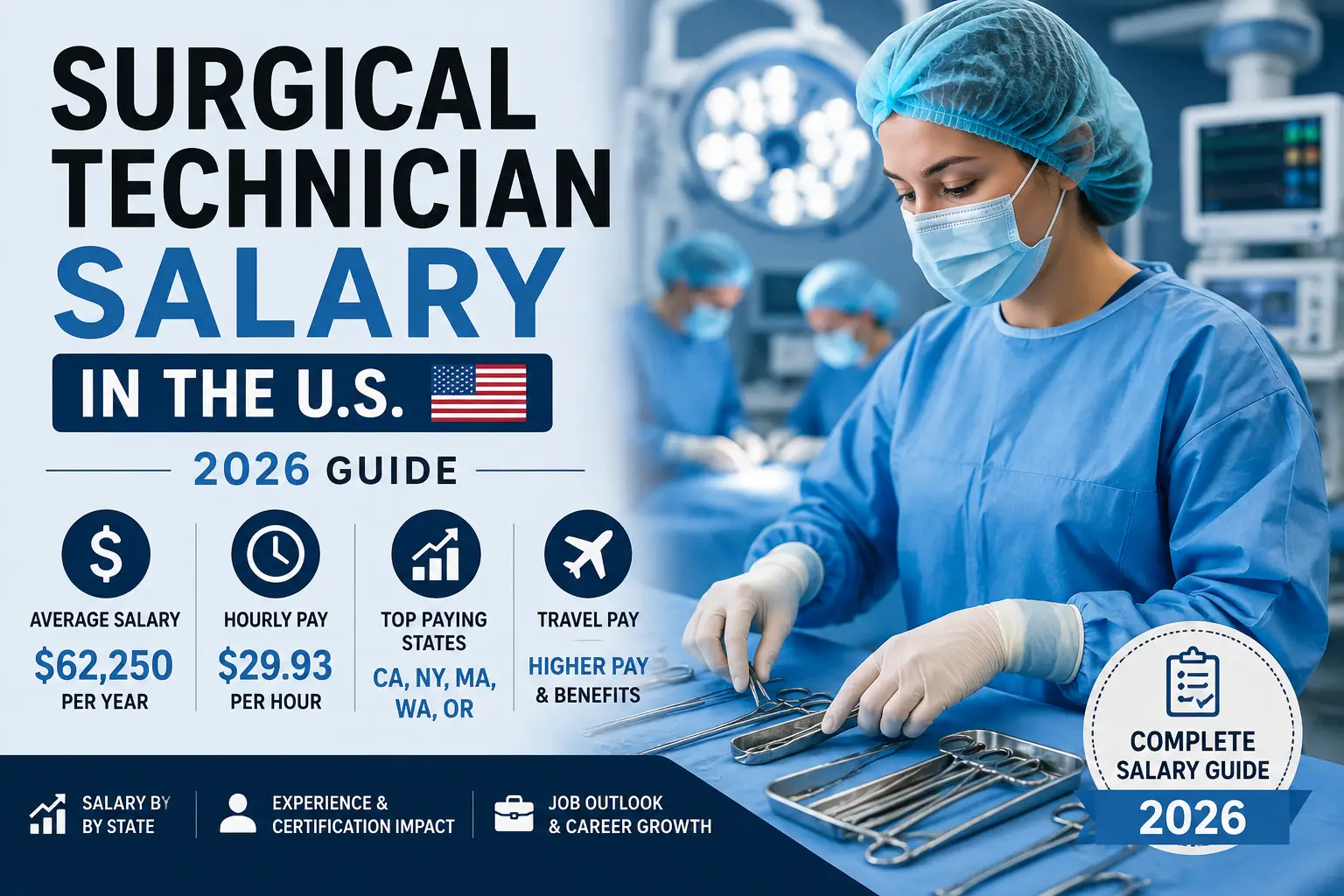
Surgical Tech Salary
📅 Last Updated: August 2026
Quick Salary Answer
Surgical tech in the United States earn a median annual salary of $64,650 as of May 2025, according to the Bureau of Labor Statistics. The average annual wage is $68,710, with hourly rates ranging from $22 for entry-level positions to over $46 for the top 10 percent. Most surgical techs earn between $55,000 and $72,000 annually in staff hospital positions.
| Metric | Amount |
|---|---|
| Median Annual Salary | $64,650 |
| Average Annual Salary | $68,710 |
| Average Hourly Wage | $31.08 |
| Average Weekly Pay | $1,322 |
| Average Monthly Pay | $5,726 |
| Top 10% Earners | $96,940+ |
| Bottom 10% Earners | Below $45,940 |
| Job Outlook (2024–2034) | 5% growth |
Key Takeaways
- Certification adds roughly 10 percent to your salary — the single highest-ROI investment you can make
- Specialization pays, with cardiovascular and neurosurgery techs earning $80,000–$110,000+
- Travel contracts offer the fastest path to higher pay — $1,800–$2,600 per week — but come with significant trade-offs
- Location matters more than you think — but high-paying states like California lose their advantage when adjusted for cost of living
- The shortage is real, with accredited training programs down 21 percent, creating favorable conditions for job seekers
- Career moves drive earnings growth, not annual raises — changing roles every 3–5 years is often the fastest way to increase pay
Walk into any operating room in America and you’ll find a surgical technologist standing two feet from the surgeon, anticipating the next instrument before it’s requested. The job is physically demanding — surgical techs have one of the highest injury and illness rates of any occupation, according to BLS data. It requires memorizing hundreds of instruments for dozens of procedures. And yet, the career remains surprisingly invisible compared to nursing or medicine.
That invisibility affects compensation. When a profession lacks public awareness, salaries don’t always reflect real market value. But something is shifting.
Between a shrinking training pipeline and rising surgical demand, the supply-demand equation for surgical technologists is undergoing its most significant change in decades. Accredited surgical technology programs have fallen from more than 500 to about 430 — a 21 percent decline. Meanwhile, the volume of surgeries continues climbing as the population ages.
The result? A shortage that some health system leaders rank alongside the nursing shortage as a threat to keeping operating rooms open.
That matters for anyone considering this career, currently working in it, or negotiating a raise. Here’s what surgical techs actually earn in 2026 — and what drives the differences.
Surgical Tech Salary by Experience
Your earning potential changes dramatically as you gain experience. Here’s what to expect at each career stage:
| Experience Level | Typical Annual Salary | Typical Hourly Wage | What Changes |
|---|---|---|---|
| Entry Level (0–2 years) | $40,000–$50,000 | $19–$24 | Learning basic procedures, building speed, still developing OR instincts |
| Mid Career (3–7 years) | $55,000–$72,000 | $26–$35 | Efficiency increases, can handle complex cases, reliable team member |
| Senior (8+ years) | $65,000–$85,000 | $31–$41 | Lead roles, training others, highly specialized skills |
| Lead/Supervisor | $72,000–$90,000 | $35–$43 | Team coordination, scheduling, mentoring new techs |
| Specialist (CVOR/Neuro) | $80,000–$110,000+ | $38–$53+ | Cardiovascular, neurosurgery, robotics — highest pay |
| First Assistant | $80,000–$110,000 | $38–$53 | Advanced role assisting directly with surgical procedures |
| Travel Surgical Tech | $93,600–$135,200 | Equivalent $45–$65 | Short contracts, premium pay, living stipends |
SalaryInfo Career Strategy: The biggest salary jumps don’t come from annual raises — they come from role changes. Moving from generalist to specialist, from staff to traveler, or from technologist to first assistant typically produces 20–40 percent increases. Annual merit increases average 3 percent. The math is clear: career moves, not patience, drive earnings growth.
Salary Growth Timeline (2018–2026)
Surgical tech wages have climbed steadily over the past eight years, accelerating recently due to labor shortages:
| Year | Median Annual Salary | Year-over-Year Change |
|---|---|---|
| 2018 | $47,300 | — |
| 2019 | $48,300 | +2.1% |
| 2020 | $49,710 | +2.9% |
| 2021 | $52,940 | +6.5% |
| 2022 | $56,810 | +7.3% |
| 2023 | $60,370 | +6.3% |
| 2024 | $62,880 | +4.2% |
| 2025 | $64,650 | +2.8% |
| 2026 (Projected) | $66,500 | +2.9% |
Note: Historical figures reflect BLS-reported median wages. The 2026 figure is a projection based on current labor market trends, shortage conditions, and healthcare hiring patterns.
SalaryInfo Observation: Wage growth accelerated significantly during the post-pandemic period as the shortage intensified. The 2021–2023 period saw annual increases of 6–7 percent — substantially above the typical 3 percent cost-of-living adjustments most workers receive. Growth has moderated slightly but remains above historical averages.
Average Surgical Tech Salary by State
Based on May 2025 BLS data:
| State | Mean Annual Wage | Mean Hourly Wage |
|---|---|---|
| Alabama | $50,680 | $24.36 |
| Alaska | $79,670 | $38.30 |
| Arizona | $69,300 | $33.32 |
| Arkansas | $55,840 | $26.85 |
| California | $82,810 | $39.81 |
| Colorado | $67,710 | $32.56 |
| Connecticut | $76,710 | $36.88 |
| Delaware | $61,160 | $29.41 |
| District of Columbia | $69,950 | $33.63 |
| Florida | $59,840 | $28.77 |
| Georgia | $61,610 | $29.62 |
| Hawaii | $71,350 | $34.30 |
| Idaho | $63,630 | $30.59 |
| Illinois | $70,320 | $33.81 |
| Indiana | $62,610 | $30.10 |
| Iowa | $54,950 | $26.42 |
| Kansas | $57,120 | $27.46 |
| Kentucky | $53,280 | $25.61 |
| Louisiana | $53,990 | $25.96 |
| Maine | $63,120 | $30.34 |
| Maryland | $67,190 | $32.30 |
| Massachusetts | $83,820 | $40.30 |
| Michigan | $61,710 | $29.67 |
| Minnesota | $79,670 | $38.30 |
| Mississippi | $53,190 | $25.57 |
| Missouri | $63,250 | $30.41 |
| Montana | $59,240 | $28.48 |
| Nebraska | $63,040 | $30.31 |
| Nevada | $74,880 | $36.00 |
| New Hampshire | $67,430 | $32.42 |
| New Jersey | $75,640 | $36.36 |
| New Mexico | $56,720 | $27.27 |
| New York | $81,990 | $39.42 |
| North Carolina | $58,670 | $28.21 |
| North Dakota | $58,600 | $28.17 |
| Ohio | $61,600 | $29.62 |
| Oklahoma | $57,050 | $27.43 |
| Oregon | $80,990 | $38.94 |
| Pennsylvania | $64,840 | $31.17 |
| Rhode Island | $67,360 | $32.39 |
| South Carolina | $56,900 | $27.36 |
| South Dakota | $53,430 | $25.69 |
| Tennessee | $58,170 | $27.97 |
| Texas | $62,940 | $30.26 |
| Utah | $66,370 | $31.91 |
| Vermont | $63,860 | $30.70 |
| Virginia | $67,890 | $32.64 |
| Washington | $78,400 | $37.69 |
| West Virginia | $49,560 | $23.83 |
| Wisconsin | $67,710 | $32.55 |
| Wyoming | $57,890 | $27.83 |
The Cost of Living Adjustment Changes Everything
Raw salary numbers tell an incomplete story. When adjusted for cost of living, the rankings shift dramatically:
| State | Mean Hourly Wage | Cost of Living Index | Adjusted Hourly Wage |
|---|---|---|---|
| Minnesota | $38.30 | 94.6 | $40.49 |
| Illinois | $33.81 | 94.7 | $35.70 |
| Nevada | $36.00 | 100.2 | $35.93 |
| Indiana | $30.10 | 91.0 | $33.08 |
| Michigan | $29.67 | 90.1 | $32.93 |
| Colorado | $32.56 | 102.7 | $31.70 |
| California | $39.81 | 142.3 | $27.98 |
| Hawaii | $34.30 | 185.0 | $18.54 |
SalaryInfo Insight: California’s $82,810 average looks impressive until you account for housing costs that are 42 percent above the national average. After adjustment, Minnesota surgical techs effectively earn more — $40.49 per hour versus California’s $27.98.
Massachusetts faces a similar dynamic. The state pays the highest raw wages at $83,820, but the adjusted figure drops to $28.54.
The lowest-paying states include Alabama ($50,680 average, $24.36/hour), Mississippi ($53,190), and West Virginia ($49,110 median). However, with cost of living indexes in the 87–89 range, the effective purchasing power in these states can sometimes exceed high-wage coastal areas.
Career Strategy: If you’re considering relocation, calculate your real purchasing power, not just the nominal salary. A $70,000 salary in Indianapolis may go further than $83,000 in Boston.
Metropolitan Areas: Where the Jobs and Money Concentrate
Within states, cities often pay significantly more than rural areas. Notable metro area wages:
| Metropolitan Area | Mean Annual Wage |
|---|---|
| San Jose-Sunnyvale-Santa Clara, CA | $98,780 |
| San Francisco-Oakland-Hayward, CA | $97,430 |
| Sacramento-Roseville-Arden-Arcade, CA | $82,030 |
| New York-Newark-Jersey City | $78,980 |
| Portland-Vancouver-Hillsboro, OR-WA | $77,610 |
| Minneapolis-St. Paul-Bloomington, MN-WI | $77,110 |
| Seattle-Tacoma-Bellevue, WA | $76,580 |
| Washington-Arlington-Alexandria | $75,970 |
| Las Vegas-Henderson-Paradise, NV | $74,680 |
| Boston-Cambridge-Nashua, MA-NH | $69,530 |
Reality Check: These metro averages often include high-cost urban centers where competition for talent is fierce. Hospital systems in these areas frequently offer sign-on bonuses — HCA Healthcare recently advertised a $15,000 sign-on bonus plus relocation assistance for cardiovascular surgical techs.
New York City employers show wide variation. Memorial Sloan Kettering lists pay ranges of $37.54–$58.16 per hour. The Hospital for Special Surgery ranges from $44.97–$51.33 per hour. NYC Health + Hospitals advertises $85,000 annually for certified surgical technologists.
Salary by Industry
Where you work significantly affects your earning potential:
| Industry | Mean Annual Wage |
|---|---|
| Outpatient Care Centers | $72,410 |
| Specialty Hospitals | $71,920 |
| General Medical Hospitals | $68,350 |
| Government (State, Local, Federal) | $68,510 |
| Physicians’ Offices | $65,630 |
Why the differences exist: Outpatient surgery centers and specialty hospitals — particularly those focused on orthopedic, cardiovascular, or neurosurgical procedures — pay higher wages because they perform more complex, higher-reimbursement surgeries. General hospitals offer more stability and broader experience but typically slightly lower base pay.
Government positions offer competitive pay with excellent benefits, pension plans, and strong job security. The U.S. Department of Veterans Affairs and military medical facilities are notable employers with structured career ladders.
Career Comparison: Surgical Technician vs. Other Healthcare Roles
Surgical techs earn solid wages for a certificate-level healthcare profession, though below many associate’s and bachelor’s-level roles:
| Profession | Median Annual Salary | Education Required |
|---|---|---|
| Surgical Technician | $64,650 | Certificate/Associate’s |
| Surgical Assistant | $65,190 | Associate’s + Training |
| Licensed Practical/Vocational Nurse | $60,790 | Certificate/Diploma |
| Radiologic Technologist | $72,250 | Associate’s |
| Clinical Laboratory Technician | $62,870 | Associate’s |
| Dental Assistant | $47,350 | Certificate/Diploma |
| Certified Nursing Assistant | $38,130 | Certificate |
| Phlebotomist | $43,130 | Certificate |
| Medical Assistant | $42,000 | Certificate |
| Registered Nurse | $97,550 | Associate’s/Bachelor’s |
| Nurse Practitioner | $126,260 | Master’s/Doctoral |
| Respiratory Therapist | $68,990 | Associate’s |
| MRI Technologist | $82,950 | Associate’s |
| Cardiovascular Technologist | $64,650 | Associate’s |
What this tells you: Surgical techs earn significantly more than most certificate-level healthcare workers — about 50–70 percent more than CNAs, medical assistants, and phlebotomists. However, they earn roughly 35 percent less than registered nurses, who require more education. The career offers a strong middle-ground option: better pay than entry-level roles with less education than nursing.
Which Employers Actually Pay Above Market
Employer type significantly influences compensation. The top-paying organizations include:
Government and public administration lead the pack, with median total pay around $79,000 for certified surgical technologists. The U.S. Army and U.S. Navy are notable top payers in this sector.
Major healthcare systems also pay well:
- Kaiser Permanente — consistently among the top-paying healthcare employers
- Sutter Health
- Hawaii Pacific Health
- Oregon Health & Science University
- The Ohio State University
Teaching hospitals and academic medical centers typically pay more than community hospitals. They often require certification and offer structured career ladders.
SalaryInfo Observation: The highest-paying employers aren’t necessarily the ones offering the highest base salary. Look at the total package — shift differentials, sign-on bonuses, tuition reimbursement, and retirement matching can add 10–20 percent to total compensation.
Some employers list specific salary bands:
- Sharp Healthcare (California): $34.17 – $49.37 per hour
- PeaceHealth (Washington): $31.14 – $51.25 per hour
- Level II Surgical Technologist positions: often advertised at $85,000 annually
Travel Surgical Techs: The Shortcut to Higher Pay
Travel contracts represent the most direct path to higher earnings — but with significant trade-offs.
Weekly pay for travel surgical techs typically ranges from $1,800 to $2,600 per week. Annualized, that’s $93,600 to $135,200 — substantially above staff wages.
What the packages include:
- Taxable hourly wages
- Non-taxable stipends for housing and meals (often $1,000–$1,300 per week)
- Travel reimbursement
- Health insurance (sometimes)
Real-world examples:
- Seattle: $2,600 per week
- Cincinnati: $2,202 per week
- San Francisco CVOR: $3,474 per week
- Nationwide average: approximately $2,463 per week
The trade-offs:
- Short-term contracts (typically 8–13 weeks)
- Frequent relocation
- No guaranteed work between contracts
- Limited career progression within one organization
- Often require 1–2 years of staff experience first
Who it’s for: Travel contracts work best for techs who are flexible, experienced, and don’t mind the instability. For those with family obligations or preferences for stability, the premium rarely justifies the disruption.
The Certification Premium: What the Credential Is Actually Worth
Certification isn’t optional if you want decent pay. The Certified Surgical Technologist (CST) credential from the National Board of Surgical Technology and Surgical Assisting (NBSTSA) is the industry standard.
What certification adds: Certified surgical techs earn approximately 10 percent more than uncertified techs, according to job posting analysis. That translates to roughly $5,000–$8,000 annually.
State requirements matter. Texas requires certification for employment as a surgical technologist. Washington, Colorado, Virginia, and New Hampshire have additional registration requirements beyond standard certification. Other states are moving in this direction — Illinois will require certification for new hires starting January 2028.
The certification landscape:
- CST — offered by NBSTSA, the most widely recognized credential
- TS-C (Tech in Surgery-Certified) — offered by the National Center for Competency Testing (NCCT)
- Certified First Assistant (CFA) — advanced certification for surgical first assistants
SalaryInfo Verdict: Certification is the single highest-ROI investment for surgical technologists. The cost of the exam and study materials is minimal compared to the lifetime earnings premium. If you’re uncertified, getting certified should be your first priority.
The Shortage Driving Everything
The surgical technologist shortage isn’t theoretical — it’s reshaping the labor market.
The numbers: Approximately 117,500 people worked as surgical technologists in the U.S. as of May 2025. Employment is projected to grow 5 percent from 2024 to 2034 — faster than the 3 percent average for all occupations. About 8,700 job openings are projected each year.
The problem: The training pipeline is shrinking. Accredited programs have fallen from over 500 to about 430 — a 21 percent decline. Fewer programs mean fewer graduates sitting for the CST exam. Industry groups have expressed serious concern about the growing number of non-accredited programs and on-the-job training.
Why the shortage matters for pay: Basic economics suggests that when demand exceeds supply, wages rise. That’s already happening in some markets. Sign-on bonuses are becoming more common. Travel rates are climbing. Employers are competing for a shrinking pool of certified candidates.
SalaryInfo Future Outlook: The shortage isn’t going away. The aging population will continue driving surgical volume. The training pipeline shows no signs of rapid expansion. This suggests continued upward pressure on wages — particularly for certified, experienced technologists.
The counterweight: Healthcare is also under cost pressure. Hospitals are squeezed by reimbursement rates and labor costs. There’s a ceiling on how high wages can go before hospitals seek alternatives — though in the OR, there are few substitutes for skilled surgical techs.
What Employers Actually Value (Beyond the Credential)
Certification gets you in the door. But employers pay premiums for specific skills.
Robotic surgery experience commands a premium — $3–$6/hour extra. As robotic-assisted surgery expands, this premium is likely to grow.
Cardiovascular and neurosurgery specialization consistently pays above general surgery rates.
Teaching hospital experience is valued because it demonstrates exposure to complex cases and academic standards.
Flexibility with shifts matters. Night, weekend, and holiday differentials typically range from 5–25 percent above base pay.
CPR and BLS certification are universally required for patient-facing roles.
What employers don’t value as much: A bachelor’s degree. Surgical technology is a certificate or associate’s degree profession. Advanced degrees rarely produce commensurate salary increases in this field. The ROI on a bachelor’s degree is significantly lower than the ROI on certification or specialization.
Career Mistakes That Limit Earnings
Staying uncertified. This is the most common and costly mistake. Uncertified techs earn roughly 10 percent less and have fewer job opportunities.
Staying generalist. Employers pay premiums for specialized skills. Techs who never specialize cap their earnings potential.
Staying in one place too long. Annual raises rarely keep pace with market adjustments. Techs who don’t change employers every 3–5 years often fall behind market rates.
Ignoring travel opportunities. Even if you don’t want to travel long-term, taking a travel contract can reset your baseline expectations and give you leverage in negotiations.
Not negotiating. Many surgical techs accept the first offer. Employers expect negotiation — particularly in shortage markets.
SalaryInfo Career Strategy: The most successful surgical techs treat their careers as portfolios, not jobs. They invest in certification. They develop specializations. They monitor market rates. They move when the math makes sense. And they negotiate every offer.
What Salary Surveys Don’t Tell You
Most salary data focuses on base pay. But total compensation includes:
- Shift differentials — 5–25 percent for evenings, nights, and weekends
- Sign-on bonuses — increasingly common, sometimes $10,000–$15,000
- Relocation assistance — $5,000–$10,000 for hard-to-fill roles
- Tuition reimbursement — many hospital systems offer $5,000+ annually
- Retirement matching — 3–9 percent of pay is common
- Overtime — time-and-a-half for hours beyond 40
The hidden cost of high salaries: The highest-paying cities often have the highest housing costs. A $90,000 salary in San Francisco may leave less disposable income than a $65,000 salary in Indianapolis.
The value of benefits: Health insurance, paid time off, and retirement contributions typically add 20–30 percent to total compensation. When comparing offers, evaluate the full package — not just the base salary.
How to Increase Your Earnings as a Surgical Technician
1. Get certified. The single highest-ROI investment. Adds roughly 10 percent to your salary.
2. Specialize. Cardiovascular, neurosurgery, or robotics techs earn substantially more than generalists.
3. Become a first assistant. Additional training unlocks $80,000–$110,000 earning potential.
4. Consider travel contracts. Premium pay of $1,800–$2,600 per week — but only if you’re comfortable with the lifestyle.
5. Relocate strategically. Look at both raw salary and cost of living. Minnesota, Texas, and the Midwest often offer better effective pay than coastal states.
6. Negotiate every offer. Employers expect it. Research market rates and don’t accept the first number.
7. Move employers every 3–5 years. Annual raises rarely keep up with market adjustments. Changing employers is often the fastest way to increase pay.
8. Work undesirable shifts. Night, weekend, and holiday differentials add 5–25 percent to base pay.
9. Teach or train others. Lead roles and educator positions command premium pay.
10. Pursue continuing education. Stay current with robotic surgery and new techniques. Employers pay for valuable skills.
Methodology
This salary analysis draws from multiple authoritative sources:
- Bureau of Labor Statistics (BLS) Occupational Employment and Wage Statistics (OEWS) — May 2025 data for Surgical Technologists (SOC 29-2055)
- O NET OnLine — BLS-derived occupational data
- Job posting analysis — Current and historical employer job listings
- Third-party salary surveys — Industry compensation reports
- Editorial analysis — SalaryInfo’s interpretation of market trends, career trajectories, and compensation patterns
Where data sources vary, we explain the differences. BLS provides the most comprehensive national benchmark. Employer job postings offer current market rates. Salary surveys and self-reported data may reflect different populations and methodologies.
SalaryInfo does not rely on a single source. We synthesize multiple datasets to provide balanced, actionable salary intelligence.
Professional Recommendation
Based on the analysis of market data, career trajectories, and industry trends:
For those considering the profession: Surgical technology offers a stable, growing career with a clear path to middle-class earnings. The entry barrier is lower than nursing (certificate or associate’s degree versus bachelor’s) and the work is more hands-on than many allied health roles. The shortage creates favorable conditions for job seekers. However, the work is physically demanding and the pay ceiling is lower than many healthcare professions.
For current surgical techs: Prioritize certification if you don’t have it. Consider specialization — cardiovascular, neurosurgery, or robotics. Evaluate your compensation against market rates; if you’re more than 10 percent below your region’s average, you have leverage. Don’t wait for your employer to offer more — ask.
For those considering travel: Get 1–2 years of staff experience first. Then evaluate whether the premium is worth the disruption. For many, travel contracts are a short-term income boost, not a long-term career strategy.
For career switchers: Surgical technology offers a faster entry point than nursing or physician assistant programs. The earning potential is solid, though not exceptional. If your goal is healthcare with good income and relatively quick training, this is a strong option.
SalaryInfo Editorial Verdict: Surgical technology is an underrated career with favorable supply-demand dynamics. The shortage is real and likely to persist. Wages are rising in real terms, particularly for certified, specialized techs. The ceiling is lower than nursing or allied health professions like radiologic technology, but the entry requirements are also lower. For the right person, it’s a solid career with meaningful work and growing earning potential.
Frequently Asked Questions
What kind of surgical tech makes the most money?
Cardiovascular surgical technologists (CVOR) are among the highest-paid, with average salaries around $146,492 annually. Surgical first assistants earn $80,000–$110,000. Travel surgical techs can earn $1,800–$2,600 per week, which annualizes to $93,600–$135,200. Specialization in neurosurgery or robotics also commands premiums. Robotic surgery experience alone can add $3–$6 per hour.
How much does a surgical tech make in the USA in 2026?
The median annual wage is $64,650, with an average of $68,710 according to May 2025 BLS data. The lowest 10 percent earn below $45,940, while the highest 10 percent earn above $96,940. Hourly, the median is $31.08. Weekly pay averages around $1,322, with monthly earnings around $5,726.
How much do surgical techs make an hour in California?
The mean hourly wage in California is $39.81, with an annual average of $82,810. However, after adjusting for California’s high cost of living (142.3 index), the effective hourly wage drops to $27.98. Actual ranges vary by city — San Francisco pays significantly more than Riverside. San Jose averages $98,780 annually, while San Diego averages $81,360.
How to make the most money as a surgical technologist?
Get certified (adds ~10 percent). Specialize in cardiovascular, neurosurgery, or robotics. Consider travel contracts ($1,800–$2,600/week). Become a surgical first assistant ($80,000–$110,000). Relocate to high-paying states like Massachusetts or Minnesota, but account for cost of living. Negotiate every offer and change employers every 3–5 years to capture market adjustments.
Is surgical tech a good career in 2026?
Yes, for the right person. The profession offers stable employment with 5 percent projected growth through 2034, meaningful work in the OR, and a clear path to middle-class earnings. The shortage is creating favorable conditions for job seekers. However, the work is physically demanding, the pay ceiling is lower than nursing, and certification is essentially required for competitive wages.
How much does a certified surgical technologist make?
Certified surgical techs typically earn $55,000–$72,000 annually in staff hospital positions. The certification premium is roughly 10 percent over uncertified techs. Top-certified techs in high-cost areas or specialized roles can exceed $85,000. Travel certified techs earn significantly more — $1,800–$2,600 per week. Certification is required in Texas and increasingly in other states.
What’s the difference between a surgical tech and a surgical assistant?
Surgical technologists (scrub techs) prepare the OR, sterilize instruments, and pass supplies to the surgical team. Surgical assistants (first assistants) take a more hands-on role — controlling blood flow, holding organs and tissues, and assisting with wound closure. Surgical assistants typically earn more, with average certified first assistant salaries around $111,764. The first assistant role requires additional training beyond basic certification.
Do surgical techs make more than nurses?
No. Registered nurses earn substantially more — the median annual wage for RNs is $97,550, compared to $64,650 for surgical technologists. Surgical techs earn about 35 percent less than RNs on average. However, surgical techs also have lower education requirements (certificate or associate’s vs. bachelor’s) and faster entry to the workforce. Some surgical techs later pursue nursing degrees to increase earnings.
What states pay surgical techs the most?
Massachusetts ($83,820), California ($82,810), New York ($81,990), Oregon ($80,990), and Alaska ($79,670) have the highest mean annual wages. However, after cost-of-living adjustment, Minnesota, Illinois, and Nevada often provide better effective purchasing power. The highest-paying metro areas are San Jose ($98,780) and San Francisco ($97,430).
What is the job outlook for surgical technologists?
The BLS projects 5 percent employment growth from 2024 to 2034 — faster than the 3 percent average for all occupations. About 8,700 job openings are projected annually. The aging population will increase surgical demand, while the shrinking number of accredited training programs (down 21 percent) limits new entrants. This supply-demand imbalance is likely to continue supporting wage growth.
Related Articles
- Registered Nurse Salary
- CRNA Salary
- Radiology Tech Salary
- Surgeon Salary
- Radiologist Salary
- Cardiologist Salary
- Neurosurgeon Salary
- Pathologist Salary
- Plastic Surgeon Salary
- Pediatrician Salary
- Anesthesiologist Salary
- Nurse Practitioner Salary
- Obstetrician Salary
- Ophthalmologist Salary
- Urologist Salary
- CTC Calculator
- Salary Slip Generator
- Overtime Calculator
- Salary Tools Category
- Private Sector Salaries Category
- Homepage